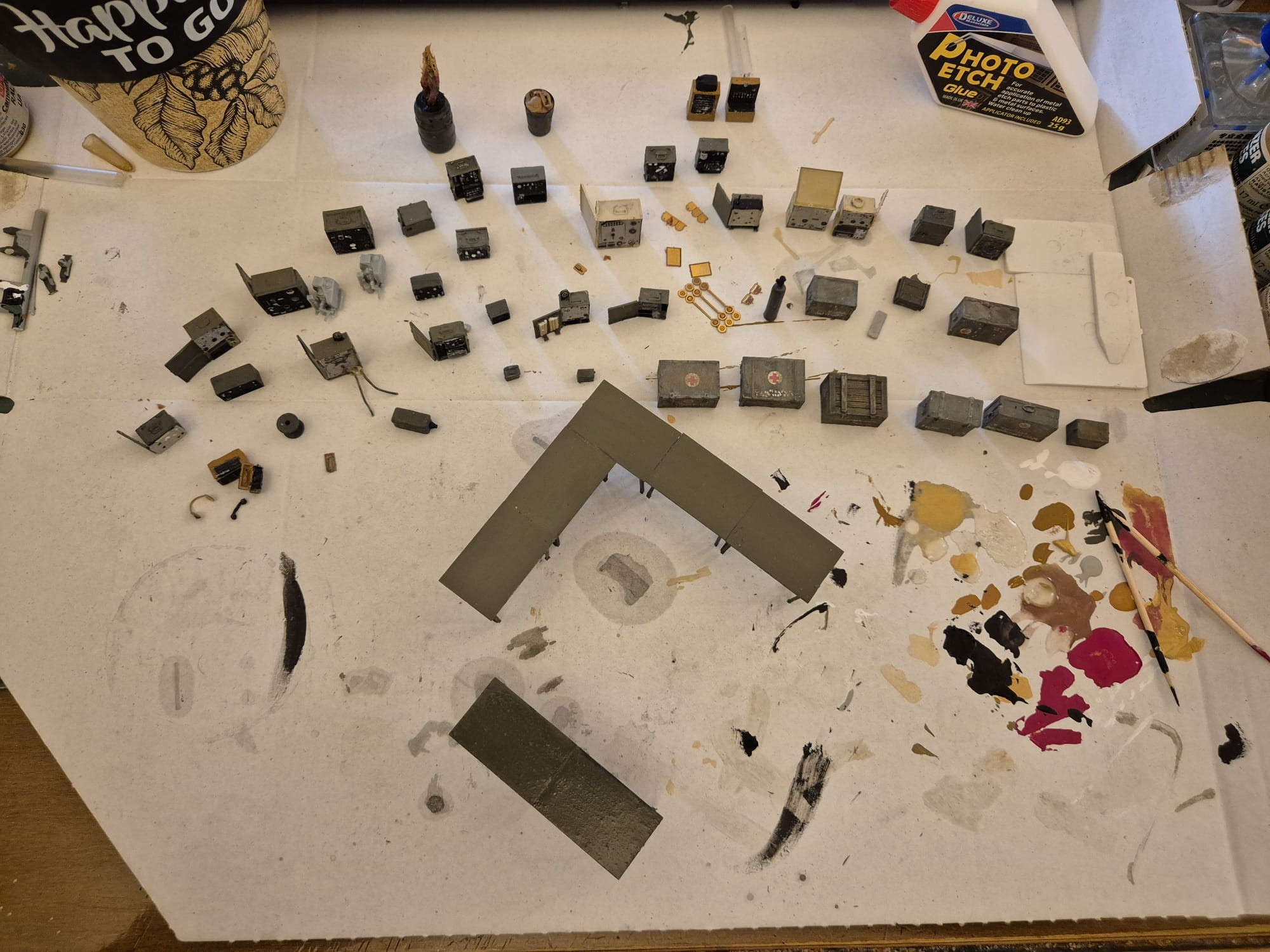
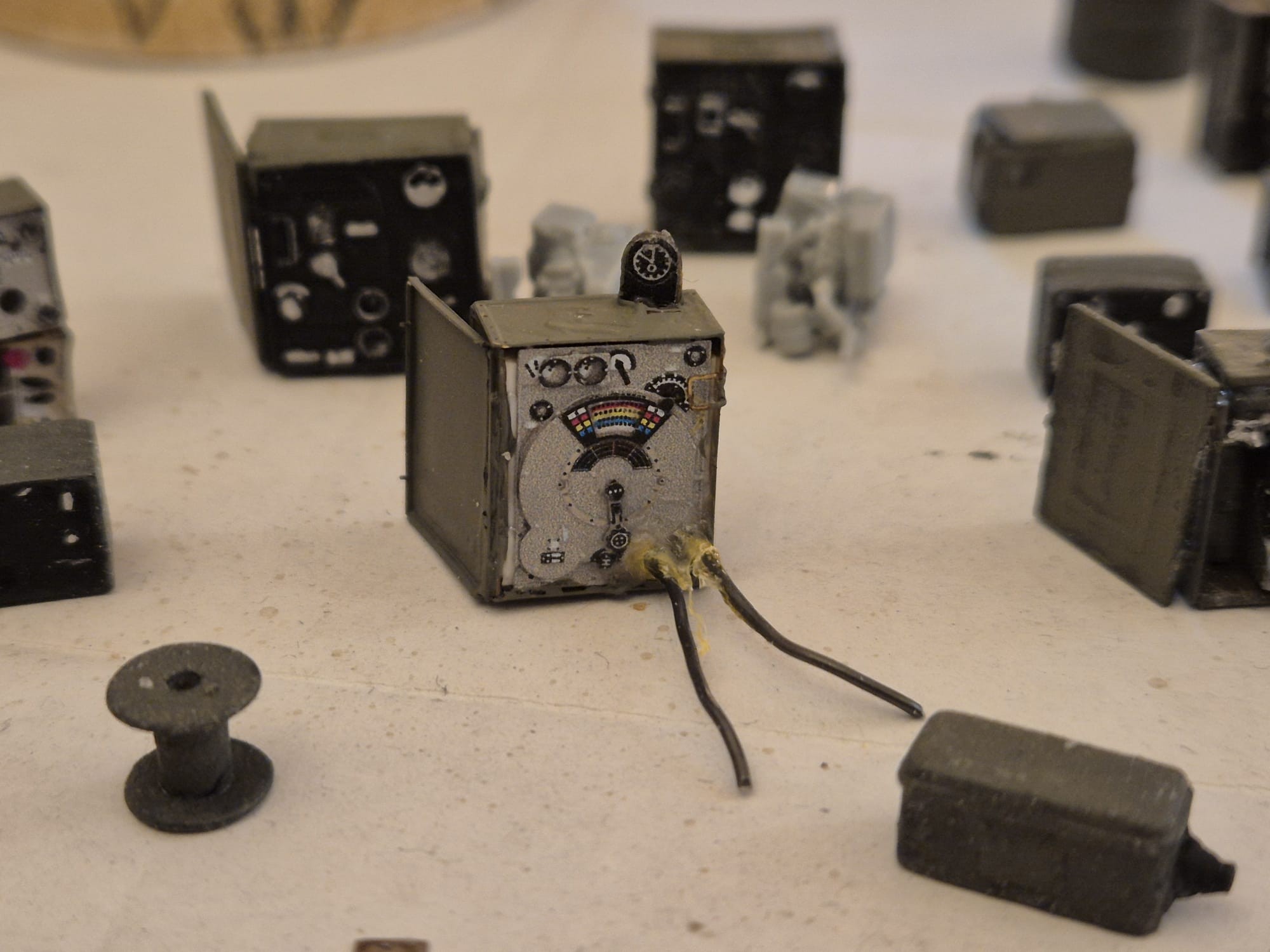
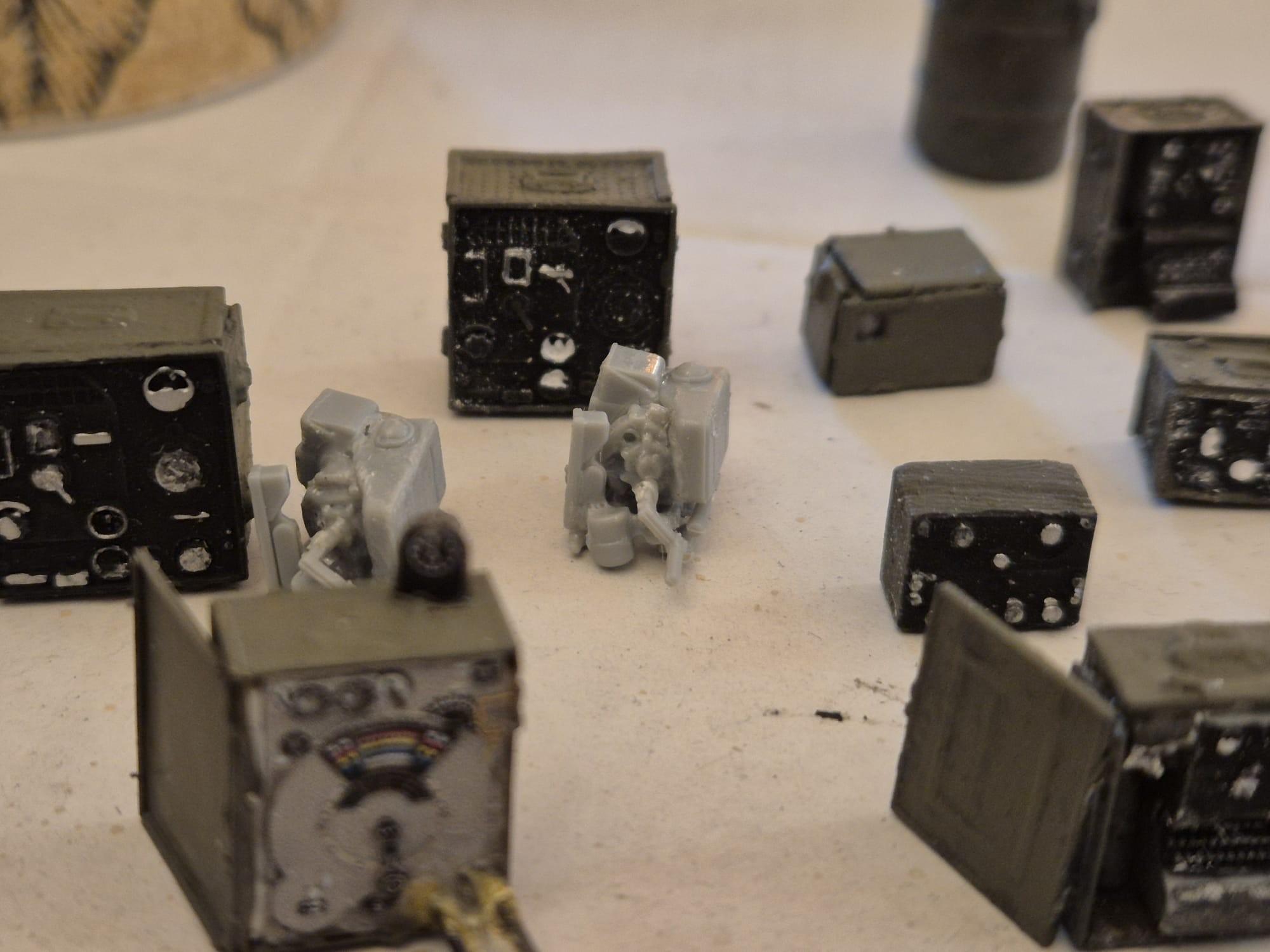
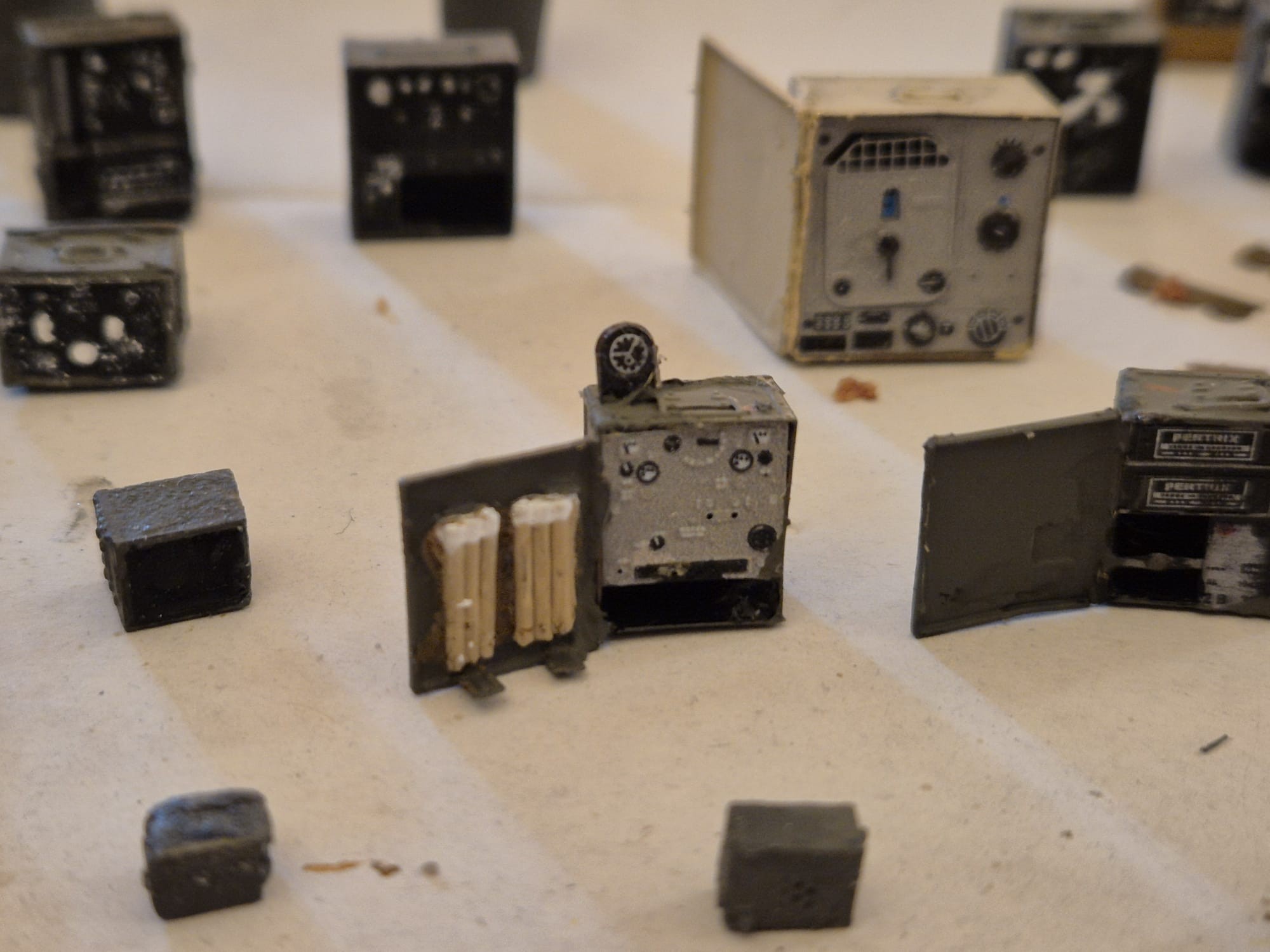
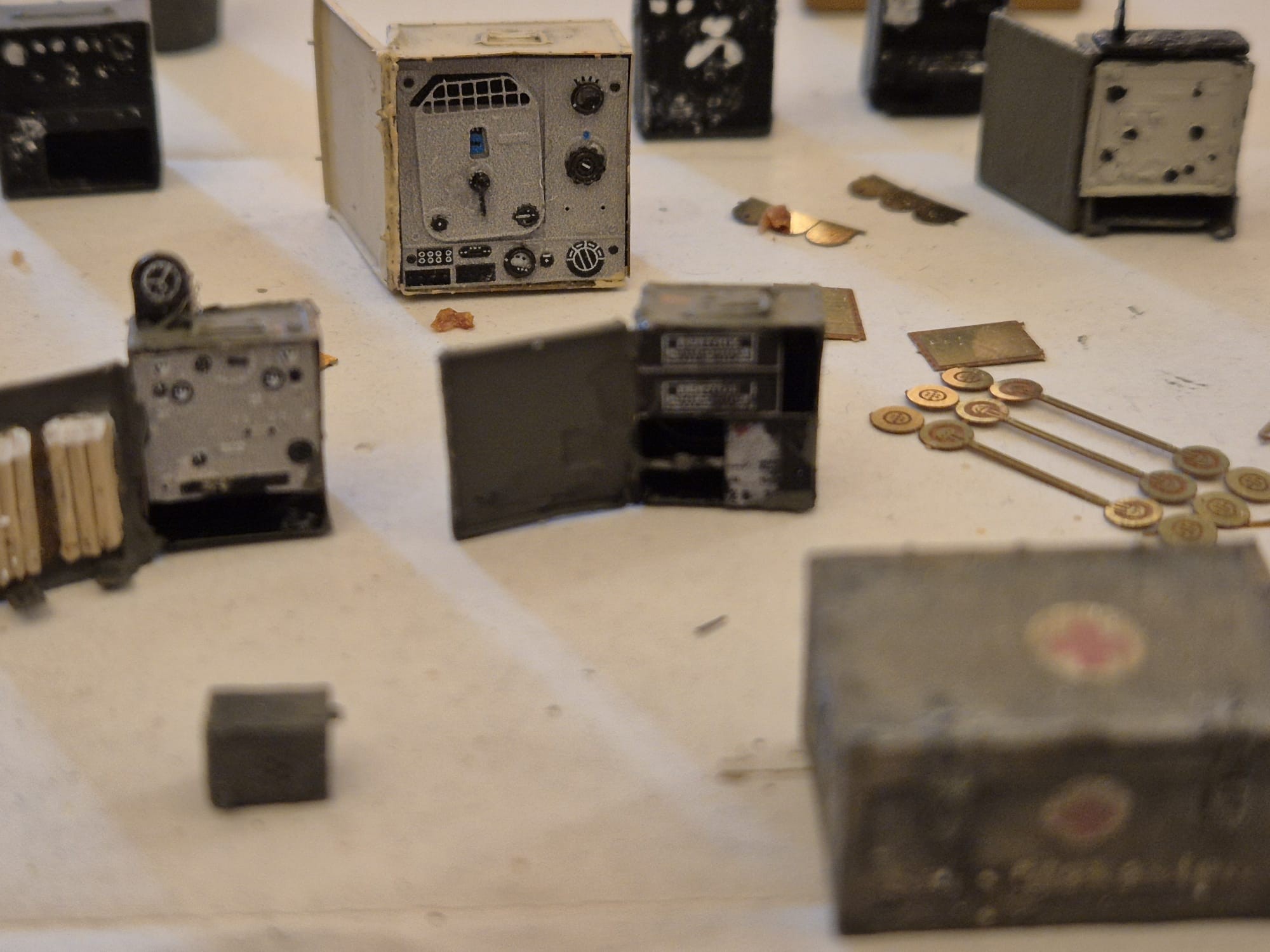
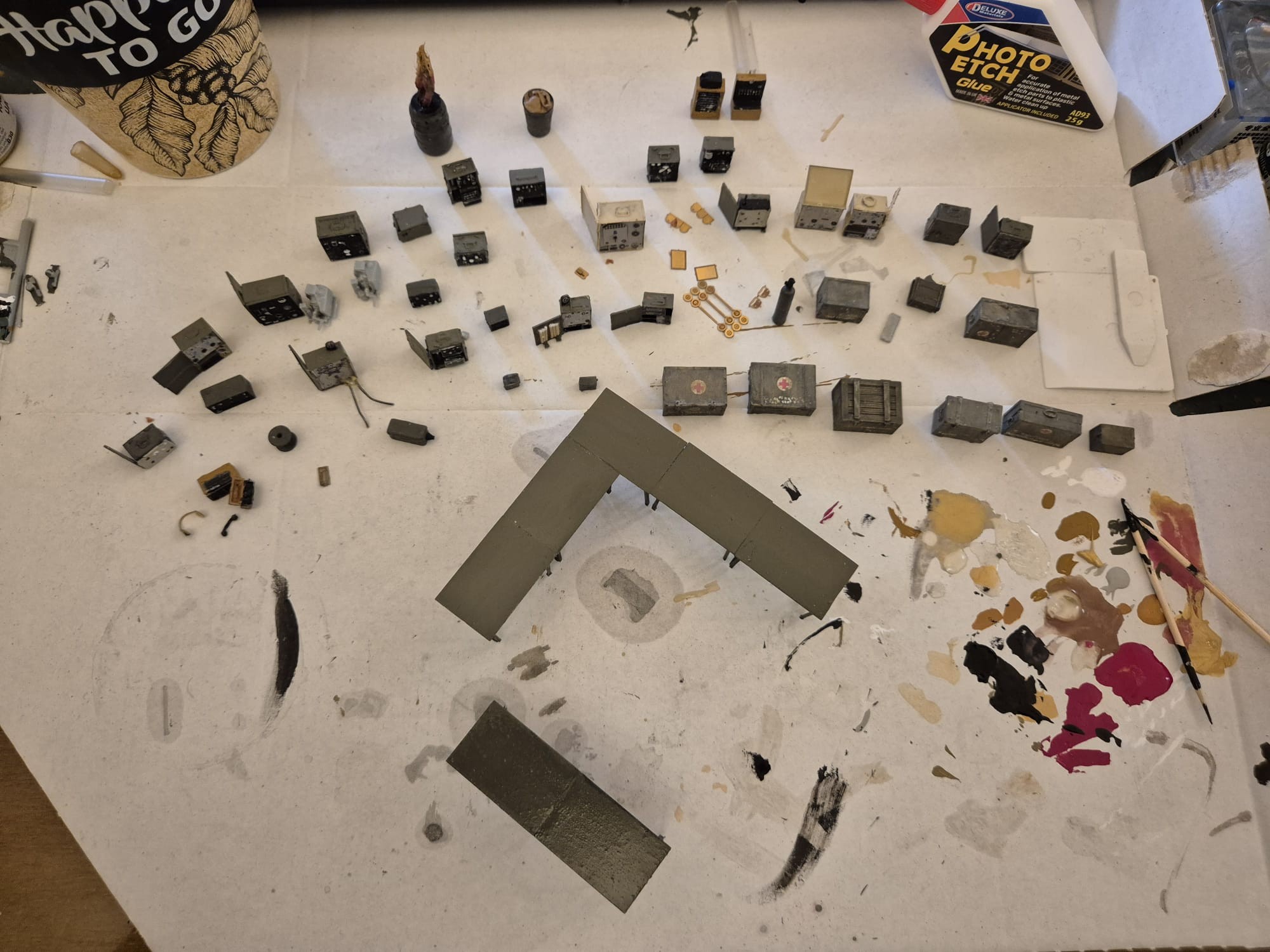
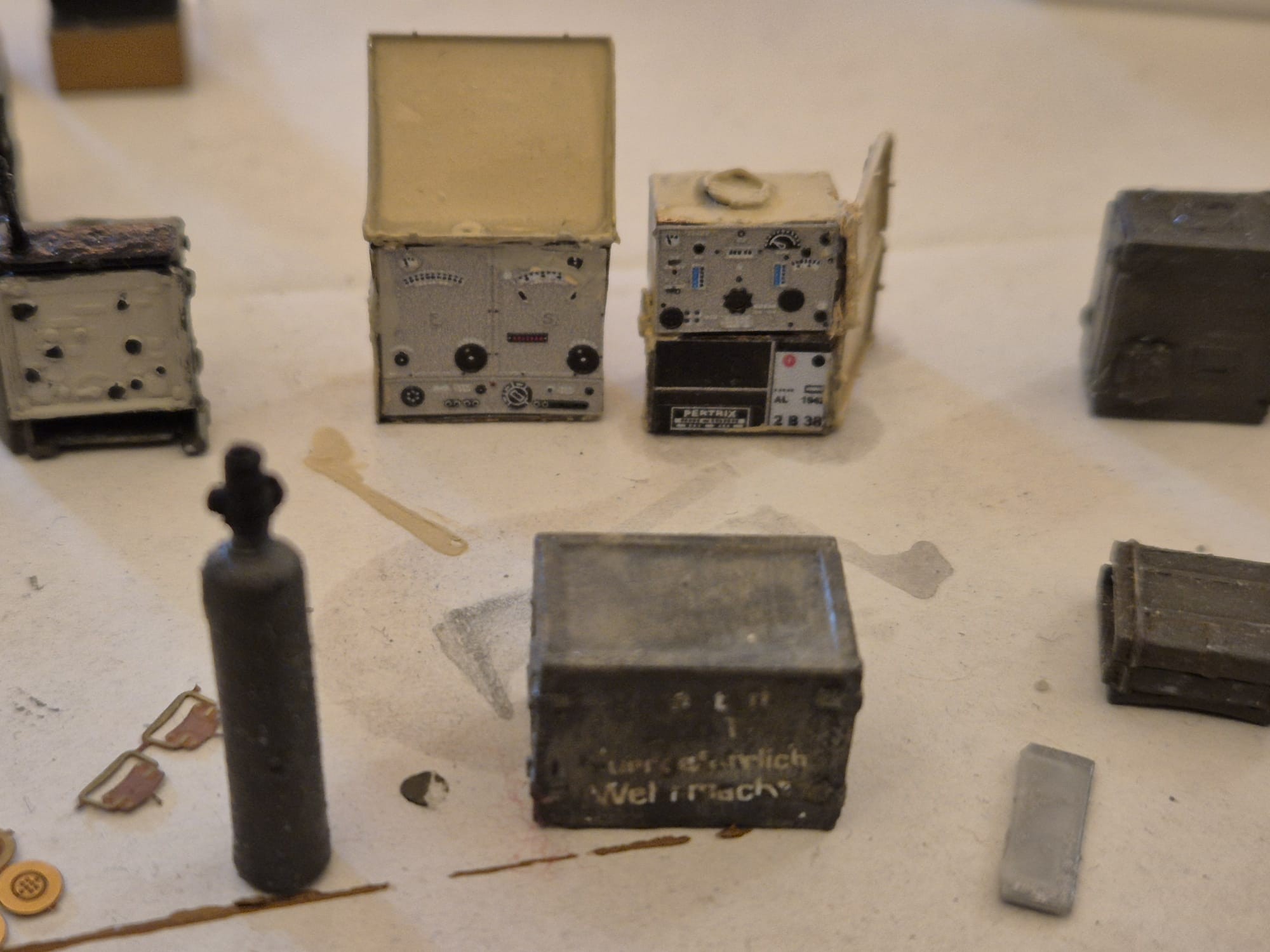
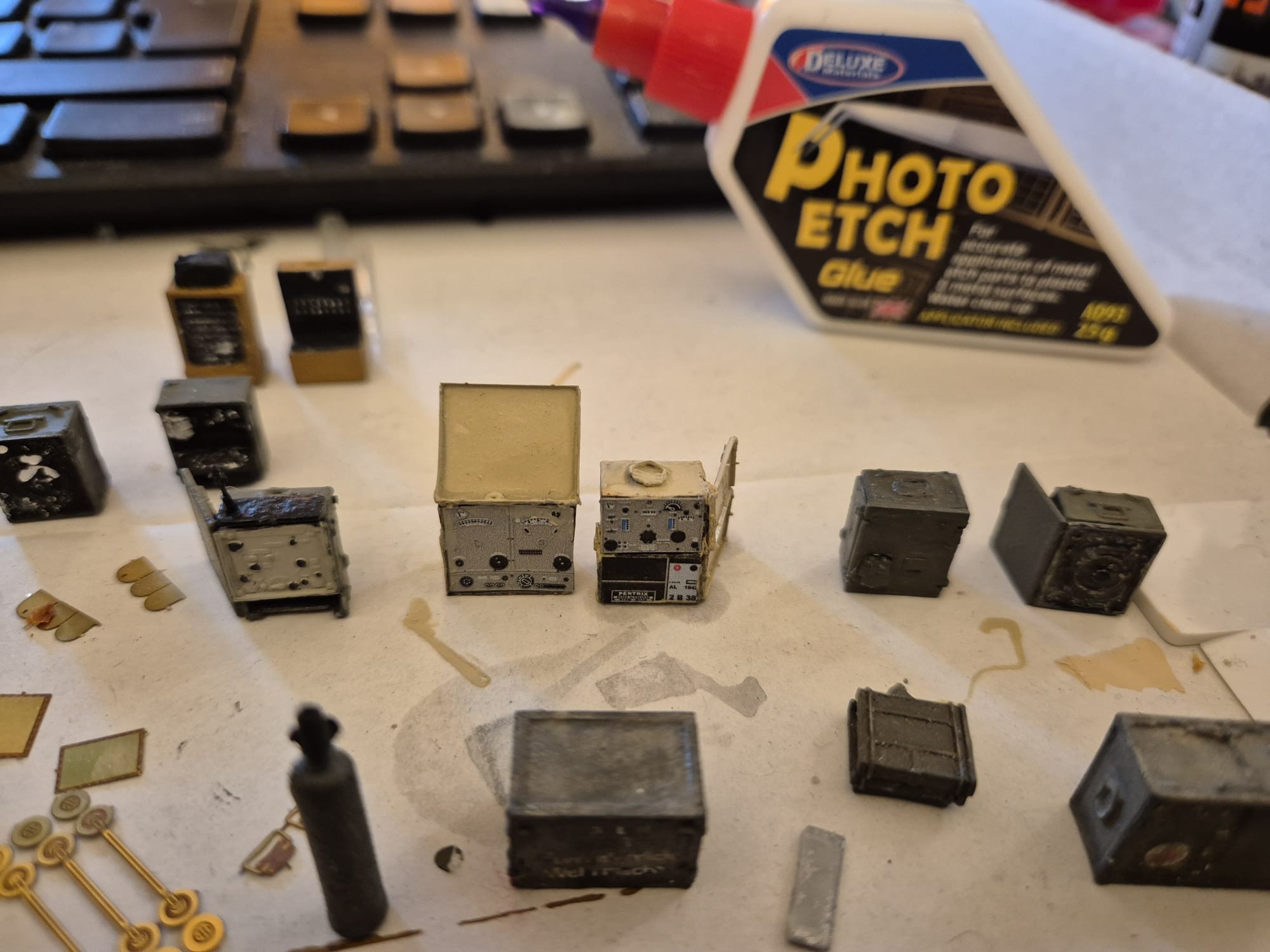
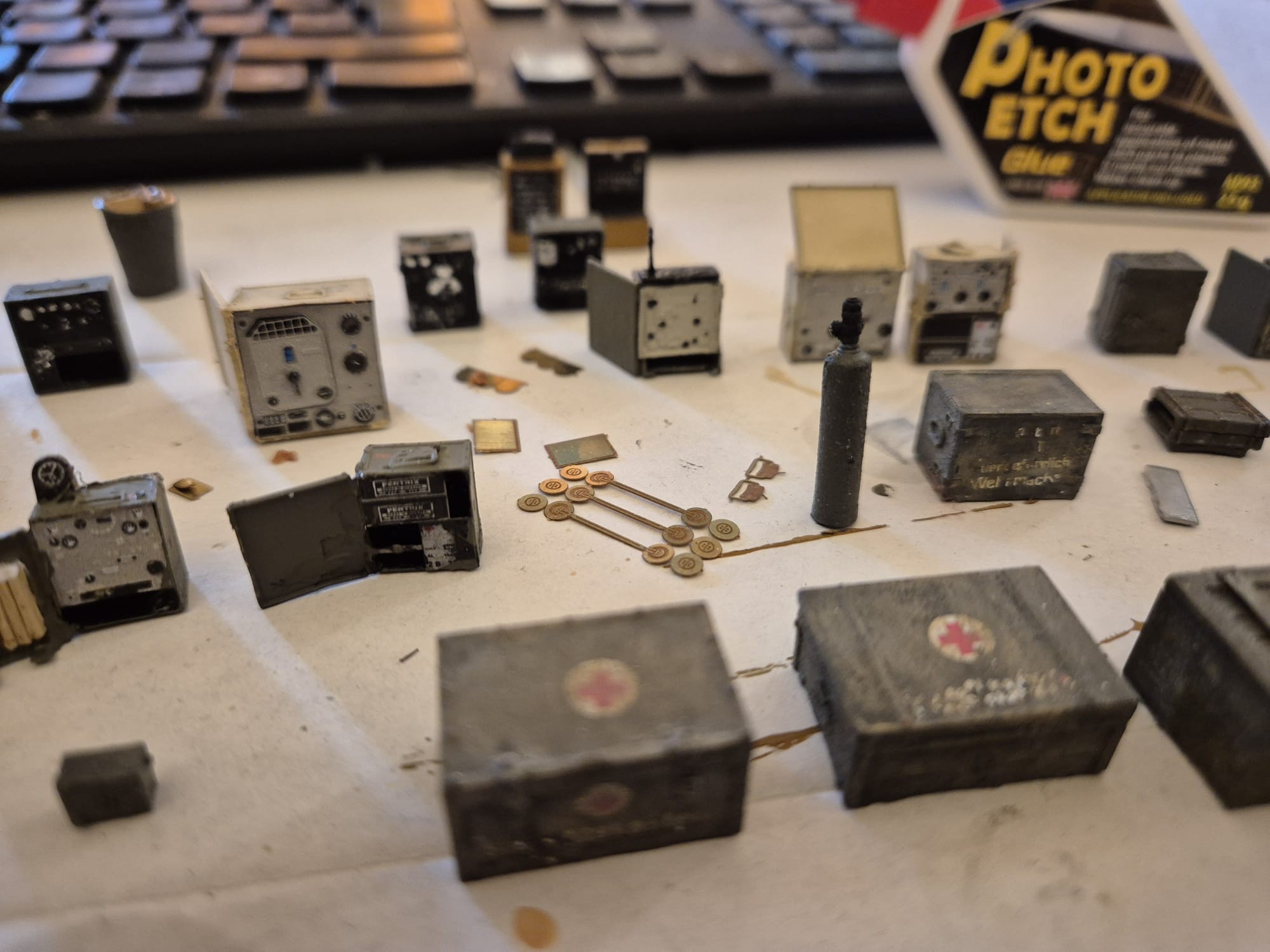
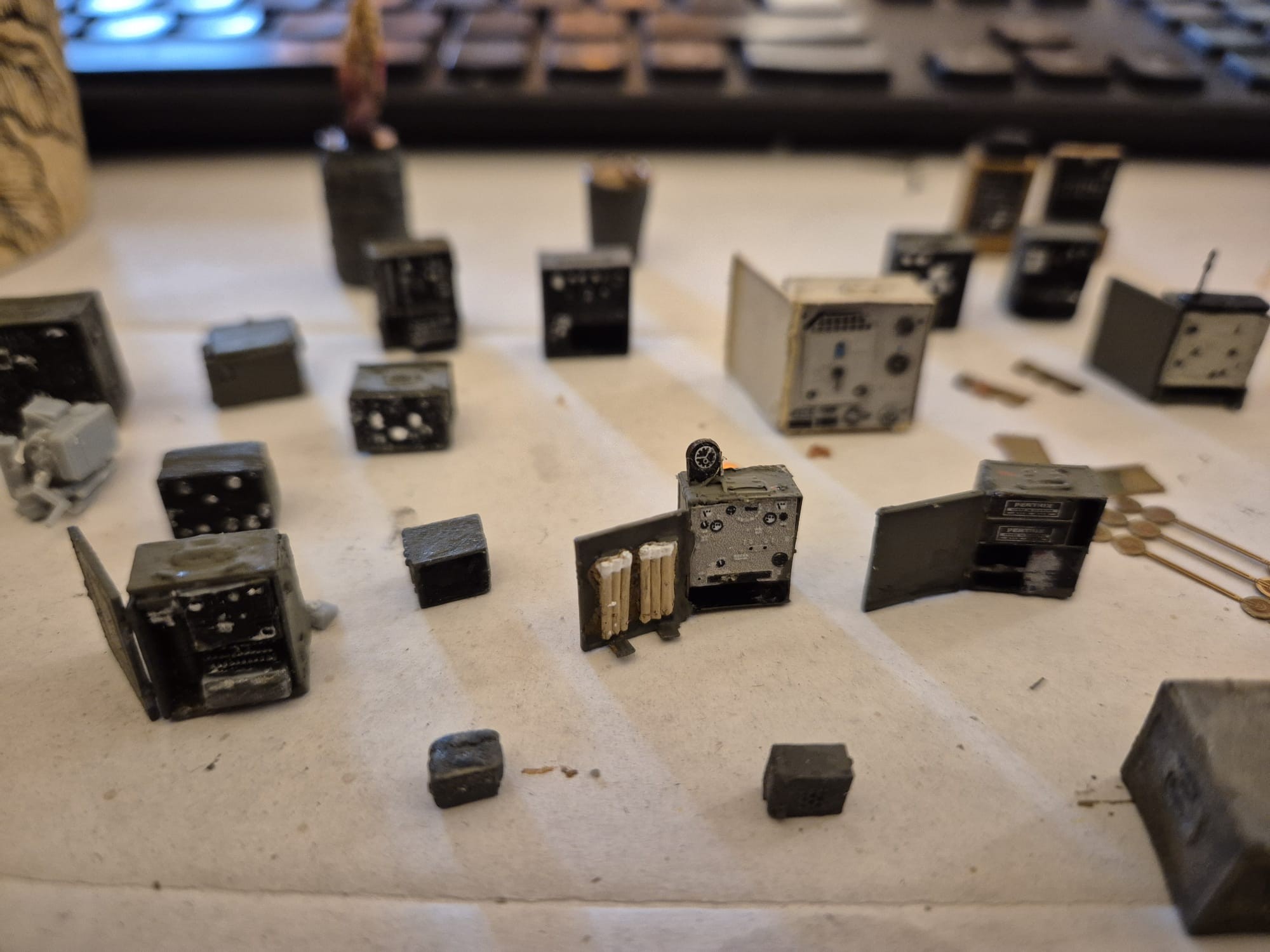
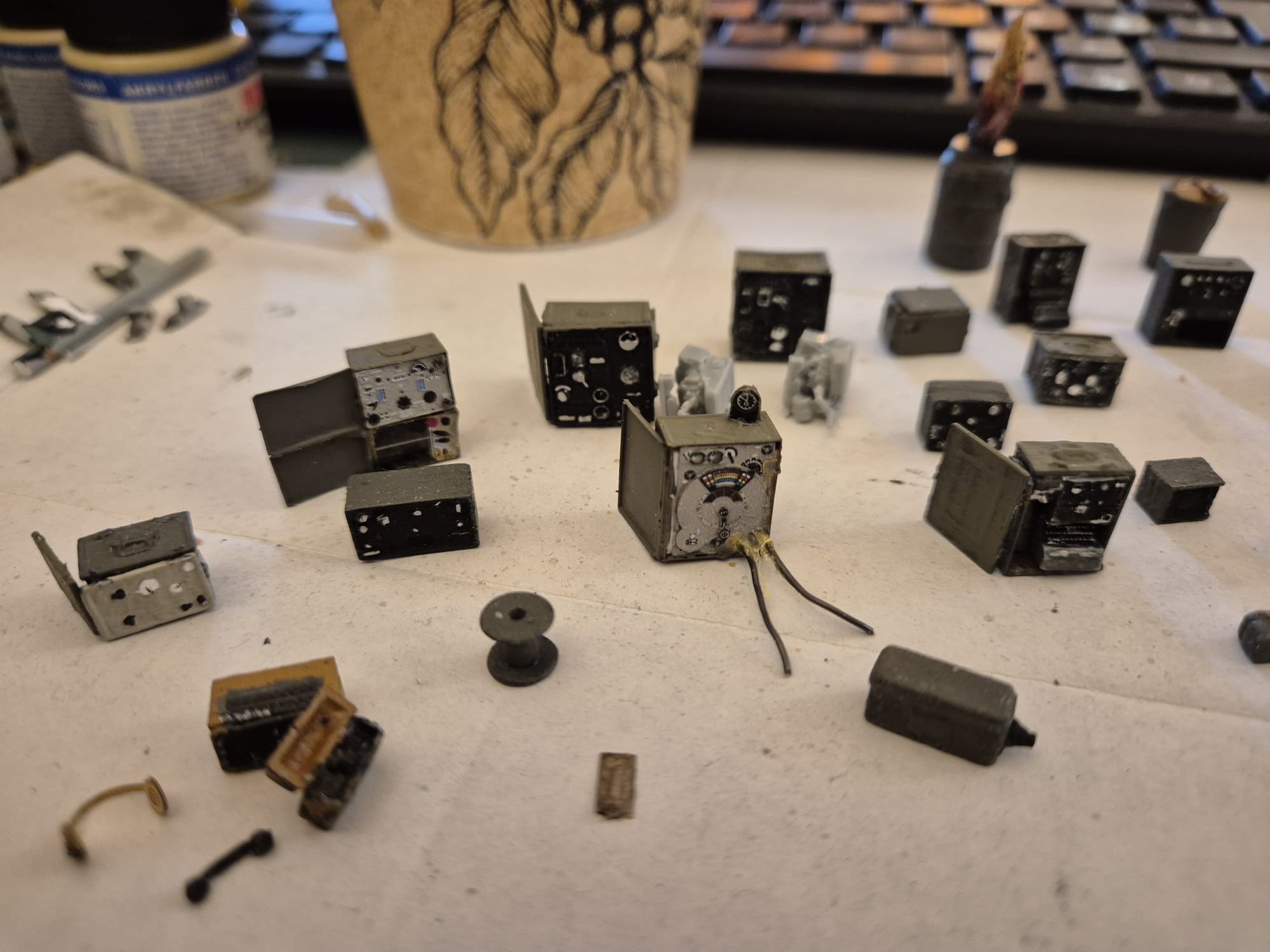
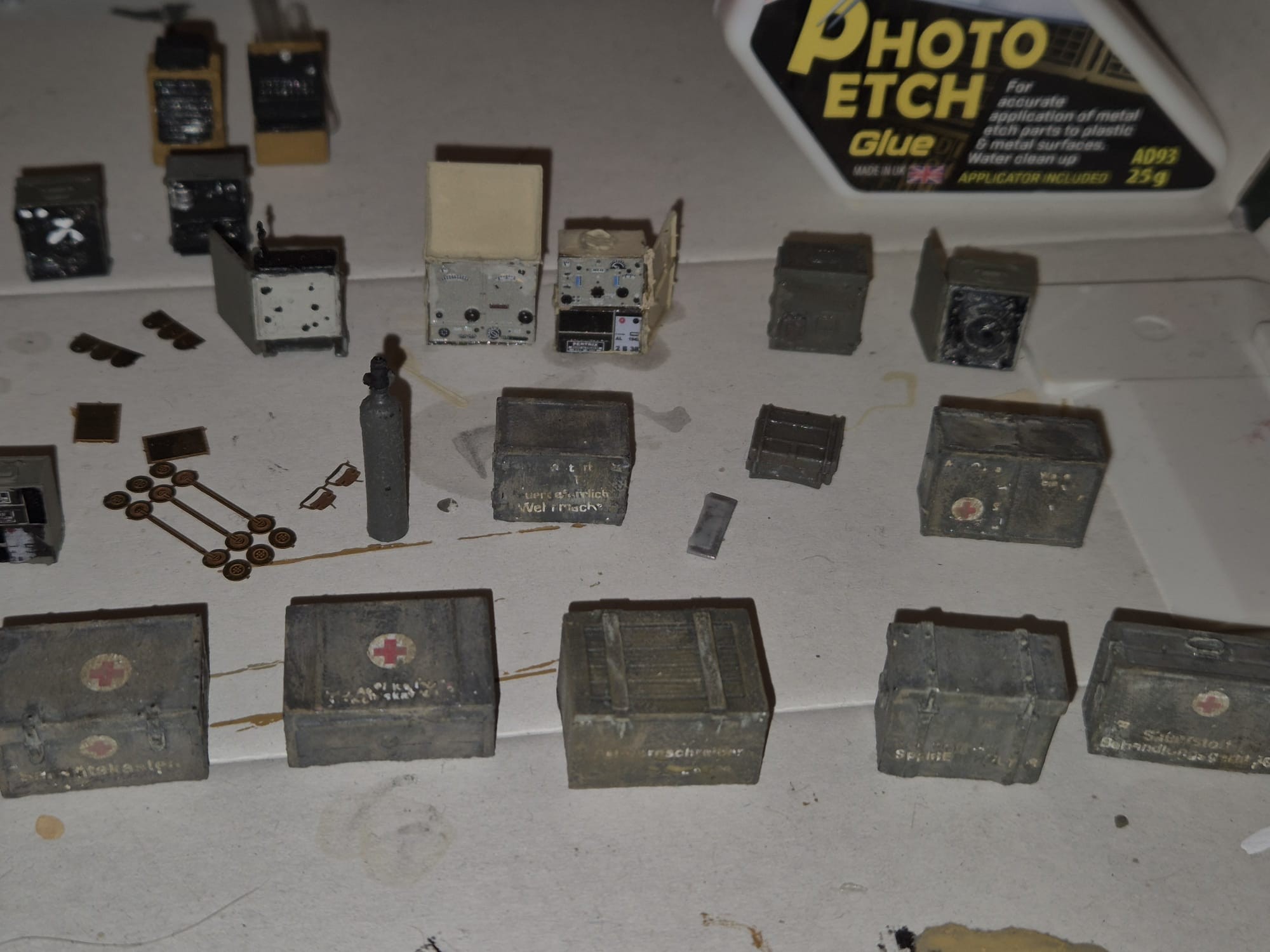
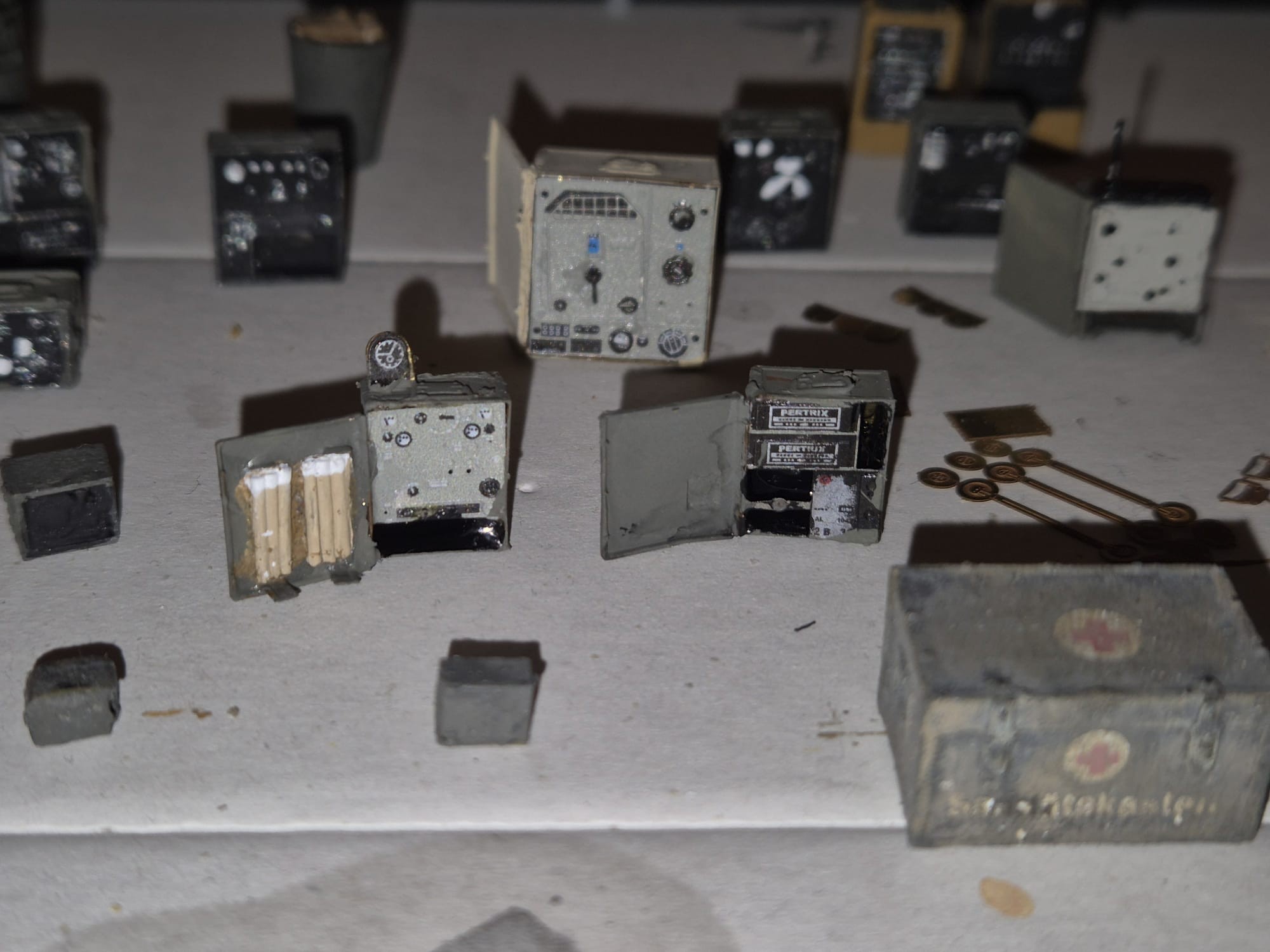
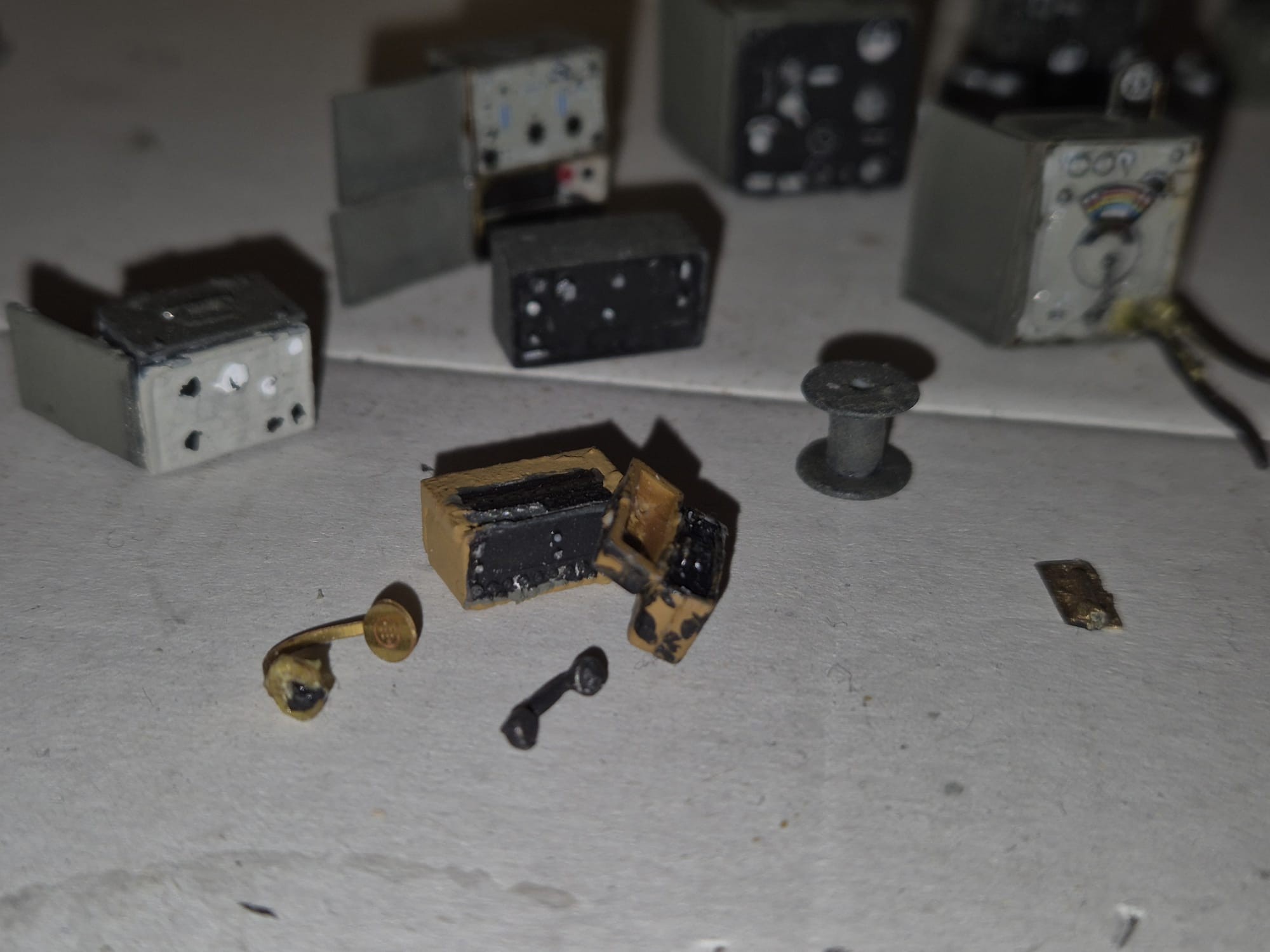
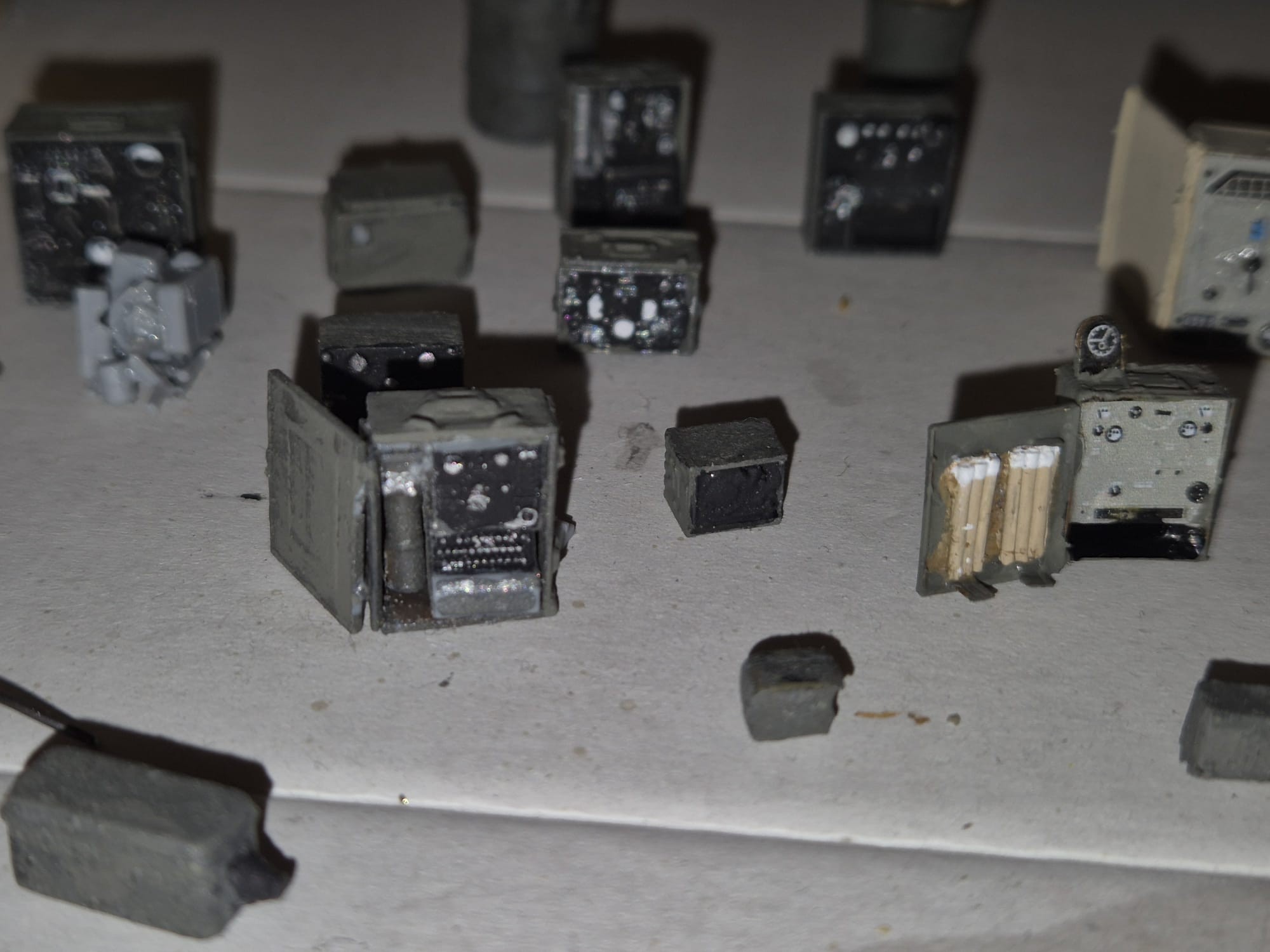
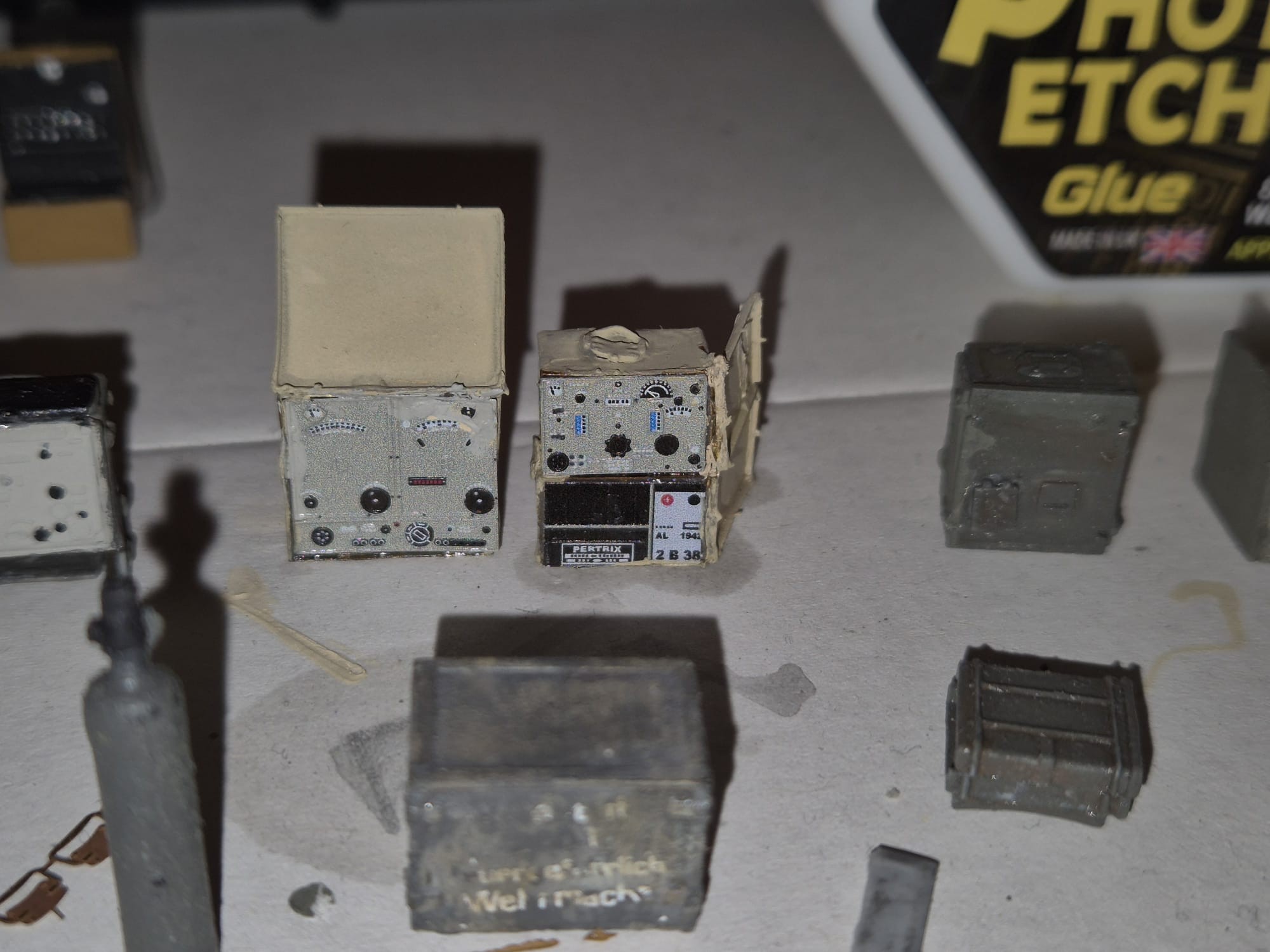
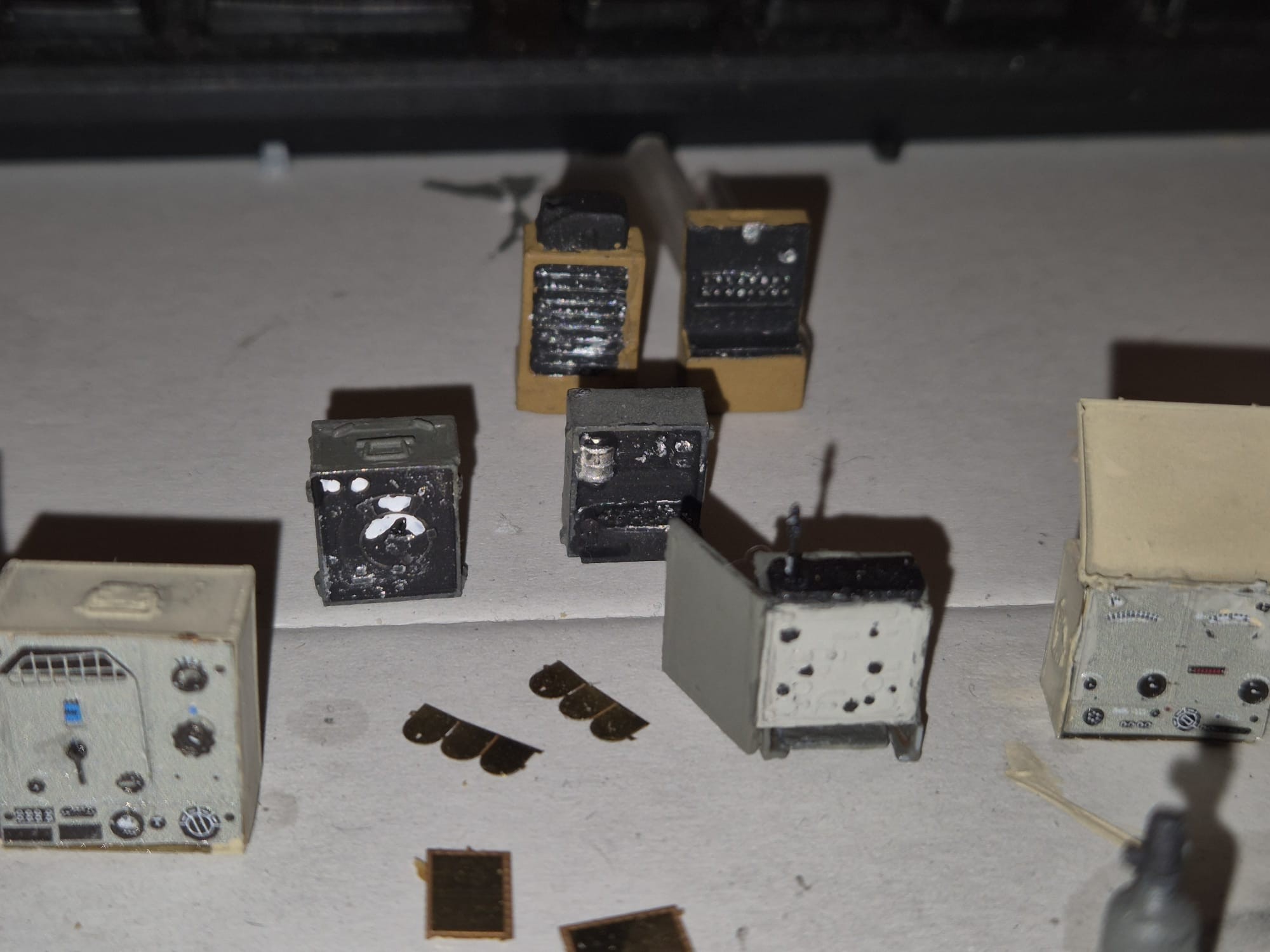
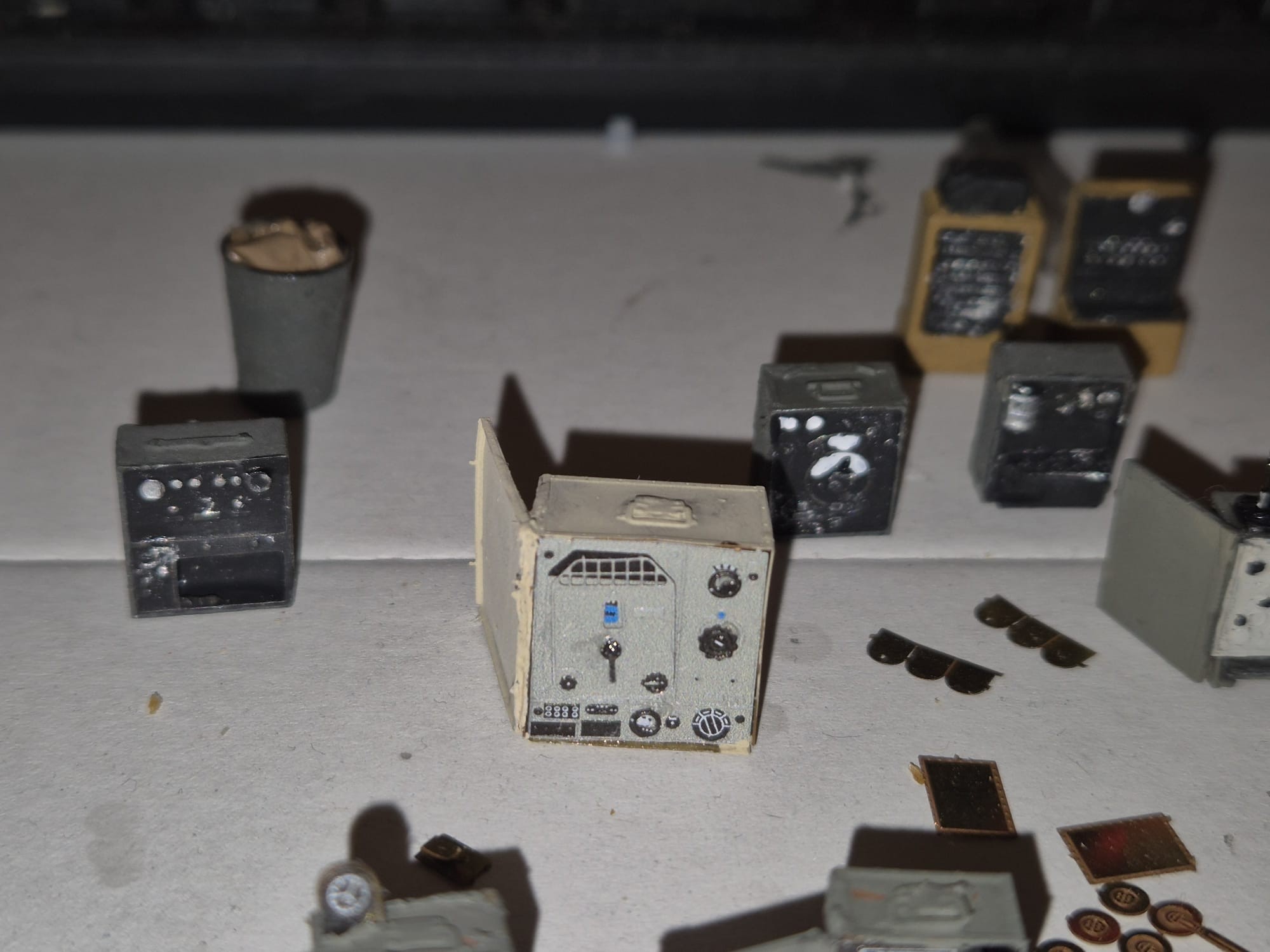
And here I am again with the by now boring subject of communication devices being repainted and somewhat weathered and completed. The only tiny item to still be finished are the generators, which appear here in their natural light grey livery. There are still a few pieces missing, but they will soon be attached to them and then I will paint them both in German Dark Yellow including some necessary weathering and detail painting as well.
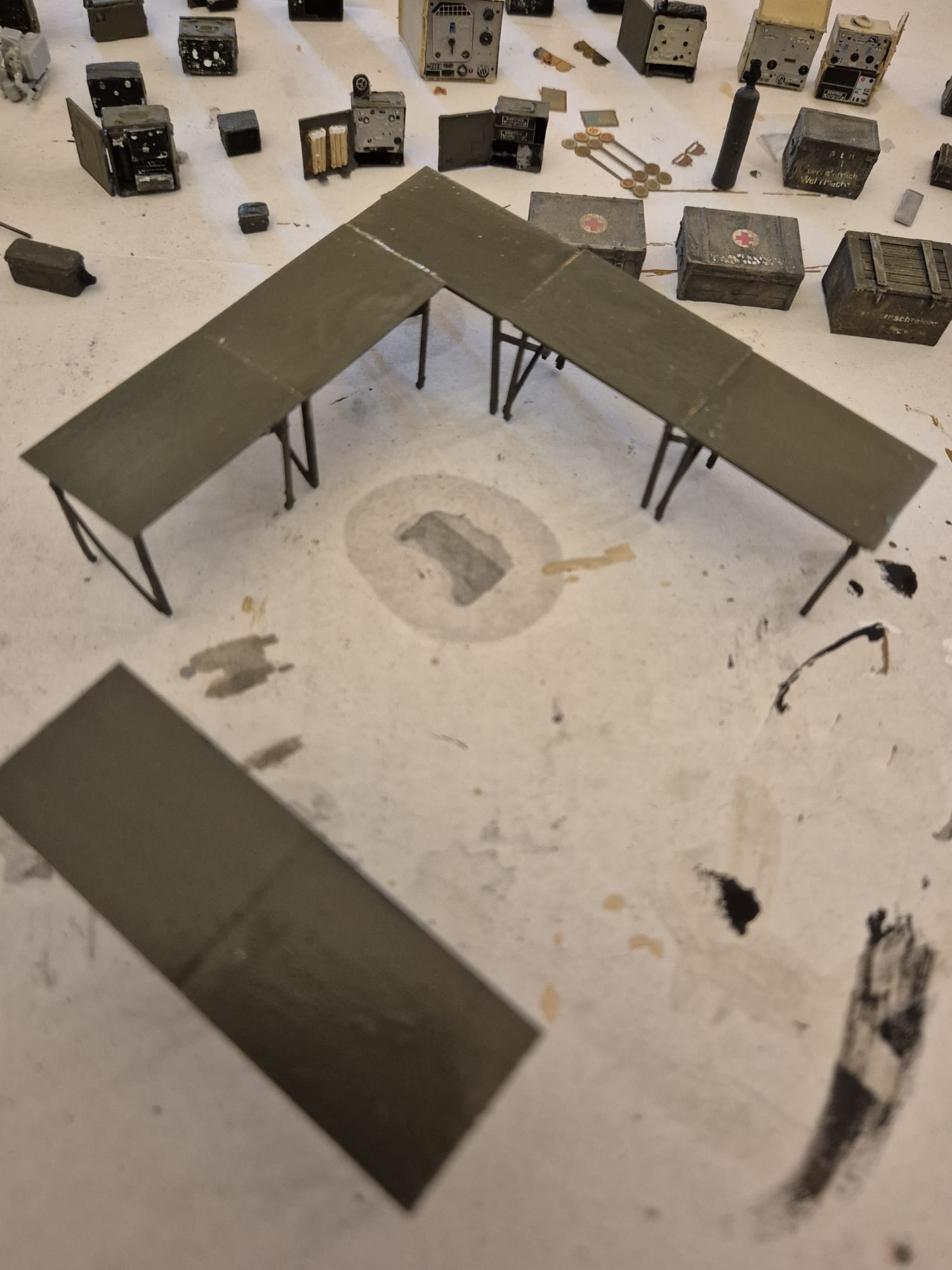
The tables have been all glued together to make it easier to place them into their niches, while the seats or folding chairs remain outside until I have built the communication operators, which I will then glue unto them and insert in front of their respective devices they operate.
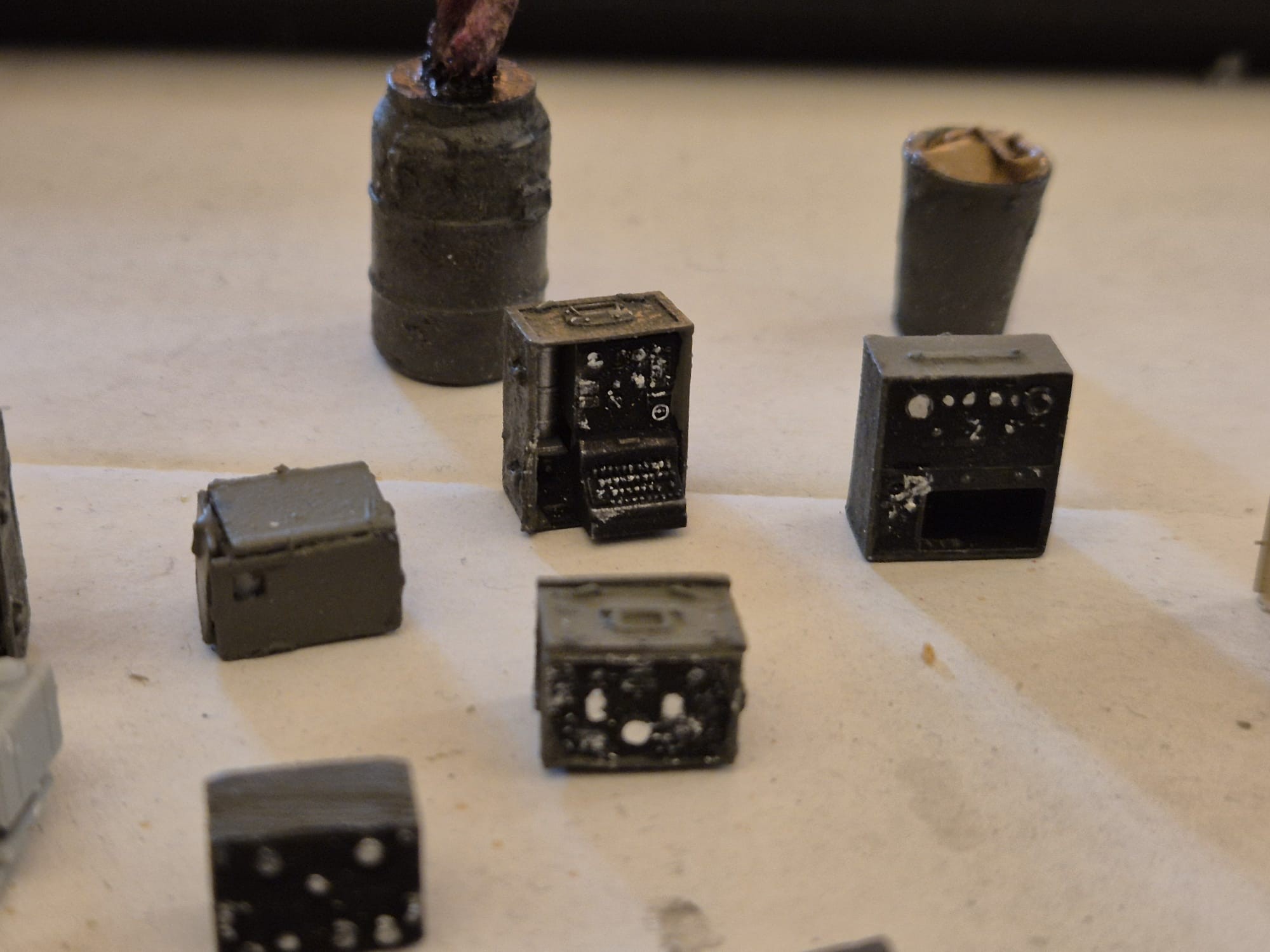
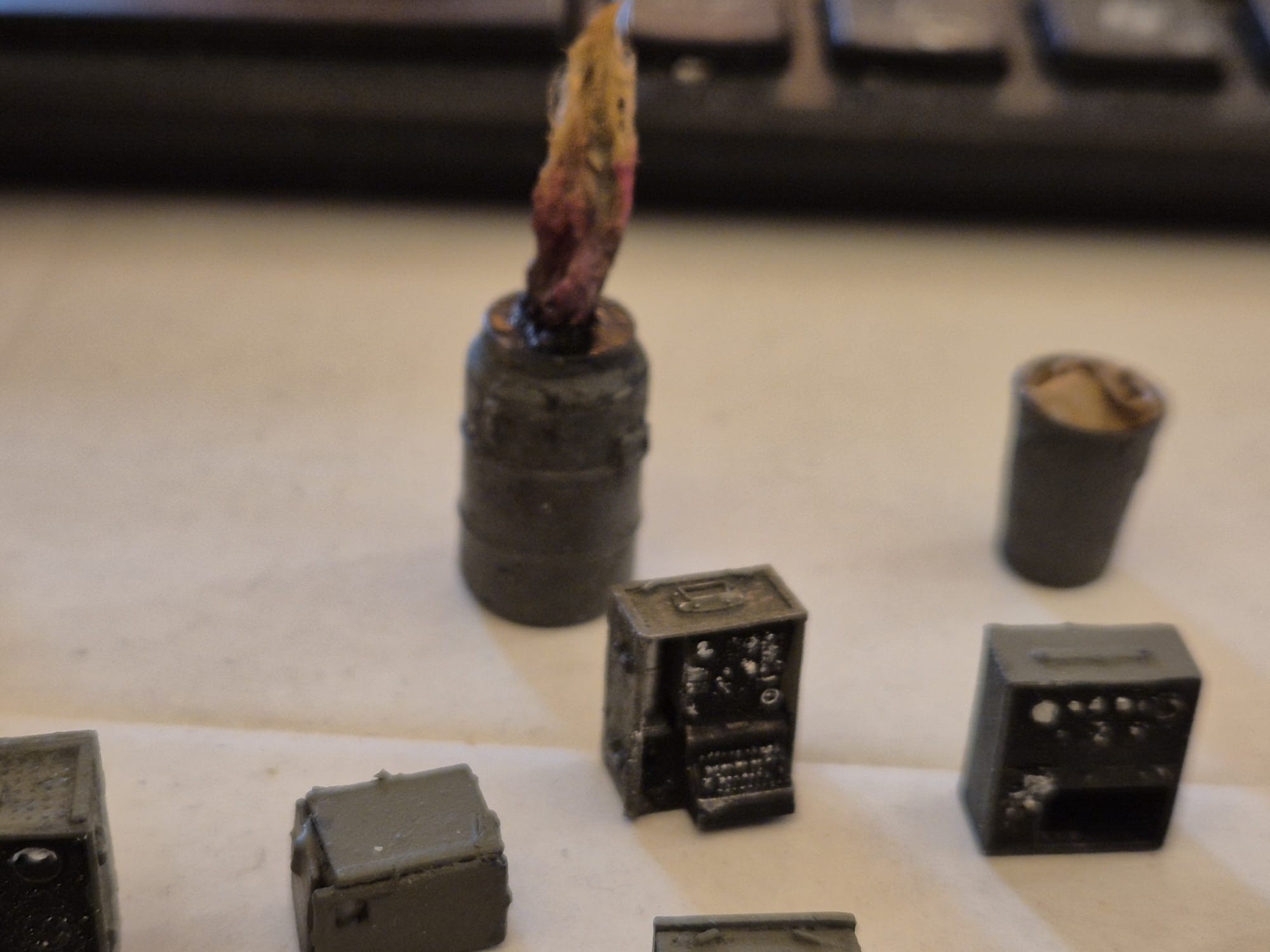
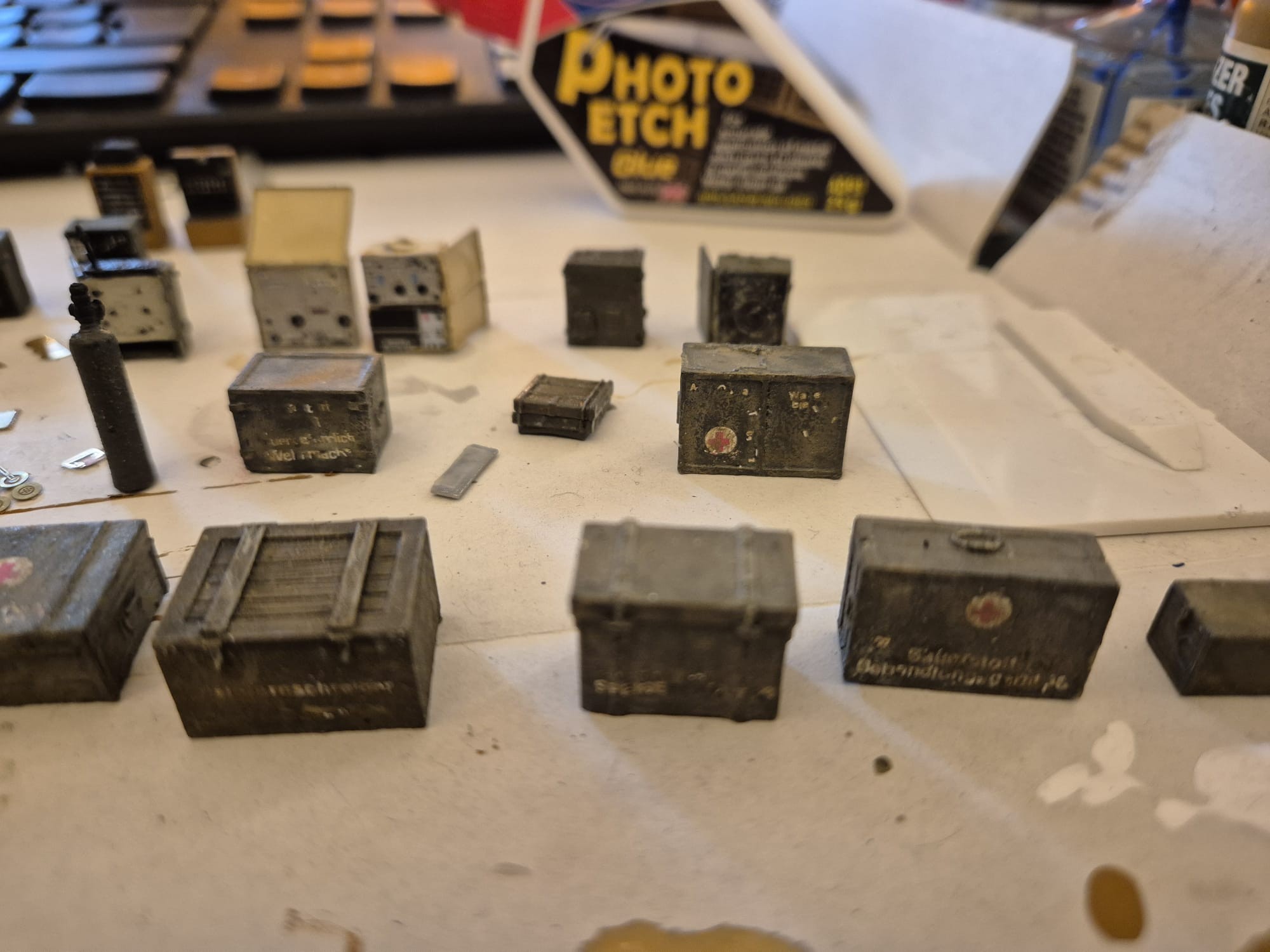
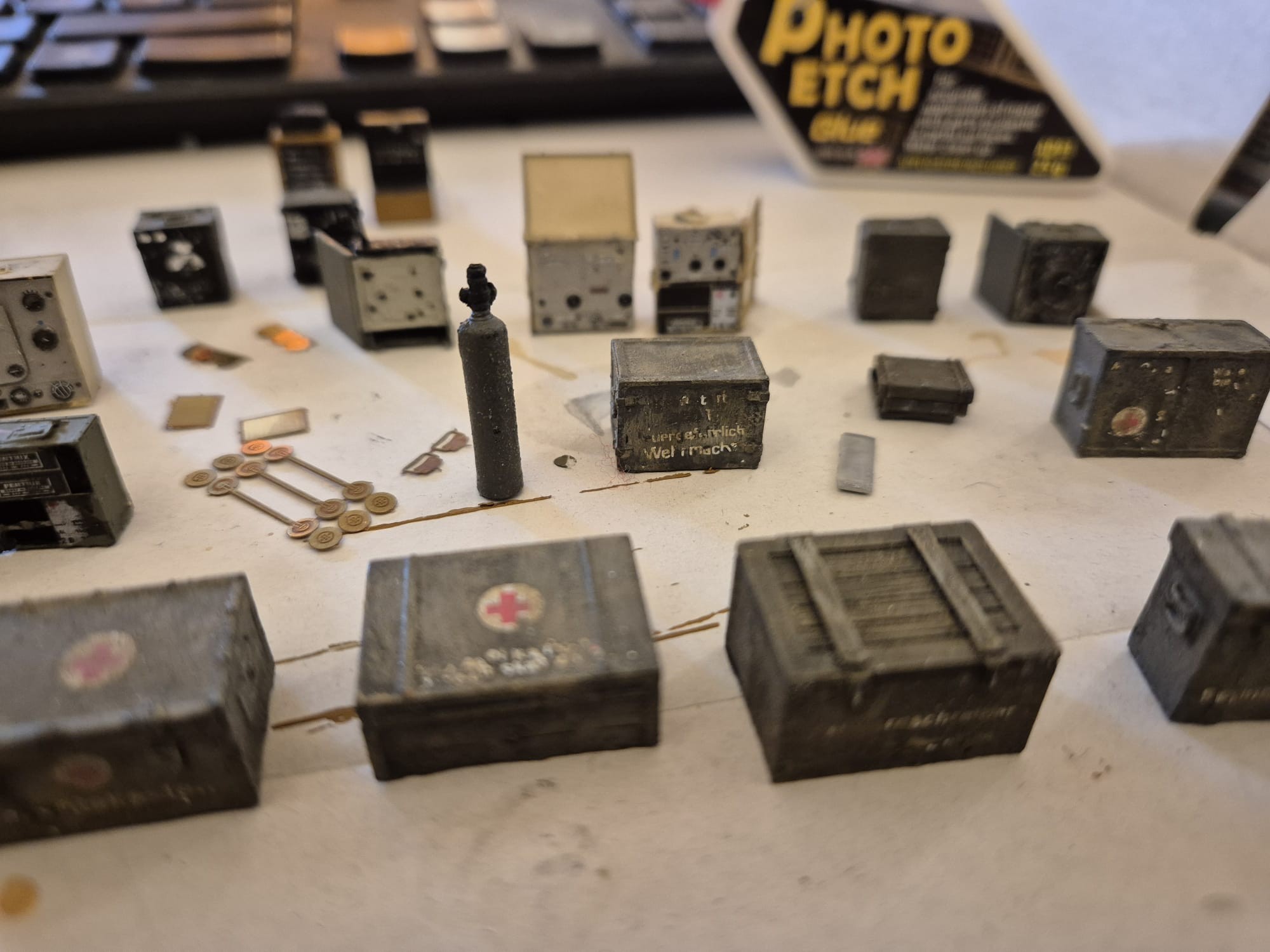
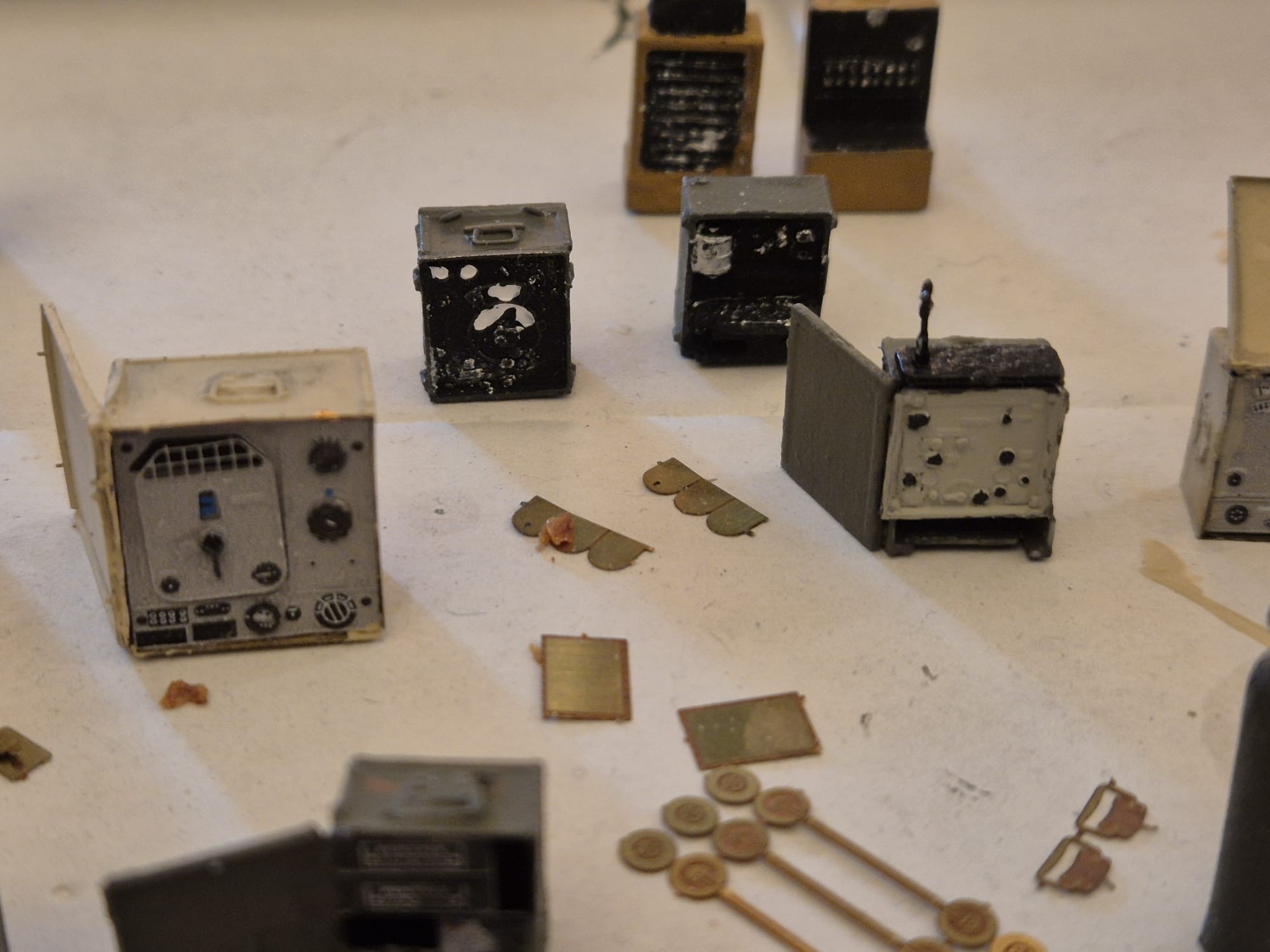
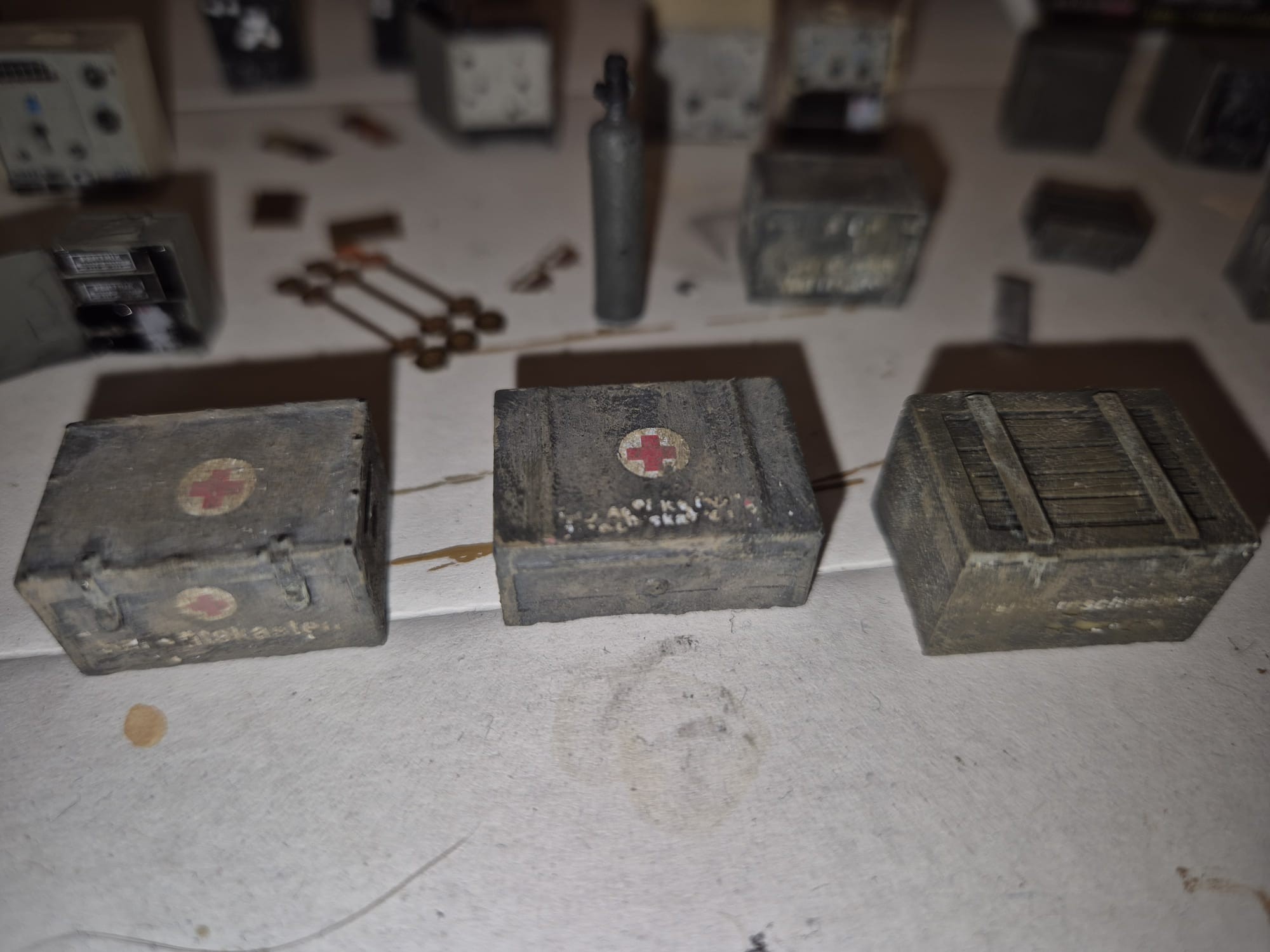
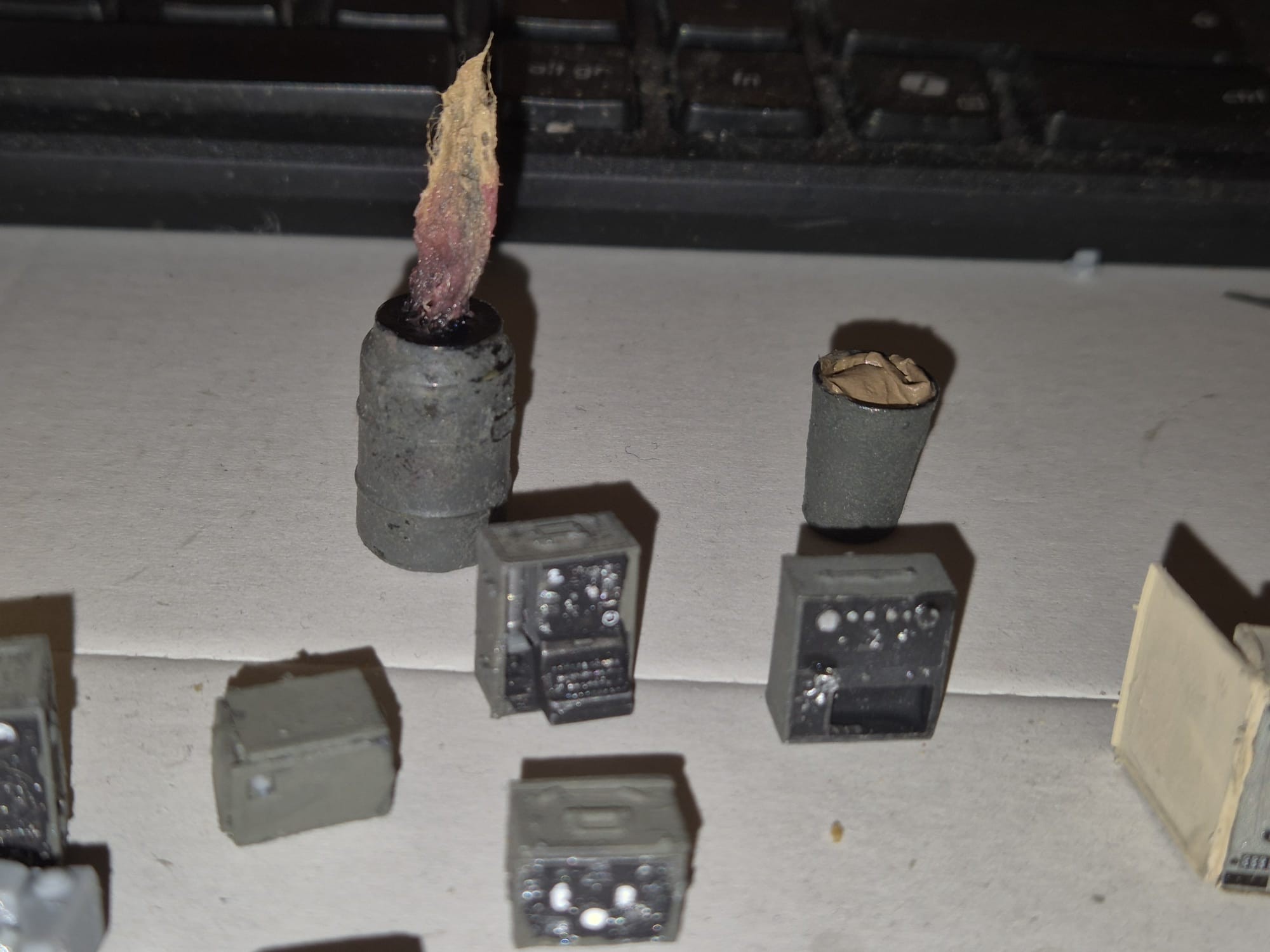
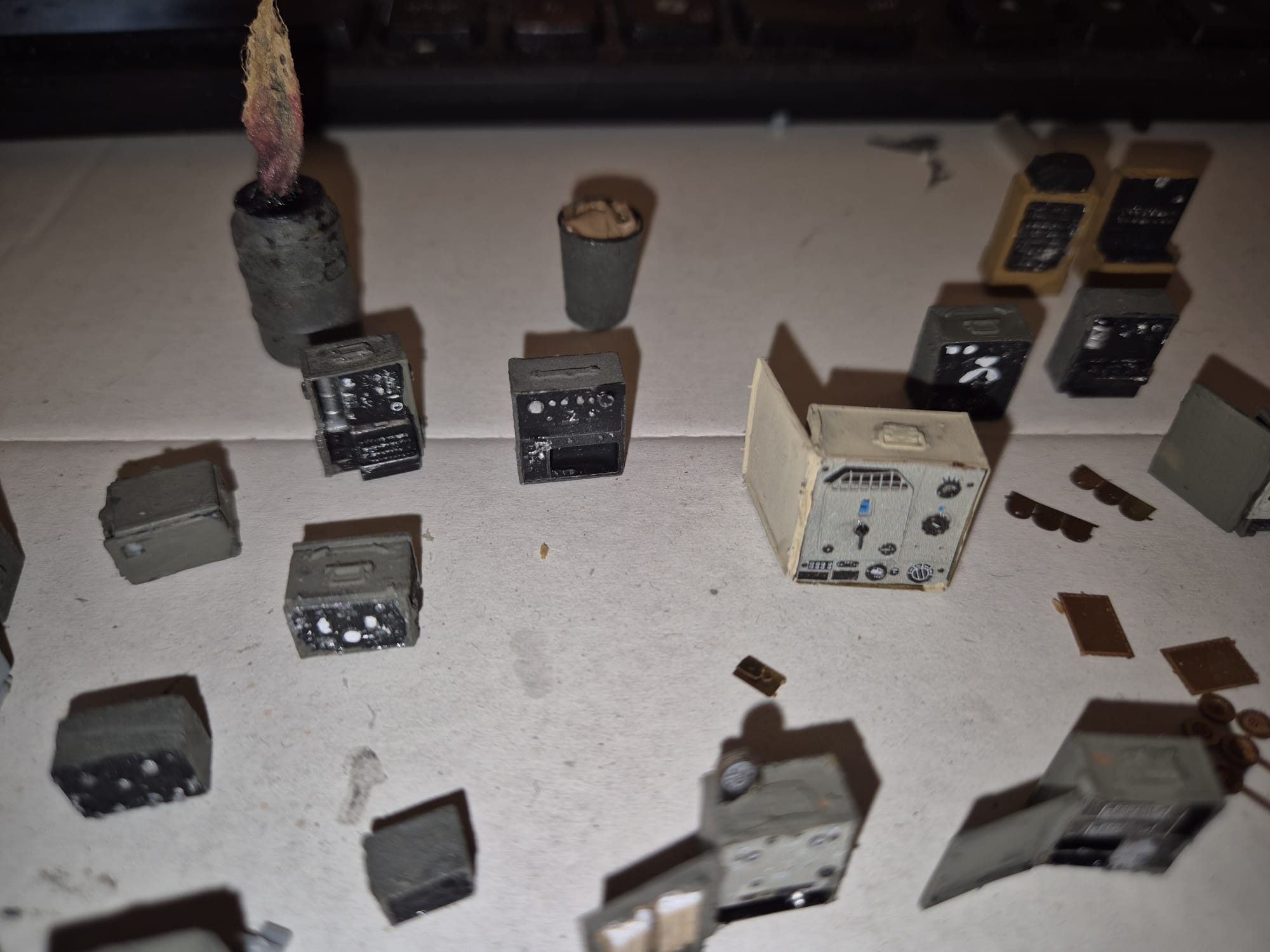
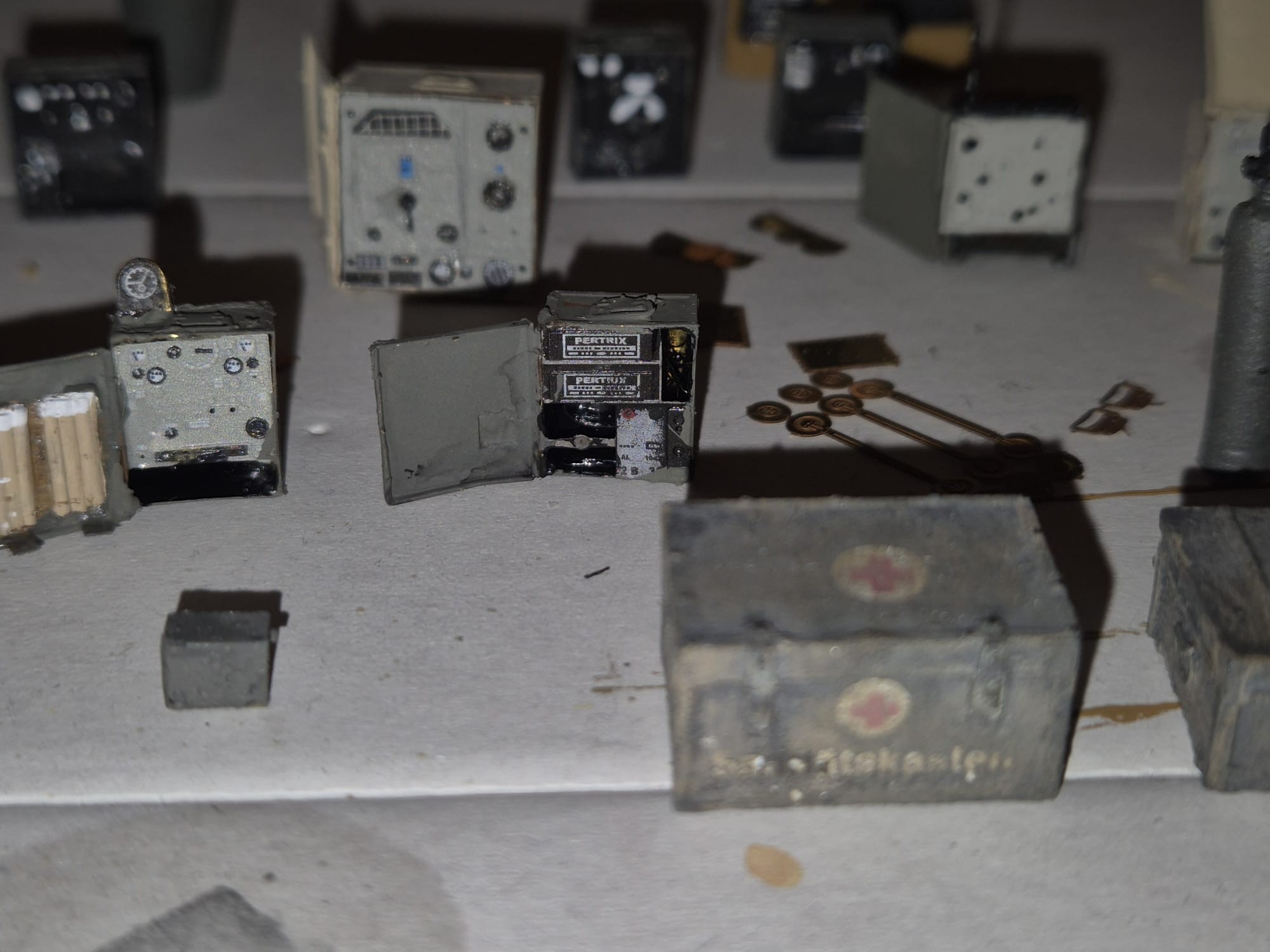
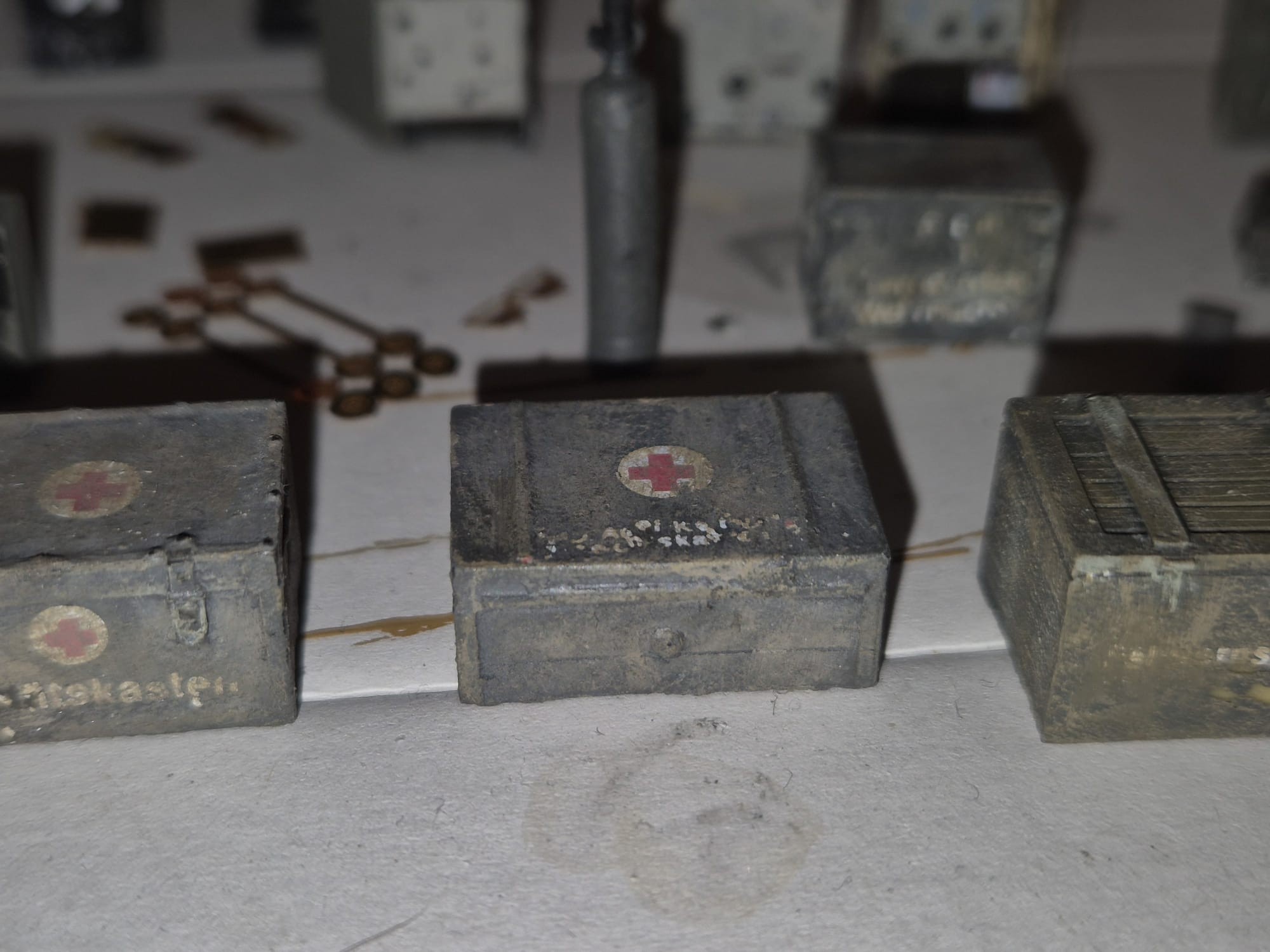
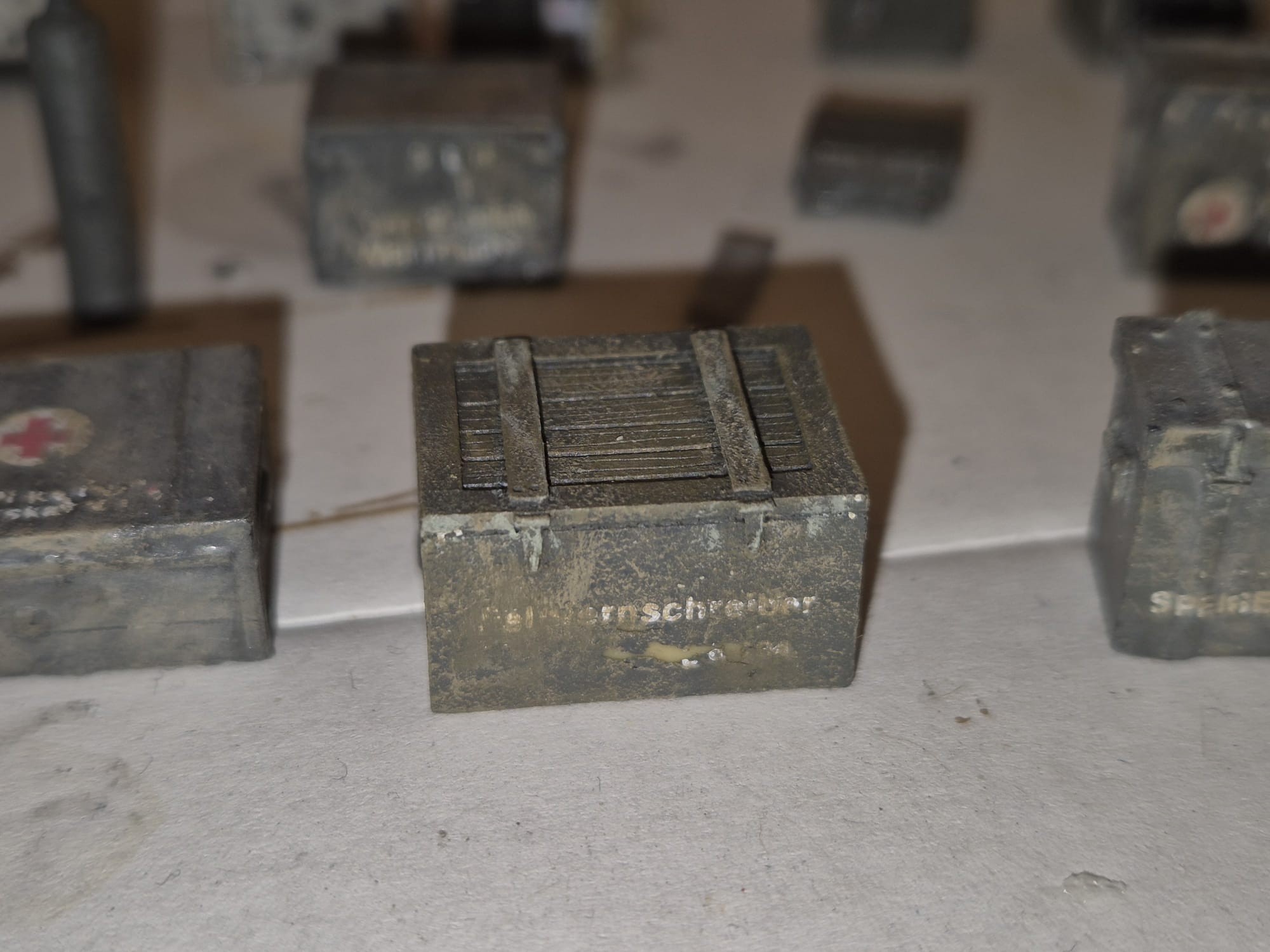
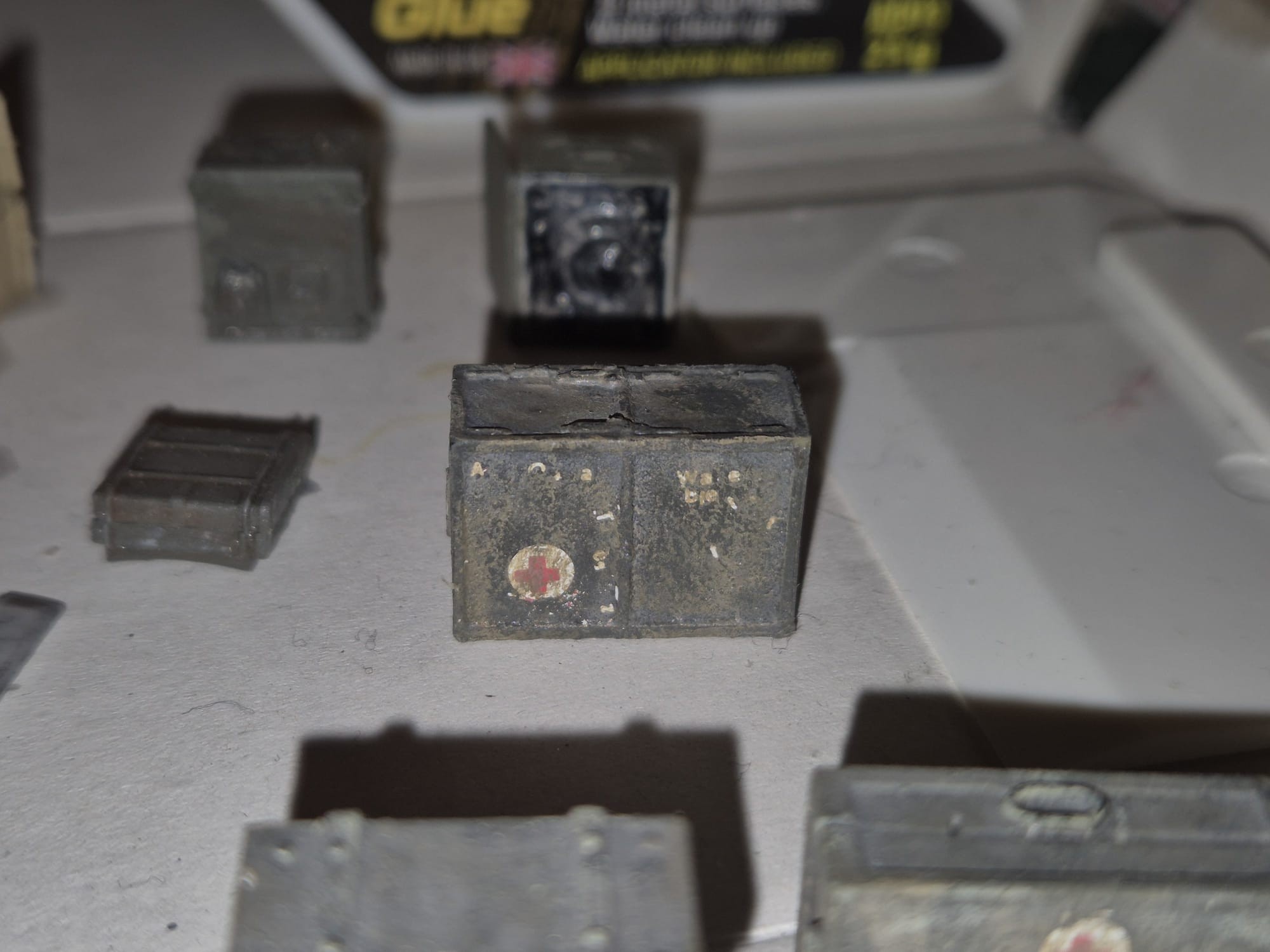
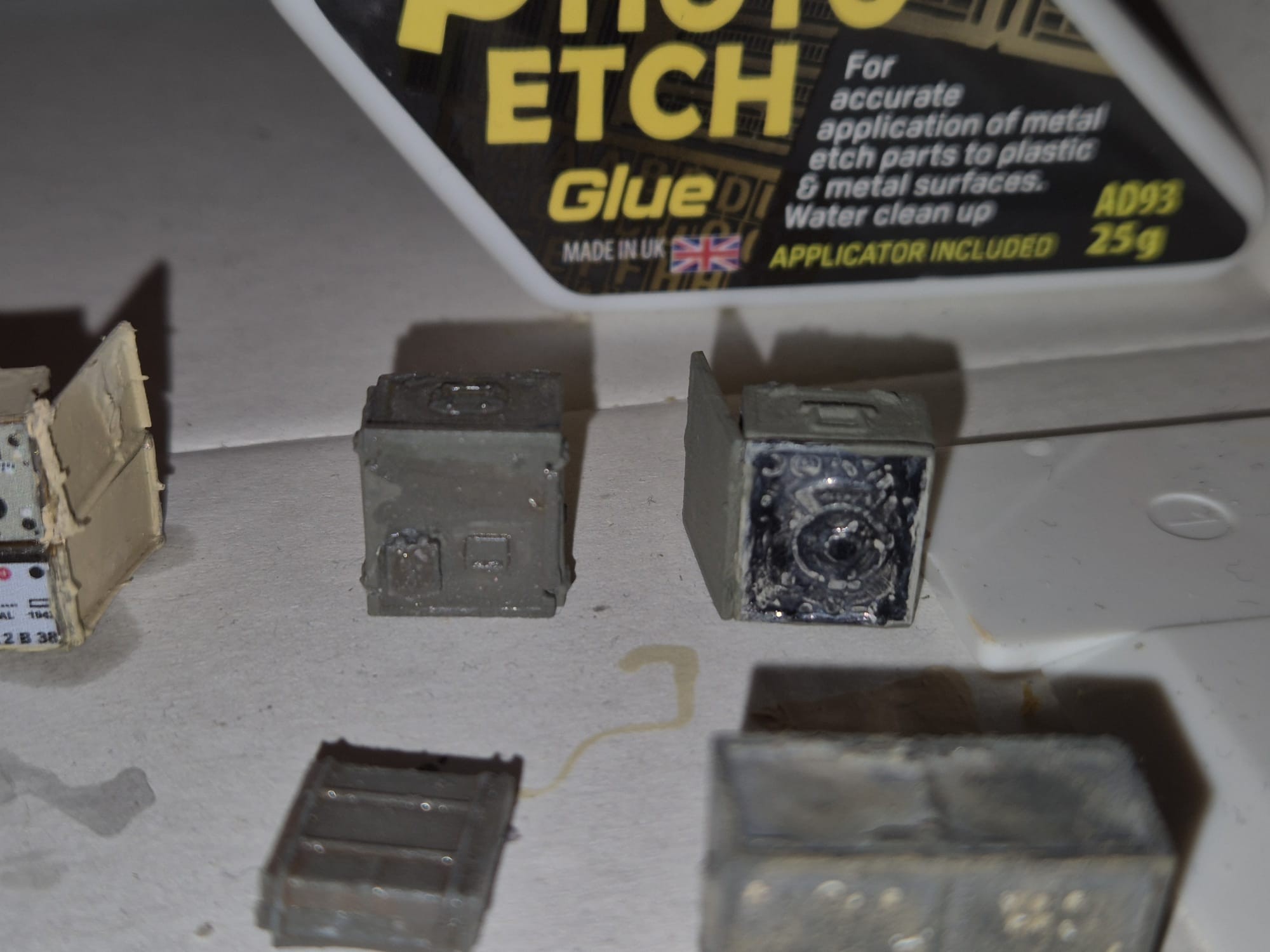
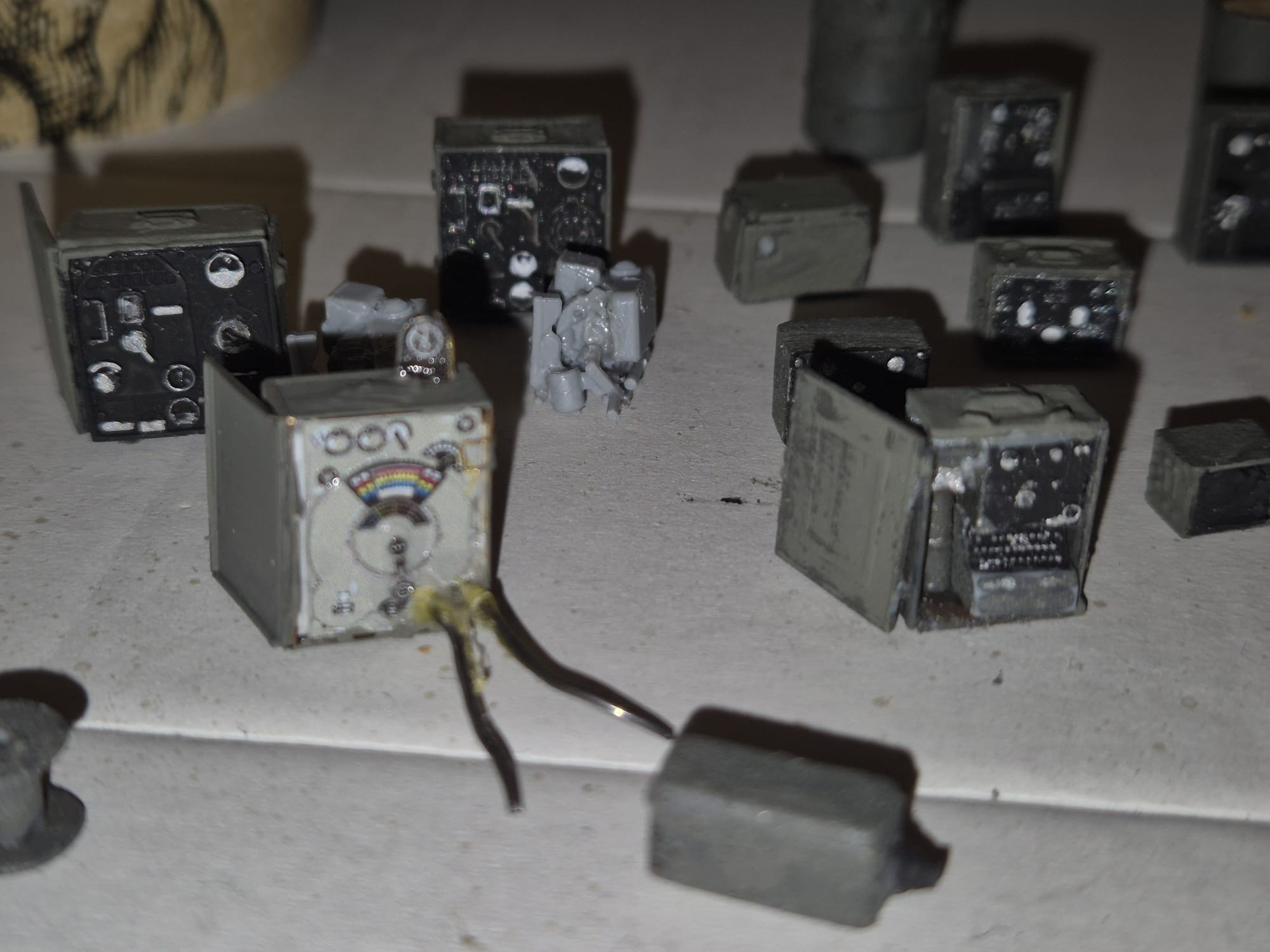
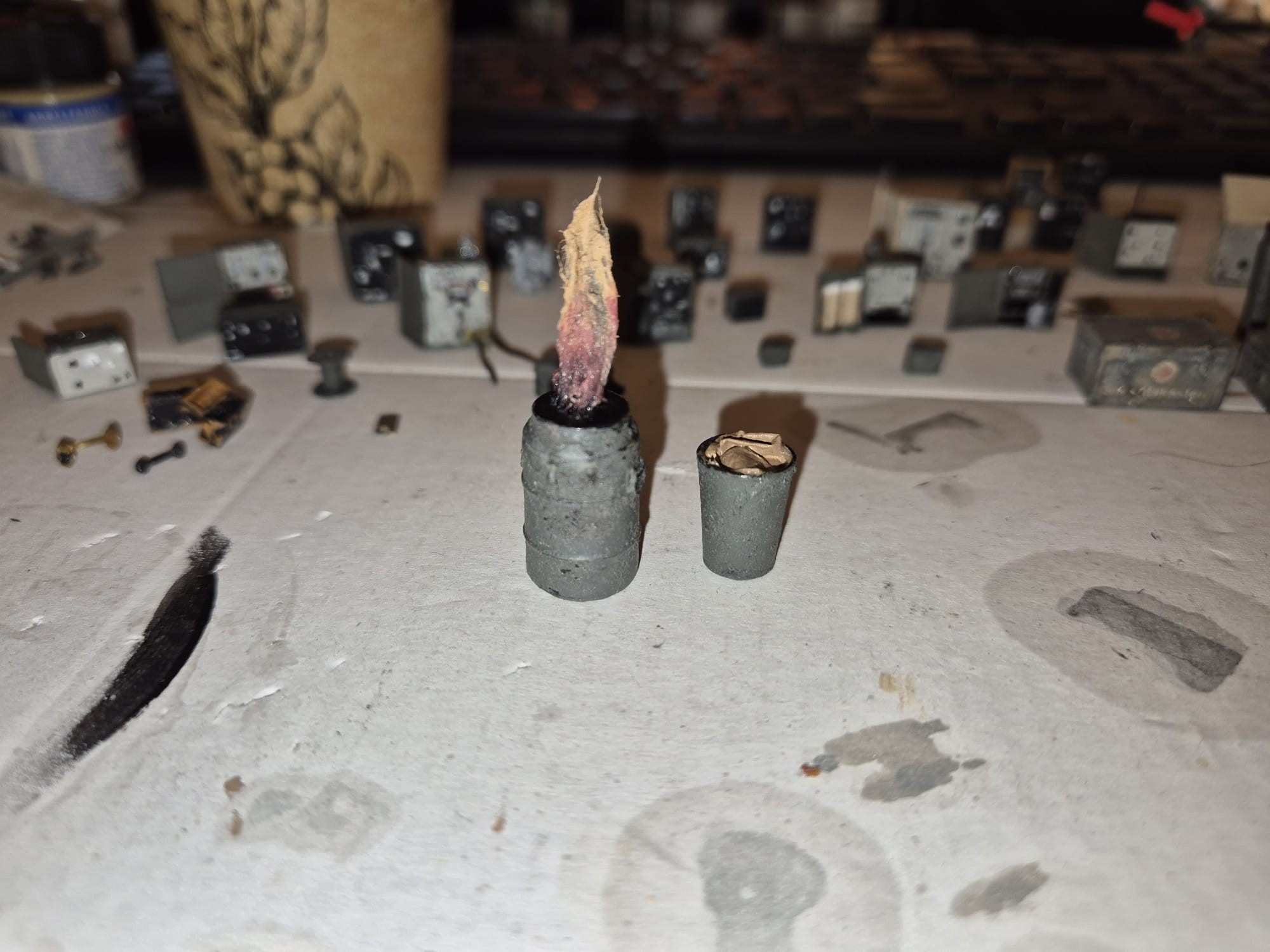
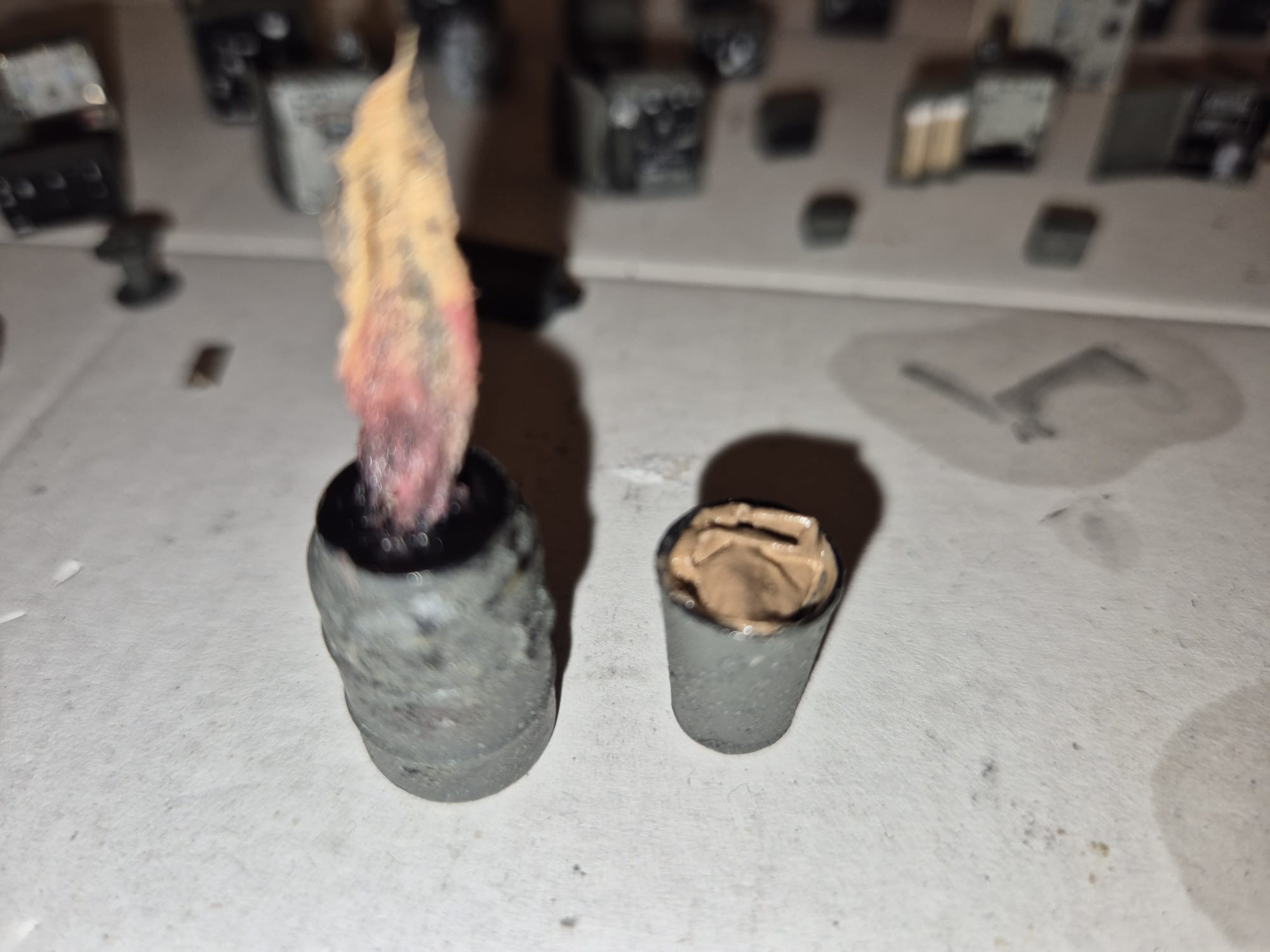
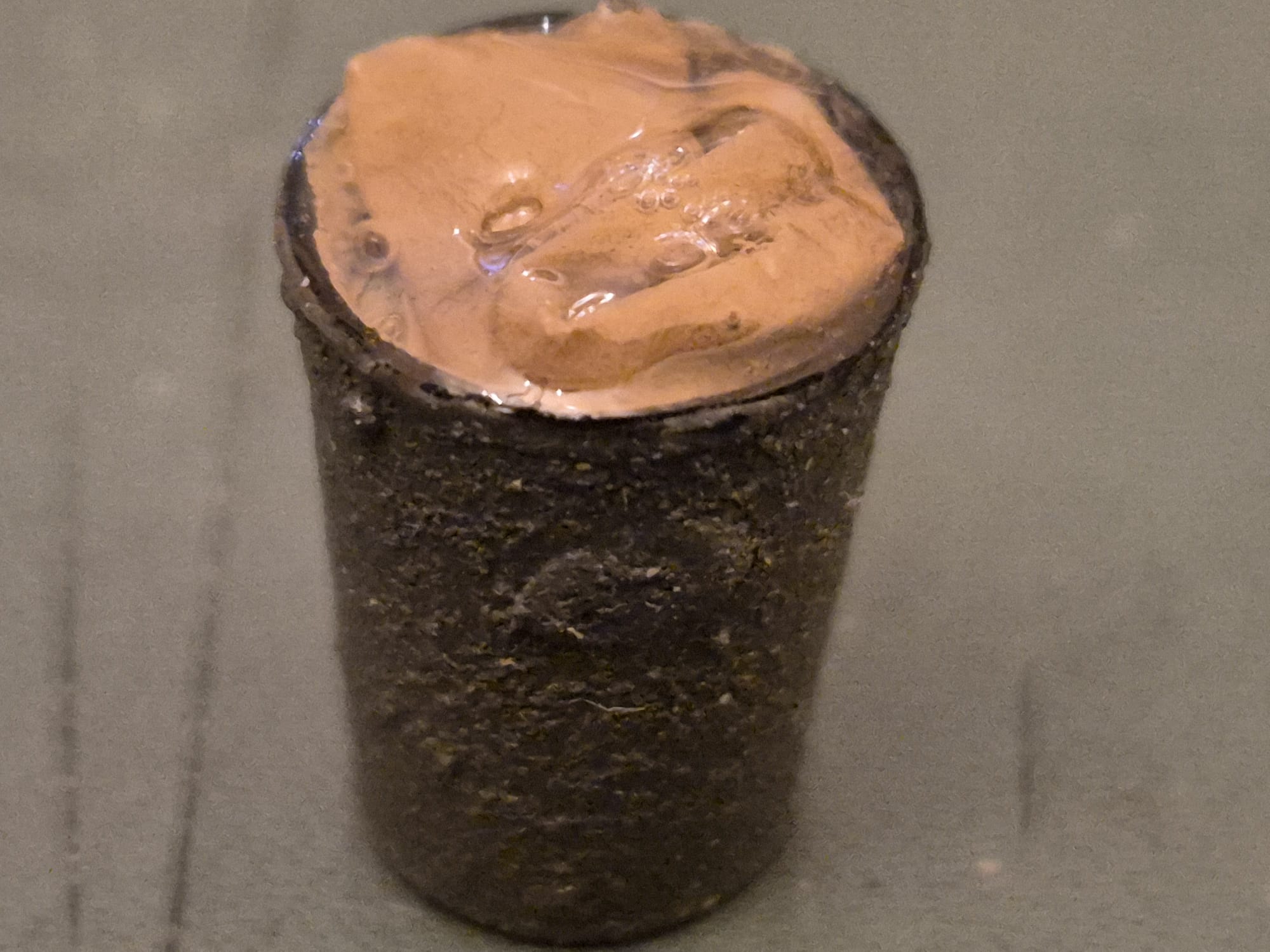
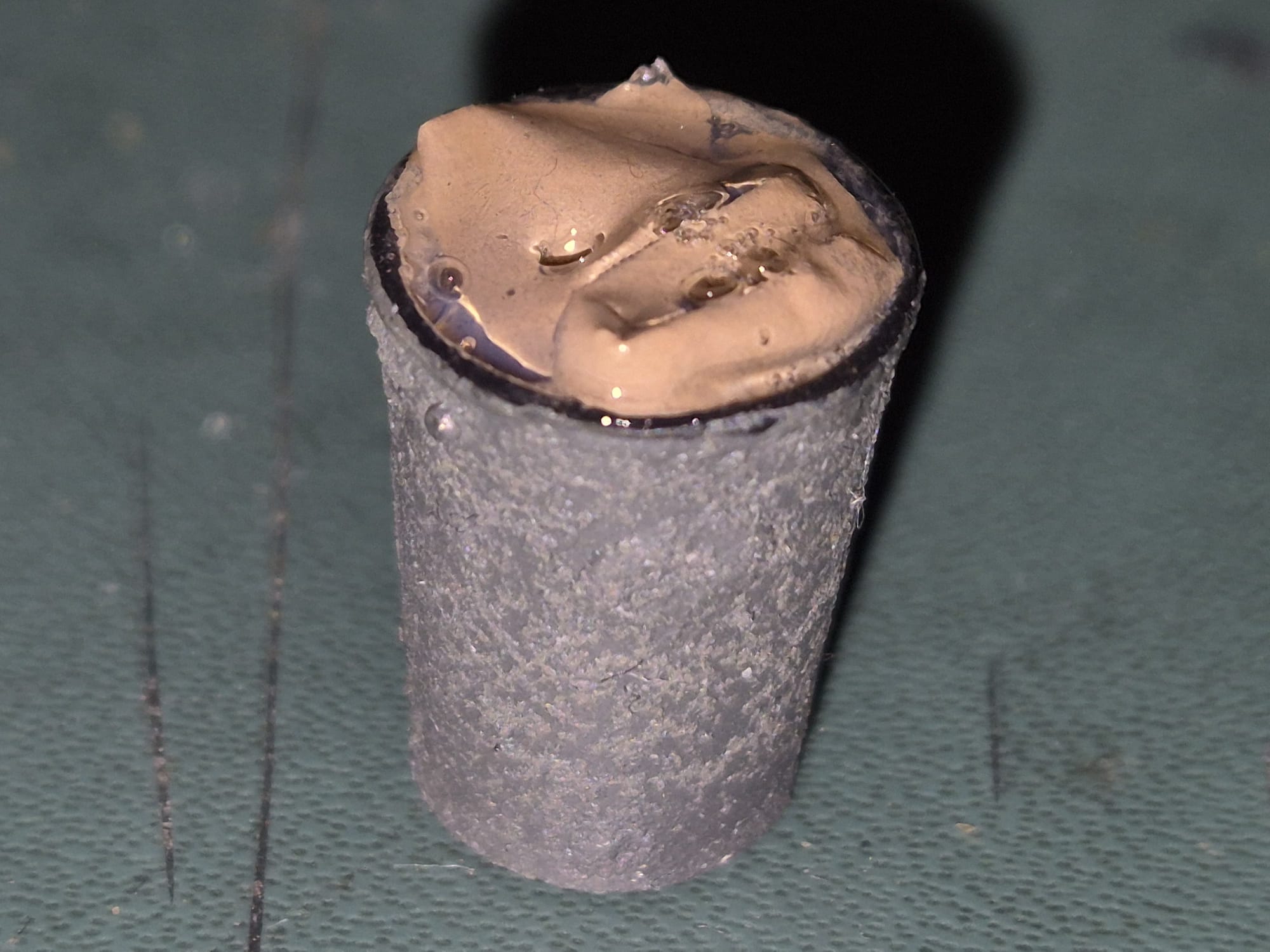
I took two sets of pictures. One under natural light and the other with a flash in order to show them all more clearly. The last few pictures are of a medical trash bin in which bandages are thrown after use and the other a field incinerator for potentially infectious or dangerous materials and chemicals.
I tried my best to reproduce a streaming flame on top.
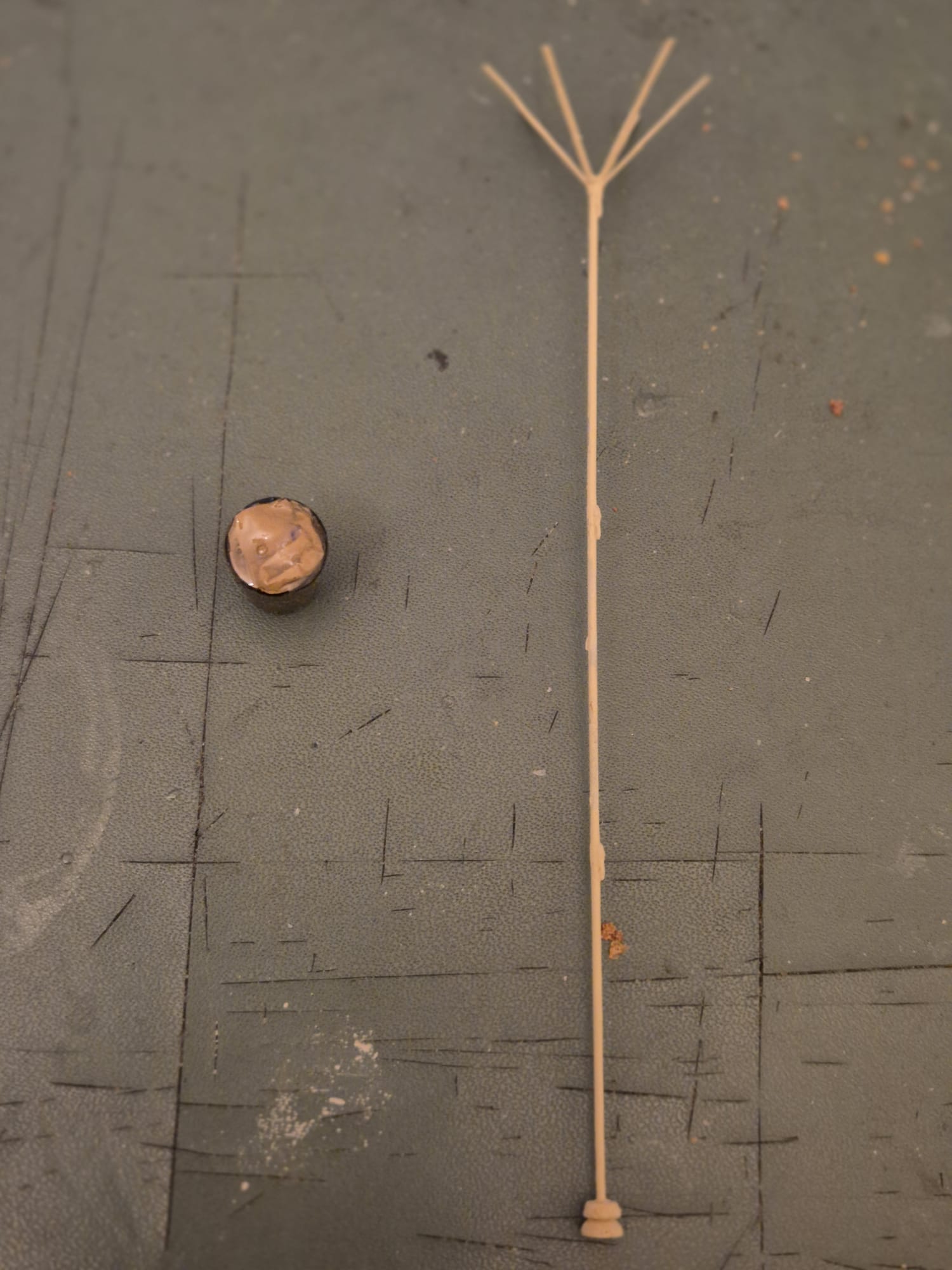
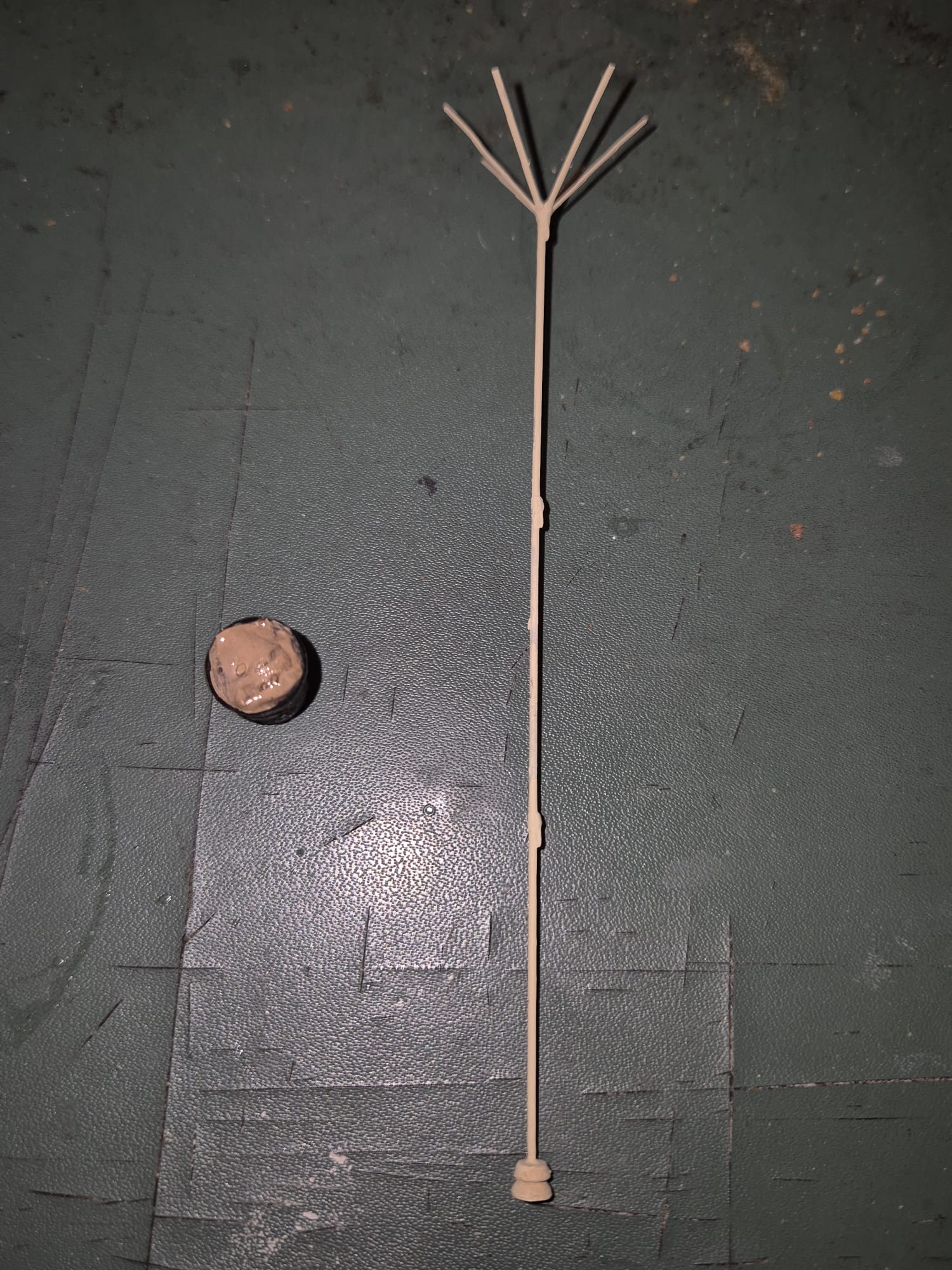
In the next picture you may see the antenna poles that were missing in one of the Eduard models contained in the device’s door (refer to my previous post about the original ones). They were made with stretched sprue, cut into the correct size, glued together in groups of three, painted in German Gray Yellow and the tips in Flat White, then attached with CA glue.
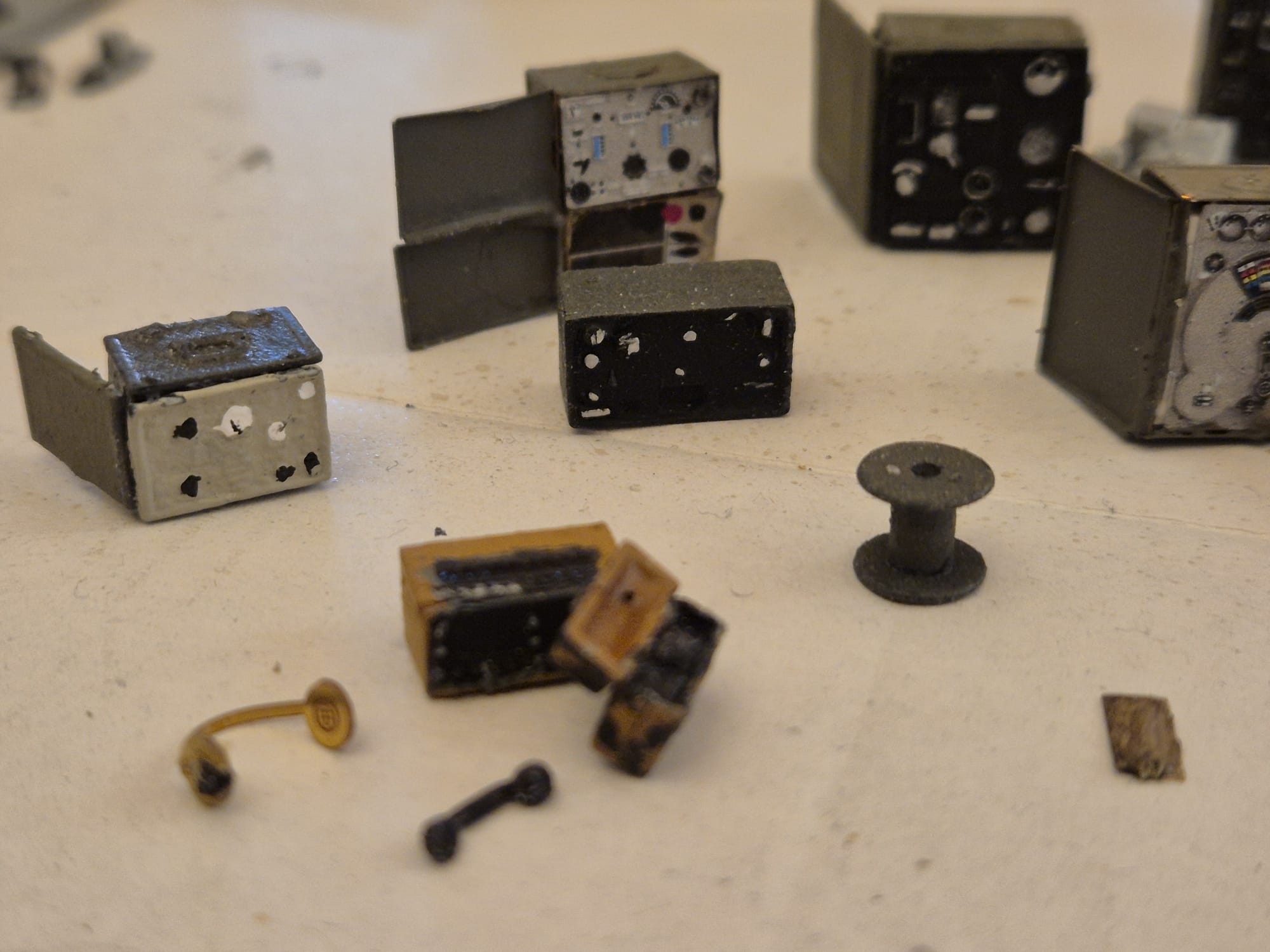
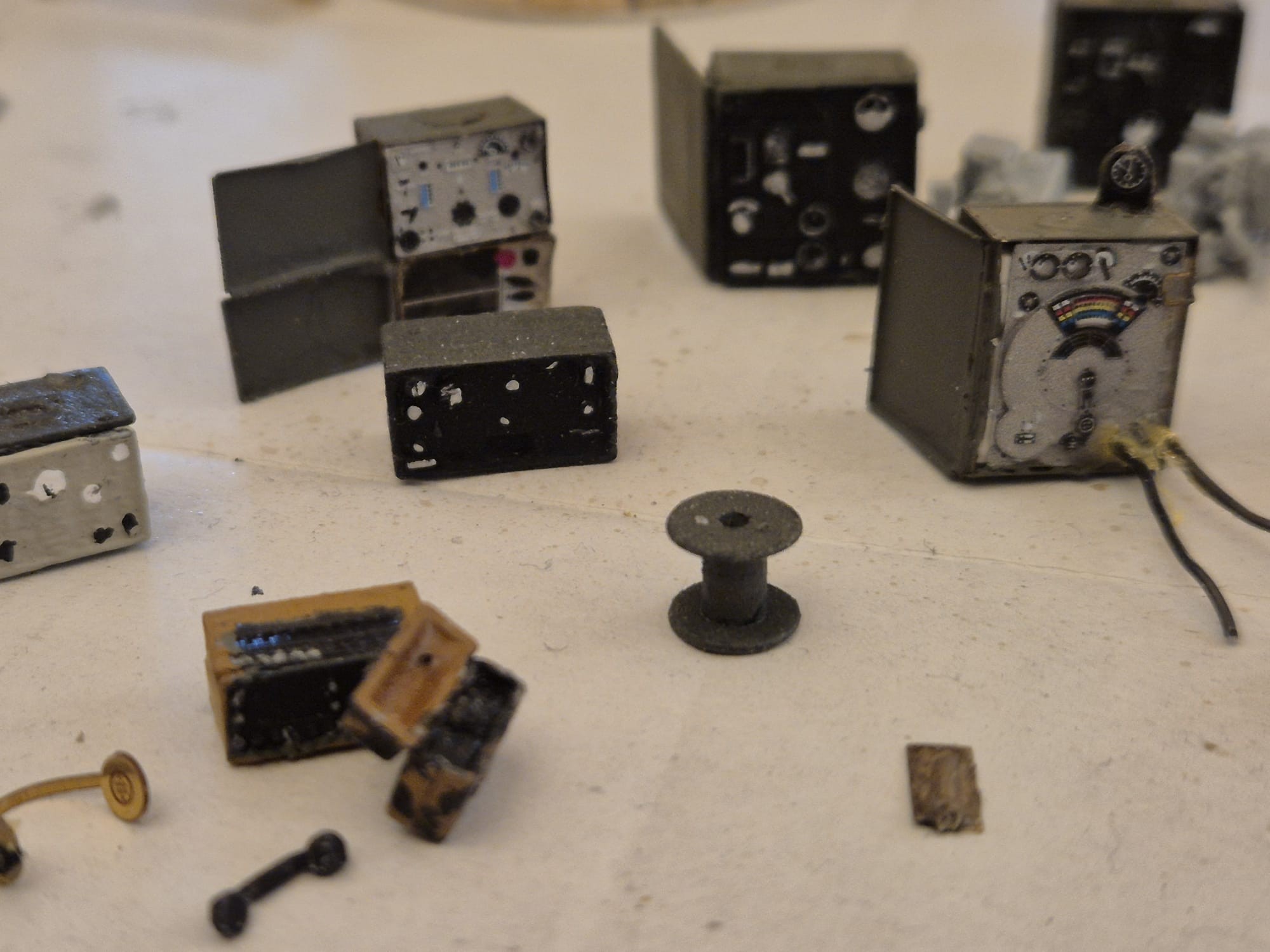
Notice how worn the cases now look. They were dry brushed with Natural Earth, Olive Green and Pale Green then washed over with Neutral Gray and Black washes and subsequently dried with paper towels.
Just finished:
A star antenna on an extension pole which will be fixed on one of the Bunker’s corner surfaces and the Medical Bin now shown with added “Realistic Water” by Woodland Scenics.
What will follow from now on is fixing all that stuff unto the various tables with CA glue then fabricating the various cables connecting these devices to each other with thin soldering flux while arranging all the thin telephone/telegraph cables on the front by wiring them to the devices with thick cotton thread (the planned nylon fibers do not bend as wished and are unpaintable) which will be coiled up and fixed with some CA glue.
Once everything is firmly fixed to the tables I will fix the entire complex under the Bunker niches. The larger devices which do not fit into the niches will be glued unto the previously built wooden table and cabled the same way. The remaining devices will be used elsewhere in other scenarios.
The medical crates and boxes will all be placed unto the Krupp Protze vehicle, while the medical disposing bin and the incinerator will be located by the trench entrance supervised by an officer.
I will be back with more once the entire complex is finally mounted and I will commence building some of the vehicles.
I hope you will continue following my progress because there is still a lot of building, painting and decaling to do.
Thank you Aggieman (Steven M.). I put a lot of effort into them and despite their very small size I tried to make them as natural as possible and some indeed look good, others instead not so much, but were treated as best as I could with the tools I currently have.
I wished there were a plating machine for such tiny devices in which one could reproduce those tiny faces of those devices by just using an image and transmitting it to the machine from a PC.
But then all the fun would be diminished and it would be an artificial mean of doing things, of which I am indeed against. I prefer doing them with my own hands and eyes and accept imperfection as being the limit a common man can reproduce.
This said though being these so tiny, no one can actually see all the minute details in them, except maybe, by comparing them with the real thing.
But in a way I tried to make them real for my tiny operators who will fill the scene in a very near future. They deserve as much attention as those who actually worked those devices.
Reality is a tricky thing. After all, all I am doing is framing just one moment in time as if it were a picture taken, but in 3D and in color, instead of being flat and in Black & White, and what’s more, it can be seen from different angles enhancing the viewer’s experience and perhaps also adding that kind of detail that so very often is gone missing in a simple photograph, not fully explaining what and who was doing something at that time.
In a strange way, it is also like a static time machine that allows you to better understand what people went through in those fateful days, and this not just through the eyes of officers, but also the common man, or better, the common soldier.
This is why I try to be so picky on my subjects, since I try to honor the memory of those who lost their lives to see us enjoying freedom and perhaps remind some others what would be the risk of loosing it should we once again blindly believe the lies of demagogues.
But enough about that.
Just know that I am very grateful for your kind comment and look forward to keep your interest in my projects running.
I, in return, will do the same with any subject in which I can say something useful and admire the vastity of creative thinking around here.
Be well and remember that only the sky is the limit! The rest is up to us.
I’m loving seeing this project come together! Each post brings new details brought to a stunning but gritty realism, like a low-resolution image getting the Blade Runner (1982) “Zoom - Enhance - Zoom - Enhance” treatment
Are you considering collating the posts somewhere? I feel like an aspiring dioramist could really benefit from that.
Thank you pr154, I used to post a lot on Facebook until one day I was totally blocked by their algorithm because I “dared” post some reproduction camouflage uniforms of the WSS German forces trying to explain my technique in painting them in 1/35 scale.
Despite my clear disclaimer that my site was apolitical and not involved in any kind of propaganda Facebook decided to block me for good and not even my explanations to them served any real purpose. I actually never received an answer or an explanation for it.
To add damage was the fact that I also was an administrator for many other pages and sites there and all that disappeared completely and all my material in all of them vanished completely, including some upscaled videos of Babylon 5 episodes on the “Babylon 5: The 3rd Age” site I did post there for those who couldn’t watch them anywhere else.
I was blocked for over a year and only with a ruse could I finally reenter, but ever since then I haven’t posted or created any more sites of any kind. I just managed to rekindle my contacts with a few people I had befriended there earlier. Ever since then I have become very cautious of what I post or discuss on such sites.
Alas, we are living in a paranoid world, more and more restrictive of free speech or even just artistic expression, which was my sole interest in life.
And so, to answer your simple question, yes I have thought about it but I am still living in the fear that someday someone may once again erase everything I have posted, for any capricious reason whatsoever and therefore I have been restraining myself from doing so.
Should I be made aware of a secure place where one’s creations and ideas are fully respected and understood as being just an artistic expression and not either politically or religiously biased, then I would consider it indeed. But as I can see, even the most liberal ones get slowly swallowed into the den of iniquity that the Internet has become these days.
This is why I have tried to trust Finescale Modeler, since I used to collect many of their magazines in time always finding some useful suggestion or trick of the trade to enhance my own modeling experience and why I finally decided to join the active conversation among peers.
My only hope is that this space will always remain as it is and not gobbled up like many others and remain embroiled in stupid political or religious intrigues, which to me are just a complete waste of my creative time.
Should you be able to point me to such a site as I described, then I would welcome your suggestion and try once again to set up my own modeler’s site there.
I thank you for your kind suggestion and will try to post more pictures of my progress in a near future.
Be well and have fun with our common hobby, which for me is slowly becoming my real work of passion.
Ah yes, I too have fallen foul of the Facebook banhammer when I was creating gaming content. The work product was still there, but my page was effectively isolated from public view. Unfortunately there are very limited avenues which are available to a small creator to understand what exactly they did wrong, much less to appeal such a decision.
Without seeking to hijack your thread or tell you how to “suck eggs”, I’ve been managing my own project postings under a “Build Log” style. The individual post/update method you’ve been doing to date is also perfectly fine for sharing your exploits, but it’s harder for an aspiring dioramist to follow your method step-by-step. Opinions on whether the individual update or the build log is the superior method vary in this forum, hence my endeavours to treat the topic with caution and utmost respect for ones own personal preferences
A happy medium might be to include a contents page, which could link to the preceding posts in order. This is something I’ve been doing even within a topic, so that an interested party might be able to find the step that interests them:
Without wishing to make assumptions of your techno-skills, I would be more than happy to generate a copy-pastable slab of text and links that would allow you to replicate a similar sort of contents page. This could allow you to continue to post individual updates within FSM Forums as you’ve been doing so dilligently, while providing access to the foundational content that preceded it. There’s otherwise no need to change what you’re doing or migrate to another platform
Well, first of all thank you for having shed some light to an alternative and very reasonable way to do it and indeed, every bit of help counts, especially if someone would like to follow my progress in a linear way. I used to be a web designer in my time (late 1980s early 1990s) and I already knew what streaming was even before some people here in Switzerland, who only did ten years later, after my return from New York to take care of my aging mother, but in time I lost track of it all and so my techno-skills, as you call them, are just relatively low right now.
I would really welcome and be grateful for your help if you could do this for me. The rest of course will be up to me, but I can still copy/paste stuff, so that much has followed me in my retirement.
And yes, it is comforting to know that I don’t have to be a nomad any longer to display my work somewhere and FSM seems to be the most appropriate venue for what I have to show and to offer. But mind you, I too am still learning how to do things but I like to learn while doing, in other words, hands on and every day that goes by I learn new techniques, new materials which I can use, new little tricks and shortcuts to take and above all, how to work in series as not to waste time and every day is a discovery day for me.
I sometimes feel like an Indiana Jones looking for a long lost treasure that I might eventually find, without allowing a René Belloq to steal it from me, but rather share it with those deserving ones among us.
It is an amazing journey I have reimbarked in after so much time having left it hanging in limbo due to my professional duties, but now I am fully prepared to tackle any hurdle with the conviction that none will stop me from achieving my desired results.
They might not be perfect, but perfection is simply not of this world. One can at least try to produce good work, but it will never be too perfect. Those who believe that do not understand what real perfection is all about and so I simply let it be.
I am simply content that someone might recognize at least my effort to reach a certain result, in which case I am gratified with the fact that I must have done something right, nothing more and nothing less. This for me is already an achievement, and as long as some recognition comes my way I am one happy man.
I sincerely thank you for taking the time to help me and will try it your way, which as I said before, seems a logical and well organized solution to help others follow my work.
I don’t know if I will ever be able to repay your kindness, but should I be able to do so, just ask and you shall have it.
Cheers Patrick! The ability to pick your brain on occasion would be more than thanks enough I’ll have a go at pulling things together tonight and see what you think out of that…
Wow! You’ve really done your homework with my posts, although the last two should be reverted and should rather be “Painting: Weathering Crates & Radio Equipment” followed by “Construction: Installing Bunker Furnishings & Radios”. Either than that you did a wonderful job by cataloguing my progress so far. I tested them all and I could really follow my own work with ease. You are a wise man and I thank you for your effort. From now on I will add more chapters to this list and should I start another future project I will make certain it will be done the same way. You have outdone yourself and I am very grateful for that.



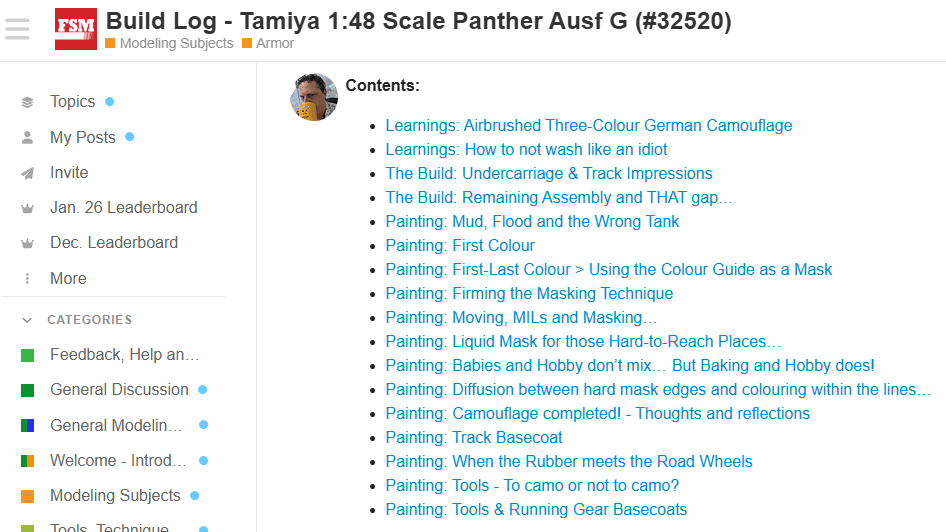
 I’ll have a go at pulling things together tonight and see what you think out of that…
 Let me know if you feel any more apt descriptions are required…

