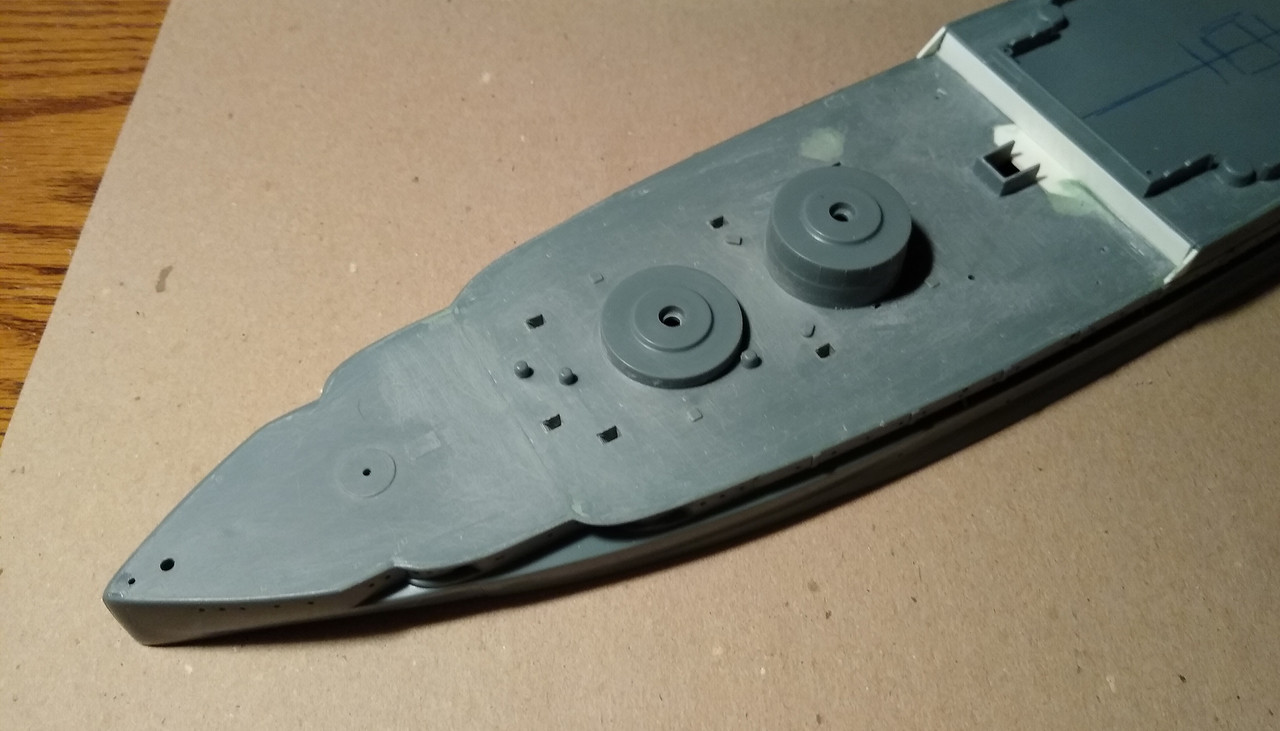
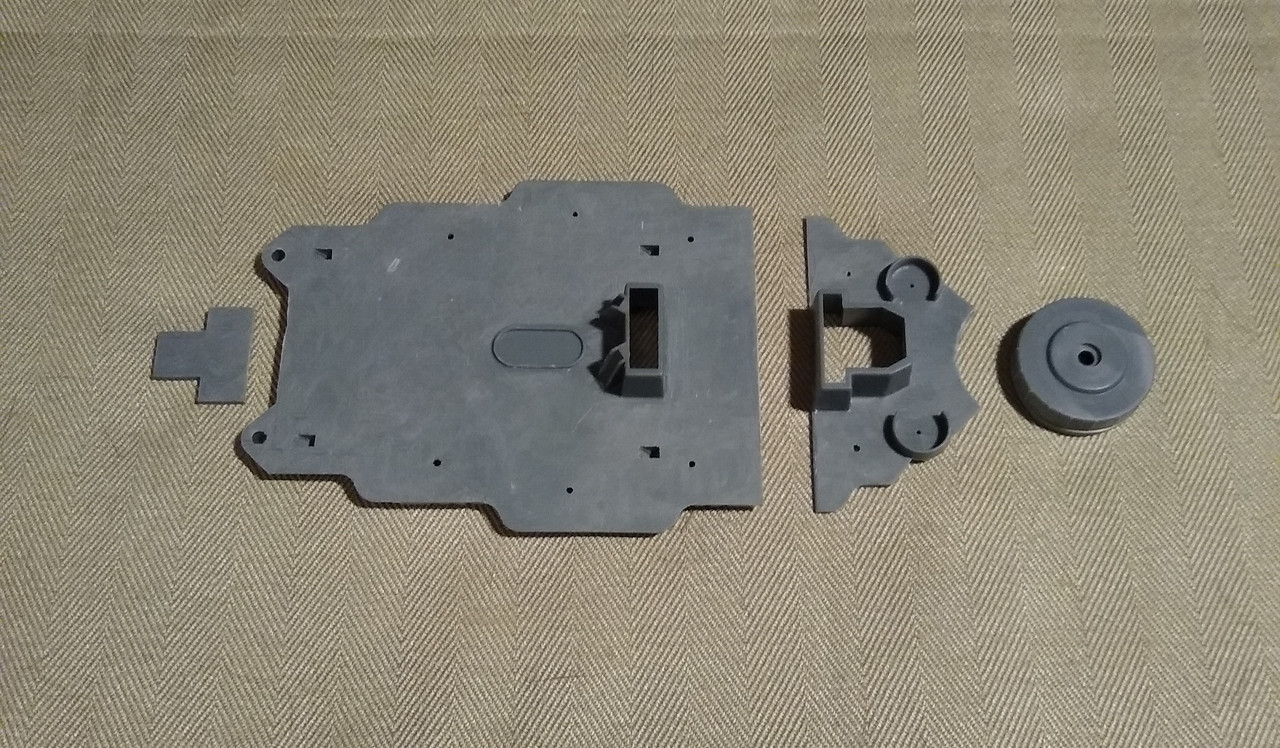
Several years back I picked up the Banner model of the USS Arizona in 1/350 scale. I had the intention of building it as a semi kit bash, which is out of the box, plus modifications / corrections as best as possible short of using photo etched parts. Well, I put something like ten hours into it, sanding and removing a bunch of incorrect things. Then I put it away for another day when life would be more conducive to such activities. So, lots of time went by.
Now in the waning months of 2019, I’ve pulled it out again and decided to build it as an “As Sunk”, circa 1960’s. Going through the kit, I was stunned at the lack of detail, especially in this scale. It actually has less detail and correctness than the Revell 1/426 (1/429) kit. I started to list the required corrections but quit shortly thereafter as the list was getting way too long.
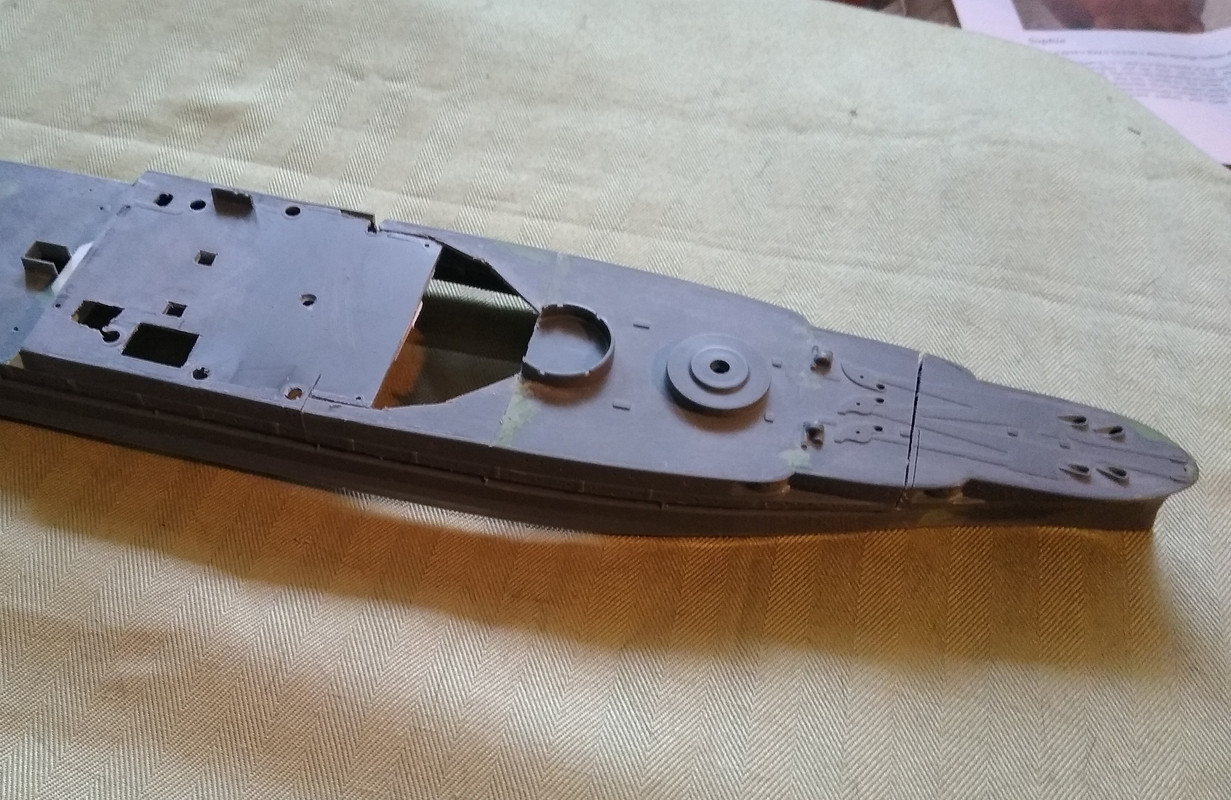
As the kit was already started I had to regroup and shift gears from the original plan to the as sunk version. So, I broke out the chainsaw . . .
As I said, I’m re-starting this kit so there are things to be un-done, in time. I will keep the upper hull assembly intact while I start cutting away the damage and salvage holes. Unfortunately, some things can’t be undone so I’ll have to either remake parts or come up with another solution. An example of this is the aft 1.1” tubs. If I were starting this new, I’d have cut the tubs out of the deck and filled the open holes with styrene. That way I could have simply added a pedestal and re-mounted them. But, alas, I cut the tubs off at the deck so now it’s either buy some or re-build them.
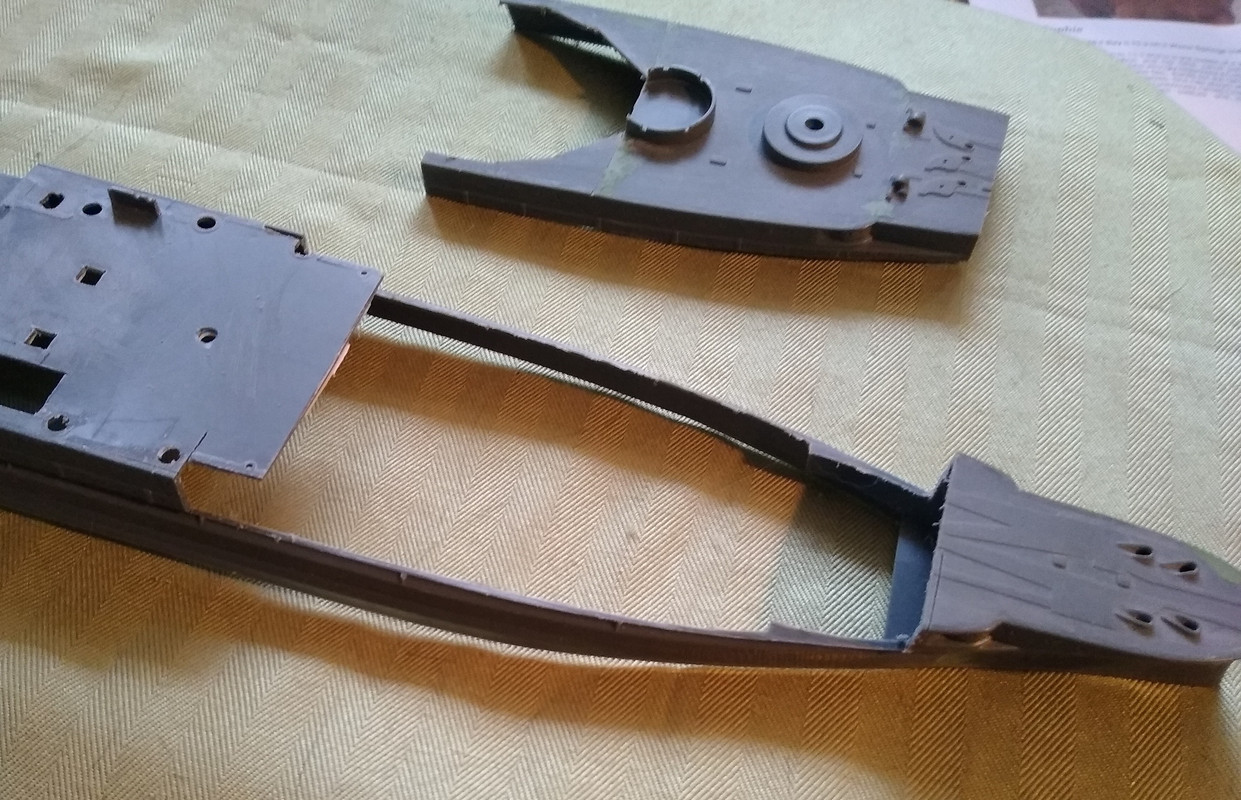
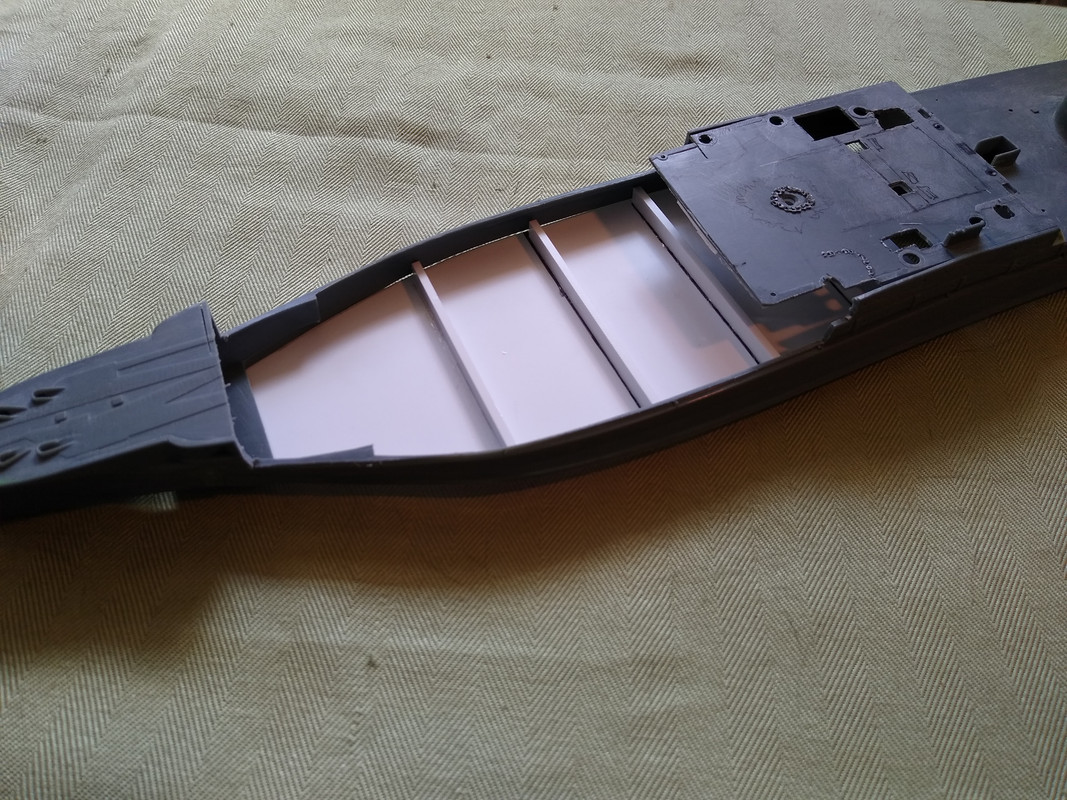
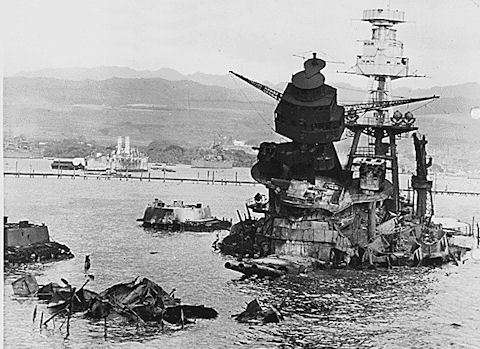
For those unfamiliar with ARIZONA, when the armor-piercing bomb detonated in the forward magazine group, the whole shebang went up in a chain-reaction (actually due to sympathetic detonation) cataclysmic explosion. This not only literally blew away hundreds of tons of ship, but expanded the forward hull considerably. Since I’m building without the lower hull, after removing the big chunk, I will have to make a frame to hold the hull expansion so I can build over it.
Basically like this. Then I can build up to get the collapsed fore deck to the right height and build up the debris slope between turret 1 and the remains of the bow. This frame is not glued in yet as I’m working on he salvage cuts in the galley area and have to add decks below those cuts.
I’ve been thinking about using that same kit as an above water version before the mast, superstructure and turret was removed using resin as the water.
It would be quite the challenge as the level of detail to make it look right would be daunting. There is also a shortage of good photos to go by cuz simply speaking, there ain’t no drawings of that. It would be a nearly 100% “on your own” kinda build. Good Luck though.
I’m going with the concept of “If Pearl Harbor were drained . . .”, and am not adding the memorial span, dock, or mooring quays. I did a model like this back in the day (1980’s) using the Revell kit and nothing but the ship’s drawings and picture post cards. Turned out pretty good, all in all. Even Robert Sumrall, formerly of the U.S. Naval Academy model shop though it looked decent.
Well, the next step is to finish removing all of the vents, salvage cuts and destroyed structure from midships and sorting out which level is which, adding lower decks as needed. The damage to the ship is compounded by the multi-level collapse between the stack and the bow, much of it dragged forward and down by the falling barbettes and turrets 1 and 2.
It is the bent and folded up remains of the bow structure. And it is not “supposed”, as I’ve been there, though a good bit of that debris had been cut away by the time I visited. You need to think of the bow of the ship like a blooming flower. As the explosion progressed (yes, multiple sympathetic detonations in a chain) through the hull, the hull contained it for only so long, expanding and ballooning. Then via the weakest path, and channelled by heavy armor belts and the forward collision bulkhead, it broke through along the upper sides and the deck area forward of the No. 1 turret. The turrets and barbettes were supported by the pressure and then as it subsided, they dropped into the chasm below, some 22 feet below normal firing position. Their fall dragged the surrounding decks down and forward, bringing about the collapse of the superstructure. (If you want more . . . you should buy my book! . . . or just keep following this thread.)
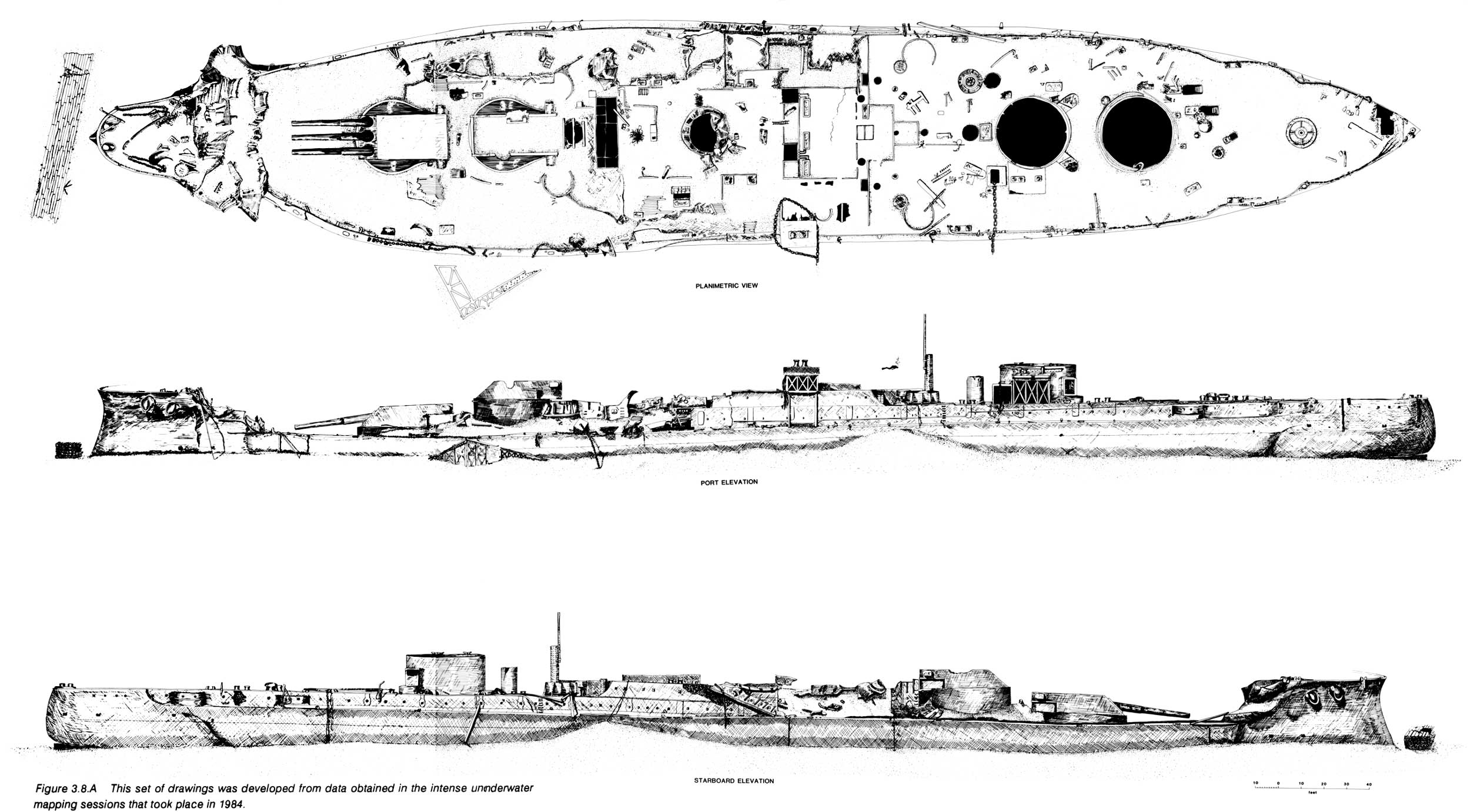
I’m very aware of those drawings, hell, I helped draw them. I was refering to drawings and photos of the ship post attack, pre salvage. There are not a lot of those.
There has probably been less than twenty photos of Arizona, post attack, pre salvage that have ever been publicly disseminated. Most of them are taken from some distance and can’t really be used for detail work. Pics of the starboard side are extremely limited; probably less than five and I can only readily recall two. When the Thirteenth Naval District (as I recall; Help Tracy, my memory is failing!) was dissolved, literally tons of records and photographs were . . . well, they kinda disappeared. Nobody has located all that stuff to my knowledge. Those records include much of the attack and post attack documentation, and a lot of info on what was going on aboard the ships at the time, including the work being done on Arizona. This is part of the reason why the famous ‘color change’ was not noted until the last say, ten years.