I suppose it’s all relative. Twenty photos of Arizona post attack, pre salvage is more than many of the other ships. Is the detail visible exact? No, but its enough to infer what should be where. It’s not meticulous like some damage charts now currently available. But it is amazing as to what is turning up over time on so many subjects. Hopefully the missing Arizona information will turn up as well.
Well, like building models of Arizona, one must really study the ship drawings and photos if you want to be accurate. It’s one of the things that amaze me when I see builders pay out a couple hundred for a big kit, then another couple hundred for wood decks, PE and “correct” detail pieces; but don’t even have the basic structure right. Finding models of Arizona that have the correct structure below the mainmast is rare. Finding Arizona models that are supposed to be ‘Dec. 7, 1941’ versions that even have the 1.1" director plats in place are even more rare.
Maybe I’m just too anal on this particular subject? Well, chalk it up to 50+ years of studying this ship, and that’s how I got the gig with the NPS and was able to dive on the wreck.
Very understandable. Some subjects, I am quite content to accept “as is”, and build them as you get from the box. Others for one reason or another, become a passion project of research, upgrades, and corrections, almost becoming an obsession to one degree or another.
Well, like when I found out that Bob Sumrall was the guy building the big ‘as sunk’ model that was going in the visitor center, I told Gary Cummins, then superintendent of the Arizona Memorial; “if we find a beer can on that wreck, we’d better note the brand, because Bob will put it in there. That’s the level of detail he works in”. Gary got a quick lesson in ‘detail’ from that statement.
There is a very good book written by one of the first salvage divers to enter the Arizona, “Descent Into Darkness” is the title I beleive. If you have not read it, you may want to look for it. He tells quite a tale.
Got it, read it. Don’t take it for gospel.
Actually it is a decent read, but not a lot of detail on the work. He mentions going inside Arizona to locate a dud bomb; even walks you through the interior . . . except, the dud was found in the West Virginia, Not Arizona. And he talks about a big hole (salvage cut) in the deck that isn’t on Arizona where he says it was. Like I said, it’s a good read, just don’t take it for gospel truth. I have no doubt that he did what he did, he just got some of the jobsites confused.
This is fascinating! I’m not a ship modeler, having way more aircraft models in the stash than I’ll ever be able to finish, plus a model railroad in the basement. But I follow this forum because I’m interested in them, and I learn ( At 74 learning new things is pretty cool). This is excellent information, and I’m looking forward to seeing your progress.
Tom
Its been a few years since I read it… the parts that made more impression on me were more to do with the bodies inside Arizona and their condition. Understandable on confusion of dives. Details can blend as the years march on.
It’s interesting; one of the first questions I’m commonly asked after people hear that I’ve dove on the USS Arizona is; “Did you see any remains down there?”. I explain that we don’t enter the wreck, as it’s no only a National Icon, but also a cemetary as such. A certain level of respect and decorum is required.
As for memories, oh yeah. Time does have a way of melding things together. I distinctly recall my dives, but had to rely on personal notes as to the routes taken and work accomplished. I would love to dive her again. there are several areas I’d really like to re-examine. But that is but a pipedream I’m sure.
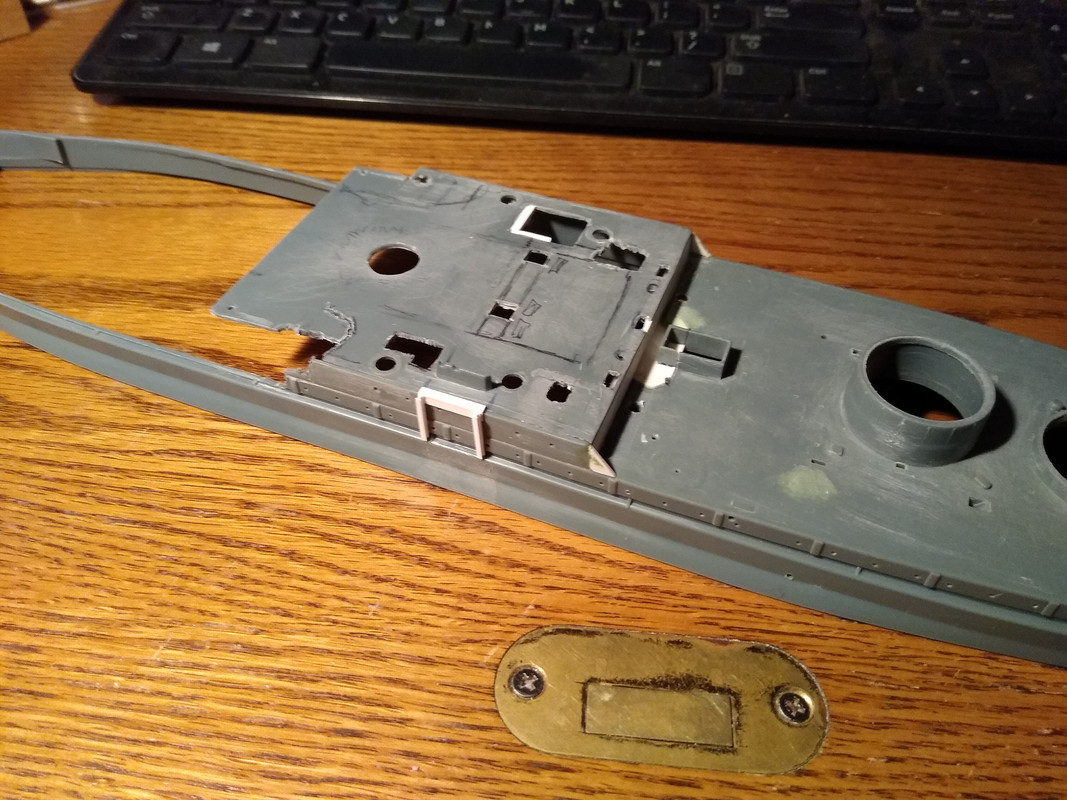
Continuing on with the deck holes and getting things shaped correctly. Some holes will need to have support added before they are cut. Also started opening up other hatches back aft too, and the support structure for the mooring pad on the port side. I’m going to use PVC pipe for the lower barbette sections. It took a bit of fitting to do the bottoms, using another PVC fitting.
One of the interesting thing about doing this model is that I’m finding all of the things I did incorrectly on the earlier 1/429 version. Of course back then, I didn’t have the resources I have now. Though, I’m still doing a bunch of this by the pictures I’ve collected.
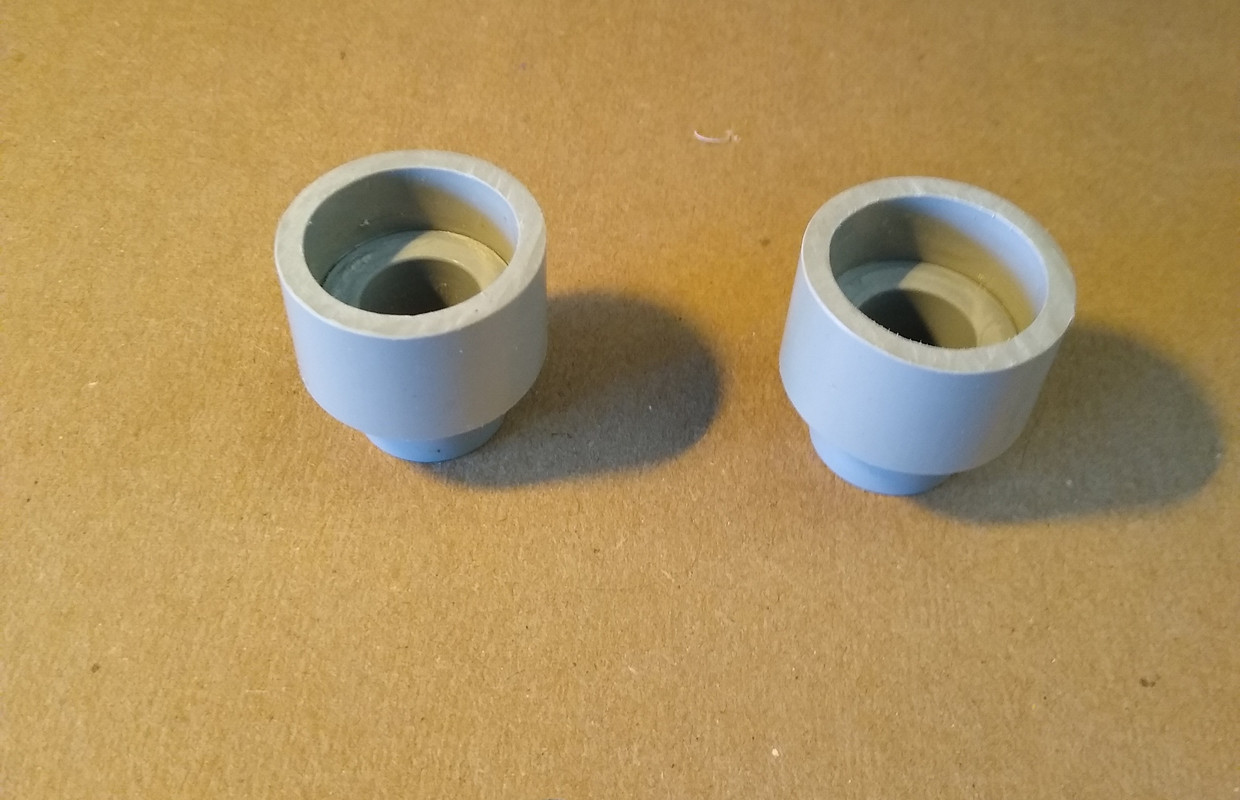
Then, because I don’t have the nine sets of bitts for the model, I tried to cast my own. It worked, but unfortunately they are just a bit too big, probably 1/200 instead of 1/350. So, we will try again, but smaller this time.
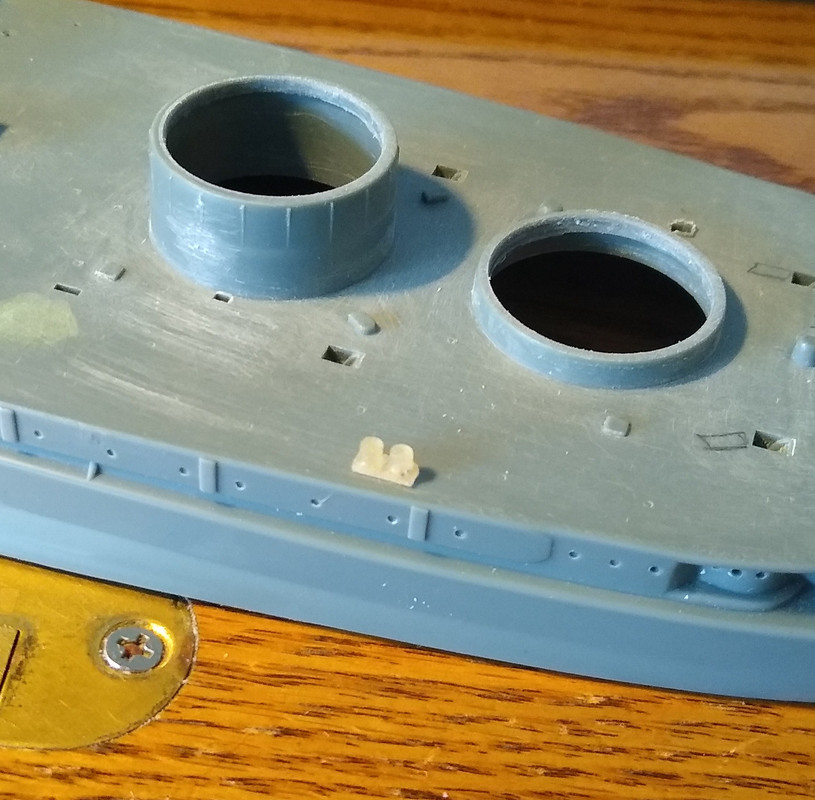
for my bitts, i used .01" rectangular plastic plates glued to the deck then pieces of plastic rod for the uprights. 1/429 scale.
Yes, and I glue the baseplate down, drill the holes through both plate and deck. Stick in the rod, glue.
Trim off and sand flat to final height, which is easy to gage with a piece of square stock flat between the bitts and sanding with a flat stick. Haven’t figured out how to taper them…
Sounds like the way to go, although trying to cast them was kinda fun. I like the glue the pad down and drill all the way through the deck. Less chance of accidently bumping and knocking off that little nub. As for a taper, there really should not be any taper, just a slight flare at to top, an I’ve seen a bunch of real ones that didn’t have the flare, just a straight barrel shape.
Now, as for the chocks . . .
Okay, so here’s the deal; I have this old Tamiya USS New Jersey, modern version, in 1/350. I had started to rebuild it as a hybrid battleship / helo/ vtol carrier. Recently I stole the chocks out of the kit for my Lindberg minesweeper, and now wished I hadn’t so I could steal them for the Arizona project.
So, if anyone has some chocks, in 1/350, that they can part with, and need anything out of a New Jersey kit, I am more than willing to do a trade.
I was going to use the 5”/38’s and build a “if Arizona had survived Pearl Harbor” version, but the modern NJ only has six and I would need eight. So that idea got deep-six’ed.
So, chocks for other parts . . .any takers?