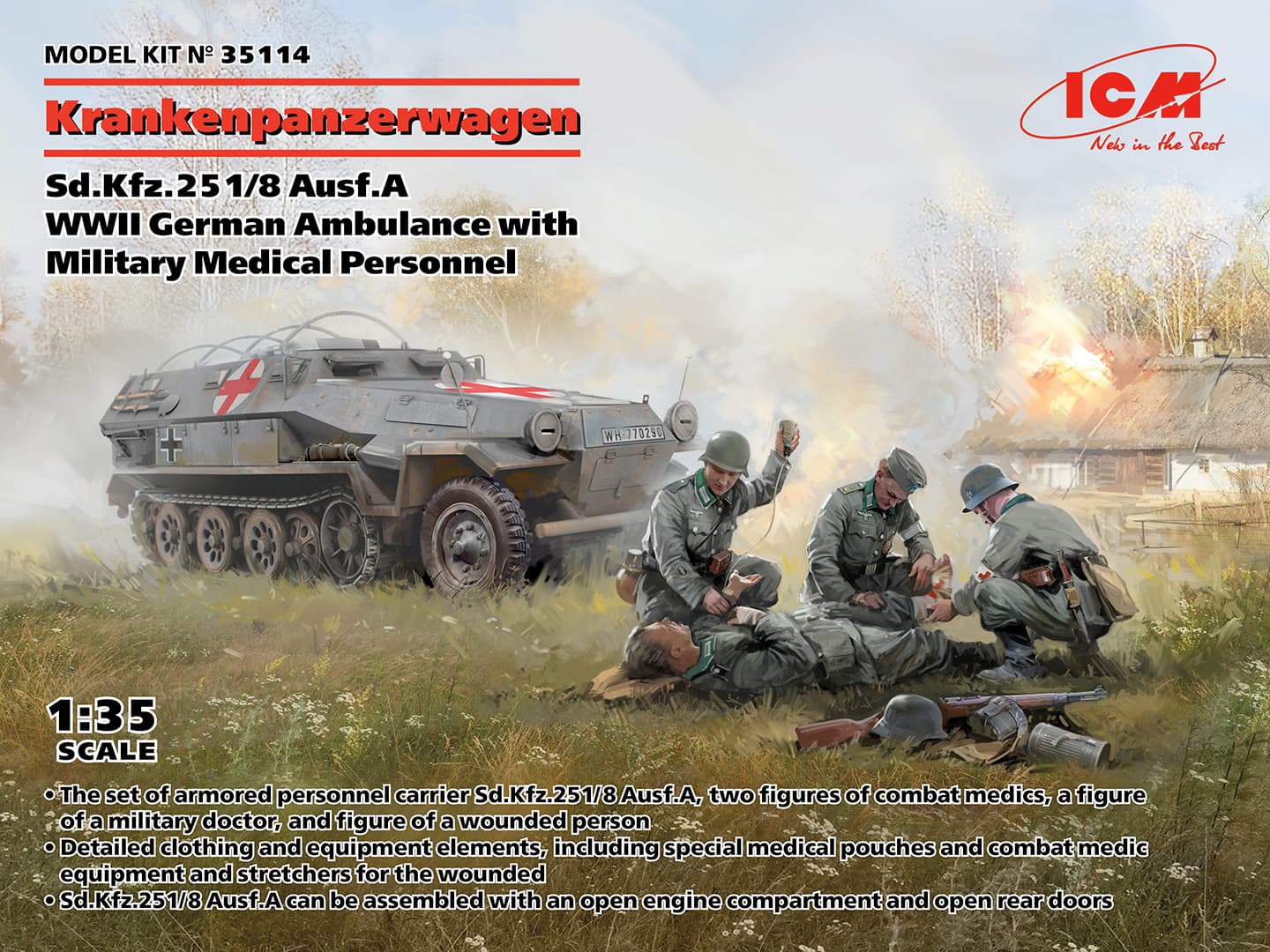
Hi all! Summer is approaching, which means I have more time for myself (yay!). I am going to start planning/building a diorama I wanted to build last year, using this kit.
The plan is to make a meadowy base, with grasses and maybe a few flowers, with the ambulance and surgery scene in the middle. I am very new to this, and first I will make sketches and then start with a base(?) before assembling the kits.
A very interesting project which I will follow with great interest.
Only one preemptive suggestion if I may: when you plan to apply the meadowy base don’t forget to “squish” either the grass or even the eventual flowers where both the medics as well as the wounded soldier have stepped their feet or boots. It makes it look more real and should be planned ahead with all the rest of your scene.
Break a leg and get it into motion. I will stand by for any progress in it.
Glorious modeling to you and remember, creativity is something you are born with.
I haven’t finished a true diorama myself yet, but I do have one bit of advice – get a copy of Shep Paine’s book “How to Build Dioramas.” While some of the products and specific methods are now a bit dated, his theories on composition, sizing, storytelling, etc. are critical. It’s considered the military diorama maker’s bible, and for good reason.
It seems quaint to use a paper book for research these days, but it’s really worth it. Plus, you can take with with you to study when you can’t be at your bench!
Toimi_Tom it seems we have read the same books. I learned a lot from Shepard Payne’s work as well as from other more current digital works as well.
Another useful source for this is Richard Windrow’s “Advanced Terrain Modelling” and his previous one simply called “Terrain Modelling” which complements Paine’s own work by filling the gaps of outdated tools and products, and which comes with fascinating color pictures.
You can find these even in Kindle format.
In any case it is always useful to have masters clarifying some crucial points in diorama building for you in order for us not to get embarrassed by gross mistakes.
My very best to you and again, thank you.
PS: I have come to the point in which I can come up with my own tricks and skills to finish a diorama, but to be able to do that one must also accept the arduous task of discovering new materials and products on a constant basis. Some very common and cheap, others alas, not so cheap nor so common to find.
A dio like that sure is an interesting idea. Just please be careful about the planning of it. Lots of quesions arrive right at the beginning - like what happend to the poor nazi? Shot or just twisted an ankle? If he was shot, then the are is still hot - how do we know that? Does it make sense to work on him in the mud (but there is at least a lot of space there) or maybe it would be better to have him in the vehicle first? More safe, protected from small arms, but more cramped.
Also imagine a unit pinned down, people laying low - you wouldn’t want to be driving a half track over that for fear of running somebody over, right?
Looking up some peroid German manual (Handbuch) could potentially get you an instant idea here. Or maybe you could find some period photo? That would be even better.
You could make is a simple thing, like a very shallow ditch and a tipped-over motorcycle. So, the injuries would warrant sending the medical track along, but not necessarily be a “combat” situation.
This has further advantages in that “gore” is very complicated to model, but a dude who simply took a tumble off his bike would be less about blood.
Also, this diorama just begs for the use of the “four sack” over-smocks German medics used early in the war. These were a notoriously sloppy fit, and the motion captured would lend “motion” to the scene.
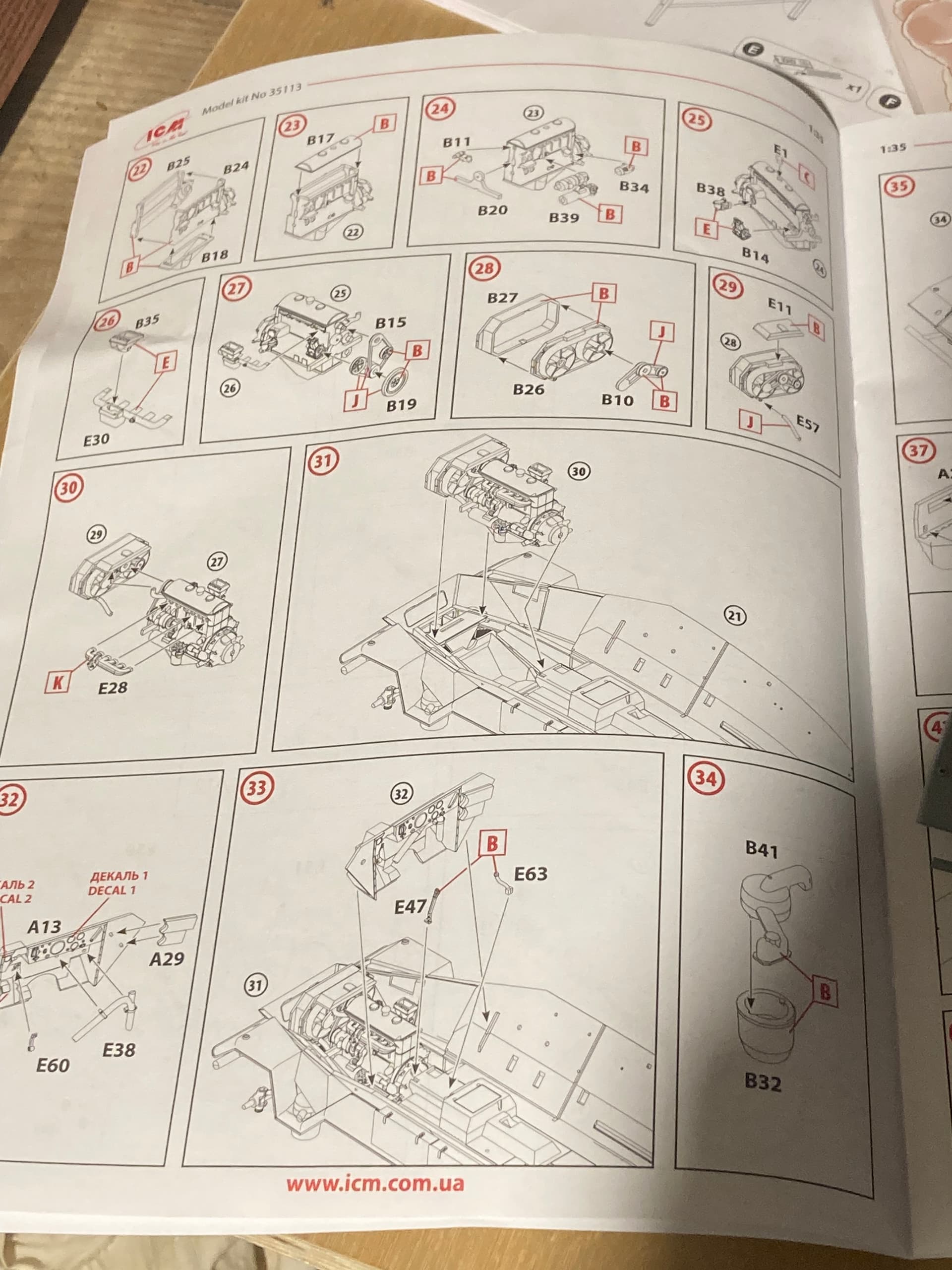
Yeah, you can probably skip the engine interior detail – but you may want to dry-fit the shell parts to get an idea of what will be visible in the finished model, AND that none of the visible parts rely on invisible ones for their placement, fit, or structure/support.
Would be a shame to get everything glued together only to discover a glaring empty hole! Not that I’ve ever done that…
In the end though, it’s totally up to you – there’s no wrong or right answer.
For me, it’s easy to get bogged down in details that won’t matter in the final result and I’m constantly fighting “scope creep.”