hobby boss USS arizona 1/350 BB-39 [1941]

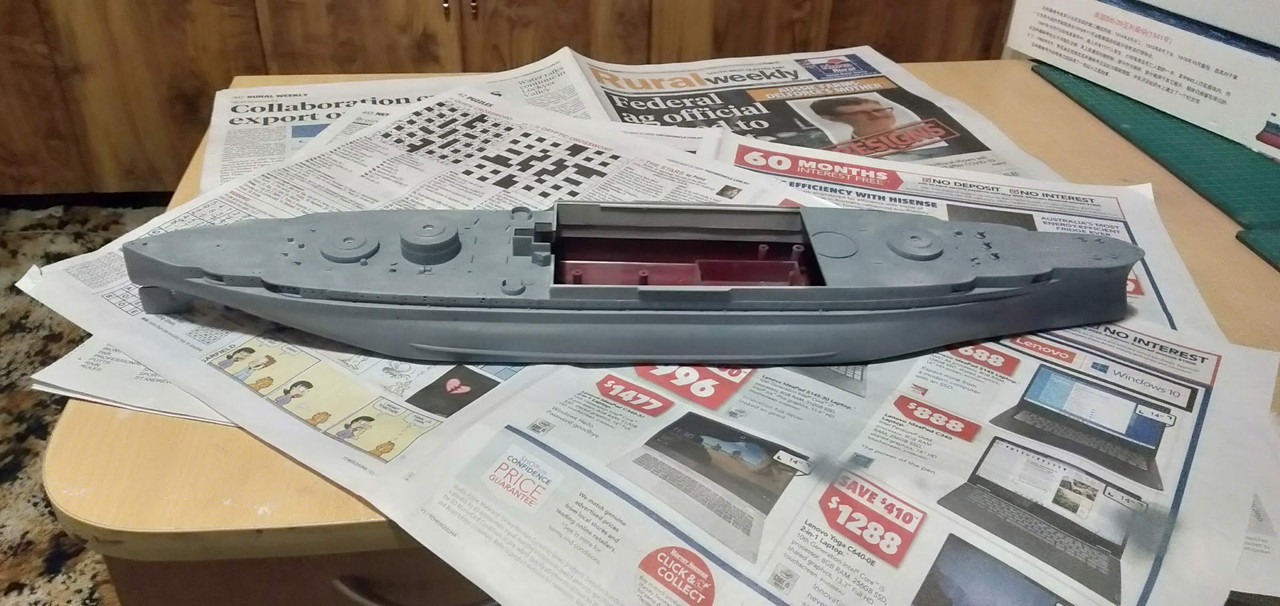
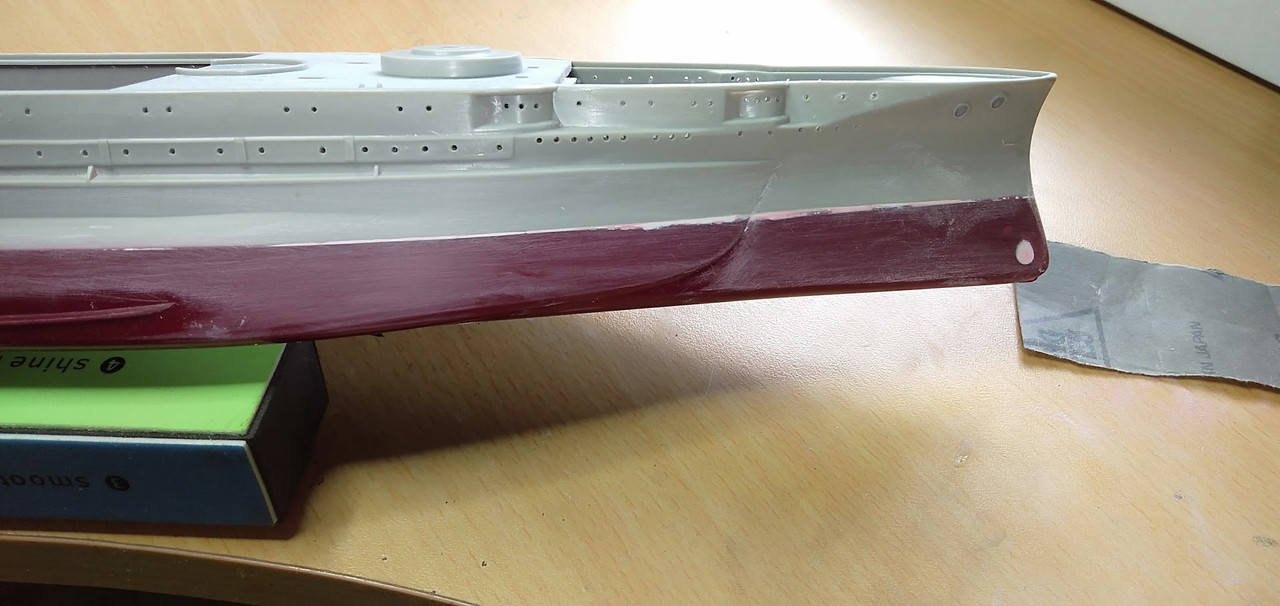
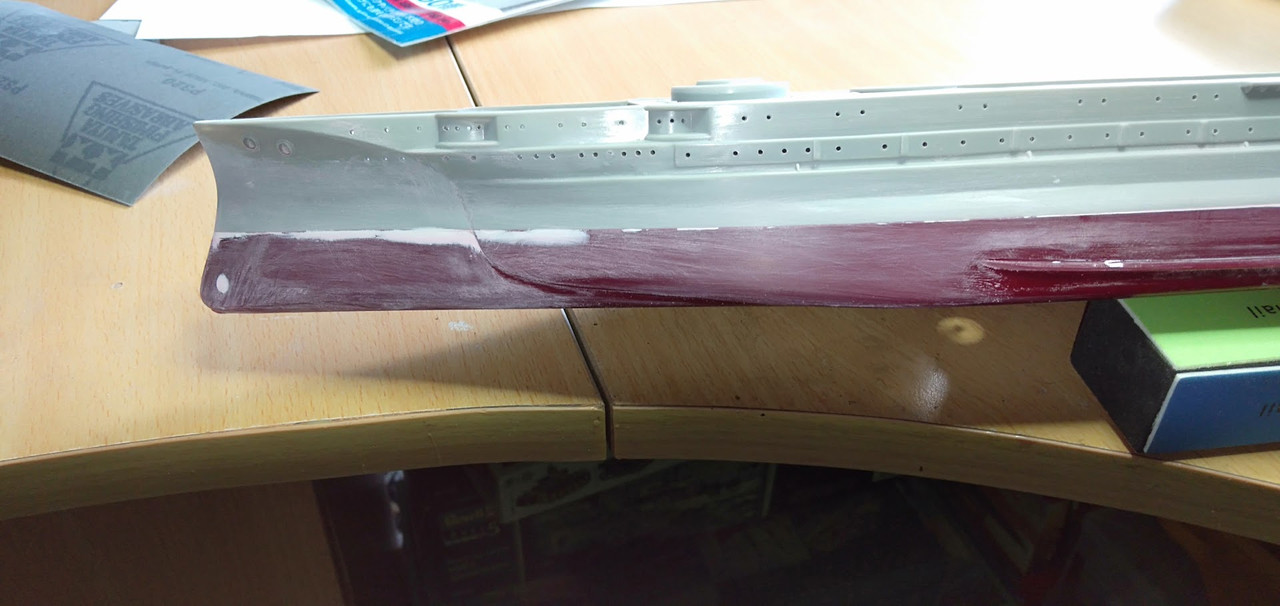
since this subject has come up , I have decided to glue the two halve’s together , thought it would be pretty simple , but they didn’t line too well . the top halve was a bit wider than the bottom , it has taken a bit of sanding to get it too primer stage , [ that’s next ] it will still need a fair bit of work after that .

I’d really like to know what that manual is, because it flies in the face of the technical documentation I’ve read.

gmorrison

I followed your logic until the end. When you divided pounds to get tons I think you dropped zeros. So instead of 16 tons of ammunition it should be 160 tons and for the crew instead of 5 tons, 50 tons. Also I think the average weight of a crew member should probably be 150 lbs not 100.

One last comment. In the case of my ship (at a much later date) the magazines were always kept full only being topped off for ammunition expended in practice shoots. Since we were using ammo left over from WWII we were encouraged to use as much as we wanted. In the case of the Atlanta I would expect it would return from a battle with a reserve still in the magazines and be immediately rearmed so it was ready for the next one.

You’re right.

Displacement tonnage is base on volume, not weight; adding and subtracting weight gets complicated.

In the case of an Atlanta, your expendables are all the bunker fuel, all the ammo (5", 40mm, 20mm, and torpedoes), potable water, food stuffs, and all the spares.

The CL(AA) were taught at Newport becasue, as over-sized destroyers, they had pretty dramatic stability equations. The CLs had more beam and did not produce the same sort of head-desking equations.

Yes of course, but at the waterline that ship is mostly pretty vertical. I realized after doing that quick math that it probably gets a 0.85 factor.

The 100 pounds/ sailor wasn’t the warm body; it’s the expendables and it’s a low estimate.

My Basic Naval Architecture class at CGA used the DD-692 (long hull). I still have the book and the graphs - for solving tons per inch immersion/stability problems…

Sorry to hijack, or pirate more appropriate, this thread.

Just finished a book about 19th Century merchant ship design. Unlike the Navy, they pay taxes and the tonnage is entirely a formula based on just a handful of overall dimensions.

The art was in building a beamy ship with convex bows that could still sail reasonably fast.

It was seriously thought that deeper ships sailed faster.

I’ve updated my CL-52 build (hull) over on my WIP thread.

As far as BB-39 is concerned, Steve5 you need to rent “Here Comes The Navy”.

Actually The gimick Trumpeter used for the Arizona’s barrels is suprisingly accurate it actually allows you to pose the barrels at different elevations seperately. Which means you can pose all guns elevated to firing position or you can pose two barrels in post firing(loading) position with the last gun in the turret firing.

Except that as I mentioned before, the Pennsylvania class ships did not do that. There was a big solid piece of steel that held them together at the same angle.

Thgere’s a photo of it in Stllwell, but I can’t find my copy right now.

I think the modeler has said that in those photos they are loose fitted, not glued in yet.

I dug out my references for BB-38 regarding the turrets.

EDIT: My remarkes below are for 3-gun turrets. Please disregard my reference to NY class and the 2-gun turrets on the NV class.

The same 14-inch/45 caliber guns were installed on New York-class, Nevada-class, and Pennsylvania-class battleships. On these BB’s the trunnion and all guns in a (3-gun turret) Turret were one unit ,meaning guns could not elevate separately.

New Mexico , Coloradoo , and Tennessee-class battleships featured the first “three-gun” turrets, meaning that each gun in each turret could be “individually sleeved” to elevate separately.

Per Gun Mount And Turret Catalog, Ordnance Pamphlet 1112
Link: https://maritime.org/doc/guncat/cat-0552.htm

For (not New York), Nevada and Pennsylvania classes the Trunnion Pressue when firing is listed for all guns in a (3-gun) turret meaning all guns are aligned together for firing and cannot elevate or depress individually.

For (edit: 16 BB’s) New Mexico, Colorado, and Tennessee, (and newer bb’s), Trunnion pressue when firing is listed per gun meaning each gun barrel can be elevated/fired, separately.

Norman Friedman did a book on US BB’s: “US Battleships: An illustrated Design History”.

In my notes I jotted down that at around page 110 he states that the 14 inch guns were mounted in the same cradle, (Trunnion and sleeve), and could not elevate separately.
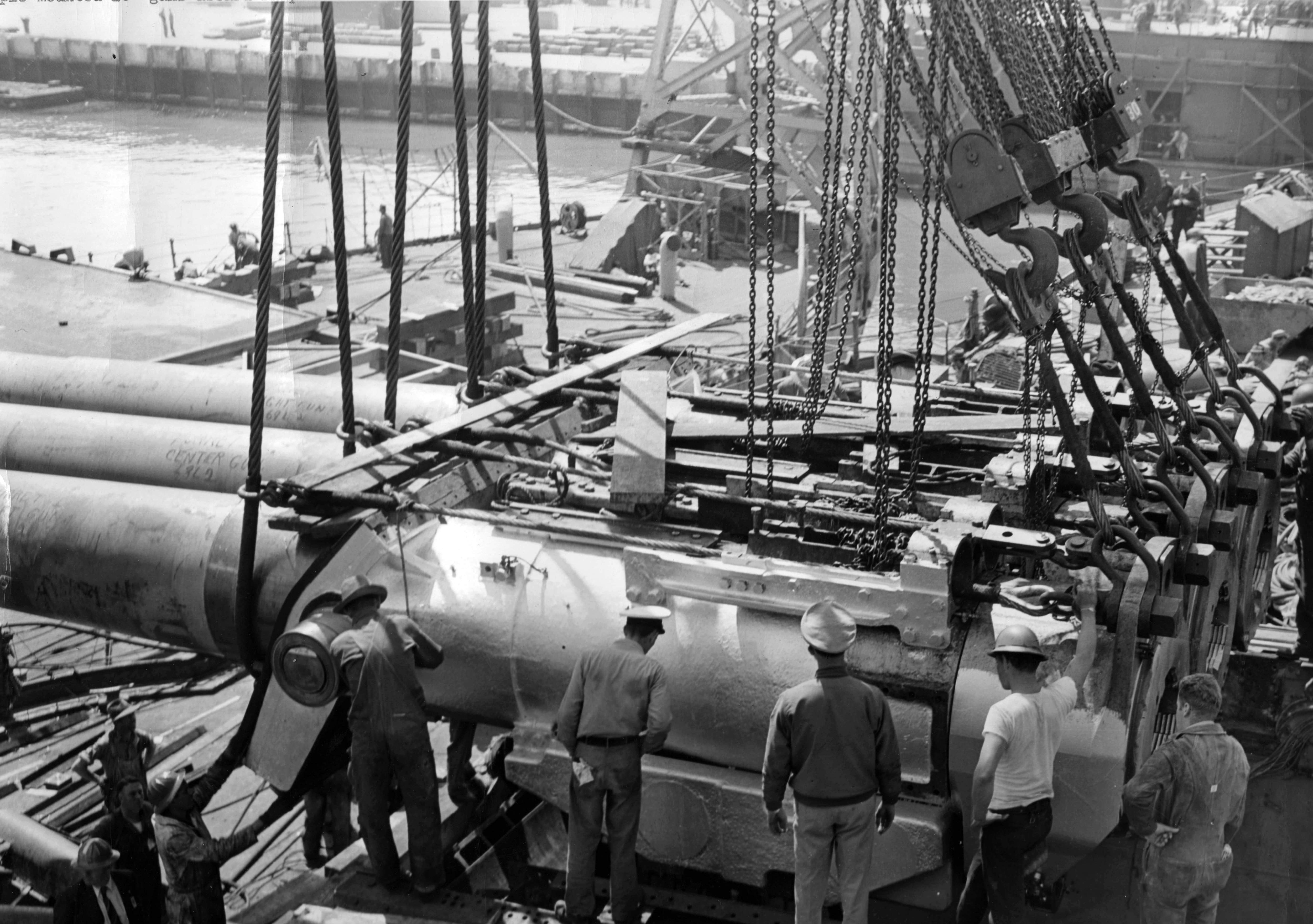
And … Model Monkey (Thanks Steve!), makes replacement turrets and guns. The guns are all on the same trunnion/sleeve.

Nino
Excellent work! Really enjoying your build.

Yes, concur with the above posts: barrels mounted together on a single sleeve.

Oddly, Nevada’s and Oklahoma’s twin-gun turrets’ guns could elevate independently. Like Arizona, their triple-gun turrets could not. The succeeding New Mexico class had 3-gun turrets with guns that could elevate independently.

Perhaps putting the guns together in a single sleeve saved space and weight.

Photos indicate Arizona’s turrets had a feature that was not present on elder sistership Pennsylvania’s turrets. Arizona’s turrets had oval access plates on the external ventilation trunks. Pennsylvania’s did not have the access plates. Nevada’s and Oklahoma’s triple-gun turrets did not have external vent trunks. It seems that as each successive ship was built, a new feature was introduced.

As Dr. McCoy says, “I know engineers, they love to change things.”

Nino, New York’s main guns can individually elevate. also the Colorado class had twin 16" gun turrets not triple 14".

http://www.navsource.org/archives/01/013401e.jpg

http://www.navsource.org/archives/01/013424.jpg

Texas

http://navsource.org/archives/01/035/013512t.jpg

http://navsource.org/archives/01/035/013534.jpg

ddp59 and Model Monkey,

Thank You. Those Pics and Post tell the story.

Separate elevation as per the photo’s.

I missed the fact of the 2-gun turrets being different. So NY and NV class could elevate those individually. So only Triple turrets on NV and PA class could not elevate seperately.

Also, I only meant the 14"/45 BB’s. All 16" guns could elevate individually.

Correction Much Appreciated!

Nino

P.S. I did indicate Colorado could elevate individial guns. My previous post: "For …, Colorado, …(and newer bb’s), Trunnion pressue when firing is listed per gun meaning each gun barrel can be elevated/fired, separately.

Steve5, How is this build going?

I haven’t seen an update for a long time. I really like the PE work your doing as it will really bring this ship to a new level.

I’m starting this kit for a American Ship GB. I also purchased the metal barrels along with both Eduard and Toms Model Works PE sets.

I am looking forward to your update. Is there anything since your last update I should know.

Ben

That was taken by Dr. Haakenson on board USS Solace. The original 8mm film was in color. The Navy department made a black and white copy for study and now only a few stills from the color film exist.

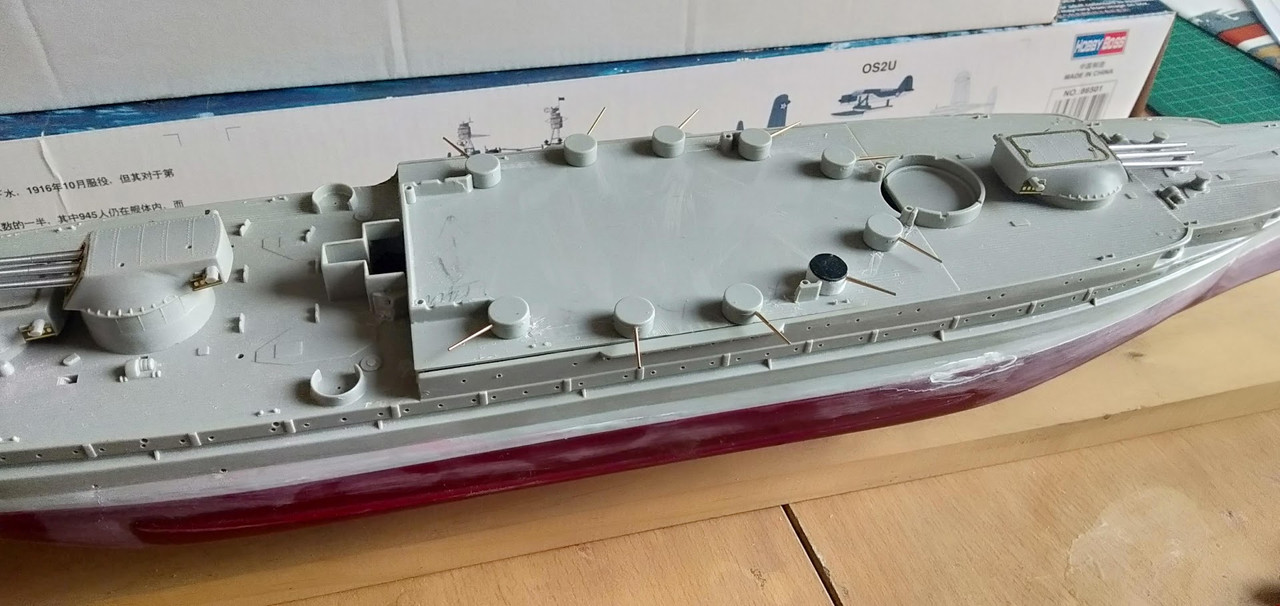
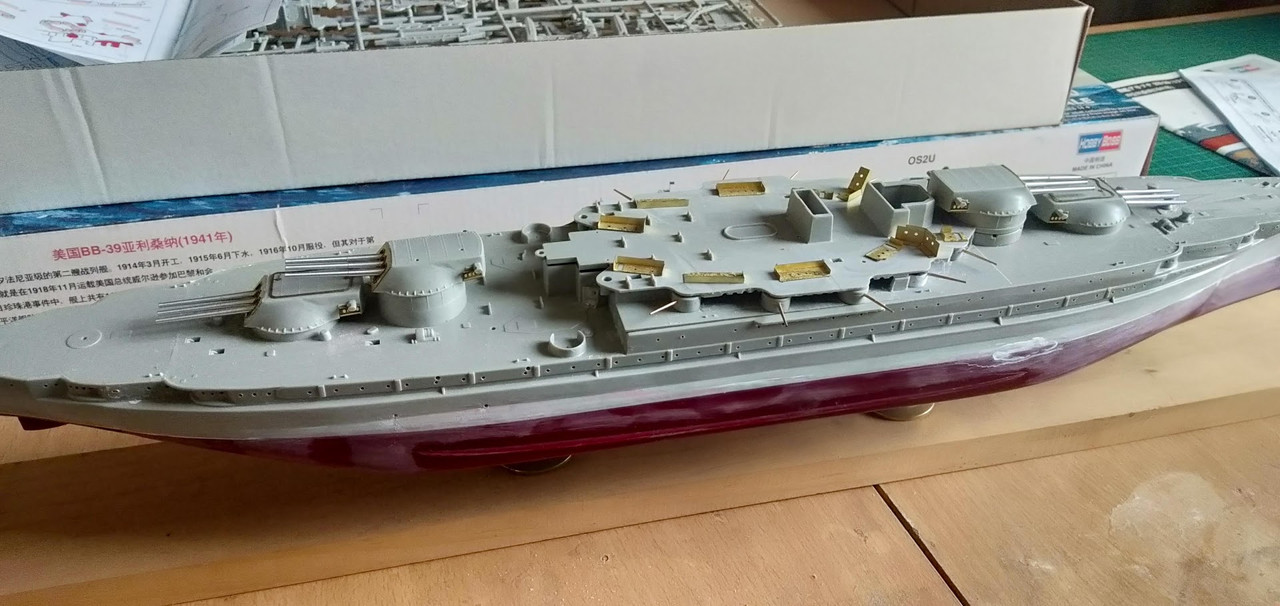
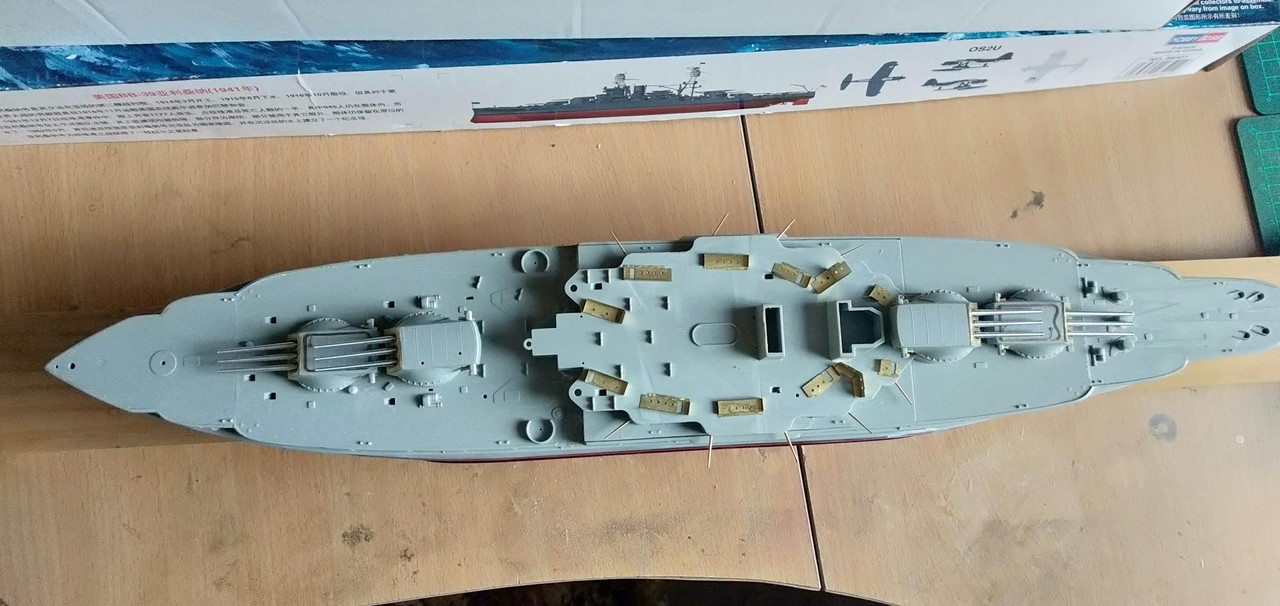
hi everybody , sorry I was gone for so long , but I just wasn’t enjoying modeling that much , and with not recieving emails and the covet19 , this got put on the shelf of doom . over the sulk’s now , I got it down from the shelf and found it had suffered a bit of a bump and one of the smaller turrets has disappeared, so I had to make another one and all the PE walls had fallen off . so of to brisbane tomorrow for supplies as we are able to do a bit of traveling now . will post some pic’s when able .

it seems I have accidentally muted myself from my own build , am I able to reverse this please .

finally able to get some primer on her

Actually, it had been around for quite awhile. US was a bit slow adapting it. There was a show, either PBS or History channel, of the best color movie shots from WW2.