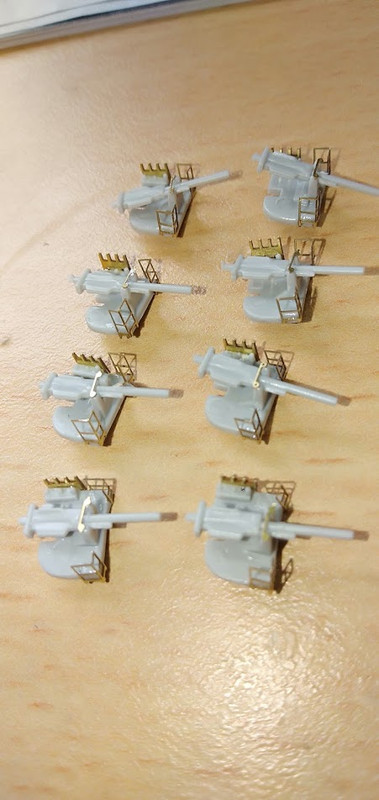
It’s probably the lens fisheye, but the barrels don’t look parallel to me. Try making a pattern that had three truly parallel lines to adjust if you need to.
The metal barrels look super. I do note that in your picture they are set to different elevations as if they could be elevated/depressed separately from adjacent barrels in the same turret. I think that may be wrong. I was of the opinion that all 3 barrels in a BB-38 and BB-39 turret were set to same elevation on all 3 barrels. Guess we need a Pennsylvania class expert to answer this one.
Something to consider before you use glue!
Nino
( My hand written notes that I have in my old Dragon Pennsylvania kit box says “…the guns could not elevate independently”. Not a reference I would bet the farm on but something that will need to be confirmed.)
thank’s gentlemen
gmorrison - will have another look at them . I was Pretty tired whenI finished .
nino - I haven’t set them in yet , was waiting till I fixed them on the deck before gluing them in position .
One point to consider. The upper/lower hull isn’t broken along Arizona’s actual waterline, so if you don’t paint or repaint following the break between pieces she’ll be 8-10 scale feet too high out of the water.
Yes, that’s a flaw on several Trumpeter kits.
On BB-39, the rifles were set in threes at the same elevation.
thanks tracy , as my maths isn’t that great how much higher should I put the water line ?
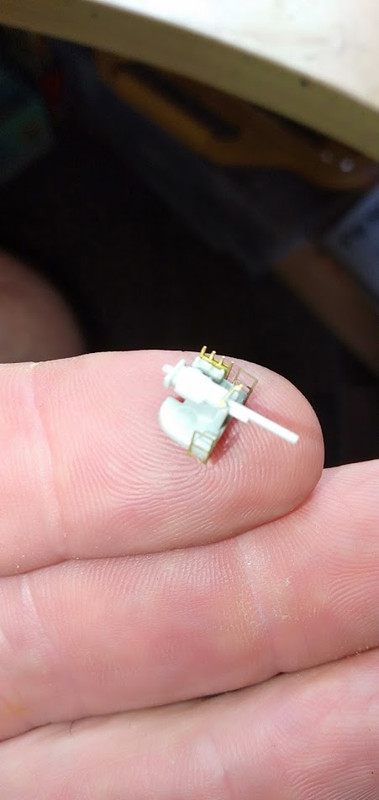
got some guns done ,
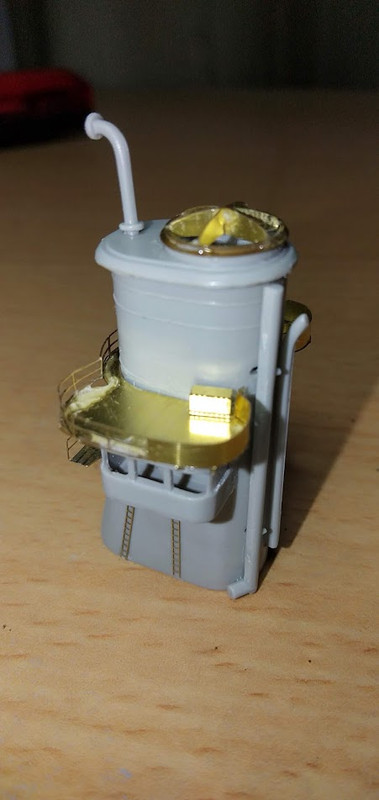
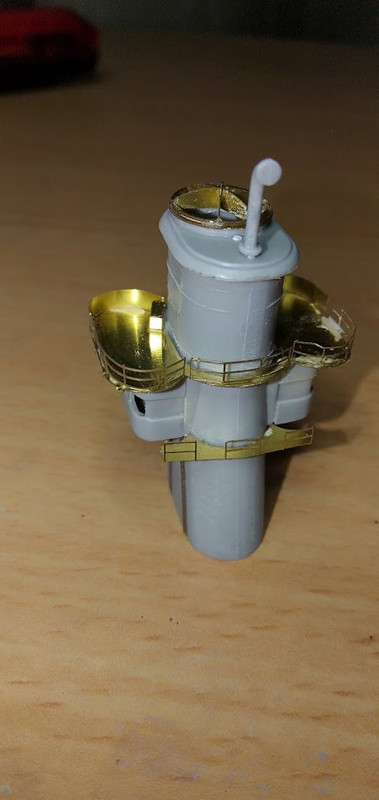
the funnel
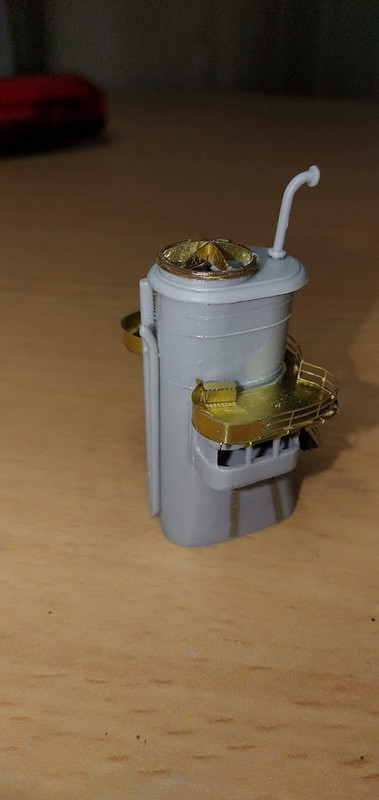
Steve,
Such fine detail at such a small scale, looking good there mate, can’t wait to see her finished.
Michael D.
thank’s michael , I am going to have to practise my bending of the PE . it isn’t great . I have heard about annealing the brass , might try it . after I watch some you tube .
Hey Steve, that funnel looks awesome. Nice work bending and fitting all that. It looks really good! Yeah, look into annealing because it might make your job easier. It helps to keep the metal from kinking, allowing a person to achieve smoother curves.
This does look very nice.
May I make a couple of suggestions?
Assuming these are not test fit pictures. One real challenge of building complex warships at smaller scales is painting them.
PE should be primed up front, either while still flat or at least before installing. ESP. With acrylic paint final colors.
This particular ship had vertical and horizontal surfaces painted two colors that are very close, but not identical, and in many cases the deck was a different linoleum color, or natural wood.
Later in the war the verticals of USN ships changed a lot, while the decks stayed mostly blue.
It is very hard to paint all of that once railings are installed.
However much you can pre-paint, the better.
10 feet at 1/350 scale is 1/35 of a foot. Which is about 1/3 of an inch.
Round down a little to match the range Tracy noted- call it 5/16”.
Now there’s a black stripe at the waterline, the boot topping.
Its wider than you think, maybe 4 feet or so. I’d be interested to hear the opinions on that. It’s a bit of a painting clenched as well, since it’s top and bottom edges are on level lines and it’s true dimension varies as the hull slope changes.
GM,
Is that really a “flaw”? I thought it was a “feature”!
The problem with most waterline hulls is that you that you can‘t show the model on anything other than a perfectly flat calm sea. Having some extra hull material would allow you to show the subject underway, with some wave and wake action sculpted into the display base‘s “sea”.
-Bill
thanks gmorrison for the help in the math’s , alway’s was only average at that . I wasn’t sure how I would go at the PE . seem to be bumbling through , will try the annealing process , and see what happen’s after that regarding painting and gluing . as I will have to heat up the PE first and I don’t think acrylic like’s naked flames , or laqueur , enamel for that fact . but I appreciate the input .
OK I don’t know if it’s a flaw or not, but if the lower hull is used, the anti fouling mask line isn’t always the joint.
Or worse, I’m building a Dragon CL and the waterline version is ok, but the separate lower hull half is a good 15’ too shallow. It’s going to require a insert.
Steve, you are one of the best & your photo etch is really super. That is a beautiful PE set & you work on it looks perfect. What kind of paint did you decide on.
Gene
thank’s gene mate , will be using MM & tamiya paint’s .
Somewhere in my pile of refernce material is a guidline to boot topping widths, which was by class/size of ships.
And, IIRC, the widths are a guideline, as it mentions that ships at sea benefit from wider boot topping than ships largely in harbors in peacetime.
I want to say that battleships were recommended a 6’ boot topping, as that allowed a lot of steaming (and using up expendibles) whitout showing any read bottom paint.
During wartime the boot topping width was doubled, as ships were more likely to expend ammo as well as ordinary expendibles; also to cruise to much more extended range.
The wider boot topping was also considered to help confuse exactly where i nthe water the ship was, which would confuse the range estimate.
The captain of the ship was the final arbiter of just where the boot topping started and stopped viz-a-viz load waterline. Some captains would go 1/3 and 2/3; some 1/2 & 1/2. Often, this was set out during dry docking when a ship would be at its lightest. Weld lines would be scribed on the hull to guide painting layout (the hull numbers & name were similarly scribed).
6’ at 1/350 is 0.205" (5.22mm)
Well you caught me. I think 6’ is the deal for a big BB but it seemed a little beyond- memory fails.
It’s hard to paint the stripe while afloat, and to be anywhere below light would be impossible.
Interesting though, and again not as big a deal on BB-39 as on my current builds the CL’s.
Ammunition was loaded in advance of a mission, not much before. An Atlanta Class CL had 16 5" guns and each had 200 rounds on board for a battle. That’s 3200 rounds at 100 pounds or so each, 320,000 pounds.
That equates to 16 tons, which on a 5,000 ton displacement ship is a 0.3% difference. Assuming 20 foot freeboard, thats about 9".
Add 100 pounds per sailor (1,000) another 5 tons or 2-3".
Then fuel.
You get 24" or so of difference.