I’m aware this colour was used in cockpits and wheel wells, but was it also used as a primer overall or on the outside wing surfaces?
regards,
Jack
I’m aware this colour was used in cockpits and wheel wells, but was it also used as a primer overall or on the outside wing surfaces?
regards,
Jack
It was used on the internal structural parts. The stringers, longerons, and ribs. The exterior was sheet aluminum or duraluminum. P-51 wings were covered in a aluminum lacquer.
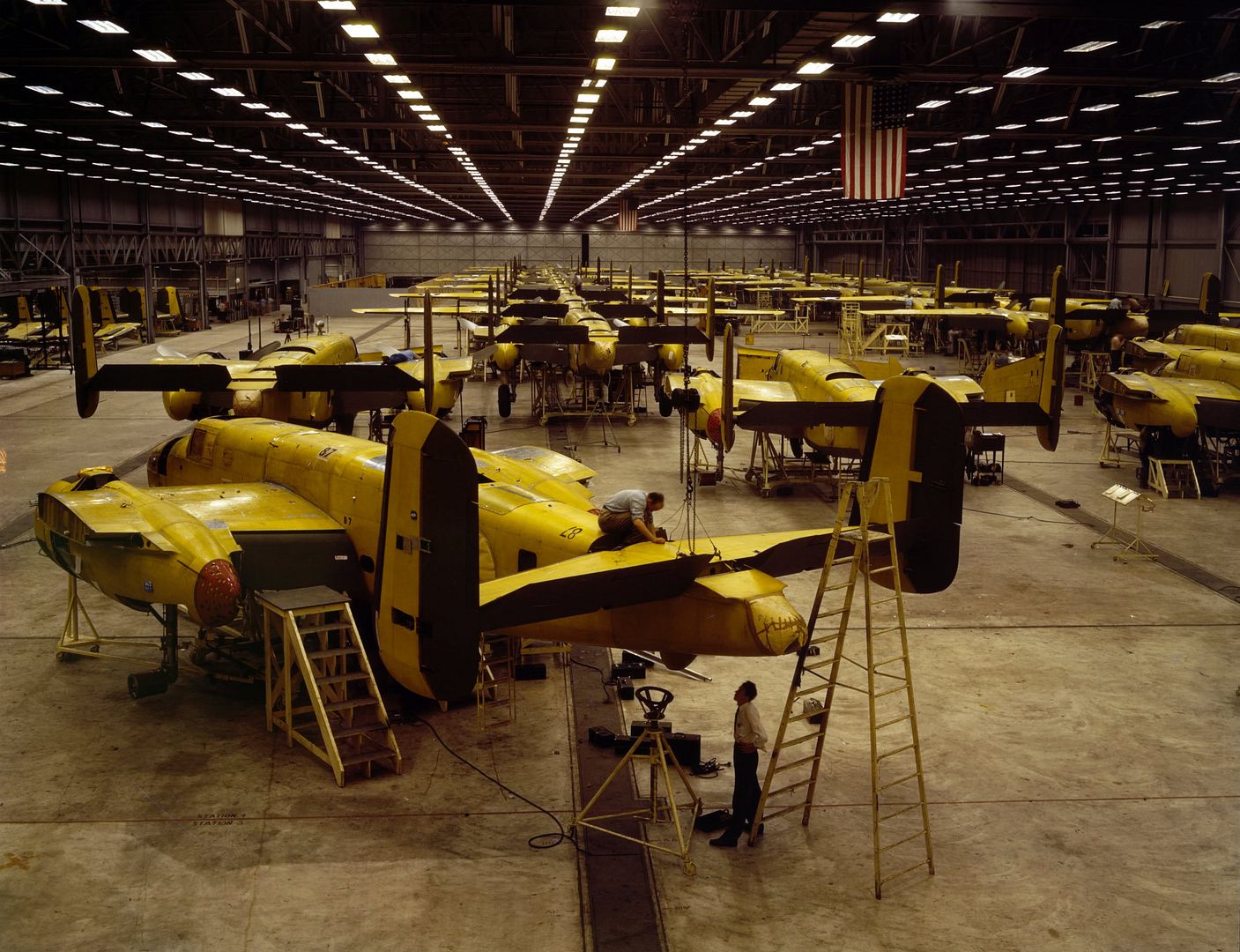
I’m pretty sure they did use it as a primer before putting OD and grey down. I’ve seen a picture of B-25’s on the assembly line like this. They stopped priming the outside when they went to bare aluminum.
Ok so that’s a no and a yes? lol
I did read somewhere an aircraft primed overall in zinc chromate would have added significant weight, plus the cost factor.
It’s just lately I’ve seen some Hellcat builds and the wing chipping has this colour and was wondering of it’s correctness.
regards,
Jack
Good article here, Jack:
http://www.ipmsstockholm.org/magazine/2004/01/stuff_eng_interior_colours_us.htm
Zinc chromate is a bright yellow pigment with corrosion inhibiting properties. Because the bright yellow colour was believed to cause eye strain it was forbidden to use yellow zinc chromate in crew areas. Instead a green version, made by adding carbon black pigment, was substituted in these areas.
Pure aluminium is resistant corrosion as a thin film of aluminium oxide forms on the surface protecting the metal from further oxidation. However aluminium is also rather soft and not that strong limiting its use in aircraft construction. Therefore alloys such as duralumin were developed. Alclad is a sheet of duralumin sandwiched between two very thin sheets of aluminium which gives it corrosion resistance. It goes without saying that it would not normally require corrosion inhibiting primers.
Primers, both pigmented and unpigmented, may be required for other purposes. Unpigmented primers (clear lacquers) are usually used to obtain better adhesion for the first coat of paint. Mr Hobby’s Mr. Metal Primer is an example of one such clear lacquer primer. There are also filler primers, sometimes called levelling primers or sanding primers, which are used to produce a very smooth and even surface for paint, filling in small scratches and imperfections. They usually require sanding and are often a yellow or red colour rather than the usual grey.

In the case of the P-51 Mustang the fuselage was given a light coat of primer.


The first 40% of the wing chord was sprayed with one coat of zinc chromate primer followed by enough coats of Acme Gray Surfacer No. 53N5 to cover all irregularities. Skin butt joints were then filled with Acme Red Vellunite glazing putty N 58485. The entire area was then sanded and sprayed with one coat of camouflage enamel. When camouflage was deleted, the forward portion of the wing (sometimes the entire wing) was sprayed aluminium. The lower photograph shows how the interior of the wing was or was not finished.
On , NAA issued a factory order regarding the deletion of camouflage paint from future fighter and bomber aircraft production. It stated: “At the earliest date, without delaying production, camouflage paint will be deleted from all spares delivered concurrently with airplanes without camouflage. Exterior surfaces such as fabric, plywood, magnesium, and dural will require protective primers of aluminiumized coloring. Alclad or stainless steel will require no covering. Antiglare paint will be on top of the fuselage covering forward vision areas to aid the pilot. The propellers will remain black with yellow tips.”
“The wing leading edge of the Mustang will be smoothed and surfaced as outlined in the P-51B and P51C Series Repair Manual Repoert no NA-5741, with the exception of that the camouflage coats will be deleted and aluminiumized lacquer will be applied over the surfaces. The deletion of the camouflage will eliminate approximately 42 pounds of finish from the B-25 Series Airplanes and 16 pounds of finish from the P-51 Series Airplanes. It is anticipated that the removal of the camouflage will also result in materially increased speed.”
Camouflage at the factory was removed with a type of thinner that did not attack the gray airfoil smoother. However, thinners available in the field would damage and remove this important coating. Rivet heads, rough edges etc would be exposed and cause extra drag. To prevent this NNA recommended that USAAF bases use the following procedure:
“In place of removing the camouflage from the airfoil smoother, apply addional paint to the area, which extends from the wing leading edge to approximately 40 percent wing chord. Use a mixture containing 8 ounces of aluminium paste to each unthinned gallon of clear lacquer (Spec. AN-TT-L-51) or clear varnish (Spec. AN-TT-V-118). This will allow the surface to assume the necessary appearance of unpainted aluminium or stainless steel. Any specified thinner may be used for the removal of camouflage from all other surfaces of the aircraft.”
And then ground crews quickly read the order and then cheerfully headed to the line shack’s paint-locker and pulled out the rags and the five-gallon cans to be filled with 100-Octane AvGas…
I would not go with that as a reference. Aside from all the information posted here already, look for period color photos. Yes US aircraft were primed in the factory before camoflage painting, but most photos will show that where the topside paint is worn away, the primer beneath usually is as well, exposing the metal beneath.
This is probably something like the extensive tank chipping that is seen so prevelent on armor builds currently, but rarely seen in reality.
Here’s a couple shots from “War In The Pacific” (full of excellent color photos!)
First is the Corsair…looks like a more green chromate on the wings.

…and here’s a Hellcat…looks like yellow zinc to me! (could be smoke and mirrors though[~])

I agree. And while we are on the subject, the term of “paint-chipping” to me is a very poor description of paint that is actually being “scuffed” or “abraided” down by constant foot traffic or some other abrassive force (similar to what sand-paper would do)…the paint is not actually peeling or being “chipped” off…
…unless it’s Japanese!
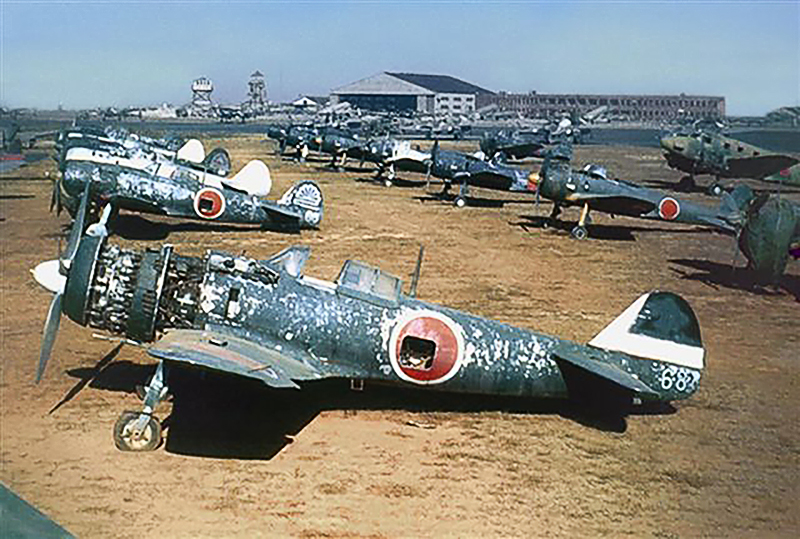
Well on the B-25 I would say yes
Good point—and GREAT pic! The Japanese paint did tend to flake off during flight from the flexing of the airframe and from engine vibrations…
Or a P-61…
Northrop had big QC issues with the Gloss Black paint they used… It wasn’t unusual to see Widows with 40-50% of the black paint chipped-off…
I think a major portion of it was due to paint being applied un-primed, hastily-cleaned surfaces, Manny…
Good point. Paint does chip off as well, but that is mostly due to impacts with material in the air (or on the ground… as in “Oops, sorry chief”). I’m an annual member of the Tri-State Warbird Museum, and the restored WWII planes there are all fairly regularly flown. The SNJ recently hit something that left a fist-size dent in the leading edge of the port wing and chipped the paint clean off the spot and maybe an average of an inch or so around it, clear down to bare metal. Mostly, though, paint disappears on aircraft through wear, as you describe.
I know I’m an FNG around here, but, while we’re on the subject - though the model-building skill I see evidenced on the 'net is absolutely spectacular, on this site and elsewhere - this whole paint-chipping thing seems to me to be a bit overdone. OK, a Marine or USAAC taking off from a coral atoll every day during sustained combat operations might get chipped to hell, and to tell that story a modeller should chip the plane up real good, but on most planes just a little actual chipping does it (leading edges of props, wings, tail, and access panels, etc. …). Paint wear is a different matter.
This is even more true of Navy planes. While you probably can’t make a carrier plane dirty enough (or, especially in WWII, faded enough or dinged-up enough), there would be very little chipping on the exterior surfaces. Bare metal and salt spray don’t get along well at all, and the squadron/group/ship corrosion control officers are diligent guys. The Navy habitually paints everything, that can be painted under prevailing circumstances*,* all the time. While there is always foot/shoulder/leg/hand worn bare metal in the cockpit and equipment bays, there is never much to be seen on the exteriors of Navy planes, even under combat conditions. I have seen a (very) few pictures of chipped up WWII US carrier planes, and those were of planes that had been in daily combat for extended periods, and even they were not chipped that much, generally. My own experience in the Gulf of Tonkin runs even with what I am saying.
Back on topic, zinc-chromate can be found on all other-wise unpainted interior aircraft surfaces. I have read that, in WWII, it was not uncommon to find three different shades of the stuff (one yellow, two green) inside different parts of of the same plane coming out of the factory. But I don’t believe otherwise painted surfaces generally are primed with it. EDIT: But, looking at some of the above photos, especially those B-25s, I could be wrong …
Don’t go into what really happens to aircraft due to weather and operational conditions here, Ordie…
We’re talikng about authenticity and realism here… [;)]
Oops … sorry, chief. [8-|]
Something else to consider…
Different components that were to go into different aircraft were produced by different factories. It is very common to have more than one or two different shades of green zinc chromate on those parts in the same airplane. Warbird Digest #13, from 2007, showed this perfectly…someone was restoring a T-6 Texan to as close to factory as possible, and in the process, they came across a lot of NOS original parts. These parts, such as map cases, etc etc, were all different shades.
Also, make sure that you research the particular aircraft you are building. The P-51, for example, had wooden floorboards, and these were not primed with zinc chromate.
…yes…
Thanks everyone for the responses. I’ve been finding evidence, photo wise, on the exterior use what appears to be zinc chromate. These are from a Corsair:


Linked from a photo set here: http://zone-five.net/showthread.php?t=15310
Here are the two built models of Hellcats I saw (along with links to their respective threads) that made me curious as to the use of zinc chromate on exteriors. They are stunning works. Some might consider the second one to be overly realistic, but is undoubtedly a virtual feast for the eyes (and that much more amazing at 1/72 scale!).

http://www.britmodeller.com/forums/index.php?showtopic=234919249
!(http://2.bp.blogspot.com/-VW4qgRzb4N8/T6gQzE34h2I/AAAAAAAAAuY/WSmDqeHcstA/s1600/Diego Quijano Hellcat 018.jpg)
http://www.britmodeller.com/forums/index.php?showtopic=234918173
regards,
Jack