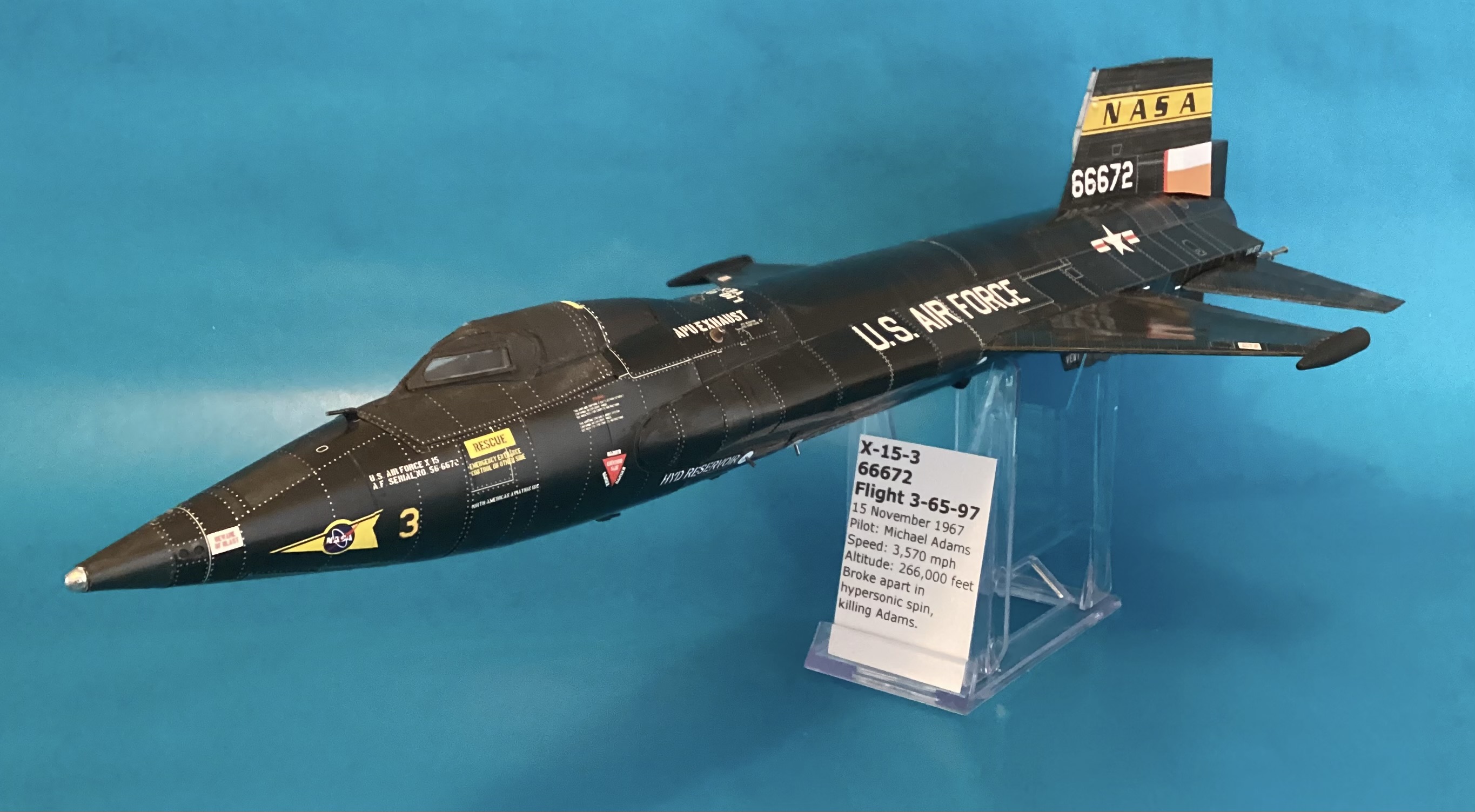
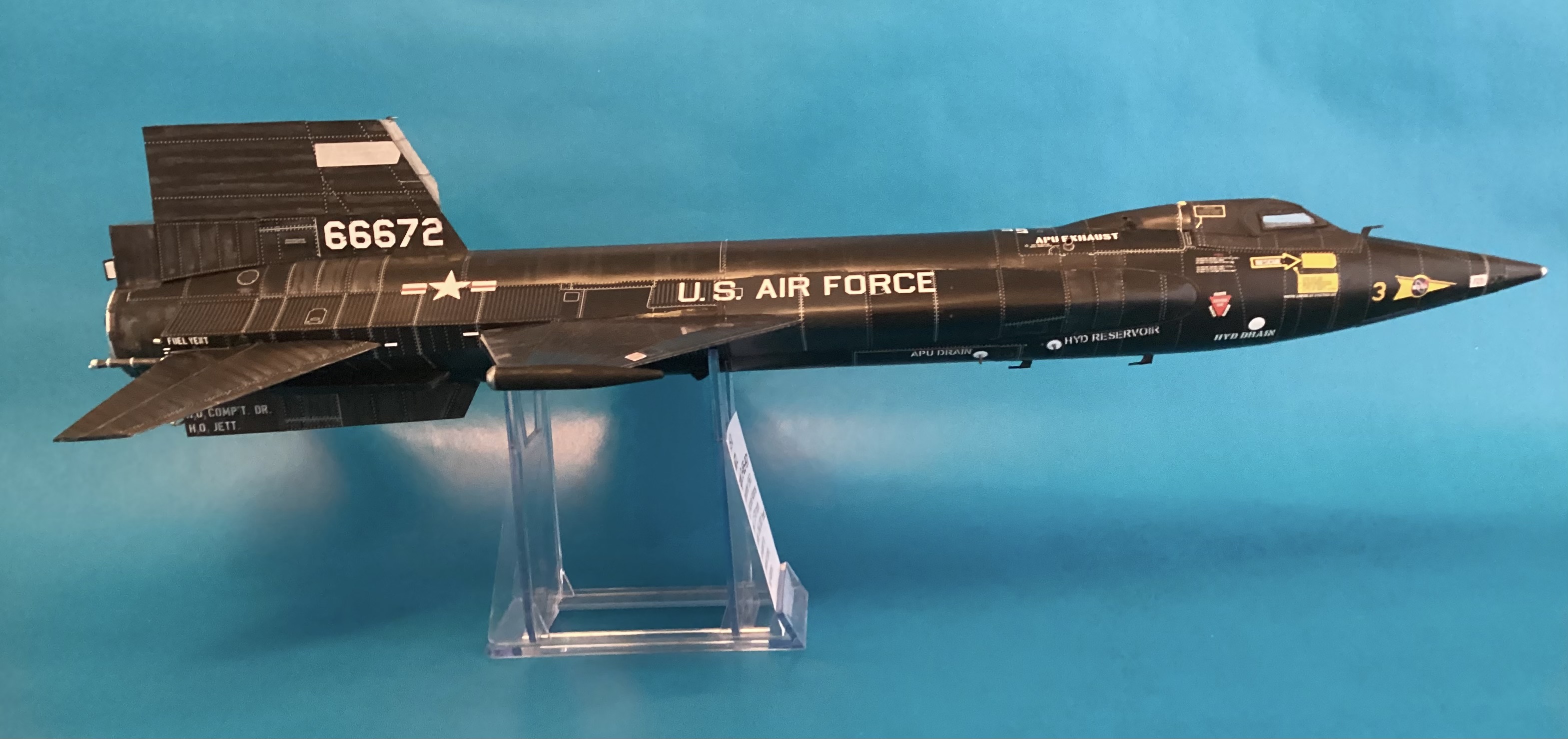
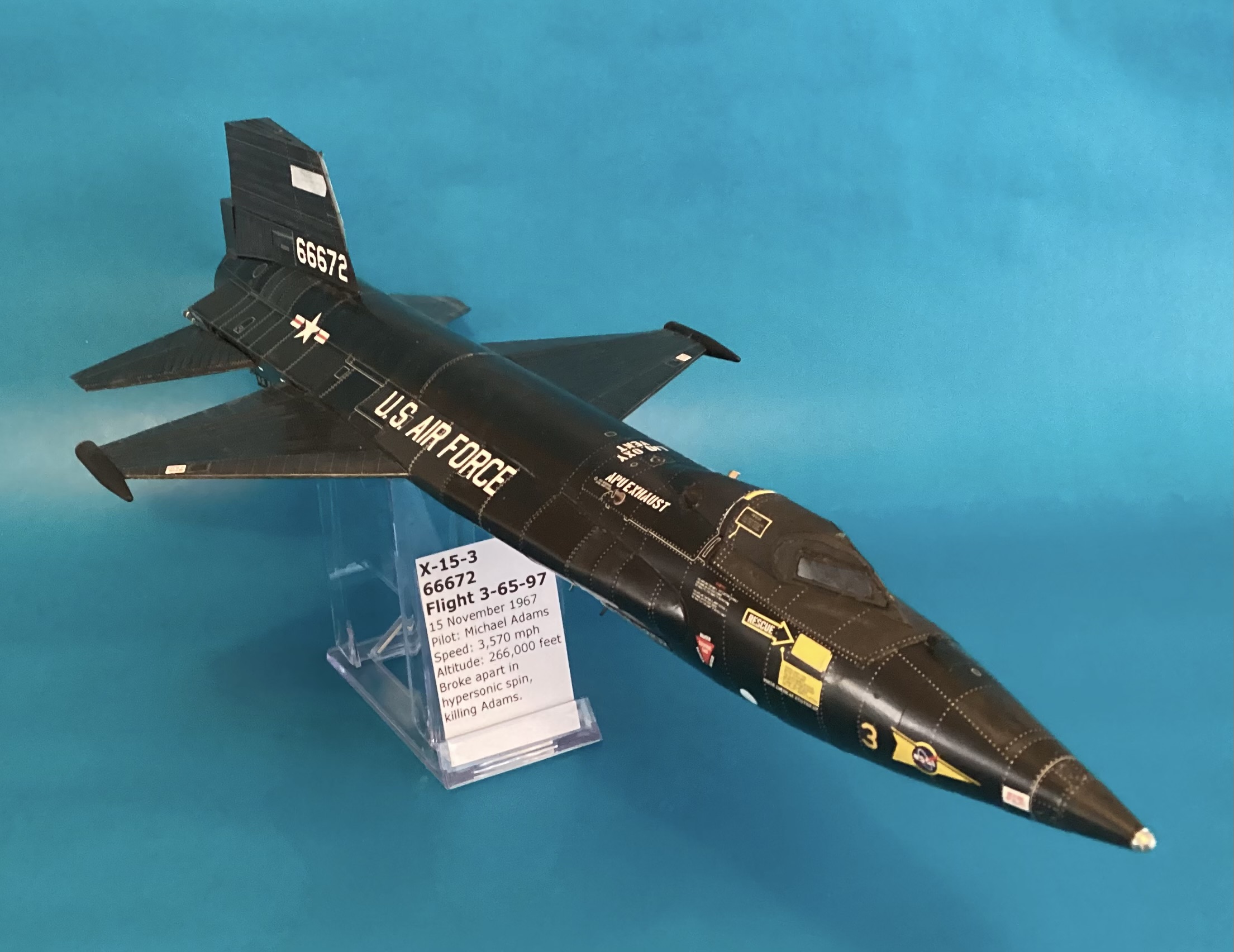
This is my 1/32nd-scale cardmodel build of X-15-3, 66672, as it looked on Flight 3-65-97. On 15 November 1967, pilot Michael J. Adams became the first and only fatality of the X-15 program when 66672 entered a hypersonic spin, began a series of uncontrollable oscillations and eventually broke apart. The causes of the accident were complex and technical; NASA was still publishing analyses of the crash as recently as 2014, 47 years after the crash.
The model is built from 170gsm glossy cardstock and it is a heavily modified and back-dated build (with digital repainting of the markings) of an X-15A-2 cardmodel. There was quite a bit of scratchbuilding involved, and I had to modify kit parts to make them more accurate.
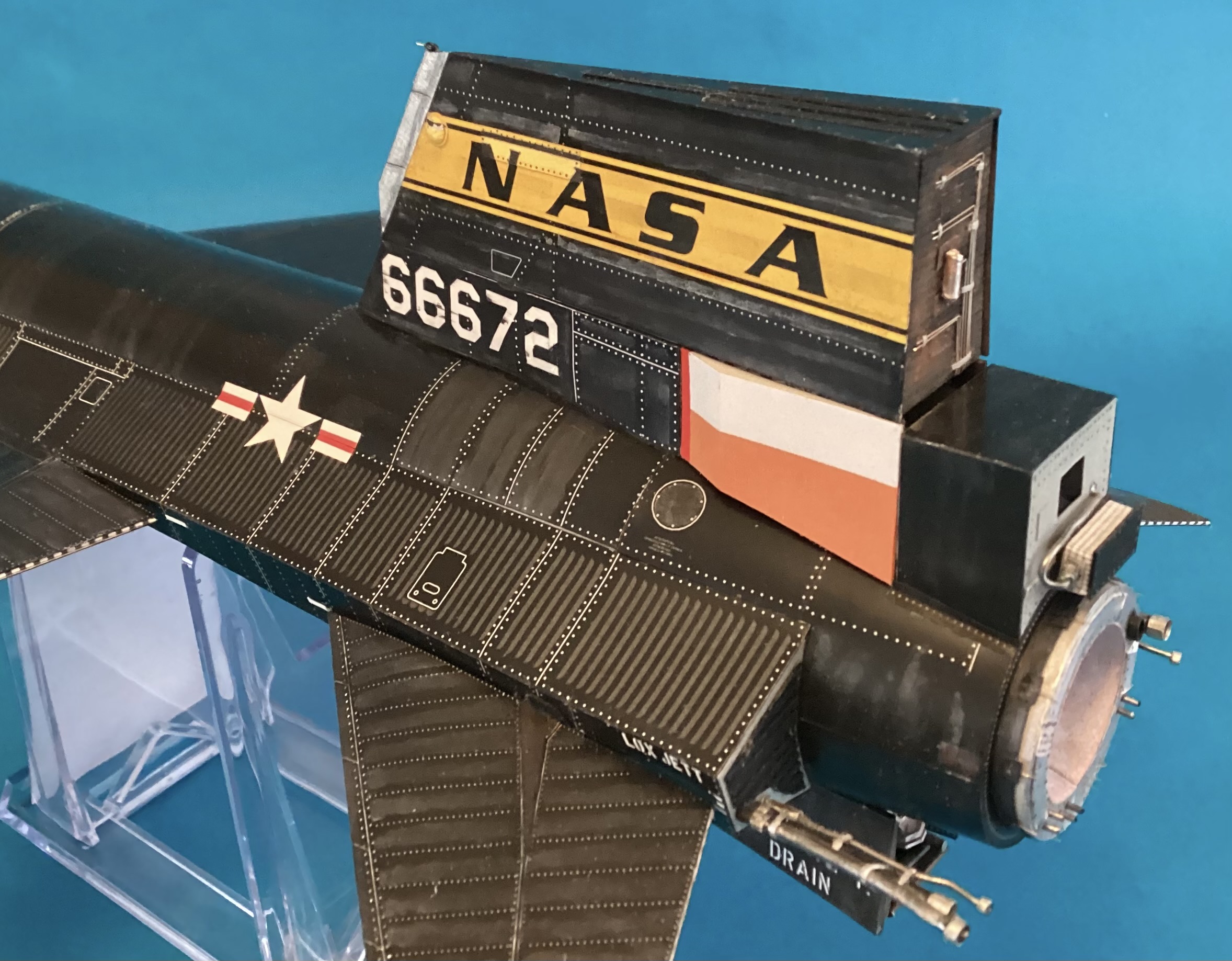
On Adams’ fatal flight, 66672 carried a number of experiments and instruments in two wingtip pods, as well as on the dorsal tail. There were no photos taken of Adams’ flight, but photos of 66672 taken a few days beforehand show what it no doubt looked like on its last flight. Markings-wise, the tail carried the yellow NASA banner on the left side only; by this point in the program, 66670 and 66672 rarely flew with the banner on the right side.
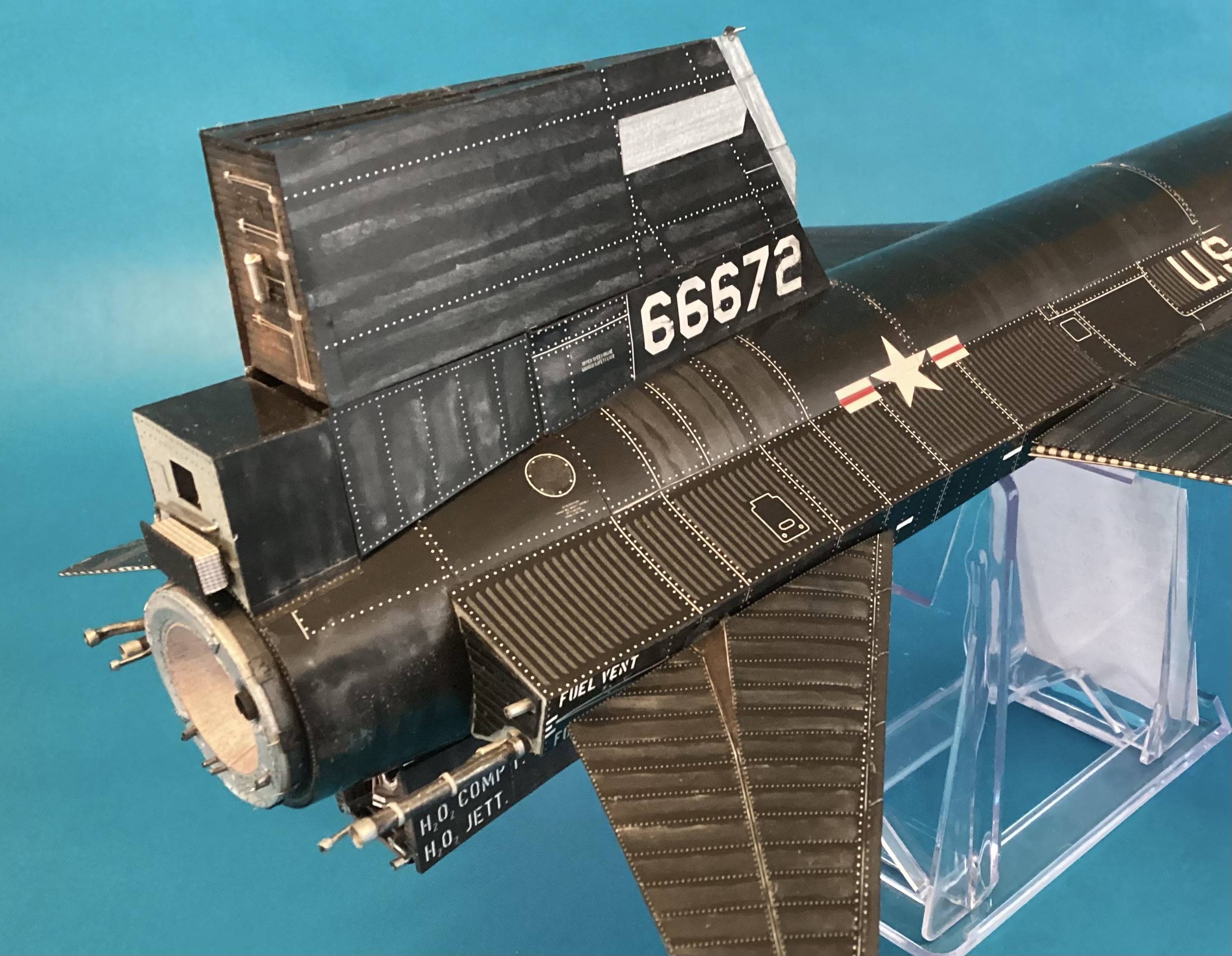
The key feature on the right side of the rudder was a cold wall heat transfer experiment that had been installed seven months before the flight. It was covered by a panel that was jettisoned at high speed, exposing thermocouples to high heat. I replicated it with a piece of thin silver card.
The main visual feature on the left side of the tail was an orange-and-white panel of test insulation (for the Saturn V) on the upper left speed brake. While testing the insulation was a stated aim of the experiment, technicians were actually more interested in testing the adhesive that held the insulation on. I scratchbuilt the panel, as well as the experiment box that sat behind the tail. I also used fuse wire to add wiring to the corrugated rear of the rudder; photos show it had several runs of wiring on it.
The front of the rudder carried a sharp-edged piece that was added to 66672’s tail only. It was made with silver card.
The wingtip pods are the points of wooden knitting needles cut to the proper length and sanded to match the pods’ shape.
It appears that on its last flight, 66672 carried two bug-eye camera housings on the underside of the fuselage, and one bug-eye housing on the right side of the cockpit. I had to scratchbuild those.
As with my other 1/32nd-scale X-15s, I added a random metallic sheen to many of the parts by marking them with a cheap silver marker, which I then quickly wiped off with a cotton swab. I applied thin strips of tape over the rows of rivets so they’d stand out and offer some contrast.