So I stumbled upon a few websites. I saw them use Lacquer thinner for Acrylics.
Isn’t that a bit weird? How come people use thinner specifically designed for something else?
I’m not trying to force people to not use Lacquer Thinner, just curious? Why not just use Acrylic Thinner for Acrylics, and Lacquer thinner for Lacquer paints?
It’s like using a hot dog bun for making burgers. Can anyone explain to me why someone would use Lacquer Thinner for Acrylics?
Though you will read in some places that Tamiya’s paints are some mysterious form of ‘acrylic lacquer’…which simply isn’t true, they are *true acrylics…*they are perhaps uniquely compatible with lacquer thinner solvents. (Many acrylics are not – lacquer thinner will corrosively attack and dissolve many acrylic formulas.)
Using lacquer thinner while airbrushing them seems to give an extra-smooth (and some say extra-durable) finish.* The general opinion seems to be that the paints will atomize more finely with lacquer thinner, as opposed to X20 or alcohol. I will say that in my own experience this seems most evident spraying their gloss colors, where the difference seems truly noticeable.
The same may well be true for brush-painting…though personally I use their X20 thinner plus their drying retarder as a less-volatile choice for brushing, since lacquer thinner is more likely to ‘sizzle’ any paint layer beneath.
*I’ve also heard it said that lacquer thinner causes them to cure faster…but have seen no proof one way or the other to support this, and have noticed no real difference on my own work.
Tamiya paints are lacquer based, and standard is use their alcohol thinner, but lacquer works too. The latter is beneficial for spraying as it ‘bites’ into the plastic?
edit… Just seen the above reponse, so it appears I’ve been witness to improper info. In any case, Tamiya’s yellow capped bottle of thinner is their lacquer product.
There still must be something different in their product to not be compatible with other waterbased acyrlics like Vallejo, LifeColor, Andrea?
There are several reasons why one might use Tamiya lacquer thinner (or Mr Color Thinner/Levelling thinner) with Tamiya acrylics.
1: You can thin the paint considerably more using lacquer thinner than you can using X-20A acrylic thinner. There are may reasons why you might want to do this, but the most common is using super-thinned paint to tint an underlying base coat.
2: When you thin Tamiya’s gloss acrylics with lacquer thinner, it seems to dry with a higher gloss than it does when thinned with X-20A or Isopropyl alcohol. Though it dries faster, it seems to self-level a little better.
Having said that, Tamiya also has a line of lacquer paints, not unlike the Mr Color range, though with fewer colours. So if you want paint that behaves like a lacquer, you can actually use a lacquer from Tamiya if you so desire.
Tamiya’s acrylics are an alcohol-based product, as far as I can tell. It’s not isopropyl, though that will dissolve or thin them. I use Tamiya’s proprietary thinner, to thin them for airbrushing or handbrushing. It took some trial and error to learn that.
I have used lacquer thinner (from an auto supply store), on a tip that using lacquer thinner to thin the matte colors results in an absolute dead-flat matte finish. I couldn’t really tell the difference, so I didn’t make it my regular thinner when airbrushing the matte colors.
I would qualify the comment that Tamiya’s acrylics aren’t compatible with water-based acrylics, though. You can certainly lay them down over water-based acrylics, and vice versa. I do it all the time. Mixing them with water-based acrylics to create custom colors might be problematic, but I’ve never tried that, so I can’t say from my own experience.
Based on recommendations I’d read, I tried thinning them with lacquer thinner. It worked pretty well, but I just didn’t like playing with lacquer thinner so I stopped.
I noticed that Michael Rinaldi, who wrote favourably about the practice in TankArt 2, has recently said that he’s no longer using lacquers or enamels.
If you go to Tamiyas website and look under their acrylics it tells you right there to use X-20a or lacquer thinner to thin their acrylics. And why you might want to use lacquer thinner. No need for me to repeat that again it can be read right there. It’s not here say on a whim why some of us use it but it got it’s start right from Tamiya themselves…
As to other brands there are only a few new players of the same ilk as Tamiya acrylics that also thin well with lacquer thinner regarding model paints …
And then of course there is the very old fashioned hot, shall we say solvent based automotive acrylic lacquers that will thin and clean up with nothing but LT. I might add, and about blow your head off from the stink. I shot those from time to time in 1/1 back in the 1970’s and 80’s. I recently shot a model car with some and got the quick reminder why I never cared for the stuff ( not the stink but too much hand rubbing and polishing.
Moving outside Tamiyas recommendations though, to which I agree with the others regarding the gloss/hardness etc. I tried denatured alcohol for their gloss acrylics and like that even better than lacquer thinner. But my LT is hardware store LT. I’m sure those LT with the retarder element in them are awesome.
The only other hobby or craft acrylic I use LT in and it too is not just acrylic put poly acrylic is Stynylrez primer. And it really levels out extra smooth by adding a little LT in. I got that tip right here at FSM, so thanks to that poster ( sorry don’t recall who it was).
At the risk of sounding like a little kid, though, they don’t say why to use lacquer thinner in the first place, do they? I think that’s the question, not “what does Tamiya recommend?” Does Tamiya explain what the advantage is, to using lacquer thinner to thin their acrylics?
Tamiya acrylic paints are made from water-soluble acrylic resins and are excellent for either brush painting or air-brushing. These paints can be used on styrene … Learn more
Description
Specifications
Additional info
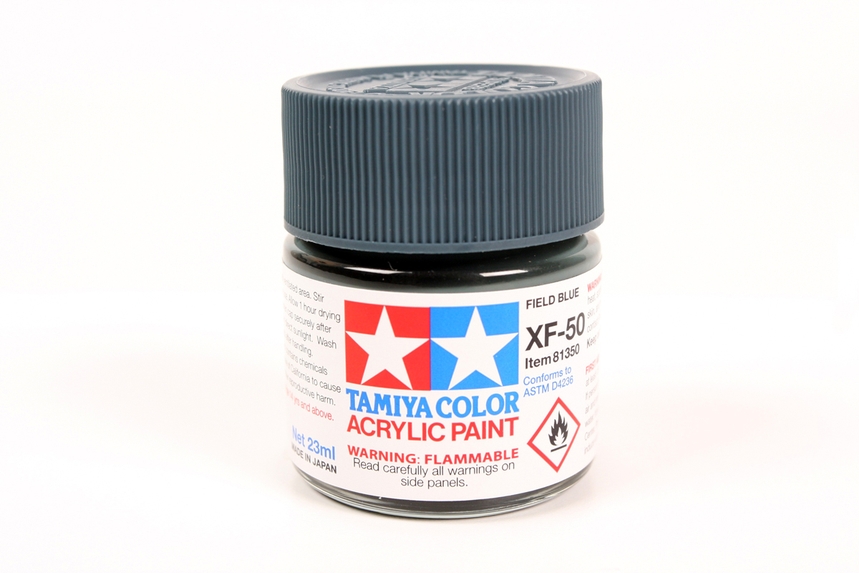
Acrylic Xf-50 Field Blue1. ## Description
Tamiya acrylic paints are made from water-soluble acrylic resins and are excellent for either brush painting or air-brushing. These paints can be used on styrene resins, Styrofoam, wood, plus all of the common model plastics. The paint covers well, flows smoothly and can be blended easily. Prior to curing, paint can be washed away with plain water.
When airbrushing make sure to use any of the following Tamiya thinners: 81020, 81030, 81040, 81520, 87077.
X designated colors have a glossy finish while XF designated colors are flat finish.
The paint can be thinned for airbrushing using Tamiya X-20A Acrylic thinner.
The paint can be also thinned for airbrushing using Tamiya Lacquer Thinner. Using Tamiya Lacquer Thinner will yield faster drying results and a harder finish.
For better paint brushing results use Tamiya Paint Retarder (87114) for a smoother brushstroke free finish.
I just cut out all the extra information in my last copy paste to get to the meat of the matter we have been discussing in the thread. Again this is from Tamiya’s website directly ( Tamiya USA):
Acrylic Xf-50 Field Blue1. ## Description
Tamiya acrylic paints are made from water-soluble acrylic resins and are excellent for either brush painting or air-brushing. These paints can be used on styrene resins, Styrofoam, wood, plus all of the common model plastics. The paint covers well, flows smoothly and can be blended easily. Prior to curing, paint can be washed away with plain water.
When airbrushing make sure to use any of the following Tamiya thinners: 81020, 81030, 81040, 81520, 87077.
X designated colors have a glossy finish while XF designated colors are flat finish.
The paint can be thinned for airbrushing using Tamiya X-20A Acrylic thinner.
The paint can be also thinned for airbrushing using Tamiya Lacquer Thinner. Using Tamiya Lacquer Thinner will yield faster drying results and a harder finish.
For better paint brushing results use Tamiya Paint Retarder (87114) for a smoother brushstroke free finish.
End of quoted material.
Ok, that said, hardware store lacquer thinner works too. And for brush painting where they recommend their retarder I use Liquitex retarder just as well…
Thanks for the official info, Oldermodelguy! Its pretty cool to see Tamiya saying the same things you guys have known about using lacquer thinner with their paint. I’ll definitely be trying that next. I’ve had good results with 99% isopropyl alcohol, but I’m always looking for ways to get better, quicker results.
For brush painting, I have found that Vallejo Airbrush Flow Improver works with Tamiya paint as well. I just put a drop or two of that in the cup on my pallette, along with the paint…don’t need to add anything else to make the paint brushable for a pretty long period of time.
If someone shoots all flats it doesn’t much matter. There is a difference with gloss, significant difference over broader areas like a car body… To an armor guy, not worth stocking the extra product imo.