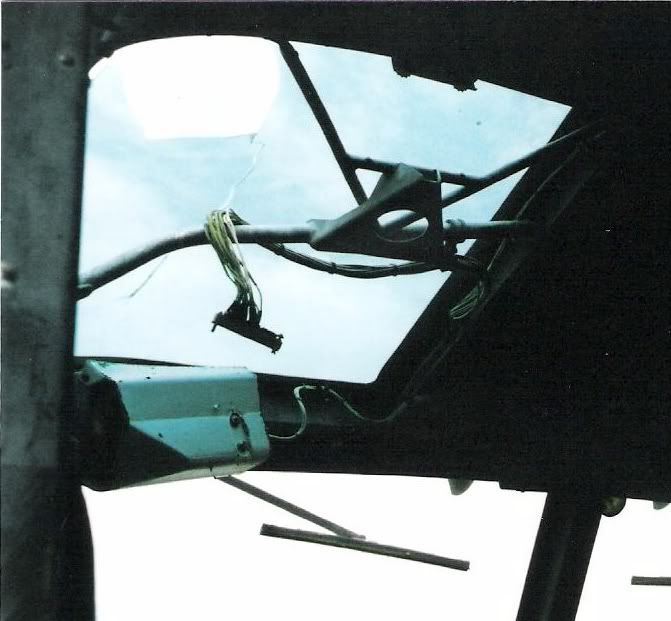
Good shot of the mount. Looks like a crash landing in a creek bed!
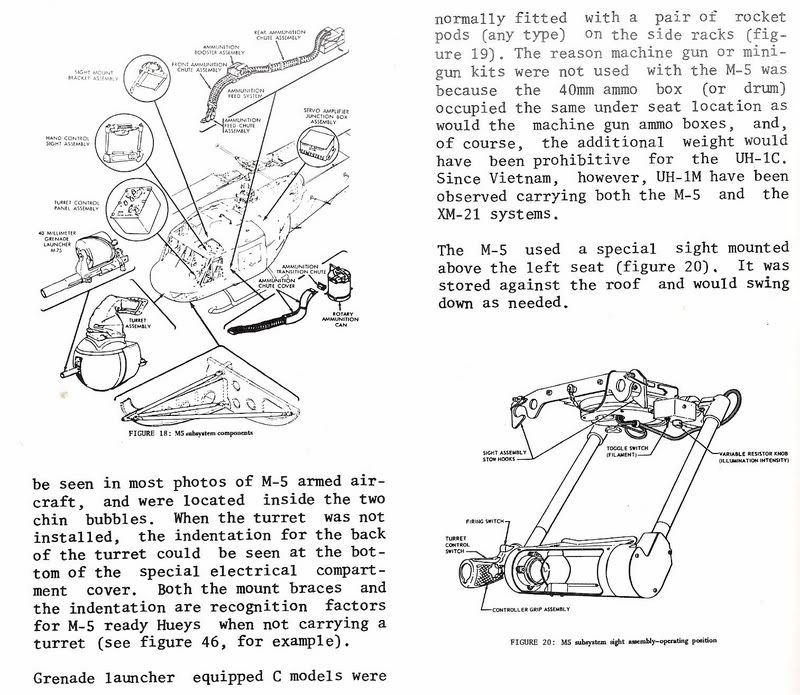
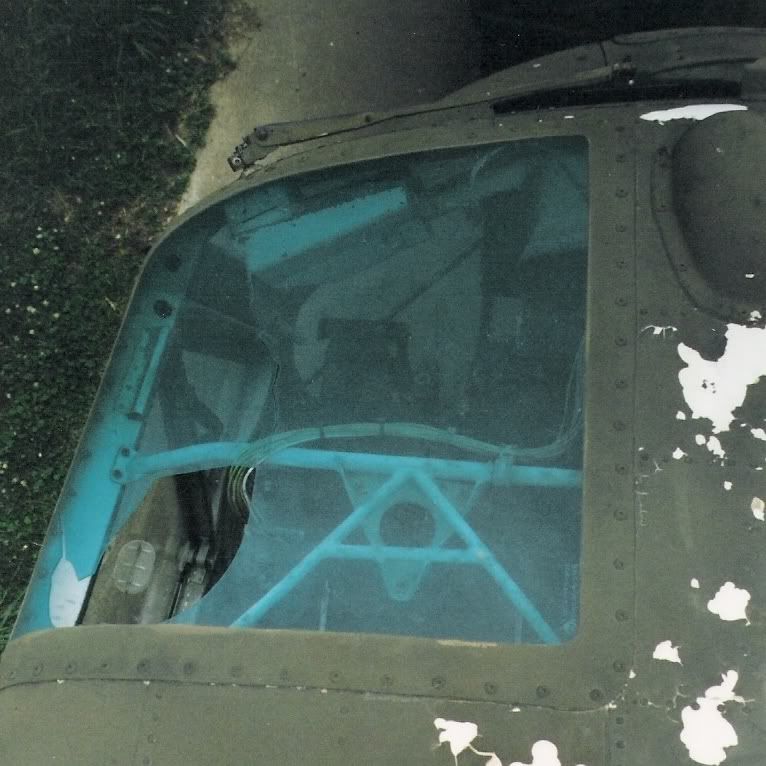
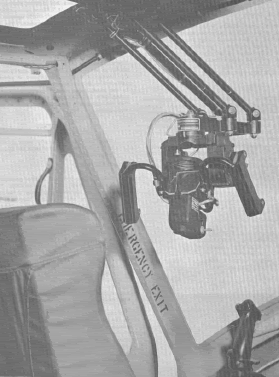
Another overlooked detail was the M5 Sight and mounting details. It was mounted in the rear portion of the left green house. Additional bracing was installed in the chin bubble for the turrent.

Good Data Mel,
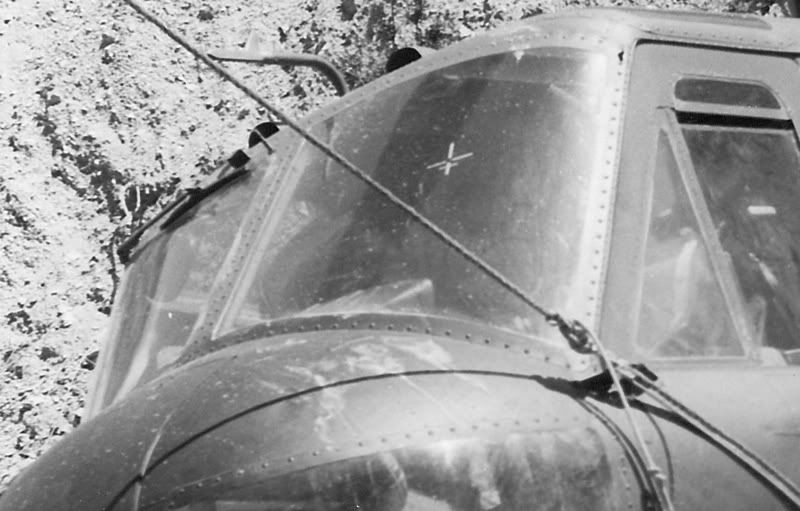
Here is the old Marine Sight.
Steve
And then there is this sight. I don’t have nomenclature. I believe it was used with the TAT.
Steve
Similar to the sight for the quad60/mini-guns
Andy (Intruder Bass)
I was amazed at your rework of the UH-1C rotorhead. Is there a thread of more of your UH-1C work? It is just outstanding. [:)]
I’ve also been following your 47 thread. WOW.
Regards
Steve
Andy,
Sorry about that…found the thread on “Dishmodels”
http://dishmodels.ru/gshow.htm?p=1530&lng=E
That just takes the wind out of my sails. [party] I can’t come close, but i can now try. Anyway, its just awesome.
thanks for the show.
Steve
Thank you, Steve
Sorry that thread is still partly untranslated - just dont have enough time.
Just wanna add also that the ammo box for XM-5 in the kit is not really correct for Vietnam. Mel pointed that to me when I already glued mine in, painted the interior and finished with washes and weathering :-)) I had to reap mine off and start all over again. New, custom box for ammo is much bigger - it is rectangular with feeding mechanism on top of it.
Andy
I just wanted to say that of the dozen or so MRC/Academy UH-1C’s I’ve see built, Andy’s is the best detailed of them all. He put an amazing amount of time and hard work into his “Mustang 6” and it really shows. I’m sure his “Chinook” is going to be equally “amazing”! Andy, thanks for sharing your remarkable talents with all of us!
Steve:
Glad to hear you are a Marine. I enjoyed working with the Navy at HT8 however I spent more years with the Marines so there is more of a bond. Navy guys don’t take offense, none intended.
You brought up a point I forgot about. Army aircraft also had two inverters, main and stndby.
The Navy required AC to be on their aircraft and this was because it was a shipboard requirement, no sparks to ground like on DC.
Tacan does require AC also Doppler, Army didn’t have this, they followed roads, or IFR, couldn’t resist this [(-D]. Navy/Marines plan on overwater flights where there is nothing to tell you where you are at.
The big difference is Marines had AC engine instruments. You had to turn inverters on when you start so you could see engine temp and pressures, Army only turned on battery. Basically Army had DC instruments and Marine/Navy had AC instruments. As I recall E models had big AC generator on transmission where Army had DC generator with two small inverters. I know generally only DC power sources are called generators, however that is what they are called AC generators and even today the OH-58D Kiowa Warrior calls them AC generators.
Ed
Mel,
When Andy mentioned that you told him the ammo box he used initially wasn’t correct for Vietnam, did you mean just for that ship, or for the entire war? I was under the impression that either a 150 round box or 203 round drum were standard during the war. My father remembers installing the M-5 system on one of their birds, but he doesn’t rememebr which ammo box they used. By the way, he said that the M-5 system he installed caused the airframe to crack. Did you ever see that? He also said that hearing those rounds go through the ammo chute between the seats while in flight was somewhat unnerving. Any thoughts about that from your end?
Thanks,
Ray
PS: Andy, I said it before, I’ll say it again: Awesome Build!!!
Ray,
I still can not fing any picture of standard cilindrical drum installed on aircrafts in Vietnam.
In fact I havent seen any other pic of it exept for this one from Squadron Walkaround book.
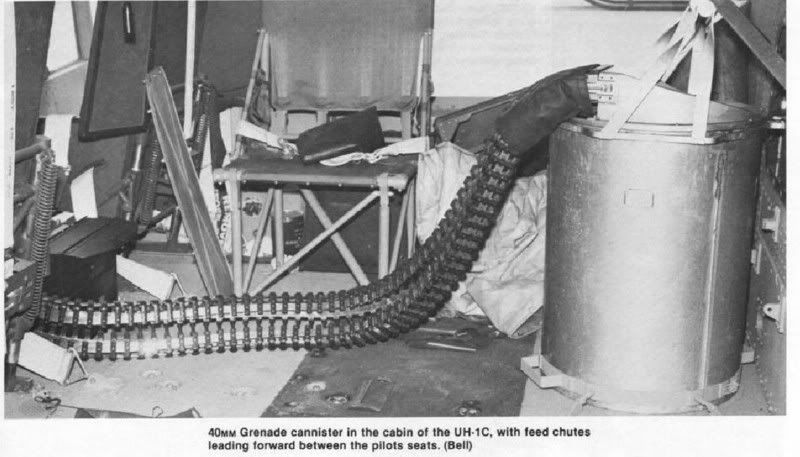
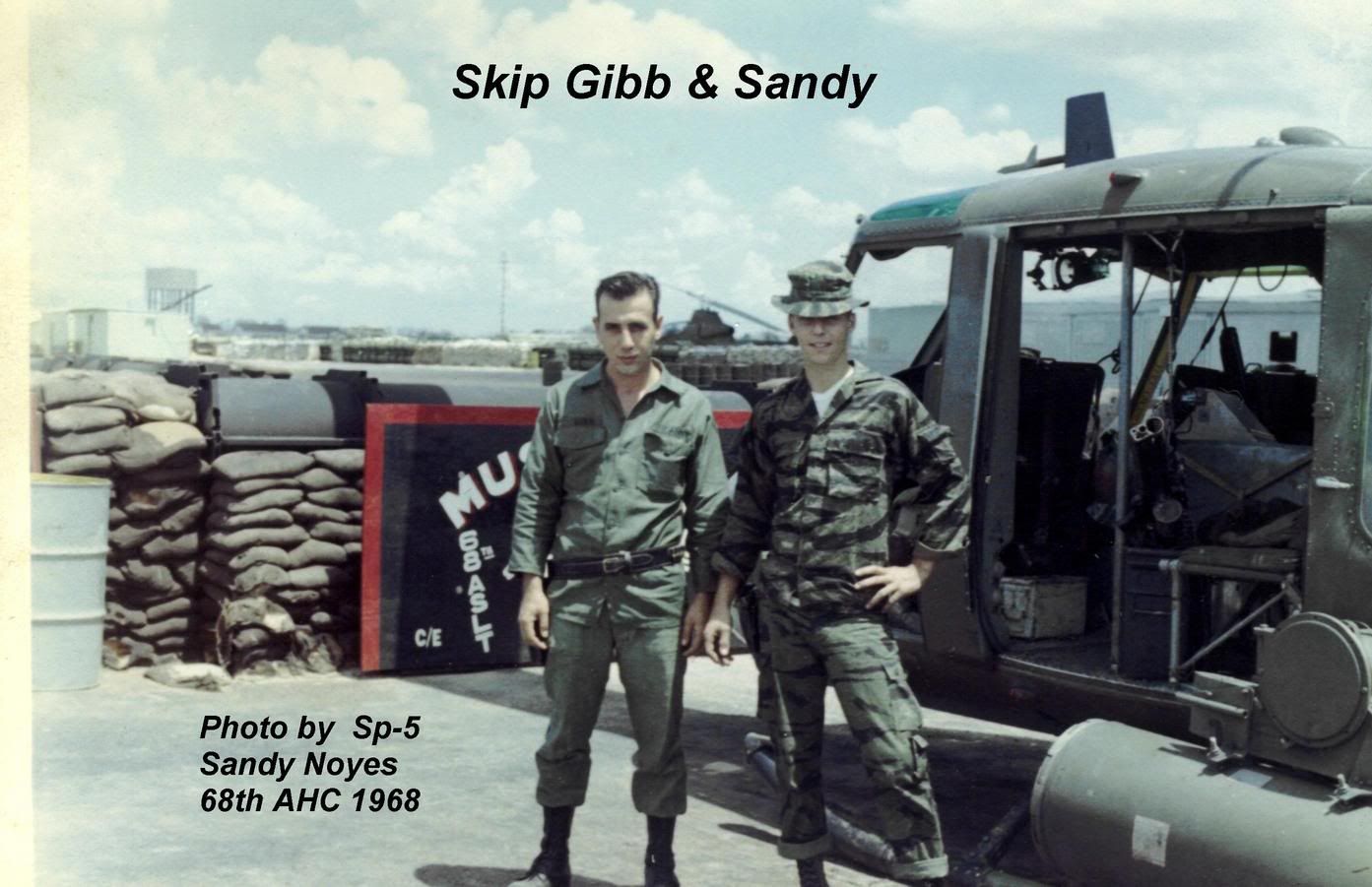
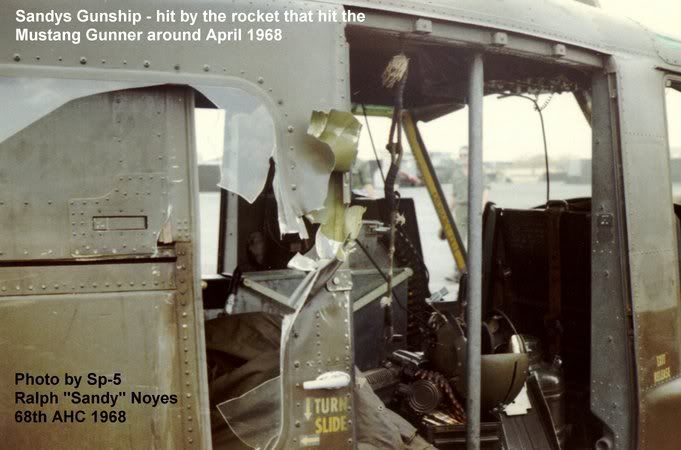
And here is the custom made box spotted on 68th AHC birds
BTW anybody has other pics of it? Dimentions?
Andy
Andy,
Yeah, I can’t find any other pics other than that one either, but then again, it’s hard to find interior pics from Vietnam of most things. The reason I asked the question was that my father remembers hearing the rounds go through the ammo chute between the seats and it would seem that that would only occur with the drum ammo can since the ammo exits the long ammo box right behind the console. Hopefully Mel can clear this up for us.
Ray
Ed,
Of all I’ve seen written on the AC vs DC, your description was the most understandable. “Sparks”!!! I can understand that one. [D)]
I never knew that about the guages. So the generator was producing AC? I assume then that there was a rectifier to change back to DC? I need to get my books back out. In the UH-1N the generators are DC with 2 big inverters for the “guys” that need AC.
As far as naming “things”, switching form manufacturer to manufacturer, everything is the same but called something else. For me the Tailrotor Gearbox will always be the “90 deg gearbox”. Sikorsky guys looked at me funny when i called the Intermdiate GB the “42 deg GB”.
BTW…I followed roads a lot too. [:-^]
Regards
Steve
Ray,
I’m afraid I can’t “clear” up the 40 mm ammo can debate. If you noticed the drawing I had attached in one post of how small the original “box” type was I doubt if it could hold 40 or 45 rounds. There were more rounds in the “chute” to the gun than in that little box. I think any total’s mentioned include the ammo in the chutes, not just the ammo box. I don’t have any pictures but the ones Andy posted is the type most used, large rectangular box. Some were actually a little taller. All were “field” modified. Some could have been “shorter” and tall still leaving a fair amount of chute between the box and back of the center console. The chute did a 90 degree at the floor and traveled along the left side of the center console towards the bottom of the instrument panel where it did another 90 degree to enter the area behind the instrument panel and into the nose compartment. This slight “twist” may be evident in the drawing I posted previously.
Hi Steve:
I’m not positive on the AC generator. I didn’t work the aircraft but I seem to remember a larger than normal generator. If you had two rotor brakes, then the generator would have to be mounted on the front, maybe that is what I remember. The inverters in those days and even on the N are rotary type not the static type used today so they needed more electricity. It would be interesting what you find out in your NATOPS on the E.
New Y’s and Z’s are coming out, that should be something. Rotor, drivetrain, tailboom and engines are interchangeable. The buzzword is commonality. Replaceable ribbon cable for the avionics, you can change sections, not have to splice and end up with a big knot. If I stay and work longer I think I am headed for the CV-22 program. Something new for an old man.
The N really has grown from the early days. I was at New River in the early 70’s and Bell was delivering new J and N’s then. The paint was polyurethane, all nice and shiny.
As long as you can see them, roads always get you where you want to go.
Take care,
Ed
Hey Ed,
2 things…
-
Looked it up, had forgotten. The AC generator was Tranny mounted and the DC was the starter/generator. Has an inverter but I can’t remember just where they hid it. I keep remembering N compartments.
-
Small world. I was in HML-167 as we got the very first deliveries of the UH-1N. Actually the first ones went to H&MS-29 as 167 was still in the process of moving from MAG-26 to 29. The first ones were Flat paint but then the Poly started coming in. Now I DO like a shiney bird. Shipboard use made them look like crap though. I guess we were too cheap to buy a touch up kit with the CORRECT color in it. [:-^]
Just be on the CORRECT road!!!
I get to watch the V-22 shoot approaches almost everyday. Yes, i wish I were flying them.
Regards
Steve
Hi Steve:
Yes it is a small world for us helicopter folks. I spent two years at New River 72-73 and then was at Campend from 86 to 89 and again in 92. Went to Cherry Point in 95 and remained there at the FST until 99.
The inverters should have been on the left side like the N model, at least that is where I recall seeing them.
Did you ever know any of the Bell tech reps?
Regards,
Ed
Ed,
E-mail sent.
Regards
Steve
Most folks don’t realize that the tall drum was originally intended to be mounted in the hellhole under the transmission, from the lift link. The feed chute was supposed to come out of the access panel that’s located in the center of the aft cabin wall. The only place I ever have seen the original configuration is in the TM. Considering the location it’s no small wonder that anything that could fit into the cabin and hold rounds was preferred over the hellhole installation. Once the electric drive was removed from it’s cap mount, anything you could make and attach it to was the order of the day.
Chief Snake