Thought I’d drop acouple off Cropdusters for you to see. The hole reason I carve is because plastic doesn’t make so many civilian aircraft types. But I know you guys appreciate seeing where plastic models got their roots. These are earmarked to fellows who actually own and fly this type. I’m adding floats to one for a fire bomber in the next few weeks. I’ll post the dual cocpit on floats soon. There are some plastic models that can be modified to firebombers. I don’t have decals for these so everything is templated taped off and brush painted to the models.
The airframes are yellow pine. Airtractor give permission to modelers to make models as long as they look good.Turbine powered Crop dusters are fast ,agile.
Those are lookin’ good. I too wish there were more civilian planes in plastic as I lack carving skills. I am currently working on converting a low wing trainer into a SEAT but it is turning out harder than I thought.
Skills such as carving can only be developed through practice. The good thing is practicing carving is not an expensive proposition. I have made major parts for scratch models from pine and even spruce cut from 2 x 4 stock. Knives are not that expensive either. One does not need a whole bunch of knives, just a few will do fine unless you are doing it for production and need to be super-efficient.
I was carving some parts for a scratchbuilt Hispano Suiza engine the other day (see my message and photo in the Scratchbuilding forum), and took a few moments to reflect on how I did the turning of a rectangular block to a valve cover that was a semi-circle on top of a rectangle. Was thinking maybe of doing an instructional video.
The above models are based on ground dimentional drawings from Airtractor. The 502 in action is a rush just to watch bet flying one is as intence. Don Stauffer I’ve been carving 20 years and have simplified it to just motor tools and finish sanders. Knives are very expencive and need to be sharp. I find a carbide drum bit on my flexshaft is quicker. Your generation use to carve models. Up until the 80’s aircraft companies had model shops. I’m glad there are a few of you who like to look at them. Just static display models no more no less. I wish every one could carve just think Pine wood derby cars… Thanks for your kind words, there are more to post over the winter so keep looking.
I have no expensive carving knives. I do most of my carving with X-acto handles and blades, but I did buy a set of carving knifes to get one with a thicker, more rigid blade. I think the whole set was around 15 bucks. As I get older and the arthritis in my hands gets worse, I do use sanders and dremel tool more and more often for really fast removal of stock but in many cases I can band saw close enough that I just need contouring/rounding, and primarily use knife and hand sanding for that.
Yes, my generation was forced to learn to carve, because typical kits (of wood) had fuselage sawed to profile and planform but it was up to builder to carve to section shape, and wings and tail were sawn to planform but we had to carve airfoil.
I wish I was born in those days ,but Had to be born in the 60’s. My uncle was a model maker for Boeing and developed models for wind tunnel tests. I picked up bits of technique from him.Carving is to me as plastic modeling to many guys. And yes with practice one can get good. But if you’ve never done a particular model like “say a Lear Jet 45” then it comes with new challenges from the last carving. I don’t believe I’ll ever get the world to carve modelbut the one truth in this is you gotta want the model pretty bad to complete it to look like the drawings. It’s a pass time I would always want in my life. And if I don’t want a particula model they’re easy to sell…
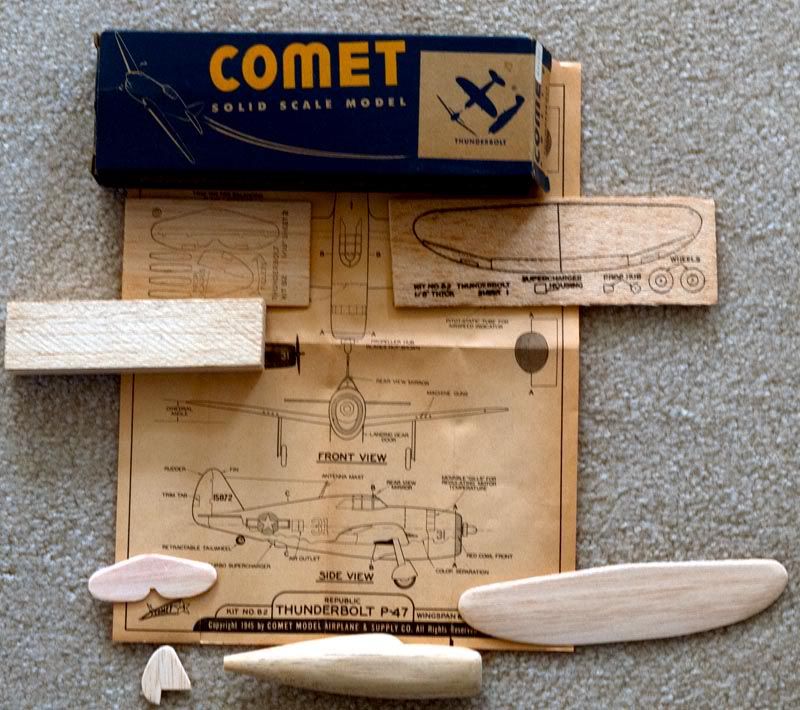
It is still possible to build such kits. Original kits are sometimes available on eBay for reasonable prices. Also, there are a couple of companies that reproduce old kits. Penn Valley Hobbies is a good source for these. Most of their kits are flying models (old rubber stick & tissue), but they usually have a couple of the “solid models.”
Yeah those are some of the most collectable models in forums on the Web. Great photo example of that kit. I always turn Balsa wood into fur when I carve with it. Pine, Popler, Oak are mediums of choice for me. But many of my models are cut from 2x4 stock found in wood piles. Line drawing are the key to the equation and a good eye for contour and you have a model that pride shows through.
Back when I built models a lot and did a lot of scratchbuilding, I used mostly balsa wood for carved stuff. the bulk of my shaping was done on a band saw to rough out the shapes, then various carft knives and various grades of sandpapers. Gosh, I think of so many scratchbuilds on my shelves that plastic or resin kits are available now…
I’m alittle disinchanted by the prices of plastic out here where I live, and my carvings cost less than $3.00 in materials. I have to like a particular model enough to see it through though. The technique is been around for years but it’s the same as what company model makers used for wind tunnel models in the early 40’s All one need is a set of line drawings and boom you have a Proof of concept model thats 100 percent one of a kind. I use to build plastic kits and found them to be less oriented to civilian aviation,I am working up patterns for the 5000th F-4 Phantom which is a great looking model. Thanks for your chat…
I can carve balsa okay, but prefer basswood. It has a much more homogenous grain. However, the thing I hate about balsa is finishing it. It is so porous it takes many coats of a thick primer. I also have to use a sanding sealer prior to the prime. Even so, some of the grain is so open it takes filler/putty. Basswood, in spite of softness, has a much closer grain that takes far less prime to fill the grain.
A block of Balsa is 20 dollars as compared to 6 dollars for a plank of pine. I can get 3 1/35th scale models from a plank of pine and one model from a block of balsa. Pine is semi hard and is very forgiving if one makes a mistake. These two models were my first attempts at building a crop duster. Cessna,and Piper have some that I’m intrested in building. The mainstay for static display models is Mahogany. I believe it’s a selling point for models ,but isn’t lowering the price of one to buy…
I suppose we might consider moving this thread to the “scratchbuilding” forum.
I have used mahogany for a few carvings of other things but never a model. I think it just “sounds good.” Mahogany is great for furniture or artistic objects that will be stained, but for painting it isn’t much easier to prepare than balsa. Since I paint all my models, I stick to a more closed grain wood. Yeah, I have often used pine. Also, I find poplar and aspen to be nice woods for models. Cheap, readily available, not too bad to carve or finish. I do a lot of ship models where I need pretty good chunks of wood (I model a lot of Great Lakes freighters and models are typically two to four feet long) so expense of wood is important. For aircraft in the 1:48 to 1:24 range I can afford basswood, which I consider the best carving wood.
Of course, there is that foam plastic the patternmakers use these days (Rennshape is one brand, I believe) but that stuff makes even exotic woods look dirt cheap
Yeah if the powers that be want to move this thread I have “No” problem Anybody who wants to chat on model making is welcome to chime in as I’ll be posting more. as time goes on…Rennshape is used in concert with CNC machines. A company I use to work for used many materials in the CNC machines and then we went to Rapid prorotyping machines. I’m just as fast as either He he he. Popler is nice if one sets the grain horizontally.
I know folks who make patterns for resin casting who carve it by hand. One of them gave me a small piece to work in. Works fine with knives and sandpaper- can be primed and painted like wood. Problem is, it is a bit expensive and can only be bought in 4 x 8 foot by a couple of inches thick. I think a sheet of minimum thickness is near a hundred bucks!
I try not to compare synthetic materials to wood as there are alot of differences,but cost is one factor. I had to be able to continue a pass time without spending alot of money to achieve my goals. I’ve got models sitting in limbo that I have “No” idea which way to go. Reason being the nearest examples are in Oregon or California. Refrence photos are the key to carving model airplanes. but walking areound an actual aircraft taking photos makes an impression on the minds eye. Hope everyone has happy Holidays …
Glad to see this thread revived. I went looking for a plastic kit for a crop-duster, and of course had no luck at all. While searching I did, however, find a reasonably presentable already built plastic model of a turbo-prop Airtractor in an odd 1:60 scale at one website, and so I thought “what the hell” and bought it, as it was super cheap. On the underside it says “Made in China, Popak New-Ray Mfg Ltd.”
I’d much rather build one, not sure if I could ever carve one, and I so admire your considerable skills, but I just had to have a crop-duster on my shelves. Here it is.