I don’t know where this “blue” rumor came from but they were black. Black, black, black. This don’t come from some internet guru or anyone who heard from someone who heard, or from some fourth persons recounting of some third persons eavesdropping during a late night drunken stupor. This comes from people that were there and worked on the plane every day while it existed.
Iron ball paint contains tiny spheres coated with carbonyl iron or ferrite. Radar waves induce molecular oscillations from the alternating magnetic field in this paint, which leads to conversion of the radar energy into heat. The heat is then transferred to the aircraft and dissipated. The iron particles in the paint are obtained by decomposition of iron pentacarbonyl and may contain traces of carbon, oxygen and nitrogen.
Yeah, it’s black. But it’s hardly the ‘stealthiest’ color. Any so-called ‘black bird’ tends to look like a hole in the sky, which makes it MORE visible than if it actually matched the local color value and ambient illumination.
SR-71s with a fresh coat of ironball paint were as black as a lump of coal. Repeated exposure to the heat of Mach 3 flight and other environmental factors faded that black to varying shades of very dark gray after some lenghty period of time. There was NEVER any blue involved in it, despite occasional rumors that there was.
Yes, that is true, but at the altitudes that the Blackbird flew missions, the thing could have been rainbow-colored, and you still wouldnt see it from the ground.
Another factor here is color scaling. Black in full sunlight will look much lighter than the same color under artificial lighting. Model railroaders have “scaled” their steam engine blacks for many years to make them look like they do in full sunlight under the artificial light indoors where the scale model will usually be seen.
I see people on the forums here constantly trying to find the exact same color as the original aircraft, but once they put it on a model, it’s going to look darker under room lighting than the original did outside. I often lighten up darker colors a bit, especially if there are two adjacent colors that will blend together under artificial light, but you could easily see the color difference on the original.
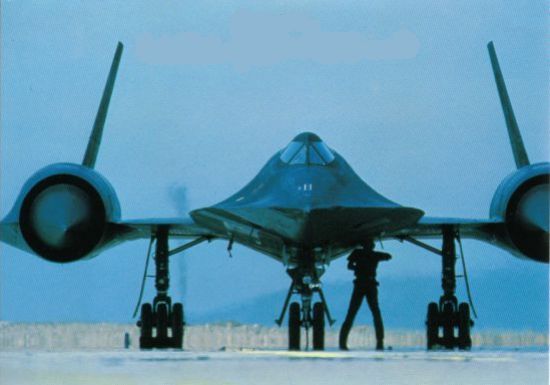
Most SR-71s were very black unless the color was old and fading, but in full sunlight, especially the CA summer sun, they looked bluer and grayer like the picture posted above.
TomZ2, interesting point about the “hole in the sky” theory, I can see your point though I’m not to sure how obvious a hole of “nothing” can be in a sea of nothing at 80k and M3.
About that pic, anyone who looks at it and thinks the plane is actually blue needs a good evaluation from someone with PHD after their name. Because the light bouncing off the plane looks blue does not a blue plane make. Or the grass green for that matter.
BLACK.
Darwin would know, he’s intimately familiar with the prototype.
I wasn’t limiting my comment to SR-71s alone. It’s not the only ‘black bird’.
.
And they don’t all fly Mach 3. Snag a copy of Ben Rich’s Skunk Works to read more about the ‘hole in the sky’ problem and the brass hats that caused it for the F-117 (AND OTHERS, he hints).
I don’t see a blue plane here. I see a picture with a blue cast due to an aged negative, slide or possibly aged picture itself. This is pretty normal for pictures of the time. Maybe Tungsten Balanced film for a daylight shot? Who knows, one thing is for sure, the plane is black. Otherwise it would have been called the Blue Bird [whstl]
 .
.