First I have to ask , do you know how to solder ? This is important in this post . Even if you are not a master at it , you should know the basics at least .I won’t make this a treatise or lesson on soldering . I do know some tricks I would like to share though . If your soldering iron has a reasonably good diameter to the tip base , here’s something to think about
You can take a pin and chuck it it a modified soldering iron and use it for creating portholes and gun ports as well as vision slits in armor . It also works great for creating holes for spark plugs in those miniature engine blocks . You can carefully take brass wire ,bend it and cut it to shape and solder the other pieces you’ve cut and build a real metal fuel injection system .
On armor you can take all those gear baskets on the back of the turret and before mounting solder the joints for a nice strong basket .I have a WELLER unit with the rheostatic control that’s numbered .When I solder etched brass I usually run with a setting of 4.5 .That’s enough to heat the metal and cause the solder , by capillary action to fill the corners and make a very smooth joint
Now on other parts .Say you have a mine seeking unit . take brass square tubing and replace ALL the pieces with brass .WHY ? well , it will look great and it won’t break if someone handles it !. You can keep the plastic kit rollers .The only NON-SOLDERED joint will be hidden by the rollers . There , that wasn’t hard was it . For the car builder .You can create suspensions that WON"T break from the weight of the model over time .Door hinges and other goodies are possible too .
The thing is , with a soldering gun or iron , the other possibilities for stuff on or in the models are tremendous in scope . Don’t be afraid to try it . You may surprise yourself as you pick up another new skill to be used for modeling . MODEL ON ! Tanker-Builder .
I find myself soldering things so infrequently that I’ve never taken the time to actually learn how to do right in the first place… I’m much better with CA and a toofpick.
I had an article a couple of years ago about soldering- example was scratchbuilt landing gear for aircraft. Also handy for yards and masts on small scale ships, antenna on planes, ships and military vehicles.
You are so right .At this moment I have created four tripod masts for 1/96 scale ARLEIGH BURKE ships . I also have a FLETCHER in the works and the soldered mast parts are far stronger than glued parts . I will be able to fold it down (with all the SOLDERED ) detail on it ,so the client can just stand it up and drop it in the locator tube . This and the small parts in 1/350 is why I love to solder these parts .No part falls apart HE . HE . MODEL ON ! Tanker-Builder
Yeah, and the brass masts and yards do not bend when you put a little too much tension on the rigging. Many of my shipbuilding friends use brass rod to replace the fine plastic masts and yards.
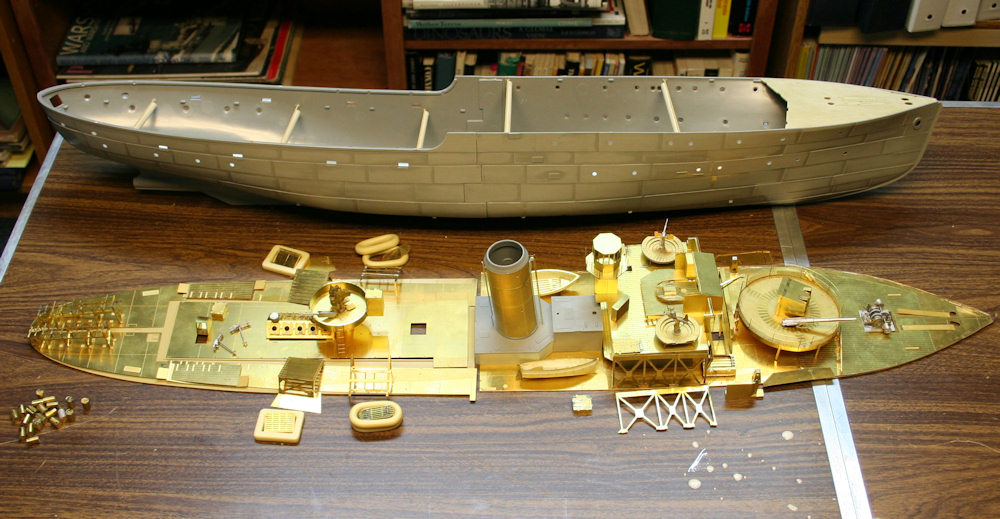
This job, the Mother of All PE Sets, is the GLS full set for the Revell Flower. For it, I invested in a good/not great soldering station with digital temp control- sweet, it’s hot in a flash, and has a selection of quality tips. Anyway, the job would be ridiculous without solder, and it’s bad enough with.
On my latest, all the railings are soldered. A good trick: Wads of soggy tissue protect the plastic deck from soldering heat. Even with, I made the soggy tissue sizzle when soldering the lower rail.
In general, hold the parts together somehow, apply a teeny bit of flux, pick up a bit of solder on the iron, and apply to the joint ensuring that both parts get the heat.
I use flux core solder, which eliminates the need to seperately apply the flux. Flux core solders these days are available down to about fifty mil diameter. It is rosin flux, which I find plenty adequate for brass soldering. I avoid acid core flux for modeling work. If not completely removed it can mess up a paint job after awhile. Unless you are soldering stainless or various forms of steel, you won’t need acid flux.
I almost completely agree Don. If the job allows you to feed the solder directly into the joint- yes. But for teeny jobs (like my 0.016" brass wire into .020" wide stanchions, or just about any PE task), I prefer to apply a tiny bit of solder to the iron’s tip and transfer that to the job… which means the flux gets lost and maybe can/maybe can’t do its job of cleaning both parts. So in these cases I pre-flux.
Cleaning absolutely needs to be done afterwards! I like to use that greasy plumbing flux, so it gets cleaned with solvent, followed by soapy water. And while I may use my plastic deck for “fixturing” a job like the deck railings, I make sure I can remove the soldered assembly for separate cleaning.
I commend you for having the courage . I do Not however recommend using the ship’s deck as a soldering jig ! When I solder rails for instance I find a board that is wide enough and the wood is soft enough and cut grooves into which I lay the brass parts .This enables me to include sheer curve etc .then when done I have three feetof rail I can do any which way , without breakage . I learned this from doing rails in 1/96 for BaD Shipmodels. This way too , if the rails are Not available in 1/350 for stairs ( I know , most come with them ) then the jig allows correct angle and of course the strength . I only do angled rail eighteen inches at a time . On your Flower , the brass is a humongous part of the ship and in 1/72 scale ,there’s Not a lot out there if you bugger up a part . I did everything on my Flower in brass Before the P.E. Set was available .Of course I operate it ( Yes, I R.C.d it ) in real world weather conditions . It sails well , I just have to have time to finish it ! . I liked your Photos .They show the real complexity of this model .This is a ship model that even out of the box is NOT for beginners . Model On - - - Tanker-Builder
I must add to your comment in saying ,I definitely recommend using brass on all the mast and rigging components on the 1/200 ARIZONA .That is one delicate job ! Oh , and " Wonder Wire " ! Model On ! Tanker-Builder
How do you like building for others ? It can be a challenge , can’t it ? Now , one thing I like about it is the things I’ve learned along the way because I had to break out of the box .Fun , isn’t it ? If you would like to talk more , E-Mail me through this site . G J Geracci - C.E.O. , (chief bottle washer and errand boy too ! )- MINSHIPCO Model On , my friend ! Tanker-Builder P.S. I do like the way they turned out .
As far as what to make jigs out of, I use particle board. It is cheap and not very flammable. It does char, but not flame up. I always keep some particle board stock in my workshop. Many building supply places have cheap hardboard steps, about twelve inches by a few feet. You want the bare stuff, not with vinyl covering. It is easy to drill, even with a pinvise and small drills, to make up various jigs.