I’m 83 years old retired and living in a nursing home. I recently got gotten into wooden ship modeling and I’m going to attempt my first ship tomorrow. Depending on how this turns out I think I’d also like to get into model aircraft as I have an Air Force vet and there are several aircraft I would like to build.
One of the frustrating things is that being in a nursing home I cannot use any of the sprays that are available and anything I do has to be done with a brush. I’m not sure how that’s all going to come out but I’m assuming it won’t come out as well as some of the models that I’ve seen here on this blog. Any advice?
3 Likes
Hi Lecl, I hope the nursing home life is treating you well - I too have had to explore low-odour options for my hobby with a 9 month old baby in the home, so I’ll share my approach…
If you’re stuck with brush painting, then best results are going to be achieved by building up required colours in multiple thin layers. If you stick with water-based acrylics such as Vallejo Model Colour series, this should help you avoild any smell of thinners.
The Vallejo Air series is formulated for airbrushes as the name implies, which would technically allow you to airbrush without creating a solvent-like smell being water-based. I’d probably suggest discussing this with the staff before investing though, because in their ignorance they probably just see a “spray gun”.
Flory washes are a great low-odour, non-toxic, non-flammable way to get contrast into your models as it flows a darker contrast colour into panel lines and then the excess is simply wiped off the raised panels.
The only unknown for me here is when it comes to clear-coating. Thinly sprayed applications are always best, but I guess there’s no reason why thin applications of an acrylic product using a hairy stick (paintbrush) wouldn’t work almost as well.
I feel like there’s potential to run into issues when it comes to gluing the kit together, as the plastic models will mainly be using polystyrene cement or superglue. This will be odorous, so keeping the room well-ventilated will be essential.
Best of luck with it!
2 Likes
Acrylics are the way to go. Easy water clean up though I find isopropyl alcohol is even better. It brushes on well which is how I touch up and do details and figures. Generally you need a prime coat underneath acrylics. I’d get some and experiment. Also there are a lot of battery powered airbrushes available that you might be able to use. Anybody try one? Good luck and have fun. Oh and get you some magnifiers.
3 Likes
Welcome to the forum! One thing I wouldn’t worry too much about is whether your first models come out looking like some of the models you see posted here. There are people here who have been doing this for decades, and everybody had a first model.
I got back into the hobby fairly recently myself, and I’ve found that every model teaches me something that I take to the next one. That’s become a big part of the enjoyment for me.
Being limited to brush painting may mean figuring out some different techniques, but there are some amazing models being built with brushes. Pick an aircraft that means something to you from your Air Force years and give it a shot.
And definitely post pictures as you go. There are a lot of very knowledgeable people here who are happy to help when you run into something.
3 Likes
Also has as others have stated acrylics are the way to go. I’m 100% acrylics and would not switch even if the paint might be a little better in the other formats. I have a modeling room with a window but I still don’t want to breathe the fumes.
2 Likes
Thank you I really appreciate your advice. When I from what I’ve read the use of the brush can come up with some excellent results but apparently technique thinning and so on is the important part. I’ll let you know how I make out with my first aircraft bill. I was in Vietnam so one of my aircraft was a b26 but I’m having to problem finding that exact model because there are so many versions of it. But I’ll keep looking. Thanks again.
2 Likes
Welcome to the forum, Lecl!
If you’re restricted to brush-painting, then remember that this is best accomplished with thinned paints.
And remember that “acrylic” doesn’t mean “water-based” or “water-soluable”. It refers to the chemical makeup of the carrier used in the paint. Many acrylic paints today are water-based, but others are not. Tamiya’s acrylics, for example, are alcohol-based.
I hand-brush with a number of acrylics from various brands: Andrea, Vallejo Model Color, Lifecolor, and the craft store brands Americana, Folk Art, Apple Barrel. I use a wet palette with these paints. That’s an air-tight box containing a sponge, to hold water, and a sheet of permeable paper that serves as the actual palette. A wet palette has the advantage of keeping the paints thinned to a consistent…consistency, and you can keep a batch of paints on the palette over several working sessions. I use a wet palette sold by RedGrass Games: Wet Palettes for Miniature Painting and Fine Art | Redgrass But there is another brand, Masterson, which has been around for years, and is available at arts-and-crafts stores like Michael’s and Hobby Lobby, or art suppliers like Blick. You can also order one online.
Tamiya’s acrylics I thin with Tamiya’s proprietary thinner. I have gotten my best results with this brand, with this thinner, when brushing by hand.
You should be able to use enamels, too, though they’re normally thinned with petroleum-based solvents like mineral spirits, and that might be an issue with odors.
Whatever the medium you use, you should be able to apply paints by hand, when you thin them properly.
I hope this helps!
Best regards,
Brad
1 Like
I would just add - you may want to consider a thinner that contains a retarder. The retarder will slow down how fast the paint drys; which will allow the paint to self-level. This will help eliminate brush strokes and give you a smooth finish.
3 Likes
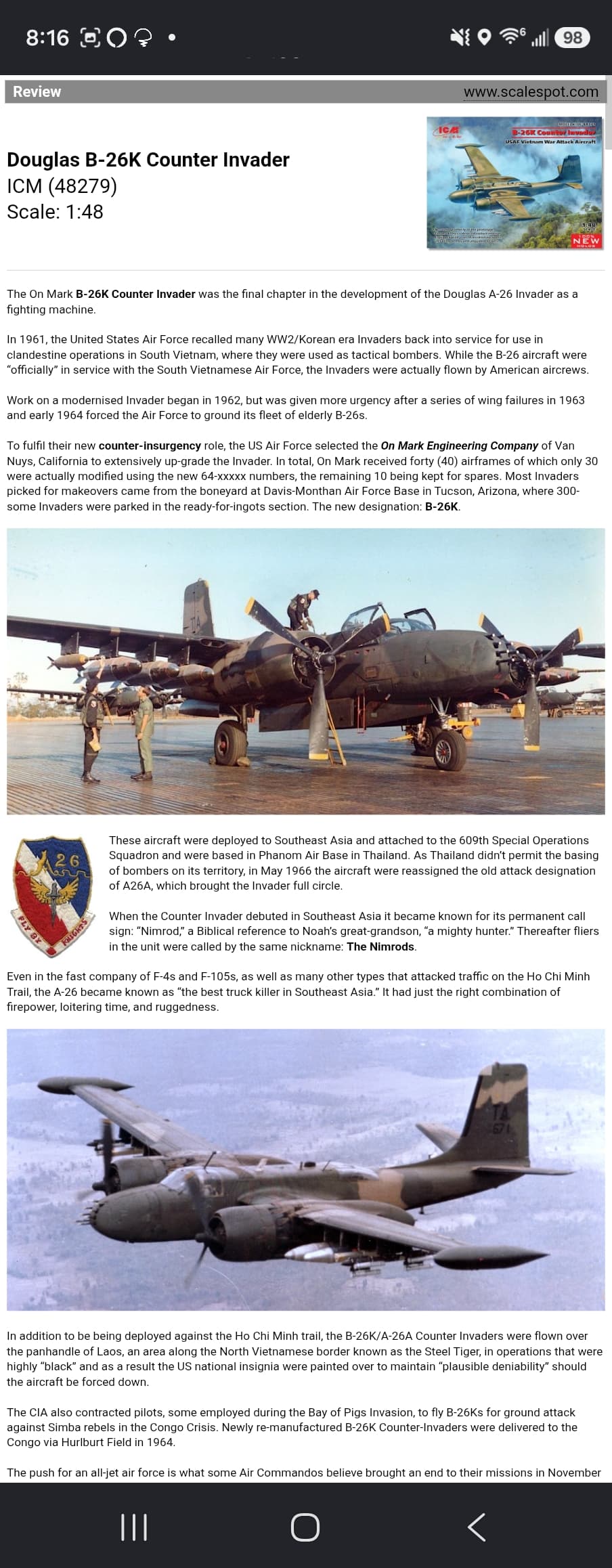
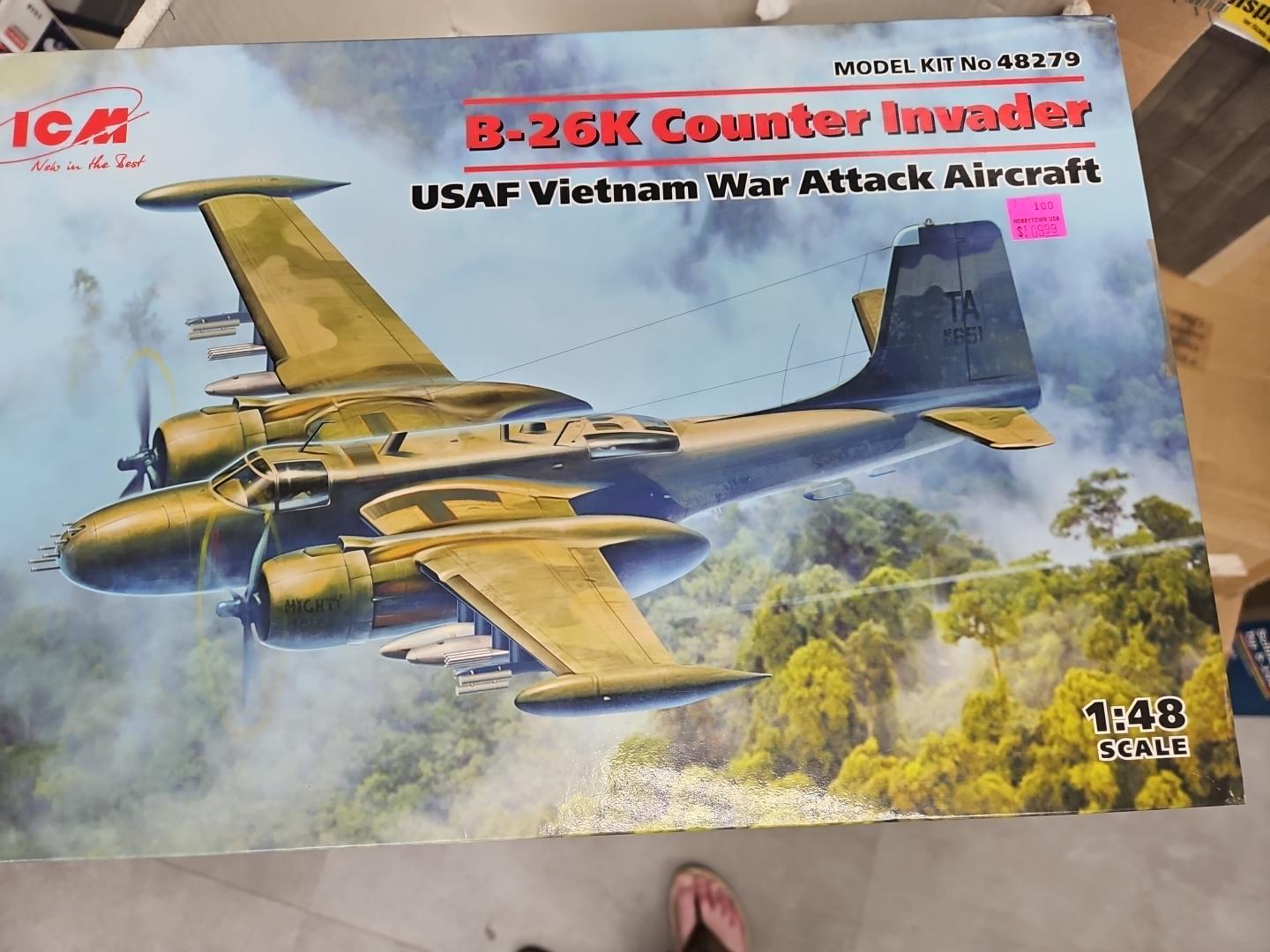
I’m planning on building that scene exactly (or as close as possible) with this kit what was specifically are you looking for I’ve done a lot of research into the B-26, maybe I can help?
2 Likes
Thank you all for your replies. I’m going to continue to investigate all these suggestions that you’ve made as I’m not very knowledgeable but I am looking forward to digging into it. As far as the B26 is concerned, I was stationed at Bien Hoa Air Base in the rsvn in 1963 and 64 and worked in the first Air Command Squadron orderly room so I knew many of these pilots who flew these aircraft. Iwas there when the aircraft were returned because the wings were falling off of them and the air commandos were returning them, I believe to the Philippines. We lost the number of Air Crews because these aircraft were not designed and that’s what my interest is. Operation to be used the way the were flown. Farmgate was the Air Force operation and I have been trying to dig into the history of the b-26 that they used. The modeling that I’ve looked at is confusing as as you would imagine memory doesn’t serve me well but some of the models that I’ve seen I really can’t imagine were used because they’re really more artist renditions than actual aircraft. Again thank you very much for all your interests at all keep you advised as to my journey. I’ve done some research on the b-26 that we in service in that time frame. I did have a picture of the aircraft but they only was I’ve been able to find are in black and white and I may have to settle for that but again I’ll keep you advice that’s what I find. Thank you again. My goal is to honor those who served and died. I I’m living in a VA home so if I describe to them the purpose that I’m trying to do they make cut me some slack.
6 Likes
I truly hope they are willing to work with you on this because it’s very rewarding hobby was very little risk of fumes or smell if done with the right paints.
You could certainly use an airbrush without much trouble, if you can use a spray booth that vents out of a window like many of us do, and it would absolutely be safe and non-toxic.
I agree acrylics are great but every time I smell Testors enamels I’m transported back to when I was a small fry and my dad built me Aurora kits…
1 Like
Thank you for your service. Poking around on the web it looks like they were B-26B birds according to this
The dates in the bit don’t reflect the article which matches your timeframe.
2 Likes
Great detective work!
Thank you for the information