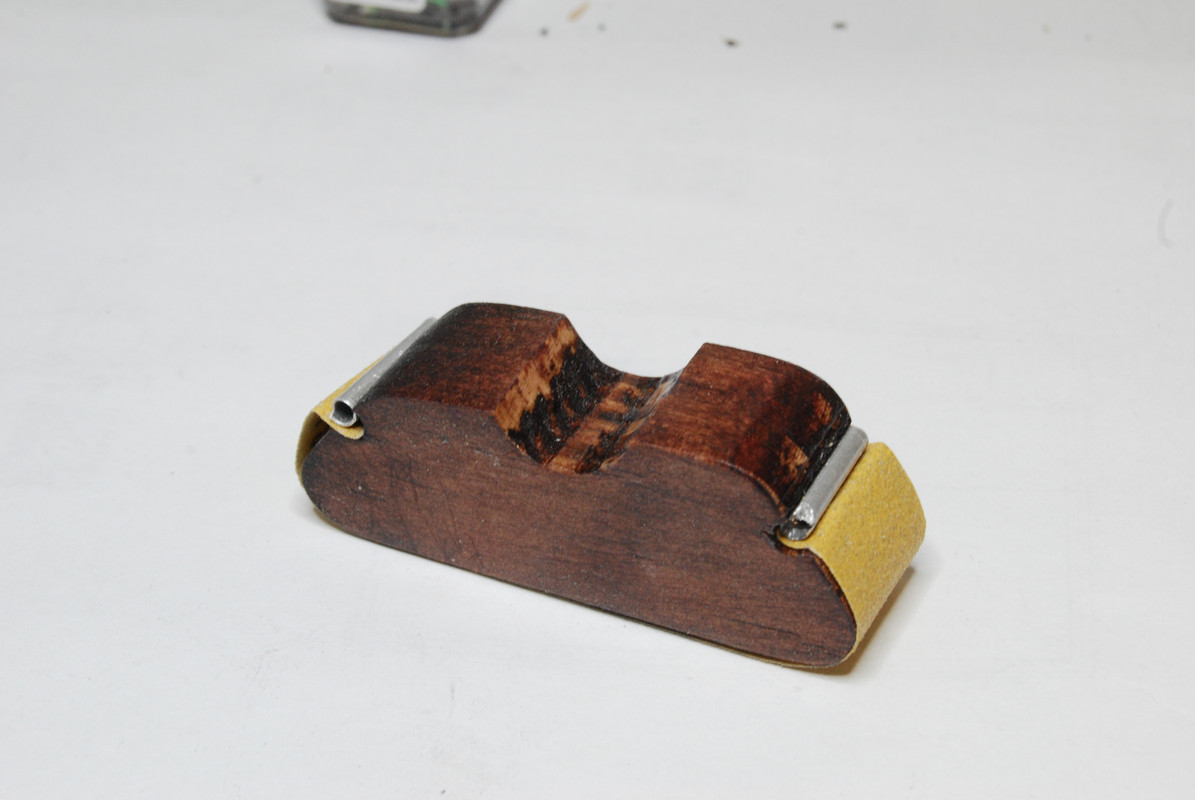
Got tired of wrapping a piece of sandpaper around a small scrap of wood, and decided I need a real sanding block. I googled sanding blocks and found nothing small enough. Decided to make my own. Used a scrap of 1 x 2 pine. Simple cut with my scroll saw. The result is about 2 inches long by 3/4 wide (width of 1 x 2). Made the notches a little too small so I could fine-tune with a circular needle file. Took fifteen minutes not including drying time for wood stain. Works great.
Years ago I’ve bought a block of cork that is rather big, but fits my hand nicely - it’s about 2’‘x3’‘x4’’ with five flat sides and one of the large faces has it’s edges cut at an angle. I wrap it in sanding paper and fasten it to the block with two flat thumbtacks. Works for me.
And when I started using a sanding block about 25 years ago it was a big advancement in my modelling technology - with it I was able to get nice flat surfaces - like when mating two halves of a hull or something like that.
Thanks, Don! Sorry for another followup, but how are they attached to the block?
I’m curious because I’ve made larger blocks, for woodworking. I took two scraps of 2x4, drilled a hole through the center of face, and use a bolt and wing nut to close it. I counter-sank the hole on the sanding face, to accommodate the head of the bolt. I like your design, but I can’t see how the retaining bars are held in place.
Quick answer is friction. By using the needle file to slowly make the hole (or semi-hole) larger, I stopped when the paper and tube just fit into the notch. At that point friction holds everything in place. You have to go slowly with the enlargement and trial fitting but it only took me about two minutes.