gee you do some nice work .

Thanks Steve. Scratch scale models are the direction I had to go…because no manufacturer made the clippers I wanted to model.
Sails are very important details for clippers and they need great attention to detail to make them believable. I chose to make mine from plain paper…and I feel they are believable.
Rob
Working the sails detail
closer detail of the jibs and foresails
Outstanding work!!, very convincing.[Y]
Michael D
Sails don’t have to be hard…these are made from simple copier paper.
With sail pannel lines drawn on both sides, copied, then cut, banded, clews added and then painted. Add some reef point made from white nylon paintbrush bristles…add buntlines…then bent to the yard.
Sails are formed prior to painting with spray paint.
Just that easy and there you are.
Thanks for the nice compliments.
Models ships should have sails replicated…its what moves them through the water.
They are just as important as any other element of a sailing ship.
Rob
If you really want to know how square rigged vessels were worked, then I would suggest Harlands “Seamanship in the Age of Sail”, and for the rigging itself then Biddlecombe’s “The Art of Rigging”. I do not believe that Harlands has been reprinted, but Biddlecombe’s has, both are available on the web.
Jack
Sails, sails and more sails…https://i1070.photobucket.com/albums/u488/rwiederrich/IMG_8991_zpsuxbg9ft9.jpg[/IMG]


https://i1070.photobucket.com/albums/u488/rwiederrich/IMG_8997_zpshpmnatlw.jpg[/IMG]
And from the stern…
Paper.


worked on the GR and am finishing up the spanker mast and sails.
Rob
Another
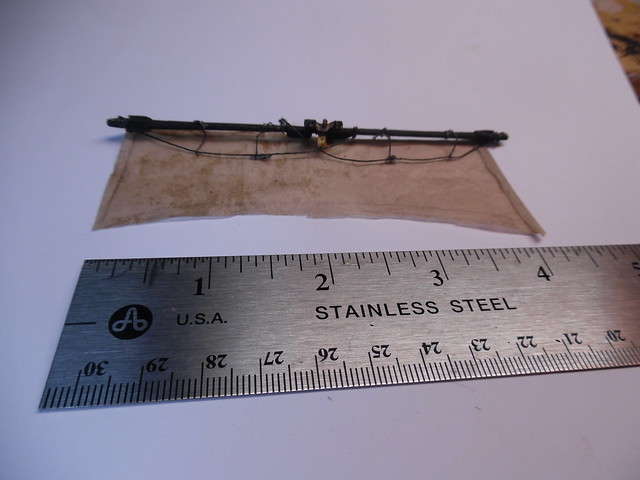
Beautiful work. I love it. But, please explain more details of how you applied your sails, and what matertials these sails are made of. Plastic ? cloth ? or silkspan ? I prefer silkspan, because, the matertial is more to scale and easy to work.
Happy modeling Crackers [:P]
Anthony…the sails are made from simple copier paper. I first draw out the scale panel lines on the paper(both sides)…then I copy the paper(both sides). I make about 20 sheets…so I have pleanty of material to use.
Then I simply draw the sail plan out on the paper sheet(adding slight length to the sail to allow for billowing) and cut out the sail with a hobby knife.
Then I add the clew point hardare(small copper eyes glled to the sail clue point to attack the clue blocks to)…add the belly banding as necessary(by cutting strips of paper and glueing them in place. Once all the details of the sail are added I paint the sail in a typical sail color(I’ve alternated this to give character to the sails)…adding just enough to slightly mask out the panel lines.
As the sail dries I form the sail by rolling with a wood dowel and by using a cake makers fondant/gum paste forming tool. (Simply a dowel with a metal ball on the end…you roll around the sail edge to form its contour.
Next…I glue the sail to the yard…making sure the sail is high and forward on the yard to aid in giving the sail the proper elevation when developing the proper billow as the sail leaves the yard and is pulled forward by the wind.
All my sails were added to their yards while mounted on the masts…the entire mast and its yards was built off model.
Rob


Thank you for your indepth answer to my question. I really appreciate your answer on how to make sails. My procedure was to first cut out a scap paper sail template to see that it fits the spar arrangement. When satisfied, the template is used to trace out the actual sail on silkspan material, which is then soaked in a diluted solution of light acrylic brown paint. The wet silkspan sail is then lightly scotch taped to a rubber ball for a billowing effect. When the sail is dried, clues are glued in place along with the proper blocks, then attached to the yard.
My question to you, is how you provide foot ropes to the yard. My method is to soak black thread in glue, strain out the glue, the. hang the thread for drying. Once the thread is dried and stiff, ends are tied to the yard, while the lower ends are glued to together. Perhaps, you have a better alternative for foot ropes.
Happy modeling Crackers [:O]
Hi Ya’ll;
I forgot this. To get a sail" Bellied" ie.Full of air. I do this, I have a light fixture globe that I keep waxed. I drop the Silkspan on it and Squirt water on it.( At this point the sail is oversized.) It dries to the curve. Then I mount it and the Belly changes according to the yard and rigging tightness.
Well footropes are done several ways…dependant on scale and how crisp I want the set-up to look. I have made them with nylon thread that was stiff enough to hold its form…prior to adding the stirrups.
But all the foot ropes on my clipper Great Republic were made with wire. I glued the sagging foot rope to the yard then added the stirrups. I then painted the entire foot rope assembly black. They look very clean and retain their nice droop without twisting and flexing of string…type ropes.
Rob
I also use wire. In the old days when hobby electronics was popular, I found a supply of very fine (forget the gauge) cotton-insulated coil wire. It had a nice fabric texture that looked a lot like rope, especially when painted with thin paint. Alas I cannot find it anymore. It was only really good in larger scales, and now I just paint the wire with flat paint like you do.
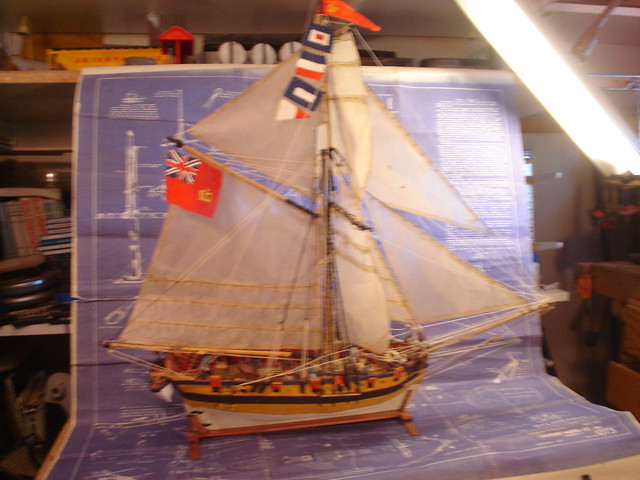
I guess sails for a model is really a personal decision. I prefer to work with silkspan, a tissue like material that is strong and difficult to tear, as is seen on my model of the British revenue cutter DILIGENCE. BlueJacket Ship Crafters of Searsport, ME sells sheets of silkspan at $2.75 each.
Happy modeling Crackers [A]
I think Silkspan is a wonderful material…however, I feel there is far too much work involved in the technique to use it convincingly. It needs to be painted or starched to form it and to mask its translucency. I have seen wonderful sails created with it,but for me it’s too labor intensive.
Here is an image of the wire foot ropes and the wire lifts for each yard on the Mizzen of my scratch built Great Republic. wire works wonderfully and it goes were you place it.
My sails are all plain copy paper.
Rob