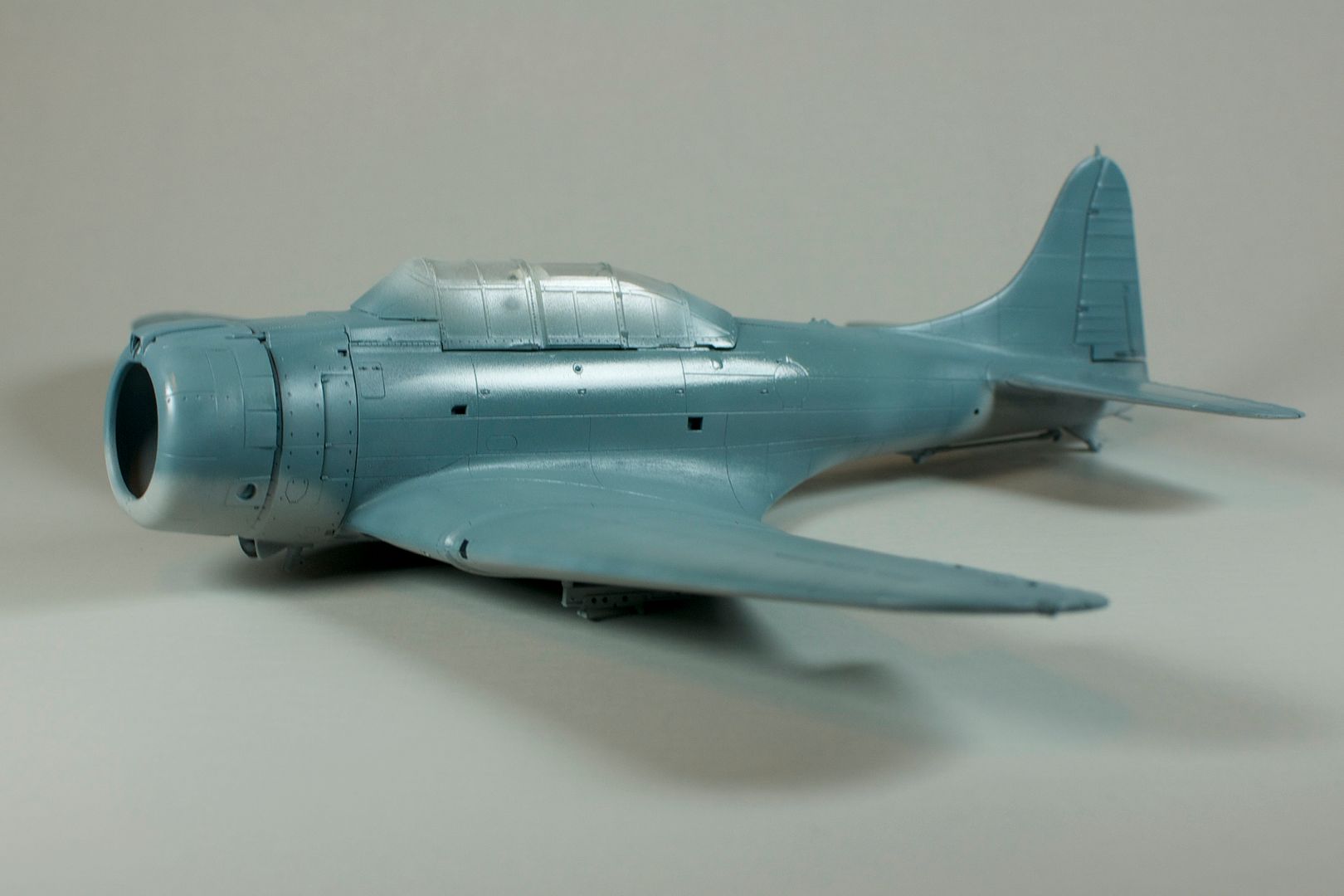
I don’t prime as often as I do & I can’t say that I’ve ever had any adhesion problems. Like mike says, wiping down immediately before painting is crucial - a greasy finger/handprint can make the difference between your top coat adhering well or not so well.
Set up for painting, wipe the kit down with a strong solvent (obviously not strong enough to melt styrene - mild acetone, methylated spirits, IP…) while wearing gloves or otherwise protecting the surface from your touch, give it a blow with your airbrush to ensure everything has evaporated & hit it with paint .
mgh: Model Master Acryl has its own primer, it does work but priming is something I seldom do. Sometimes I might apply a base color close to the final color. That base is paint that has a bit left in the jar, a good way to finish it. I don’t want a 12 jars with a few drops of paint left if you know what I mean.
Absolutely a different and positive experience with MM Acryl without priming. For the record, no parts washing whatsoever, just a surface clean with paper towel quite wet with alcohol.
I don’t have a lot of experience with air brushing or priming, but I thought I would comment on this post.
I have been sucessfull with spraying acrylic paint without using primers. I have used Tamiya, Model Masters and Gunze acryilcs with success on both plastic and resin. However, I have noticed that it does take a lot of paint to get good coverage and the finish is delicate, but looks great.
My current project, I decided to try to use primer. I going to try to use Mr. Surfacer 1200 thinned with Hone Depot Lacquer Thinner almost 2:1 and shot at 12-14psi. You can see my post in this forum on my questions about using Mr. Surfacer 1200
I did a small test last night on some resin parts and the primer left a very nice surface to paint on. I practiced on some sheet stryene and if applied too thickly too quickly at a higher pressure 18-20psi, it does grain up., But when I turned down the pressure, thinned a little more and sprayed very light coats, it left a perfect finish to paint on. I am going to shoot some color tonight to see how it works once painted.
It was a small test on resin cockpit sidewalls, gun bays and jet nozzle. I am going to paint a few colors tonight to see how it looks with different colors and paint. Plan to paint MM Green Cromate flat acrylic, Tamiya Medium gray flat acryilc and MM gloss black enamal (as a base coat for some ACLAD2)
I will try to post some before and after pics and let you know how it turns out.
Hopefully, one beginner (me[:$]) and make some mistakes and help you out!
I have tried MM Acryl Grey primer mixed with flat clear in a 2:1 primer to flat clear, and the adhesion improves dramatically. It also helps if the model is lightly sanded (super fine grit) and cleaned with alcohol prior to aplying the acrylic primer.
there are some tricks you can experiment with to get those craft store paints to adhere better
you can mix a little Future in with the paints themselves, you have to thin them anyway to brush or spray them, a little bit of flow extender might help you out, too,I use Anita’s, from the Hobby Lobby
LifeColor, Floquil PolyScale Railroad, and Model Master Acrylic all have a primer
the main thing is to remember that the Folk Art, Americana, and Apple Barrel paints practically insist on a rough surface to adhere to,when I starting playing with them, they always peeled with any masking if the paint underneath was the slightest bit glossy
I know why you are using them,it is hard to beat a 2 oz bottle of paint, even if you have to buy a 1oz (Floquil RR) or 3/4 oz (Lifecolor) of primer in order to use them
my “A-List” of primer and paints is LifeColor primer, a bit of Anita’s in the paint (or LiquidTex Flow Aid if you can find it), and I use the same brand of primer as the paint to thin with
I hope this gives you some help with your experiments
I have not tried thinning with Future. What I am using for paint is artists acrylics in tubes, not the craft paint (though I do use a flat black craft paint for some detail work). I typically thin it with Windex.
Are you suggesting I could thin my paint with Future and forgo the priming all together?
Wow. This thread is definitely a testament to the idea that what works for some doesn’t work for others, and vice-versa. Using Lifecolor without a primer? Last time I tried that I may as well have been misting the plastic with water. Over primer and, better yet, over a misted coat of itself, it goes down great.
Personally, I fall in the “always prime” camp. First because I do believe it’s better for paint adhesion. Second, it helps me spot flaws I need to fix. And third, it hides the nastiness of putty, any mixed media going on, etc, and provides a uniform base from which to paint.
If someone held a gun to my head and forced me to pick just one primer (that’s a humorous scenario, isn’t it?), I’d have to say Model Master gray enamel primer. And that’s having used Tamiya’s stuff, Mr. Surfacer, Alclad surface primer…the MM primer has always been consistent and consistently great.
The problem with thinning with windex is that the ammonia in the windex actually attacks the paint (what makes it such an effective cleaner) with (at least to me) unknown results for its adhesion and durability.
Can’t speak for artist acrylics, but I’ve thinned Vallejo rather successfully with Future. Sprays pretty well, unless you’re trying to go ultrafine with, say, mottling camo or something. Dries to a smooth, rather durable finish. I’ve experienced no paint lift on the two builds I’ve tried it on (save for the canopy frames of the Dauntless, but I blame that on the Lifecolor interior green, since it lifted away and the Vallejo was just along for the ride). BUT…they were primed.
I didn’t mean that I can use Future as a thinner and then spray without a primer coat first
I am a firm believer in using a primer,it’s the only way I can get LifeColor to adhere to plastic,and I need something to cover up the putty from my “modeling skill”, lol
the Future should work the same with the tube Acrylics as with the Folk Arts,just make sure to only use it for part of your thinner, it won’t evaporate, too much could leave you with not enough opacity
I did just think of something for a cheaper primer, though
Future mixed with Tamiya Flat Base,after dipping a canopy, the paint sticks well enough to the Future coating,maybe mixing a few drops of white in with Future and Flat base will give an Acrylic mixture that adheres well to the model, and has “tooth” for the color coats
Doog, you have a point about different results for each person,I watched the owner of my LHS brushpaint Model Master Acrylics directly from the bottle onto his model, without a primer at all,I sort of winced when I saw it,the next week, the model was decaled and setting on display with his others in the case,no way I would try that
Interesting about the Windex attacking the paint, maybe it is time for me to experiment with some different thinners. I have only been airbrushing for a little while, and when I first began, I think I tried using windshield washer fluid, but not with great success.
Other thinning suggestions? Keeping in mind that I am spraying indoors, which limits me to acrylics.
I am just about ready to prime an A-10, which is one of the main reasons I am looking for a primer I can airbrush, it has so many nooks and crannies to try to get into. I have carried pieces outside in the past and rattle-canned them with primer, but difficult to get a decent even coat (for me) when working with odd shapes. Unfortunately I have had to put the model on hold for the last week or so, but hope to get it at least primed over the weekend.
I’m with ya on rattlecanning. Even with the really good spray heads I feel like it’s a bear to control. It’s a hammer when you need tweezers.
As for other thinners, I’ve had great luck with Testors’ universal acrylic thinner. In fact, it’s what I use now for both Lifecolor and Vallejo. Not entirely convinced as to durability, but it sure makes them spray well and alleviates most tip-dry issues.
Just…whatever you do…beware of thinning with alcohol-based stuff. It can work great on some acrylics, but it can cause others to clump badly and really mess up your airbrush.
Still have not managed to find any model acrylic primer locally. I did some experimenting with no primer, with gray rattle-can primer, and even mixed up some hardware store latex primer. No question in my mind that the rattle-can primer was most effective. After carefully wiping down the model with rubbing alcohol, spraying the acrylic straight on with no primer appeared to work, though the only test I did was to stick some blue masking tape on it after a couple of days cure time. I will say that I thought it was a little more difficult to airbrush with no primer; I thought it took a little more care and patience, building up thin coats.
If I ever decide to make an internet order for supplies, I will order some Tamiya acrylic primer and see what kind of luck I have with that. It’s either than or try to fashion a DIY paint booth, but I am trying to tame my spending on supplies. I only came back to the hobby last May, and it is truly frightening the amount of money I have spent on supplies, kits have been a minor expense in comparison (but then my ‘stash’ totals 7 kits still untouched).
At any rate, I appreciate the help here, and thought I would post an update.
This is something I would like to experiment with as well.
Yes Windex is normally used for cleaning the airbrush, not as a thinning agent, but so is Isopropyl alcohol for that matter or any other thinning agent. I am no chemist so I don’t know the differences in ammonia and alcohol as far as attacking the paint goes.