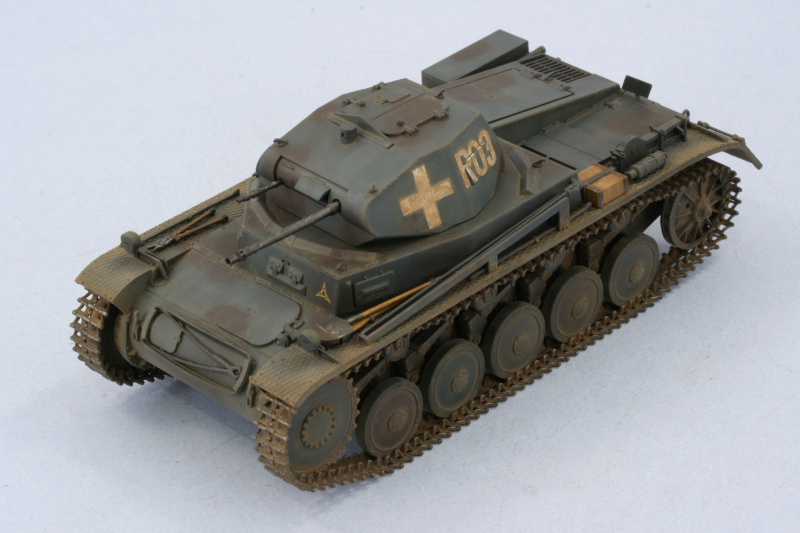
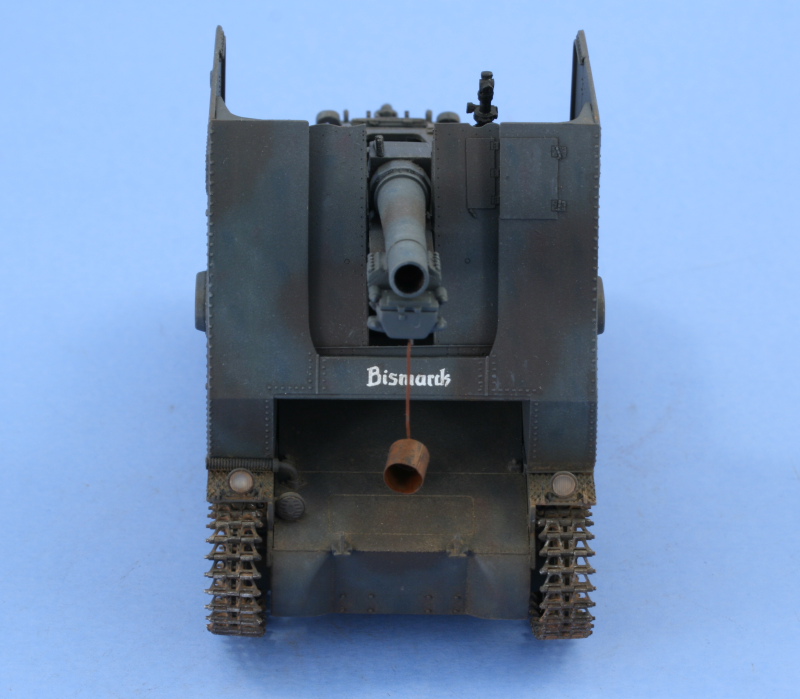
With respect to both Bill and Eric, and a nod to the impressive amount of scholarship and depth of discussion going here, this reply here convinces me yet again that when it comes to the discussions of “correct color”, all opinions are correct within a reasonable parameter, and that the best a modeler can hope for is to get a color which satisfies him, and damn all the rest who claim to “know” the alleged “truth”.
When you get down to “scale effect”, weathering, photographic variables, printing inconsistencies, computer monitor differences, and just plain evidential discrepancies and throw in crew-painting inconsistencies and even possible manufacturing variables and inconsistencies in the actual paint, and you’re really just chasing impossible-to-know, dubious conclusions.
Of course you’re right. This is called wasting time on a subject that’s fun. Might note that Jentz and Doyle would disagree. If you check out their article (written in 2002 I think) they proudly announce that they’ve tracked down the prewar colors and the colors used through the French campaign. And they caution modelers, if they care about accuracy, not to build any German tanks that fought after June 1940. Other volumes are out now, so I suppose if you buy them you can paint a Panther. Personally, I wish I could prove that American and British tanks had four color camo. I have eight US AFVs (never built one) and they’re all supposed to be olive drab. Sounds like mud and snow time to me.
I will have time later today or perhaps tomorrow to read through your latest post but just wanted to drop a quick note to let you know that by no means am I seeing this discussion as adversarial. [:)] I too am a historian by training (it’s what BA is in, I served as an undergrad TA and considered a career in academia before my student loan debt convinced me otherwise!) and so am viewing this discussion through that lens. [B]
To Karl’s point, there’s no way we will be able to establish a 100% certain/concrete position on this issue one way or the other…and I readily concede that there are multiple possibilities out there that may yet be further explained/modified/tossed out as research continues and more evidence comes to light over time. [;)]
The fine art of paint mixing is a long standing one in the modeling world. I often custom-mix my colors all the time. If you want to engage in that, my suggestion would be to get a color wheel and do some reading-up on color theory. Things that we think should happen from an intuitive standpoint often don’t once you start getting into the mix-and-match approach. [;)]
It has taken about a decade or so for that to be widely accepted as true that there were 2-tone vehicles in France. Whether or not ALL the vehicles in France were 2-tone is up for debate as there were clearly still 3-tone vehicles/gear running around in various locations as supported by the current photographic record.
There’s no doubt that Culver/Murphy came before Jetz/Doyle and that both teams used some of the same documents…but Culver/Murphy relied on a translation vs. the original source documentation as asserted by Jentz/Doyle. Jentz/Doyle always assert in each of their PT editions that they work only from primary source documentation and that their conclusions are based solely on that. Does that mean that Jentz/Doyle disregard non-primary sources that others might have used? Sure…so that’s a factor we always have to keep in mind. Primary source/original documentations have their limits and this could produce the opportunity for gaps to be filled by conjecture/speculation/interpretation.
I agree that the 1939 date reference is the key here…and we know that historians can and do hang their hats all the time on potentially suspect assertions if it serves their ultimate end purposes. When I read this, I see it as an attempt by Jentz/Doyle to show that Culver/Murphy incorrectly (whether deliberate or not is up for debate) claim that an alteration happened in 1939 while Jentz/Doyle do not. Jentz/Doyle only mention it in their defense of why they believe that ALL France 1940 vehicles would have had the 2-tone scheme. For whatever reason, Culver/Murphy used the Wiener data to support their assertion that 1939 onward was montone while Jentz/Doyle say the Wiener data does not indicate this at all and furthermore the actual official order timeline chain doesn’t either.
I don’t see the non-sequitur you do here. Jentz/Doyle are continuing down the path that says we have hard evidence of 2-tone in Poland (something you agree is true) that ties to the Nov 1938 order timeline. Jentz/Doyle, working from the original order documentation, have an official signed order dateed July 31, 1940 as the first official indication that a change from 2-tone to monotone was ordered. They also state in PT 1-2 that in June 1940 an official order was issued about units not buying paint directly and that montone scheme was now the order of the day. The follow-up order of July 1940 reinforces that June order, nothing more. Since the previous order that it replaced was dated Nov 1938, it is an accurate assumption in the absence of an official order stating otherwise that until June 1940, the official authorized scheme for all vehicles serving at the time of the French campaign was the 2-tone scheme. The key here is that there isn’t an official order that says a monotone scheme was authorized for France 1940.
I agree that the lack of a paper trail is critical around the monotone scheme and the absence is glaring and very important when viewed in the larger context of how the German Army went about procuring and accepting equipment and how equipment was handled in the field after acceptance. The Waffenamt had multiple different departments in charge of various aspects of the entire procurement and they were mechanistic in how standards were set, who had to evaluate and approve them prior to when they were set, and when they would go into effect and what contingencies were allowed in relation to their implementations. The German Army had to pay for everything they got from the different manufacturers and paint was something they bought and used on an industrial scale. There was not a paint shortage though…the phrase “save on paint” doesn’t mean there was a shortage. The panzer gray was applied first to the hull and the 1/3 disruptive pattern was sprayed over it, so by not applying the Dunkelbraun, it would save on paint (and time) at the factories and depots. Solely a procurement decision once they had sufficient info from field experience that the camo pattern was ineffective. Since they had to issue orders to literally dozens of manufacturers and depots for all the various equipment being ordered and produced, it was a very big deal. They wouldn’t have done it ad-hoc.
See comments above about the saving paint angle. I think we can agree that repainting in the field was always a low priority as evidenced by how slow units were to comply with the already-year-old directive at the time of the outbreak of war in Sept 1939 to convert from 3-tone to 2-tone. The depots/factories on the other hand faced no such limitations and were in compliance with the orders for new equipment being delivered 1939-1940.
I agree that the end of the French campaign offered a natural break-point in terms of hindsight around why the new order was issued around vehicle paint schemes. But we have to remember that at the end of the French campaign things didn’t just “stop” for a period of time in terms of activity. Prepartions for possible Operation Sealion were underway, efforts were still ongoing in the Norway campaign and there were ominous rumblings coming out of the Italian efforts in N. Africa as well, nevermind the preparations for possible actions in the East against the Russians.
We do have a paper trail for the German procurement contracts (in each of the PT editions you see the evidence for that for each vehicle type, same thing in Spielberger’s work on production schedules, etc.) and the general orders issued not just to specific manufacturers but also to units in the field around everything under the sun from maintenance schedules, to parts ordering, to paint, to training, etc. The Bundesarchiv has enormous amounts of paper to support virtually every aspect of the German war machine activity, especially the early war periods when everything was being handled down to the “t” from a bureaucracy standpoint.
See my post above with the color chips as referenced on the official RAL Farbtonkarte Nr. 840 B2 that was updated in 1938. They are color chips, not swatches, but don’t know anything more beyond that. Could those have changed over time? Possibly, but not dramatically…they weren’t exposed to the elements, weren’t on a recovered vehicle, etc. Jentz/Doyle state that they have accurately replicated them in the print (color pages are not the norm in the PT series of publications). As you can see when viewed in color, the tonality between the two is very very close and how much they would change once exposed to the elements is up for speculation.
You are correct that a disruptive pattern is designed to break up the outline of the vehicle. In a “clean” environment, the 2-tone does that but on a muted basis vs. the previous 3-tone scheme…however in-the-field experience eventually showed it lost its value once the vehicle had any kind of dust or dirt accumulation. It is not the first time that the Germans changed the paint scheme after field experience demonstrated that the authorized schemes weren’t effective. Witness the later change from monotone Panzer Gray to monotone Dunkelgelb in Feb '43 after experience in Russia (and the loss of air superiority) over an extended period (with field discretion for applying Olivgrun and Rotbraun for the full 3-tone) and the Tropen schemes introduced in Feb '41 for N. Africa and modified again in Feb '42.
This assertion is backed up…there are many photos of “clean” vehicles where unless the lighting is absolutely perfect, it’s difficult to pick out the two tone. Doesn’t mean it isn’t there. Film quality of the era has already been mentioned and when the photos were being taken, it was often by amateurs whose intent was not preserving pristine replications for future generations of model builders. [:)]
It’s all about sample size. The handful of photos that count as “high quality” where you can see the two-tone is limited to be sure but as time goes on, more are being found in personal albums and collections as that generation dies off and their estates are sold. This is leading to a dramatic increase of available photos in terms of volume vs. only the official Bundesarchiv and similar sources content, much of which was recycled repeatedly over and over in different print publications. For example, I have color photos of a Pz IV-D in France in a nice field where you can only see the 2nd tone on a small portion of the lower rear hull because of the lighting/angle and dust…but it’s there. See also the Pz I color photo I posted earlier…it’s there but hard to see without looking closely and that’s of a vehicle also in the field. You simply cannot discount the huge distortion effect of a dust coat combined with lighting, camera, film, etc. variables in order to establish an absolute based solely on the photo evidence.
Not all of them have been hidden. Where it’s not hidden, we have evidence of the 2-tone scheme being present. No one is arguing today that there weren’t 2-tone scheme vehicles in France in 1940…but at the time Jentz/Doyle first published their findings in 2002, that was exactly what was being argued…that 2-tone was only applicable to Poland and not France. [:)] See my comment above again about sample size…and why this particular topic is so vigorously discussed in many circles. Because it is human nature to want absolute certainty, when we don’t have it then it comes down to what are the variables, what are the interpretations, and when do certain circumstances apply or not apply.
The photographic evidence, because of all the variables that it contains, can only offer supplemental evidence vs. concrete proof of something having taken place. In absence of the concrete photographic evidence showing that ONLY the 2-tone scheme was used, we have to fall back on what IS available as concrete evidence. That is the official order timeline and when those orders were dated. We can speculate all day long about what happened prior to the official orders being issued…but the fact remains that the official order date is a concrete anchor point around which the supporting data can be assembled. And that’s exactly what happens…people assemble the supporting data that supports their position around that anchor point and then the camps form until such time as other supporting data for/against the different positions comes to light and then the camps will shift.
For me, personally, I prefer to apply the 2-tone scheme for Poland or France 1940. It is the majority position based on the documented and photographic evidence to hand, i.e. the 2-tone scheme was ordered since Nov 1938 and was not countermanded until June 1940 and the photographic record exists to show how close the 2-tone scheme colors were to each other. Then, as a builder, I work off the other evidence I know is also supported by the photographic record around dust, weathering, etc. to create the effect I’m after, like this: