I’ve taught and written military/diplomatic history my entire life and can testify that “revising” a given party line can make for some very good history: see the much more complex and rich view of the Crusades held by contemporary historians when compared to the cardboard “religious fanatics/land-hungry noble” argument put forth by Gibbon and copied until the 1950s. It can also lead to calamity: I saw diplomatic history destroyed by neo-Marxists writing during the heated atmosphere of Vietnam convince the bulk of the historical community that the Cold War was caused by Harry Truman and not Joseph Stalin. (This point of view has changed a bit since scholars got into the former Soviet archives, mostly thanks to Boris Yeltsin. Turns out “Uncle Joe” was a bigger thug than we dreamed.) One thing about “revisionism” - it’s a very good way to get attention if you can make your case. And it reflects a very profound and fascinating phenomenon: at certain levels we know more about the past than those people who lived in it, at others, we know profoundly less. This is true in little issues too. Can even raise temperatures in the room. (Henry Kissinger once remarked that faculty politics were so nasty because the issues were so small.) So let’s look at the great color debate.
Jentz and Doyle have spent years writing and researching German armor. They’ve obviously found a good niche. I have one of their books and I like it. Along the way, however, they found it useful to make what I find an extremely questionable argument that knocks a prominent work of the generation preceeding them – “Panzer Colors” by Culver/Murphy. Below are some bits from a piece by Jentz and Doyle: note their claim to new evidence and the implied argument and Culver and Murphy didn’t do their job:
Panzer Facts #4
ACCURATE CAMOUFLAGE COLORS AND PATTERNS
FOR GERMAN PANZERS FROM 1933 TO 1943
by Thomas L. Jentz and Hilary L. Doyle
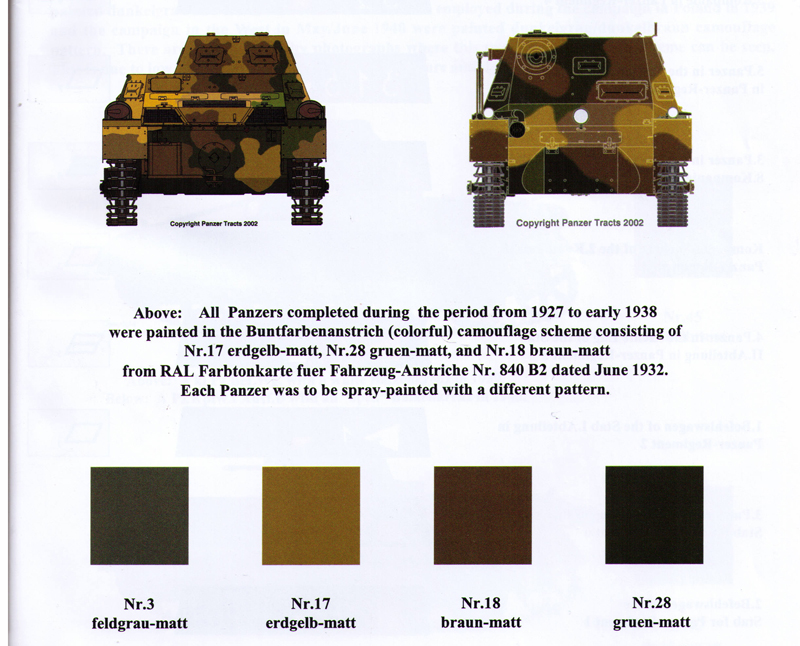
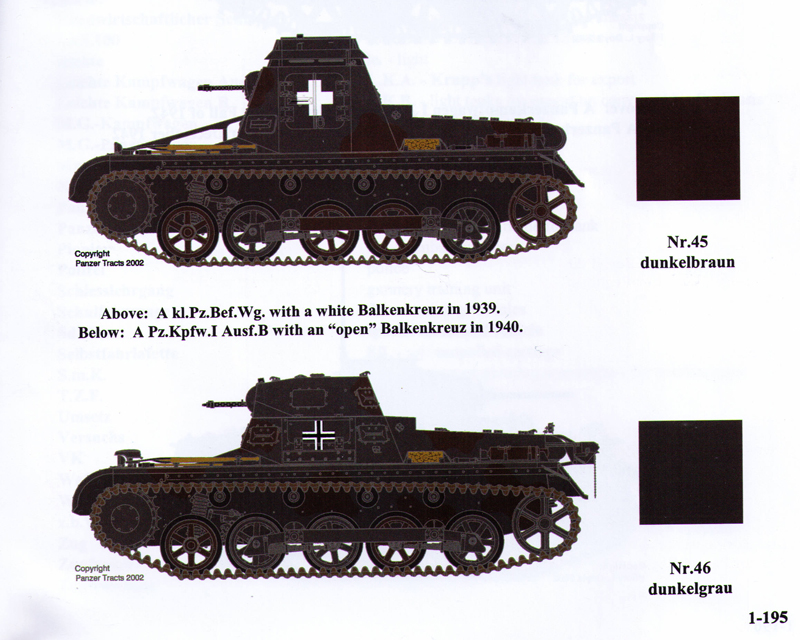
The correct camouflage colors and patterns applied to German Panzers from 1933 to 1943 have been published in the recently released Panzer Tracts No.1-2 - Panzerkampfwagen I - kl.Pz.Bef.Wg. to VK 18.01. These colors are based on German Army orders and manuals and original RAL paint chips from 1922 to 1941.
How did we succeed in getting these colors and patterns right when so many other attempts have failed? The answer is simple - persistent in-depth research that took over 15 years. This investment in time and money was needed to sort out the right answers when we were faced with seemingly contradictory evidence. We also refused to release the results until we could accurately print the colors through a tightly controlled process.
What caused others to publish results that are so far off the mark? It shouldn’t have been lack of guidance. Our good friend and mentor, Walter J. Spielberger wrote an article entitled “Coloring of German WWII Tanks” which was printed in George Bradford’s AFV News Vol. No.3 in November 1965. Spielberger stated that: “Up to 1935, the Reichswehr colored their vehicles in the usual multicolor pattern, mainly green, brown, and yellow. Starting in 1935, the official paint for all German vehicles, including armor, was a dark grey/dark brown combination. Since 1940 the dark brown was discontinued and all vehicles were painted in dark grey only. . .”
As an example let’s look at the Squadron/Signal Publication “Panzer Colors” since it is widely known and many modelers, model magazines, and other authors use it as their key reference. The authors of “Panzer Colors” state:in their Sources and Acknowledgements:
“The basic information on official WW II German camouflage color specifications is contained in a c. 1957 paper by F. Wiener, written for the R.A.C. Tank Museum at Bovington. . . Walter Spielberger’s book on German armored cars, 1900-1945, provided the material on Reichwehr color schemes. . .”
on page 9 in the text:
In 1922 new standards for painting vehicles were issued, retaining the wartime gray, green, and brown for combat type vehicles, . . .
on page 10 in the text:
In 1935, the new Wehrmacht standardized a new basic scheme for all large items of military equipment, including all vehicles and large weapons. The colors were dark gray and dark brown, and the proportion of color to be used was 2/3 gray to 1/3 brown, . . ."
and, on page 11:
“The Campaign in France and the Low Countries was fought by German vehicle painted overall dark gray, . . .”
Walter Spielberger had already correctly determined that the Reichswehr colors were yellow, green, and brown not gray, green, and brown. So where did the authors of “Panzer Colors” come up with the idea that the “Reichswehr” colors were gray, green, and brown - and - where did they get the false impression that Panzers employed in Poland and the Campaign in the West were painted dark gray? Let’s take a look at the reference that they claimed was used.
David Fletcher at The Tank Museum provided a copy of the document that the authors of Panzer Colors stated that they had used. The report “Der Anstrich des Heeresgeraets 1939-1945 1945” was written by Fritz Wiener (a close associate of Walter Spielberger). This report had been translated into English in November 1967 as “Painting of Army Equipment 1939 - 45” and contains the following relevant statements: "With the change from multi-coloured combat uniforms to plain colours, striking colours were avoided on equipment. As far back as 1914 all armies went on active service with their equipment painted grey-green, grey-brown or in a similar unobtrusive colour. During the first World War they attempted to make large equipments (guns, vehicles, etc.) less visible to the enemy by painting them with large irregular patches in shades of grey, green, and brown. This so called “Mimicry” type of painting was then adopted by the Armed Forces (Reichswehr). . . After 1935, the Armed Forces introduced a new and considerably darker shade of grey-brown for use on their equipment. . . .This paint was in general use in the Fall of 1939, but the first alteration came in 1939 (sic - 1940 in the original document).
OK: now let’s see what Culver and Murphy actually wrote on the page 10 – a page before they made their “error” and one not mentioned by Lentz/Doyle:
“Late in 1939, a new specification was promulgated, changing the official vehicle color scheme. In order to save supplies of paint, vehicles and equipment – previously painted dark gray and dark brown – were to be painted in overall dark gray. It is probable that this order was not completely carried out before the invasion of Poland on 1 September 1939. After the Polish campaign had ended, the winter of 1939/1940 was spent in repairing damaged vehicles, bringing the new Panzer Divisions up to strength and replacing many obsolete tanks and vehicles with more advanced types. By Spring of 1940, most vehicles were painted in the single color dark gray. HM 1940, no. 864, dated July 31, 1940 standardized this order for all vehicles and heavy equipment.”
Culver was wrong about the Reichswehr Yellow. But what the two tone Panzers of 39/40? In another piece Lentz/Doyle argued that “all” AFVs through the French campaign were in two tone. Culver argues that those two tone vehicles still in use from Poland (several hundred vehicles) would like have remained two tone in France, but that anything new or rebuilt would have been gray. So Culver says some of the AFVs were brown/gray but most gray. (For Lentz/Doyle claims see below.)
(http://www.armorama.com/modules.php?op=modload&name=SquawkBox&file=index&req=viewtopic&topic_id=172769&page=1
But let’s get down to where the two agree. Both Culver and Lentz/Doyle agree that something happened in 1939 concerning color: this quotes Lentz from above: .”After 1935, the Armed Forces introduced a new and considerably darker shade of grey-brown for use on their equipment. . . .This paint was in general use in the Fall of 1939, but the first alteration came in 1939 (sic - 1940 in the original document).” Do note the term “alteration” – this means something changed. Culver wrote a new order was “promulgated” in late 1939 (not clear if this meant after Poland, but if the incentive was to save paint, this would have referred to new vehicles – you wouldn’t save paint by repainting old ones) ordered vehicles be painted gray. The two are saying exactly the same thing here. What Culver doesn’t have is a Directive #. If you’ve ever studied a bureaucracy you’ll know that a good idea leading to action on the is often later followed up some a stamp of approval written in triplicate by the appropriate office. So let’s think this one through.
- Everyone who was there and talked about it said German tanks in France were gray. Lentz/Doyle argue that the gray and brown colors were so close that they are rarely possible to identify in the photo record. Lentz/Doyle repeatedly claim the photo record is overwhelmingly misleading – this tells you what the people that took the photos thought. To me, this is a red flag.
- Both Lentz/Doyle and Culver agree that something happened in late 1939 to alter the brown/gray pattern. I guess Lentz/Doyle argue that this was a proposal not acted upon until it had been approved by channels in July 1940 when gray was adopted as a general color. Culver/Murphy argue that in late 1939 the Wehrmacht began painting new AFVs gray but that this did not become the norm until the reequipment process of winter 39-40. (I can testify that the process referred to did take place. It was a time of furious activity throughout the Wehrmacht – indeed, the speed with which they worked as opposed to their enemies showed up in May 1940.) Culver agrees that some German AFVs would still have had the gray/brown scheme in May 1940. Lentz/Doyle argue they all did.
- Classic impasse. A conservative historian would say “case not proven” and leave it at that. Let’s look for something that has the “ring of truth.” A change in color scheme either takes place or is proposed in late 1939. The status quo was gray/brown. Why make the change at all? Two answers immediately suggest themselves. 1) Because the colors were so close, painting them both was a waste of energy. 2) All gray was better, so let’s change what we’re doing and paint them all gray.
- This leaves at another point where there is agreement. In July 1940 the Wehrmacht went all gray. They did this in the wake of the most spectacular military victory of the 20th century until that time. If all AFVs in the Wehrmacht were gray/brown, why, pray tell, would they make the change at all? Was this simple inertia – of a decision proposed in late 39 put into action in the summer of 1940 regardless of the outcome of the greatest triumph in the history of German arms? Or was it the final bureaucratic seal of approval of a process that had been going on for about nine months and was viewed as vindicated by the French campaign? (Would also mean repainting a small number of two toned vehicles as opposed to repainting the entire Panzerwaffe.) Might add that the second argument sits nicely on the side of the photo record and the memories of a small army of old soldiers.
I have not and will not spend years studying German AFV colors. Maybe Lentz and Doyle are right. If so good for them. If nothing else, modelers can paint brown and gray early war tanks. If they had a proper “paper trail” rightly beloved of historians, there’d be no quibbling. Some progression of documents that said “we’re wasting the German tax-payer’s Reichsmarks on brown paint – let’s think about repainting the army next summer.” And maybe they took one document and a very select group of photos and came to the wrong conclusion. If they did so, they would be in a very large boat. There are few more vague notions on earth than progress, and nobody in the field of history will take newer research as better.
And while we’re at it what is gray? If you really want to know what Panzergrau looked like at the factory you’d need to know the pigments and their ratios. Knowing the “color” tells you only the ball park. In front of me I have a tube of Winton “Paynes Gray” one of the most important colors in art. Winton, like all quality paints, lists its pigments. Here’s how they make their “gray”: Pigments- Ultramarine (PB29; Amorphious Carbon (PBk6); Powdered Slate (PBk19). Used individually those pigments would make dark blue, black and white paints. Together they make a dark gray. I used this paint in addition to some black and white (basic gray) and got a dead ringer for Tamiya German Grey.
The End.
Eric