Ive been building for a long time and always wondered about surface detail on aircraft models they always seem out of scale be it rivets or panel lines seems to me to take away from the model. in all but the larger scales and even then their over done anybody else feel this way. Hope to here from all of you. Alex.
True. Except on larger scale models such as 1/32 & 1/24, they are pretty much out of scale. But they do add visual interest to an otherwise plain surface. I think the current trend of recessed lines and rivets is often overdone. Many vintage aircraft had overlapping skin panels and raised rivets, yet that is seldom replicated accurately in any scale. Nearly 50 years ago, Revell was repilcating flush rivets on some of their 1/32 kits with embossed circles around the rivet head, rather than as simple divets. This produced a far more accurate looking flush rivet. If it could be done with the mold technology available then, why not now?
THANK YOU! My thinking also. Bob
Mine too.
I’ve yet to see the real deal with recessed panel lines.
I would be in heaven if someone made a 1/48 DC-3 with all of the overlapping panel joints, strengthener plates and so forth molded on. Of course at some point, after some service, every a/c is a little different.
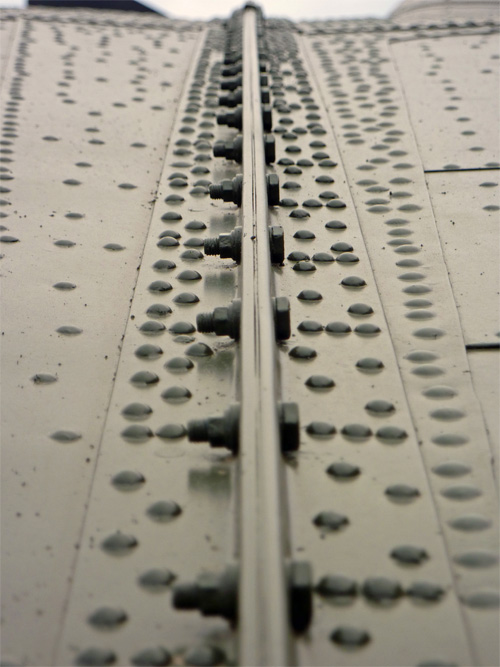
This is the wing join on a C-47, just outboard of the engine nacelle. I would love to see that done properly in 1/48 as well. I dont see anything recessed or butt joined… well maybe down teh center of that external rib with all those protruding bolts… The rivets are not exactly perfectly aligned either… Rosie must have had a late nite before she worked on this one.
Agree. Except for those of us with experience around real aircraft, I suspect most model panel lines have little significance for the viewer. In 1:72 I usually fill and remove most panel details, seems no loss of appreciation by others examining, For airplanes with tight tolerance sheet metal skins, like Gulfstream and Falcon exec’s, the paint completely conceals virtually all details. Good post, I found it relevant.
Stik- you really are a lovely man! I’ve boarded more than a few 737’s with some hours on em, and been fairly appalled by the amount of reinforcing plates that get added around the corners of the doors and windows.
Thats not a rib son, thats a flange!
When I was a “tad”, I got pretty good at running the tip of a very sharp lead pencil along raised panel lines. I thought it looked very good, at the time.
This conversation really makes me miss you-know-who.
I was on the fence with panel lines but now I’m one of the guys who likes them. Especially recessed panel lines.
I am now warming up to panel line washes. I’m in the finishing stages of a build right now on which I used an enamel panel line wash…Ammo of Mig to be exact. I thought the results were great. I feel like it gives the model a constructed look as opposed to a solid look. Plus, having the panel lines opens many more doors when it comes to weathering.
Do panel lines they exist on the real planes? No, not really. But in the modeling world there is no doubt that they bring much more visual interest. In my minds eye a build that has no panel lines, although accurate, looks like an obvious model or even toyish. I don’t mean that as an insult to anybody’s work but that’s just how I feel. The panel lines make up for something that is lost in the scale, I believe.
When I see a model with no lines I see a solid piece of plastic. But when I see panels I think “Hmm, I wonder whats under that access panel on the wing?” With the lines I tend to mentally see inside the plane as well as outside. When I see a model with no lines I see just a model. But when there are lines I tend to see all the parts of that model.
This is all especially true for me when I see models that are also weathered well.
Fortunately bipes don’t have many, if any at all. However, I do find them useful as guidelines for weathering the panels they border around.
I like the surface detail. I feel it does just give the model a bit more character than a bare piece of plastic.
I’m with Mike and Fly-in-hi on this one. I realize full well that these aircraft are not “precisely” the way the plastic kit represents the panel lines. Just the way the right tool for the job is crafted a particular way, these panel lines are as such so as to trap a wash or paint of some kind in an effort to represent a border or framework or a pop of color where it’s needed to help convince the eye of what it’s trying to see. Of course everyone here realizes that already. But I still think it’s important to verbalize the significance of suggesting a shape with a color or a shadow to help create the illusion of something that’s maybe too difficult to mold or shape.
Now, I won’t argue that with newer technologies available…that perhaps one of these big companies needs to cowboy up and slide mold us a new G@# DAMNED kit that’s been plagued with issues in the past. I might guess that it costs a lot of money to invest in a kit that may not make that money back. Soooo… There’s my 2 cents. =]
How epic would it be though if a C-47 or B-17 came out with a true to life construction? Even as AM add ons?
I find working with a recessed PL is easier to get a visual break but I find a well done pre shade/post shade on a raised PL can yield a very real result. Here’s an example of raised Pl’s that I think looks more realistic, perhaps due to the non-highcontrast of bare metal vs the typical dark panel wash of recessed PL’s

I absolutely agree Reasoned. =] I haven’t sanded off any of the raised surface detail on the Revell/Monogram P-40B that’s currently on the bench. I’ll drop an example here perhaps as soon as I can get past the engine detail and put a coat of primer on it. But certainly a raised panel line should be nothing to worry about. I think all it requires is a slightly different touch when trying to leave whatever wash/pigment/etc you’re bringing out.
I’m just waiting for the forced perspective to come into vogue. Then I’ll have to figure out the sun angle and adjust for shading…
I have to agree. I work my fair share of hours on a flight line, and been around aircraft for most of my life, and all your Skyhawks, Cherokees, Bonanzas, Barons, ect. have overlapping panels AND raised rivets. Heck, even your older model Citations and Lears have overlapping panels for the most part. Now with your newer aircraft like Cirruses, Diamonds, and Columbia/Cessna 300s, thats not so much the case anymore.
Mine is another vote for panel lines and rivets. I reckon they look great when done well. Like on the recent Tamiya 1.32s for example… some of the stunning weathering on the planes you see online wouldn’t be the same without that detail in the molds. Like this one by Marek Vrzak , for example… (apparently this plane took him years to finish).


Perhaps manufacturers wil just give us a kit with “smooth” parts, with foil, adhesive and a rivet tool and say “Have at it!”. It would save them a lot of time and money on detailing ( and kill the debate on raised or recessed panel lines). Might bring up some other interesting debates, however… [:D]
I think the key to panel lines, raised or recessed is “subtlety”. From no panel lines, you get the other extreme of over-emphasised panel lines that make the model look like a jigsaw puzzle! I guess that’s what modeling is all about.
Gary
Ok, so who remembers the “good old days” when Airfix’s planes were covered in a forest of rivets and Matchbox’s had trenches a 1/72 scale hand could fit in without touching the sides? [:)]
HOLY CRAP really?!?
Yeah, the boiler-plate rivets! They made the model look like a steampunk subject!