I picked this up, it was listed as “started”.
It’s long OOP, so I did what I could.
Can you identify subject, scale and manufacturer?
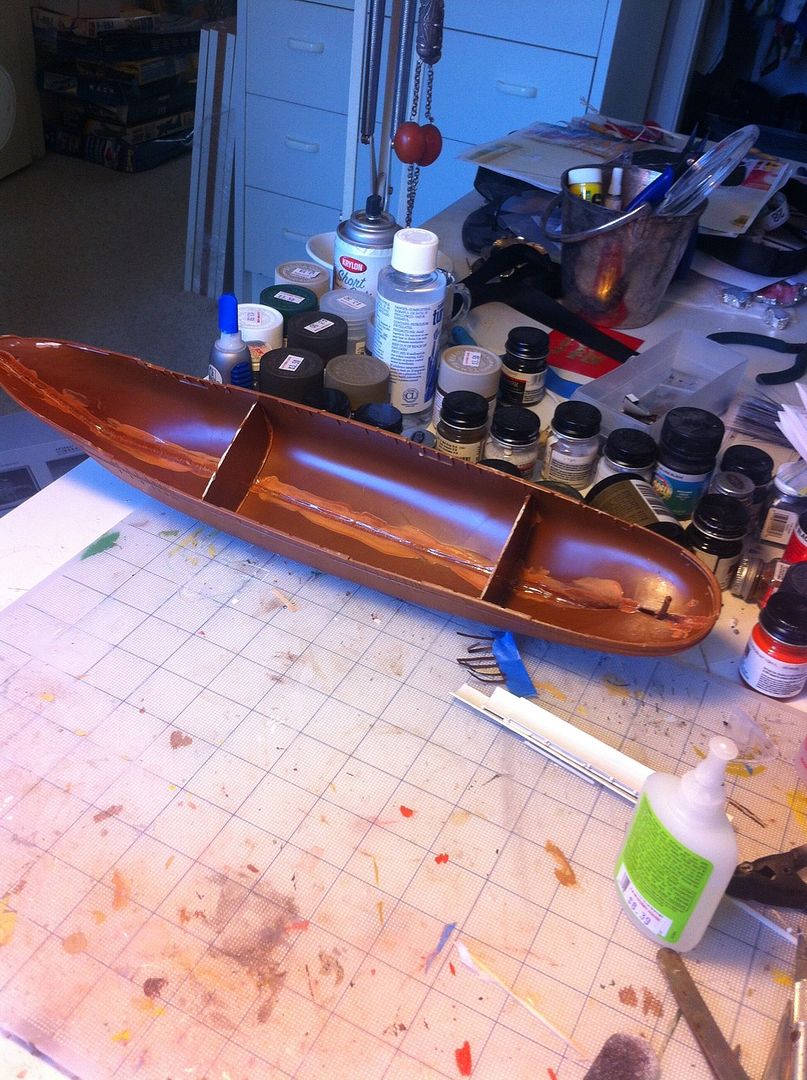
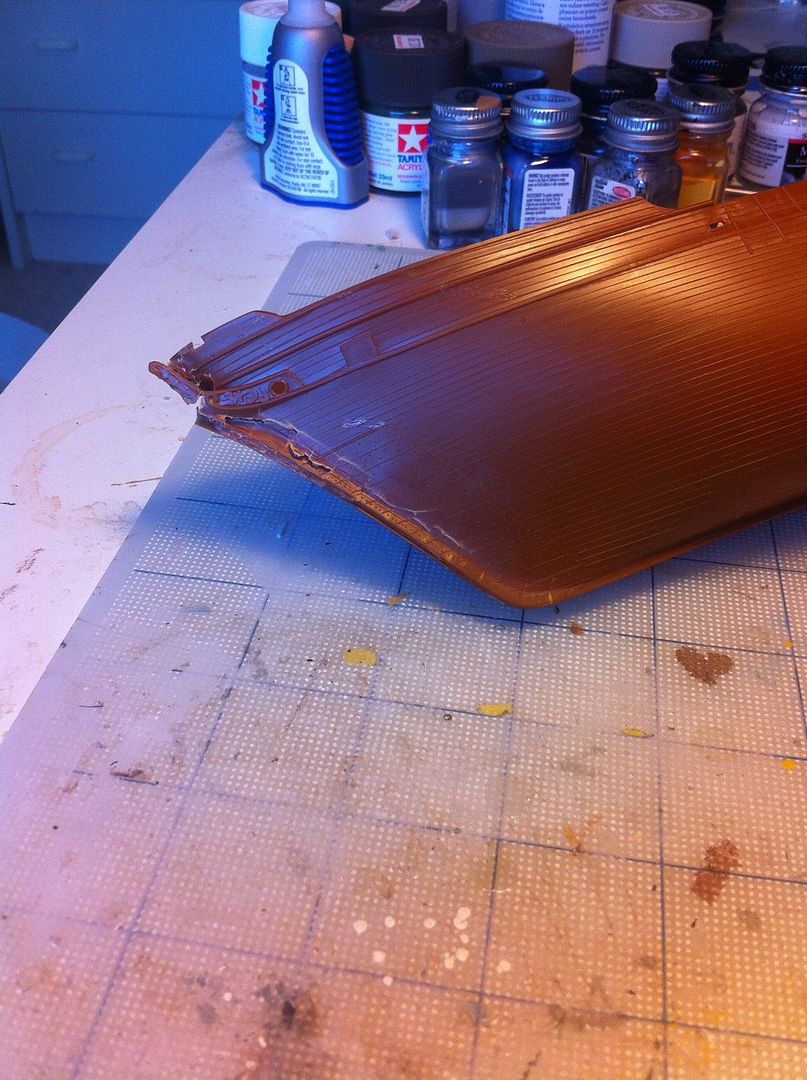
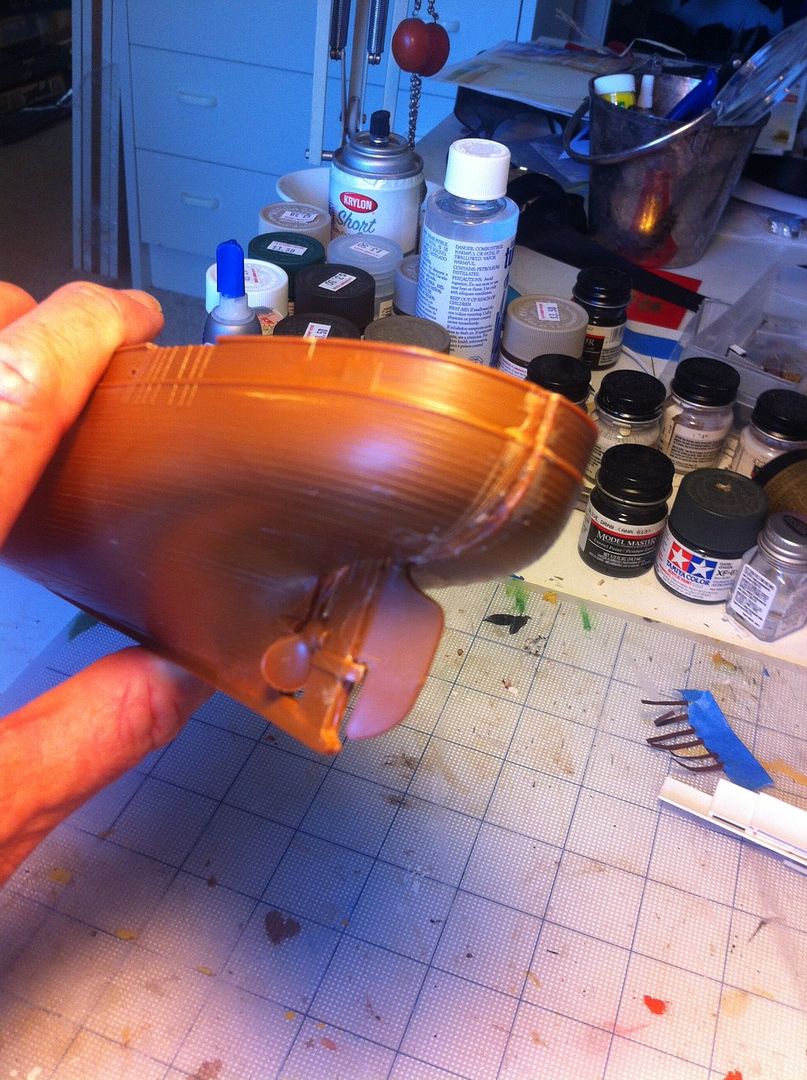
I picked this up, it was listed as “started”.
It’s long OOP, so I did what I could.
Can you identify subject, scale and manufacturer?
Airfix Discovery?
Yes, that is the one. 1/144.
I think the damage done is beyond hope. I’m stuck with as-is too.
After I make some more progress on my schooner, I’ll get this back down for another look. It could be a nice model.
Hi " G "
I concur with Dr.Tilley .It is definitely that ship . Now what you could do if it’s that bad a glue Bomb is this . Do your own version of that type letting the basic hull you have be your guide .
Knowing you it would not be a loser . T.B.
Mr. Tankerbuilder you are a truly inspirational character. No sooner than I had read your post, an idea for a dio came to mind. It’s perfect for the subject. The kit did come with some figures and a bunch of dogs.
i would cut it apart at the seam, cleanup the seam area & glue back together. done that a number of times with built or partial built ships off ebay.
Goodness, it looks as though the glue was applied with a trowel. I have an Aurora “Sea Witch” that is in similar straights. Good luck.
English is a funny old thing, between the Saxon argot and Norman French we get all sorts of muddled words and homophones. Things that are lineal are refered to by the old French term “straight.” Things that are bound as in a channel between islands get the Saxon/middle English :strait." The Straits of Gibraltar are restricted by tthe Iberian peninsula and the north African coast. The Straits of Magellan are bound by the islands off Tierra del Fuego–and are not at all straight. The sense of ‘bound’ is also what gives us the term “strait jacket”–a crude device to keep the wearer on a straight and narrow course.
As I remember, the Airfix Discovery is quite a nice kit.
I went on board the real ship once, in (I think) 1978, when she was moored in the Thames. At that time it looked as though she’d been pretty much neglected for quite a few years. I believe she’s been moved since then, into one of the London Docks. [Later edit: Oops. She’s now the pride of Dundee, Scotland.]
I recall reading, a long time ago, an article about her in the grand old magazine Model Shipwright. The author had made a very small-scale diorama showing her stuck in the ice.
One interesting detail I remember clearly. She had a big midships deckhouse, which contained the helm and a lot of sensitive navigational instruments. Most of her standing rigging was wire (as was typical in that era), but it was feared that iron wire in the vicinity of those instruments would mess them up. So her mainmast standing rigging was old-fashioned hemp. The point is significant for the modeler because it meant that the mainmast rigging was disproportionately heavier than that of the fore- and mizzenmasts.
There’s an old British movie, “Scott of the Antarctic,” starring John Mills. It’s an early color film; as I remember it has a few brief shots of the Discovery under sail. Most of the story deals with the later Terra Nova exhibition, when Scott and his party abandoned theif ship and tried to make their way to the South Pole on foot and by sled. The photography is spectacular, and the finale, in which everybody slowly freezes to death, must be one of the dreariest in the history of movie-making. I first saw it on late night tv when I was getting over an operation. I didn’t know how it was going to end, and it sent me into a state of near-clinical depression that lasted several days.
On the other hand, as a bonus to the movie you get the music, by Ralph Vaughn Williams. He later reworked the score into his Seventh Symphony, “Symphony Antarctica.”
One approach to the Airfix kit would be to make it a waterline model, surround it with ice and snow, and build a little tape player or MP3 “device” into it to play excerpts from the symphony. If done well enough, such a diorama could make everybody within earshot feel like jumping off a cliff.
The moral of the story: If going to snowy climes, learn to ski, dummy.
I have to say that the “Google” workaround to not having a search function on the forum any more, worked. Our old discussion:
http://cs.finescale.com/fsm/modeling_subjects/f/7/p/150285/1607896.aspx
After the Ross Expedition in 1842 which made it to 78-10 S, it was 60 years before Scott headed the Discovery Expedition in 1901. Shackleton was Third Officer. The expedition, whose primary objective was scientific exploration rather than polar attainment, made it as far as 82-17 S.
The Ship was built in Dundee, launched in 1900, and has returned there now. It looks to have been restored pretty well in recent years.
She was Christened S.Y. Discovery, as she could not fly the White Ensign, rather she sailed under the burgee of a yacht club. Wiki says she was launched as R.R.S. Discovery, I remember another source that said she was named that in 1920. Anyhow, this ship.
Shackleton then had his own expeditions in 1907-1909 on first Endurance, then Nimrod. Try finding models of those.
The fateful Terra Nova (no model there) expedition of 1910-1912 is the one that killed Scott. Amundsen (Fram, no model there) made the Pole at the end of 1911, Scott a month later.
I may have mentioned it in the previous thread, but there is a book called “Race For The South Pole” that I enjoyed. Alternating chapters of log entries from Amundsen and Scott.
And bring your recipes for dog.
Amundsen pulled the sledges along with his men and his dogs. They created a bunch of generations of dogs as they went, slaughtered them and cached the meat for the return trip. Of course they ran out of seal as soon as they had left the ice shelf.
Scott brought motorized tractors, which failed. He brought horses, which required feed. (The dogs ate dog and seal meat).
And his party followed strict military class rules. The men dragged the sledges after the horses gave out, the officers rode on them or walked behind.
The pole is at 3000 meters elevation, a job in itself in roadless country at minus 50F.
Amundsen couldn’t be sure he’d found the exact pole, so they circumscribed it in a big circle maybe 5 km across with flags. It was those flags that Scott found a month later.
Heartbreaking.
I took some photos of the Science Museum’s model of “Nimrod” before the gallery closed and thought I’d share them here as you mentioned it was difficult finding models of her. But reading it again, I think I must have misread your message.
Thanks John, those are great. I’ve snatched them for my files.
I meant models that can be purchased, or even plans. Fram in particular.
Okay Now ;
Drop the " Mister Stuff " G " .You can call me everything except cusswords and late for dinner . But " T.B. " Will do Or " Tanks " etc .You git da pichur ? T.B.