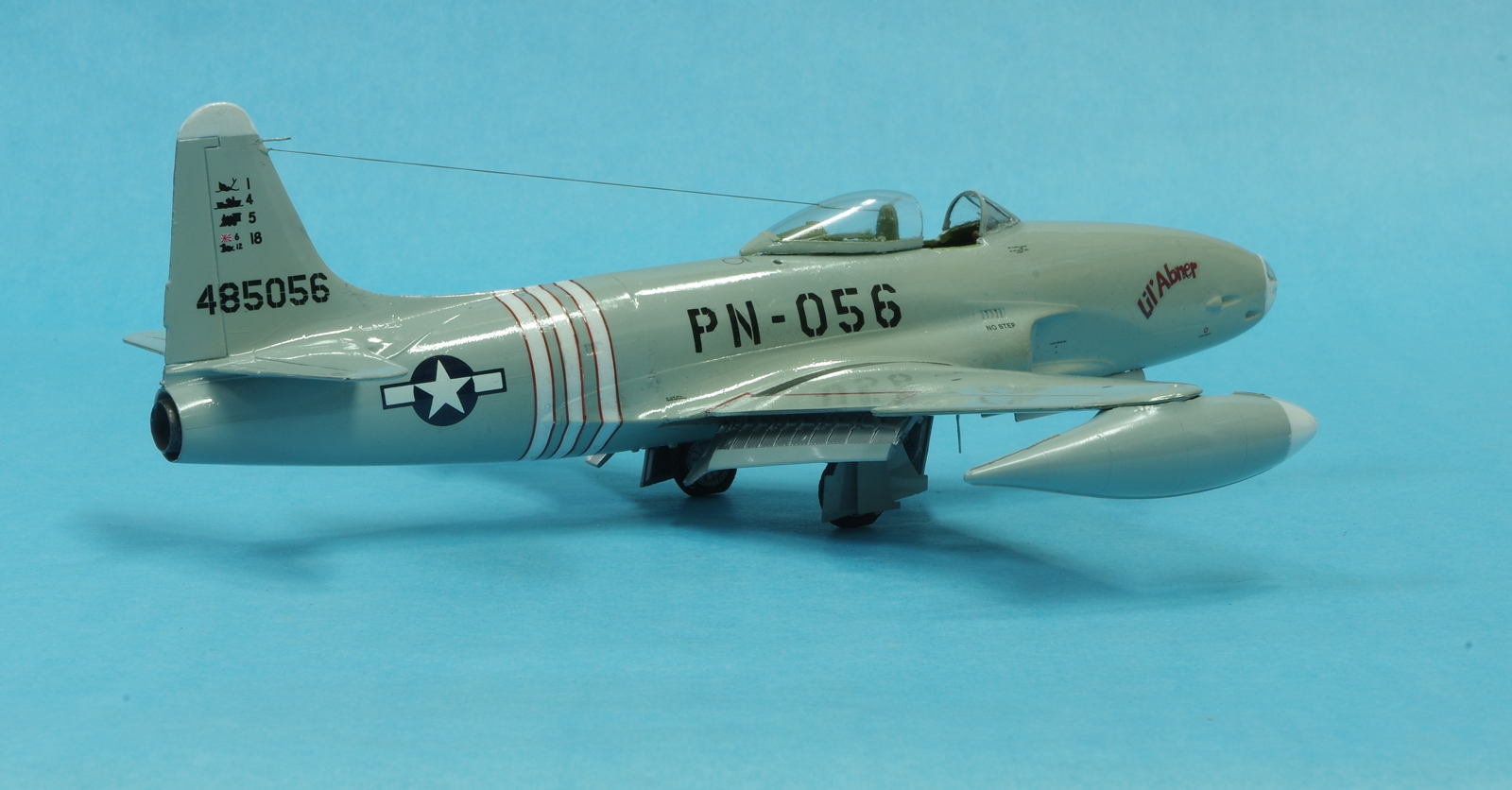
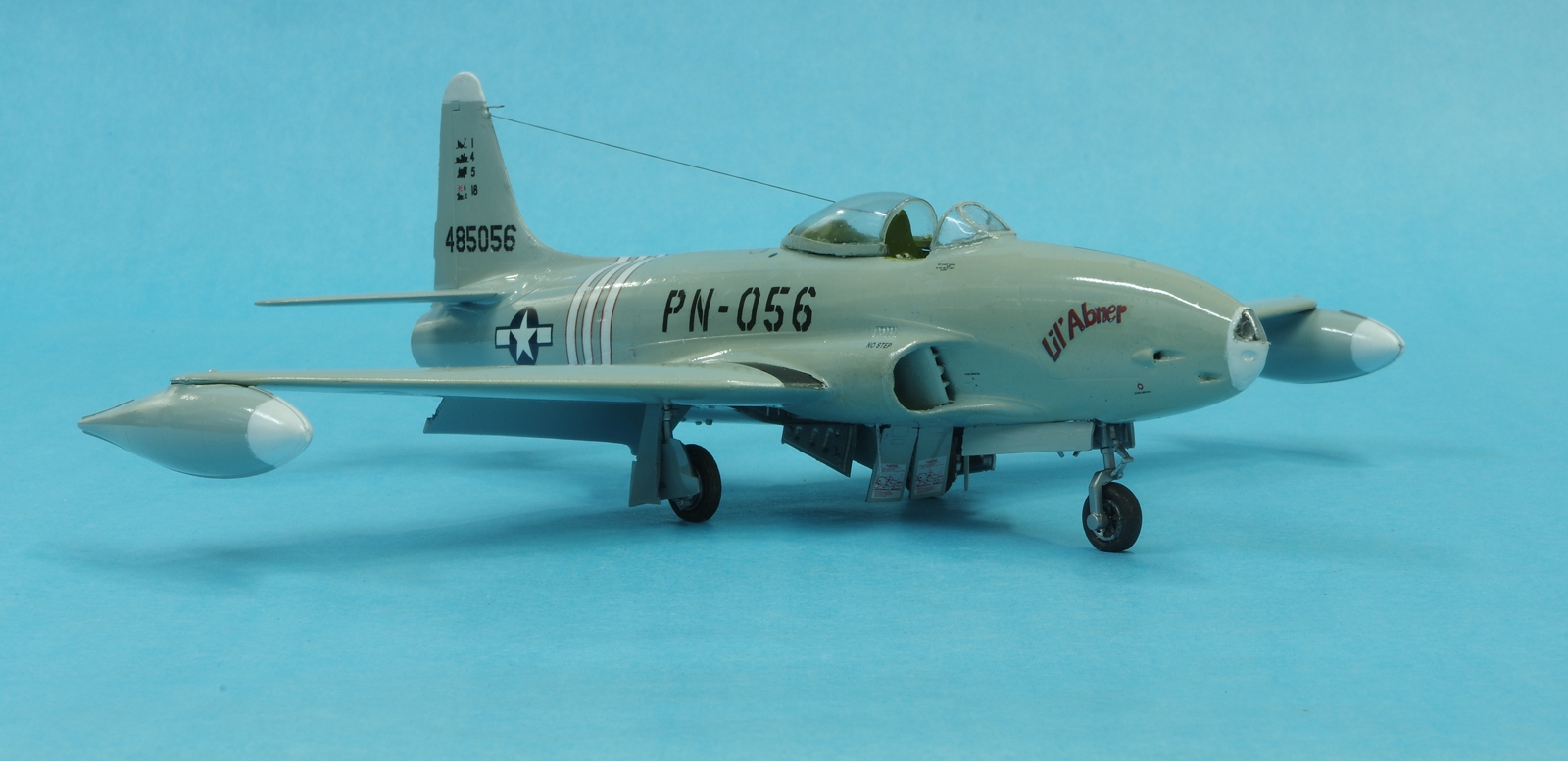
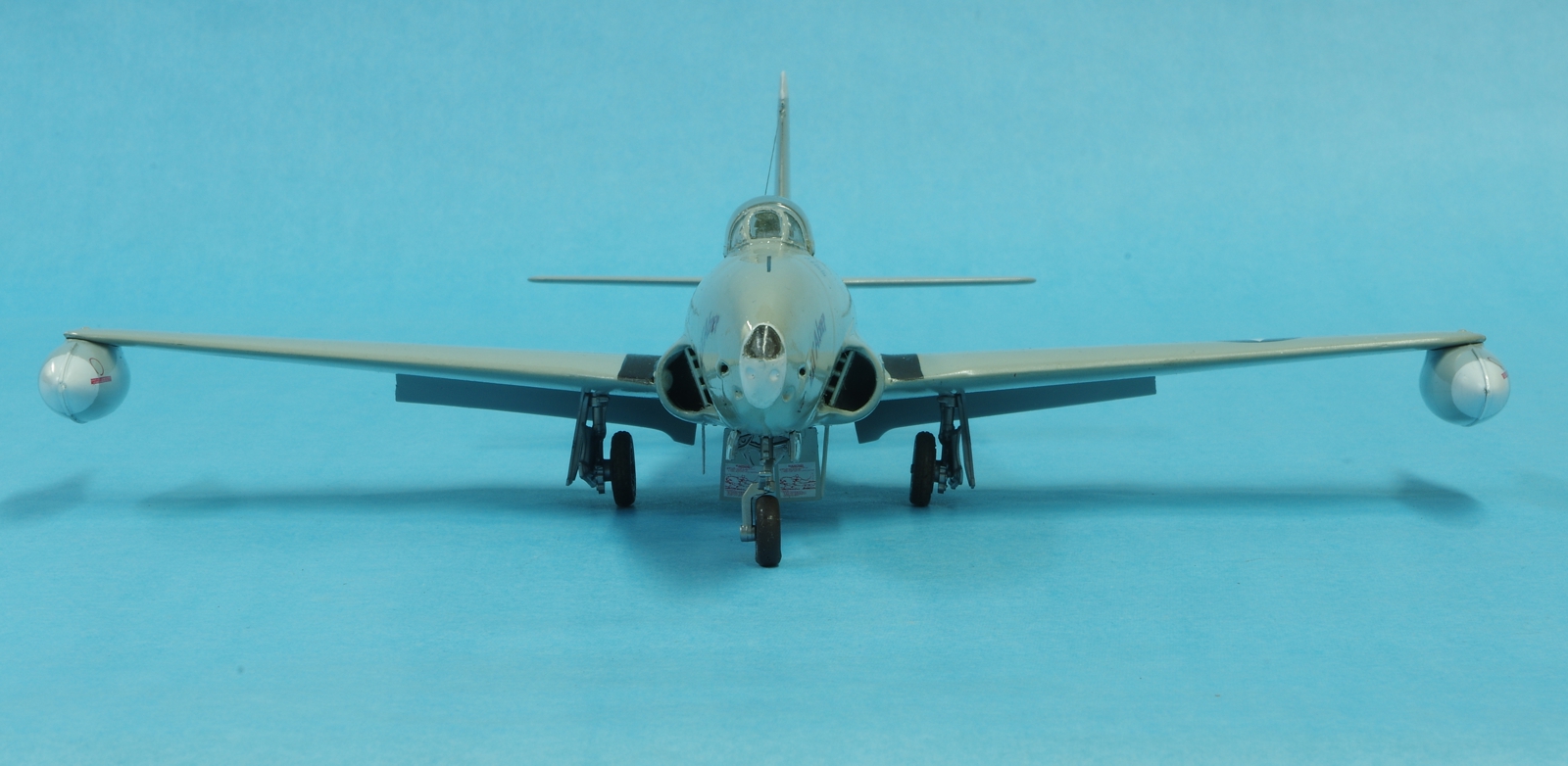
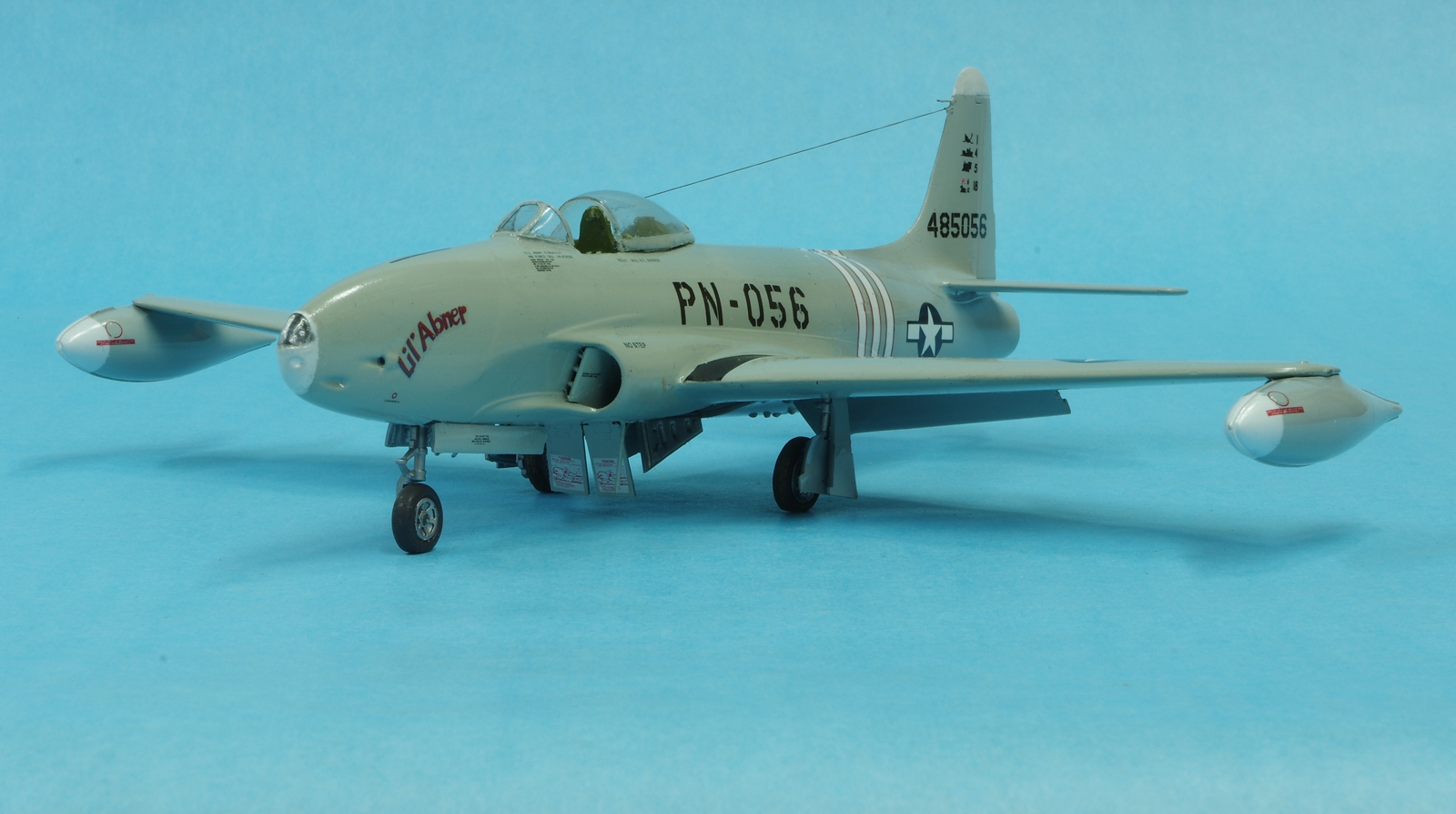
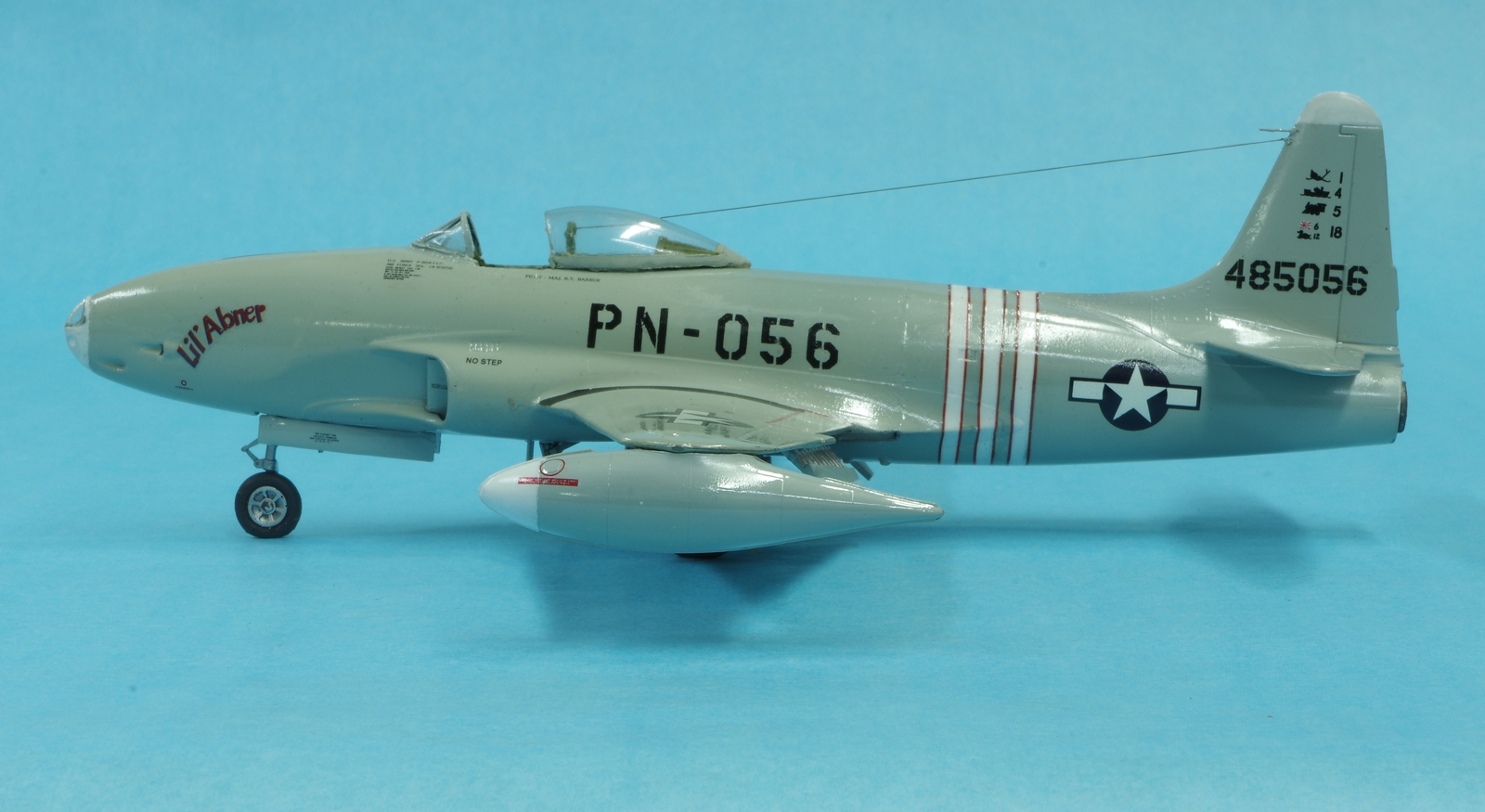
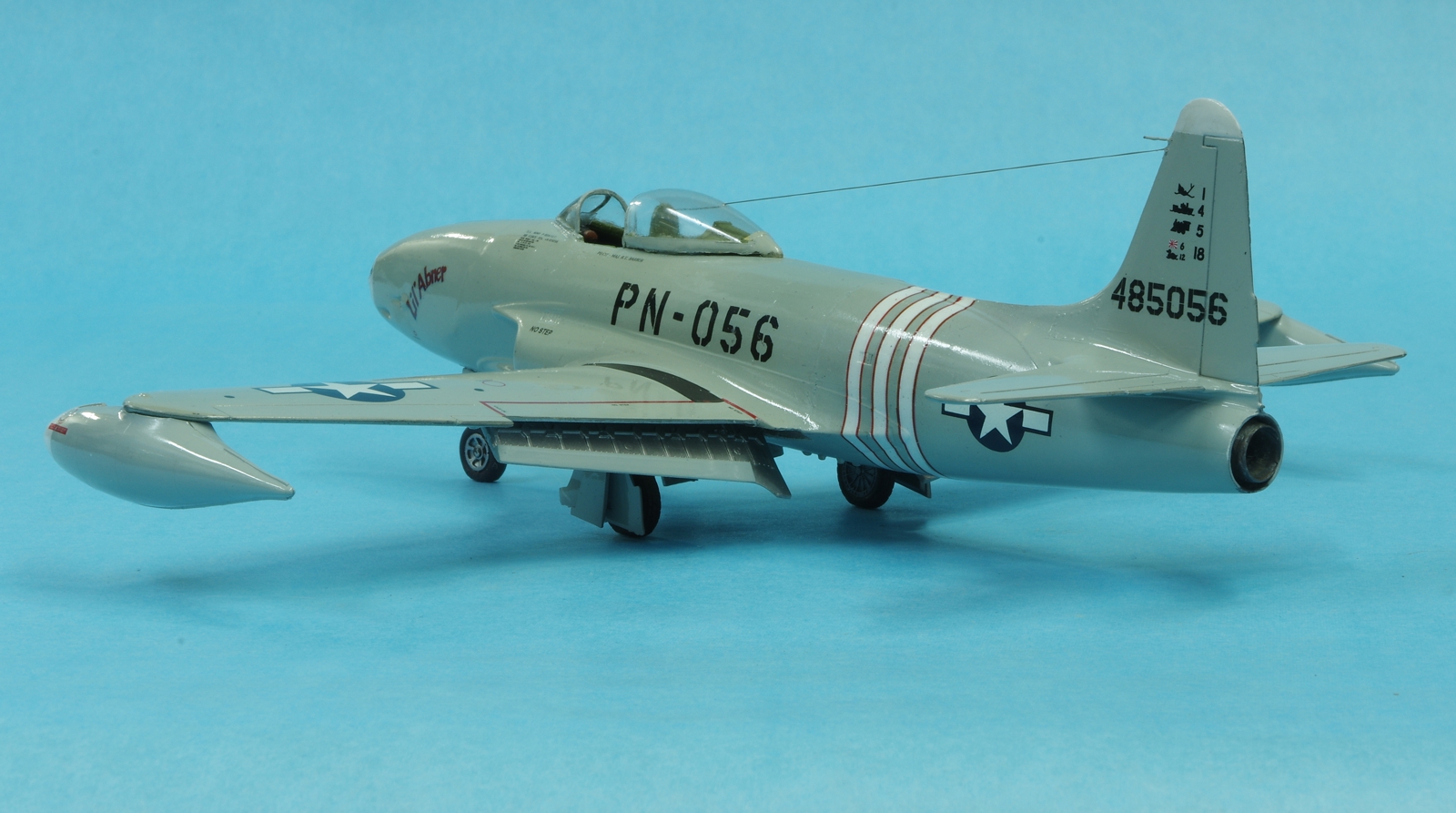
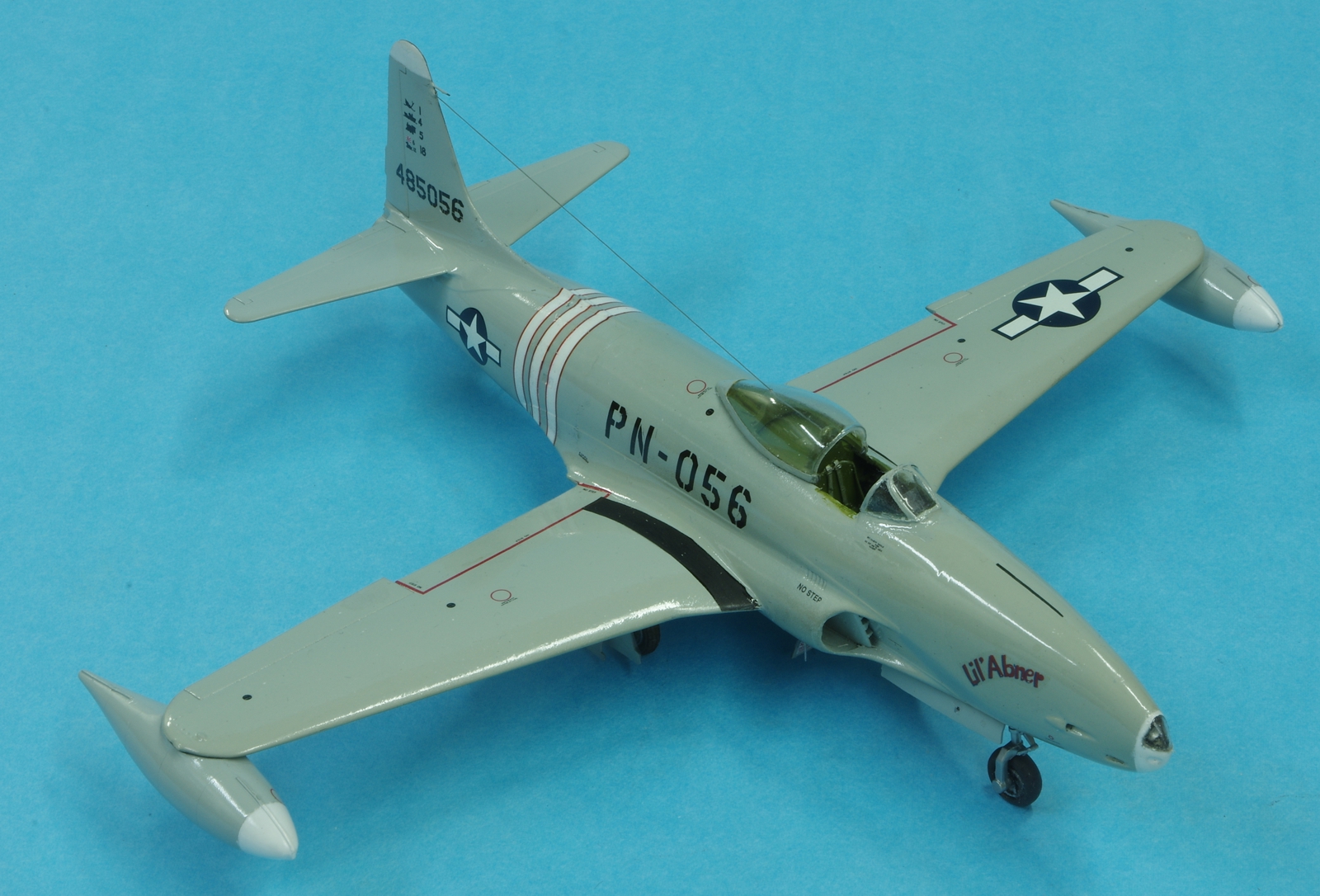
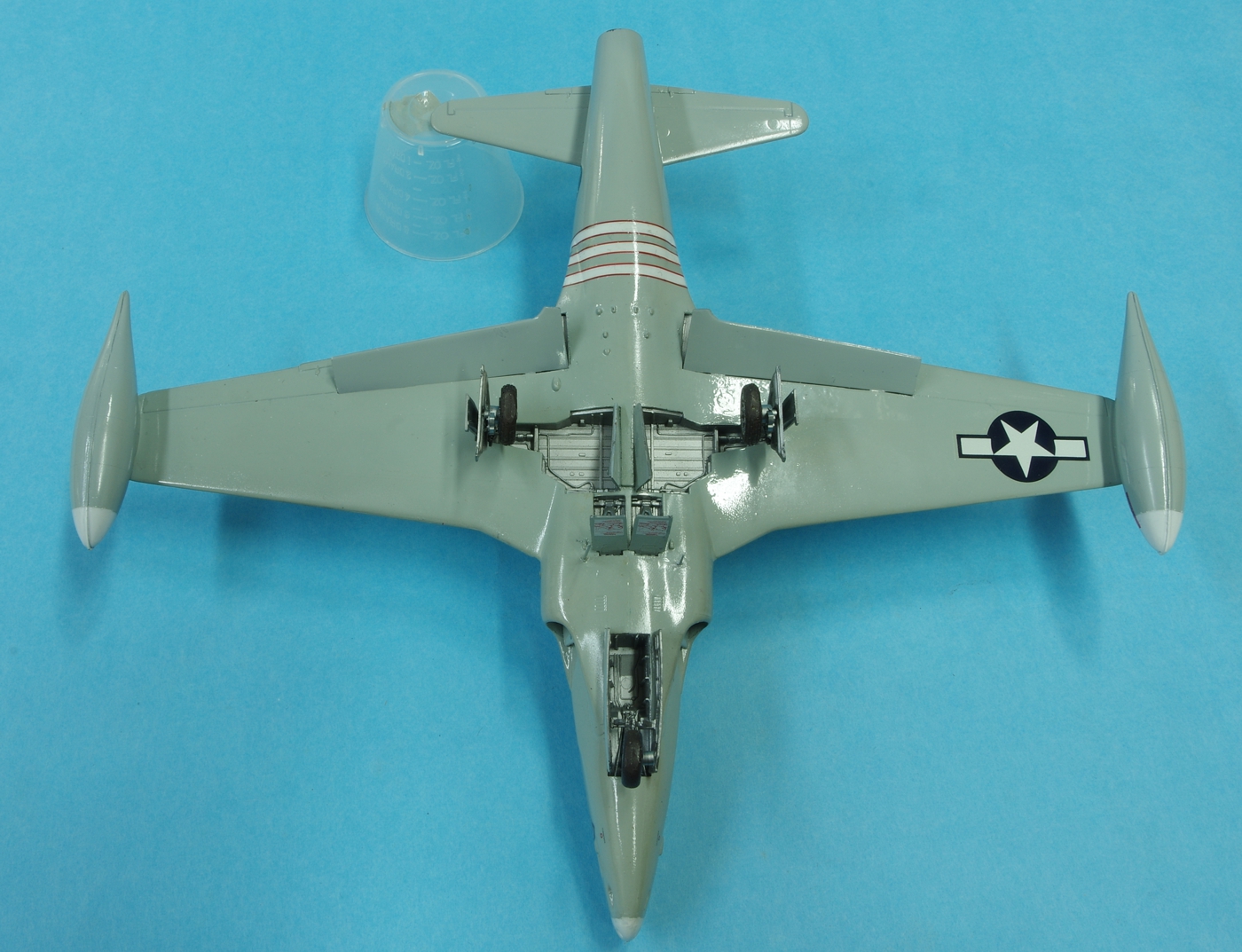
I’ve been building the early jets and it became the F-80’s turn. It would have been nice to do the XP-80 but it really had little in common with the Monogram kit, being a lot smaller and planned for a different engine. I some time in the past bought a bunch of P/F 80 sets from Fox 3, Gerry Asher, and for this I used the resin and vacuform parts to do a P-80 from the first production block, the P-80A-1. These airplanes were painted ADC Grey and were filled and polished. The finishes didn’t last well at all and the P-80A-5 and later airplanes were all delivered in bare aluminum. The P-80A-1 had a landing light in the nose in place of the black panel that covered a radio direction finder antenna in later airplanes, and the cockpit was 9 inches further aft than later P-80’s with ejection seats. Early P-80’s were not built with ejection seats although many were later retrofitted with them.
Four P-80’s from the -1 Block were sent to Europe before the end of WW II, and two of them were sent to Italy where they flew but did not enter into any combat. The other two went to England where one was lost in a crash.
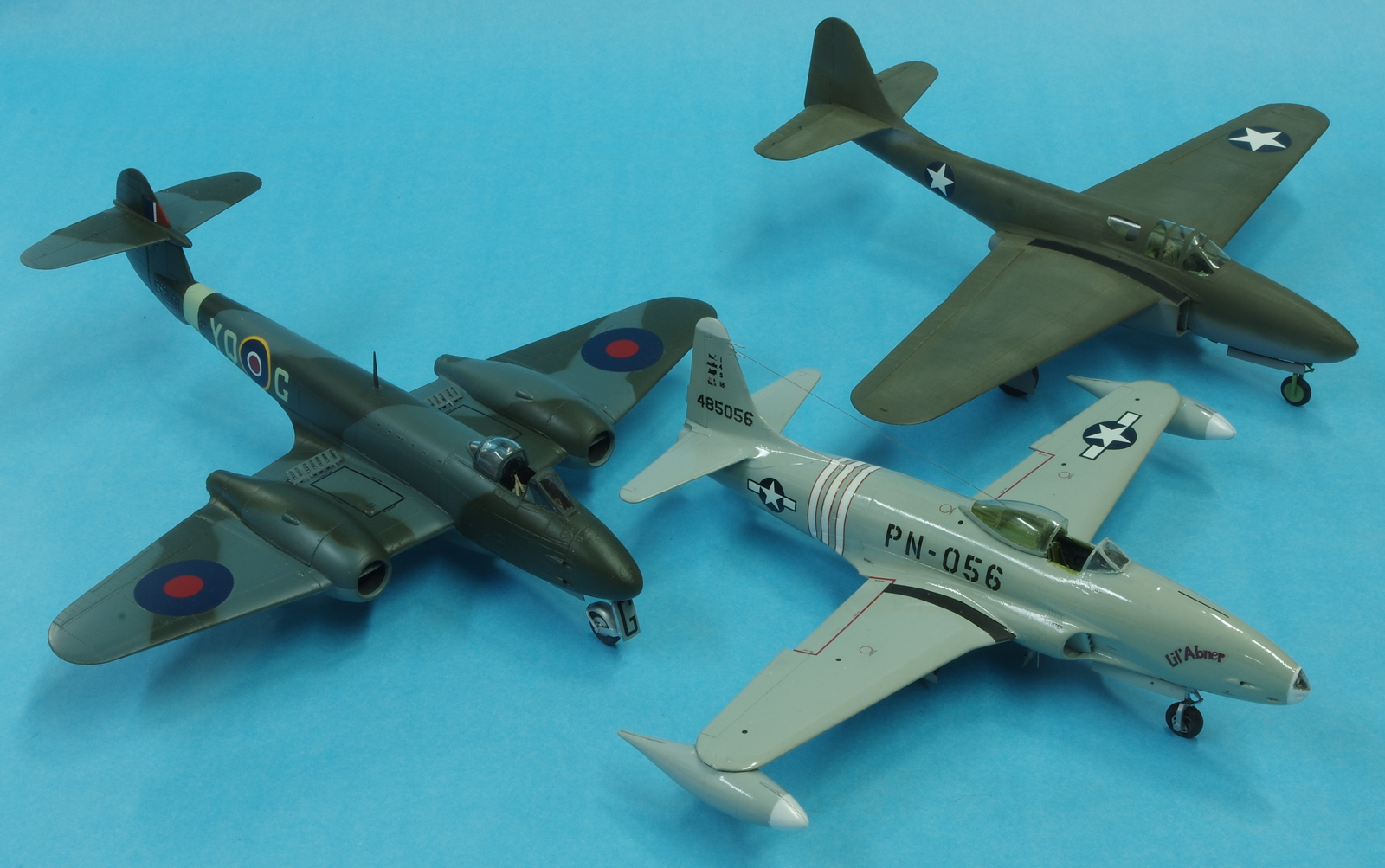
A P-80A-1 with the markings “Lil’ Abner”, an Al Capp character from the cartoon Dogpatch, was flown by Rex Barber, who was a participant in the Yamamoto shootdown and is most likely the pilot who fired the fatal shots. He was commander of a P-80 squadron at March Field.
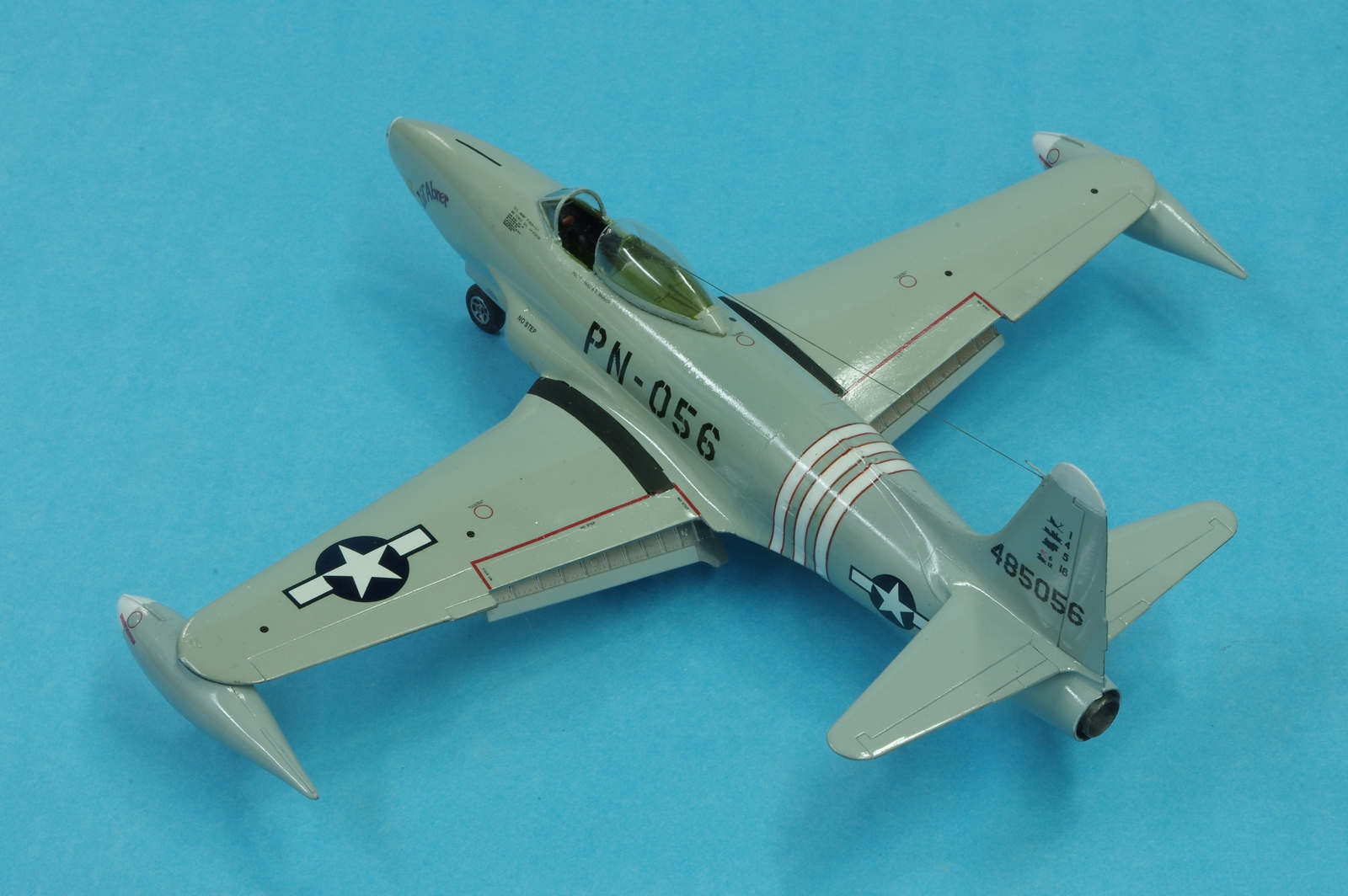
It seems strange to see a jet with an antenna wire and masts, but that’s the way it was with the first P-80’s.
I worked really hard to keep the detail on the bottom while fixing the parting line between the front and rear fuselage so I wouldn’t lose all the liitle bumps. After the model was nearly done and I was adding the antenna masts to the bottom I happened to read the part of the instructions where it said to remove the bumps because they were for JATO bottle mounting, an item which the A-1 was not equipped. You can get it right when you build yours!
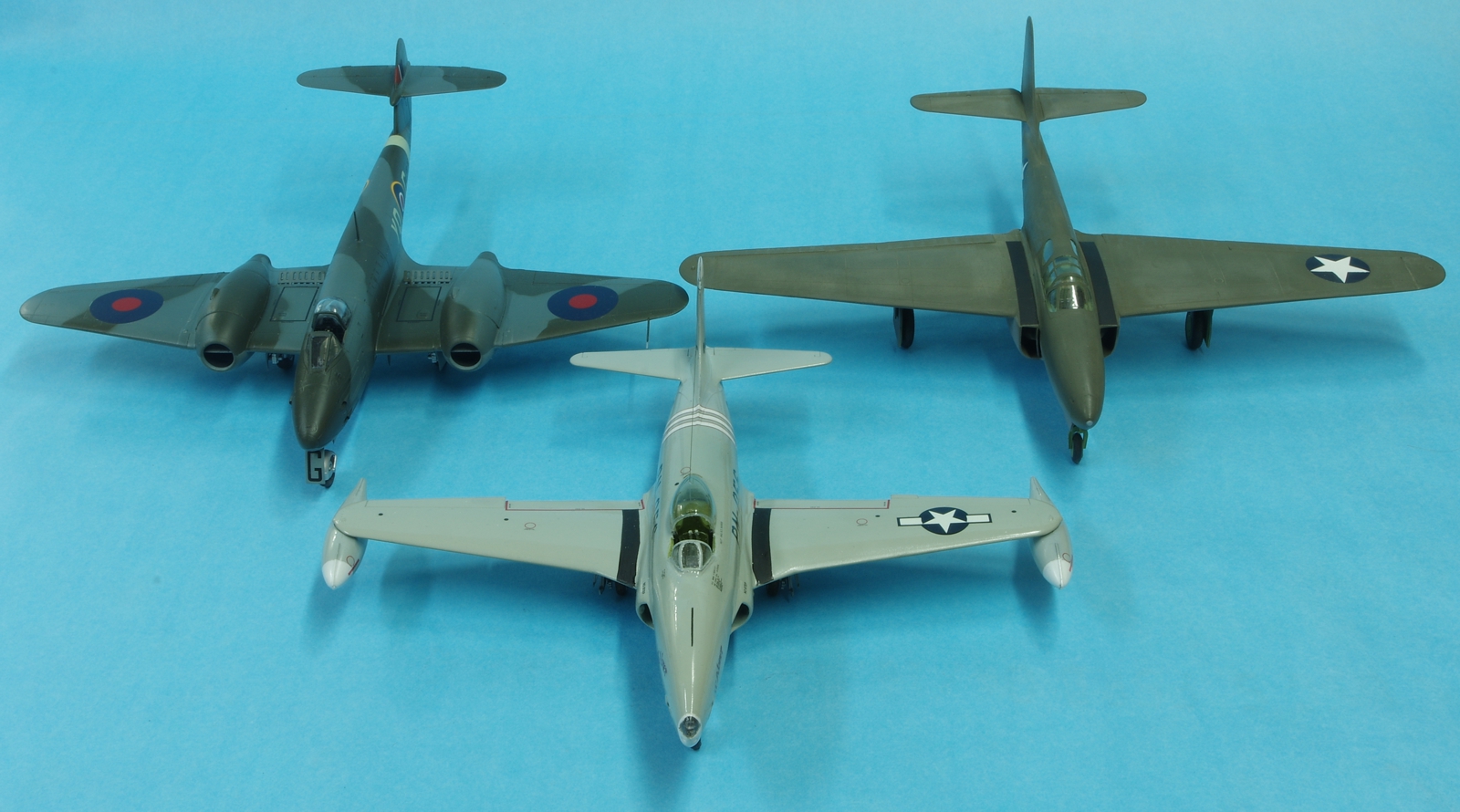
And with some other early jets, the Gloster Meteor F.3 and the Bell XP-59A.
Glad you posted that. I think the story of those birds in Italy are a story that needs a wider telling. I am really into early US jets and feel the roll of US jet development is often denigrated. The US was not nearly as far behind as many stories would have us believe.
As an aside, Rex flew an 80 under both the highway and rail bridges over the Crooked River Gorge, just outside of Culver, his home town. That’s about 120 miles from me, the new highway bridge is named in his honor. He is buried in the Redmond Cemetary. Do a search for pics of the bridges, hard bend in the gorge just downstream from the rail bridge, and it’s narrow to boot.
Jeaton, I’ve had this Monogram kit sitting on the shelf of doom, partially built, for the last couple of years. Maybe I should bring it back out and finish it as a “what-if.” Your P-80 build is excellent.
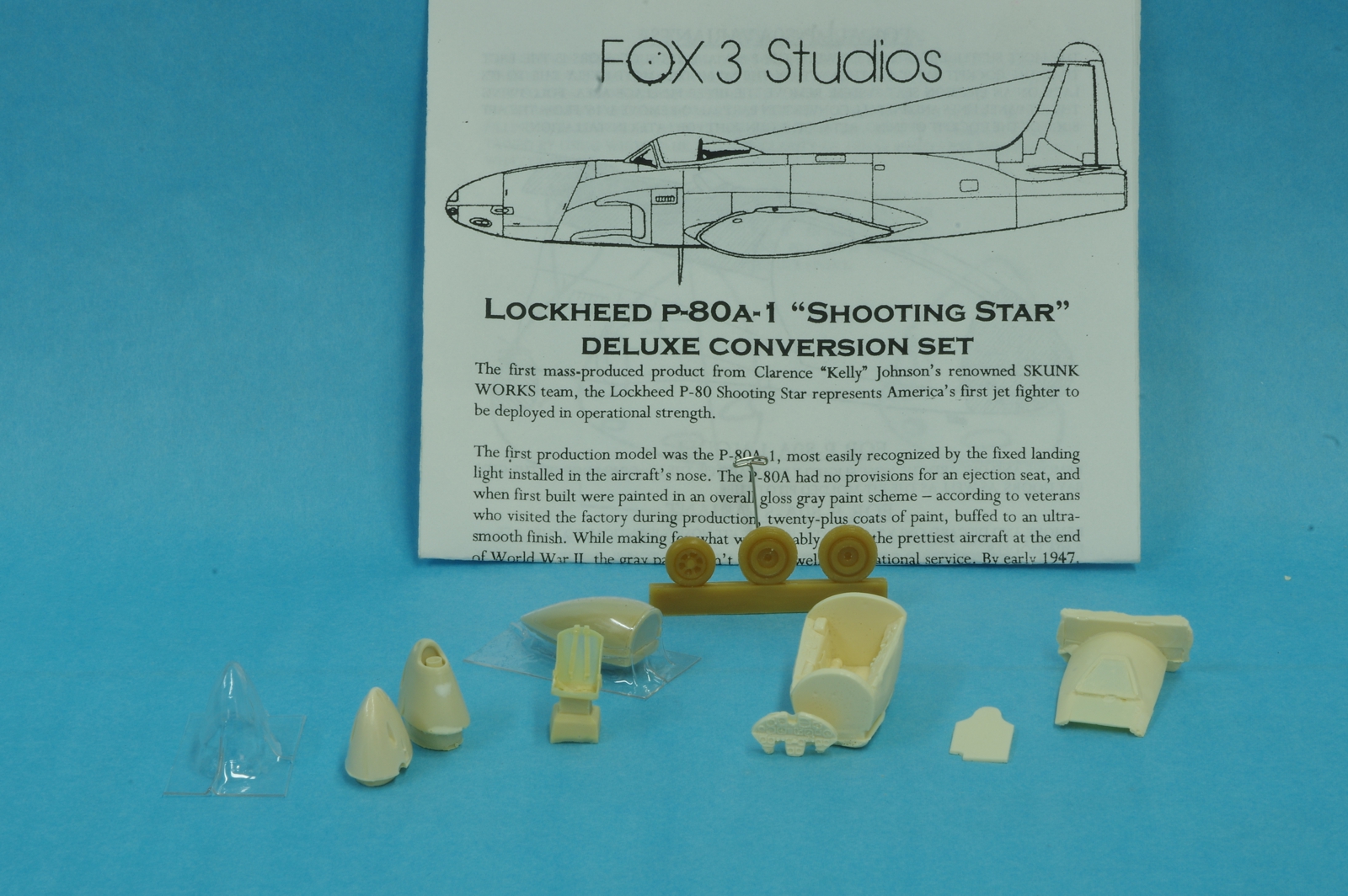
Carlos, the FOX 3 set provided all the parts needed in resin except the gunsight. I used the Monogram gunsight but cut off the solid plastic combining glass and replaced it with clear sheet plastic. A vacuform main canopy also was part of the set, and a clear vac part for the landing light cover, which was no fun to trim out and glue to the resin replacement nose, way too small for my fat fingers. The Monogram windsdcreen is not well molded but I used it. I have at least three kits and all of those parts look the same. Truth to tell, looking at photos I found it hard to see the difference between the canopy location between the P-80A and the P-80C, and especially to find cockpit photos of the P-80A.
Here’s the FOX 3 set, one of the resin parts is a replacement for the upper cockpit skin which includes the place where the windscreen fits.
Thst’s a nice early jet collection. I remember a FSM article on backdating the Monogram F-80C, and it was quite involved.
I had read that the P-80 had performance comparable to the Me-262, something that cannot be said of the P-59. “If it looks right, it is right” applies here.
One of those endless debates online. On paper, the P-80 outperforms the Me pretty clearly. It weighed quite a bit less because of access to better alloys.
The P-80 was not the only US jet ready for operation by the end of the war. A squadron of Fireballs was loaded on a carrier for transit in the pacific as the war ended. The Fireball was certainly not a match for the 262, but might have been adequate for the Pacific theatre.
Great work! Thank you for sharing. I love early jets. Speaking of early jets Jeaton01, didn’t I read somewhere that you flew the Dassault Falcon 20? I ask that, because I have about 1,700 hours in it from my last job. Anyway, beautiful P-80! It makes me want to build one.