Nice looking texture on the turret, Greg!
I really like that landing craft, Bob!
Nice looking texture on the turret, Greg!
I really like that landing craft, Bob!
I wasn’t at FSM when this GB was started but I would like to join if possible. I have been working on a Bronco Models 10.5cm LEFH18(SF) auf Geschutzwagen 39H(F) for a couple months. The cannon was mounted on a Hotchkiss H39 chassis. It was with the 21st Panzer division at Normandy. The model is about half done. I believe I can have it finished by the June deadline. Any chance I can join the build?
Bob: thanks for the kind words. BTW, I just realized your LCVP is the Lindberg kit…WOW!
SS: thank you.
Shiv: I used Mr. Surfacer 500 in the jar.
Half way through a build is normally to much, but seeing as you haven’t been on the site very long, I think I can make an exception. I take it it’s 1/35th scale. I will add you to the roster. Welcome aboard.
Greg, really nice work, looking good.
Bish: Great. Thanks much. Yes, it’s 1:35. As soon as I have some of the major components assembled so it actually looks like something, I’ll post a pic. And I’m glad this will be my first badge.
Here’s the box art for my build:

Glad you choose this as your first build. Ye, I did google it and found some images of the kit. Will be an interesting one to watch. Look forward to seeing the build pics.
SP: Interesting, I knew there was some sort of system set up but it’s something to actually be able to see it written down there.
Greg: Looks good, I’ve only recently been trying to replicate the rough cast texture myself.
Duke: Very cool! Welcome aboard!
You can rely on the army to think of everything. I never thought they would actually have a load plan for these, but it makes complete sense. Thanks for posting that.
BD welcome aboard, love your choice.
Stik great info, I wish I had that a while back.
Bish, you know on something big like that everything is thoroughly planned. How closely reality and plans match … well…
Jibber, if the question had been asked sooner, I gladly would have dug it up sooner…
Have a look at this guys, it is the landing table plans for one sector of Omaha beach, for the 29th Division. The other sector from the 1st Infantry and the Utah beach for 4th Infantry were pretty much identical. Just remove the Ranger Force elements and change the sub unit designations. You can see exactly what type and how many of each type of landing craft and ships were scheduled to hit on what sector at what time in minutes off of H-Hour Tanks in LCTs, Infantry in LCAs & LCVPs, Engineers in LCMs, HQ & Medical units in LCIs, Artillery in DUKWs etc.
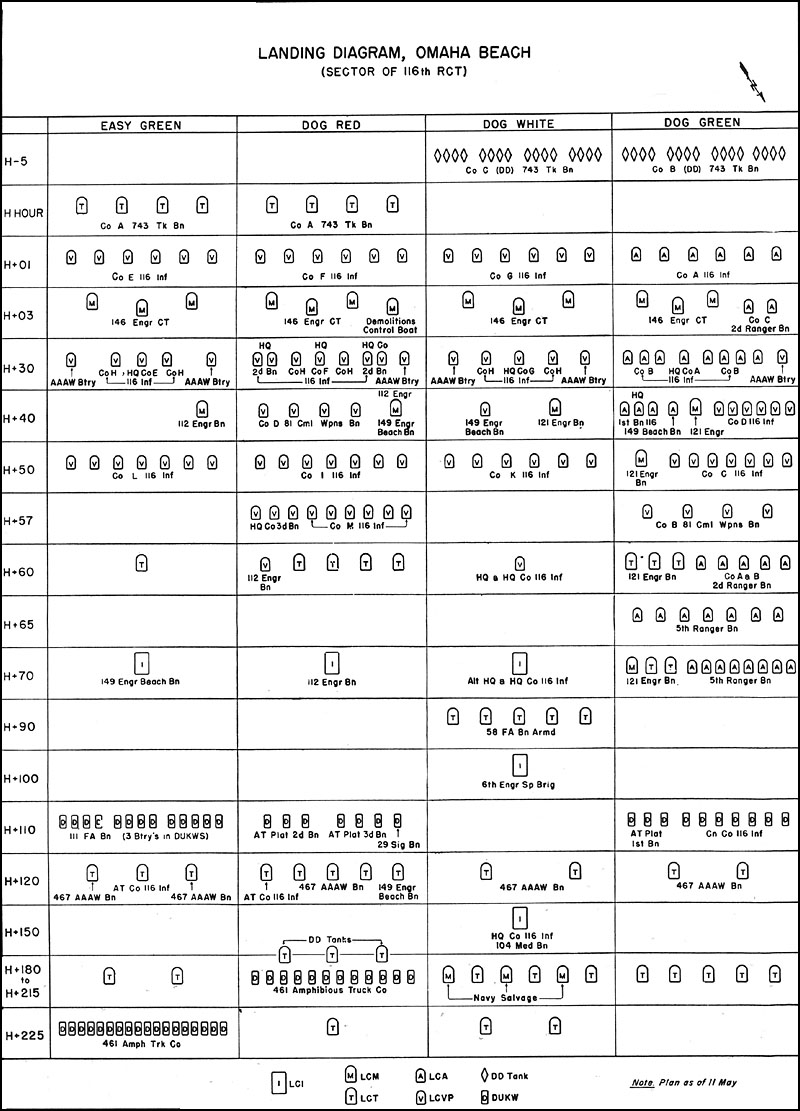
I take it the timings are in minutes. Interesting that the first waves are all tanks.
And of course, we all now just how long a plan lasts.
Yes, the H+/- times are all in minutes. The DDs were supposed to beach 5 minutes before the assault infantry hit in order to neutralize strong points and provide fire support as they disembarked. But seeing how almost all of the 741st DDs sank in the Channel on the run in to the beach, the plan started unraveling before then. On the other four beaches the schedules were pretty well adhered to. Even at Utah, where ocean currents pushed those troops laterally to the wrong beach area.
1/48 Tamiya Cromwell MK IV
Paints: Tamiya, Vallejo Model Color, Vallejo, Golden mediums
Weathering: Iwata Com.Art acrylics; Vallejo Acrylic Game Washes; Ranger “Distress Crackle”, Sennelier pigments; various oils
Foliage: Scenic Express “Super Trees”; Scenic Express Matte Medium


Okay, the Cromwell is finis. I have a build log in the armor section if anyone is curious about how the kit was made. Instead of modeling war stories I’d like to give a little note on why there’s foliage on this model. It says a lot about a very violent campaign.
After the war Ike said “Plans are useless; planning is invaluable.” That’s a good description of the Normandy campaign. In May allied planners predicted the liberation of Paris in D +90 days and did it in +85. Montgomery did indeed plan on drawing German armor toward his sector to facilitate an American breakout to the West. On paper a work of genius – in practice things were one screw-up after another and it took a valuable assist from Hitler to help the allies sweep through France. The screw-ups started at the top. SHAEF planners feared dreadful losses on D-Day and the next week but assumed that allied air and naval support would force the Germans to begin a phased withdrawal toward Paris soon. Nobody was thinking of a six week attrition slugfest in Normandy itself, but that’s what happened.
Amazingly although the allies knew almost everything about the German order of battle on June 6, the “brass” paid little attention to the tactical implications of the bocage. Neither, ironically, did the Germans. But within 48 hours of D-Day (the invasion itself had been far less bloody than allied estimates) it was obvious to everyone that the allies had chosen a defensive paradise for a battlefield. This in turn amplified every error made by Americans and Brits concerning the nature of armored warfare in the ETO and there were many.
By 1944 the Americans had seen – correctly – that the kind of “cavalry charge” blitzkrieg as found in 1940 was obsolete and put all their emphasis on “combined arms.” In general a good idea, but one with a steep learning curve. (The learning curve was inherent when you consider that the US had rearmed starting from nothing in 1940 and most of the British Army was “green” in 1944.) US thinkers thought of armored divisions as units to exploit a breakthough – not to create it. OK. They believed anti-tank guns and tank destroyers would take care of enemy armor. Not so good if the enemy was standing on the defensive. Independent anti-tank and armored battalions were originally given to Corps – by fall all allied divisions had both armored and anti-tank battalions attached to divisions but it took weeks to work out proper tactics combining tanks with infantry. The Brits were a little brighter. They saw the need for an “infantry tank” and the Sherman and Cromwell fit that bill well. The short 75mm gun carried by both – supported by machine guns – was an excellent weapon for use against defensive strong points. The Brits had also seen the need for a more powerful tank gun – hence the Firefly. It was an odd division of labor. The US never developed a good anti-tank gun (the 76mm intended for the job was far less powerful than the German 75mm equivalent found on the Panther and didn’t match the 75mm German anti-tank gun also carried by the Panzer IV and Stugs). The Brits never developed a good tank until 1945 and then they never made a bad one. So putting the splendid 17 lb gun on a Sherman should have been a no-brainer. It wasn’t. (Not sure if it’s in the gene pool, but the Abrams carries a German made120 mm smoothbore after the original British designed 105mm was found wanting.)
All German guns – whether 88mm, or one of the 75mm types had one thing in common – they could kill allied tanks. To make matters worse, the Panzerfaust and Panzerschrek were coming into wide use: they didn’t kill a lot of tanks but the threat slowed tank movement until infantry had checked things out and thus giving German armor and anti-guns more time to deploy. (Only heaven knows why the US Army didn’t develop a more powerful bazooka – it would have come in handy in the ETO and Korea for that matter.)
As everyone on both sides knew all German armor was superior offensively (sparing Fireflys) and the “Cats” better armored. The allies were also up against some elite German units. The German static units surrendered or were removed early in the game. In their place came units like the Hitlerjugend facing the Brits and the Panzer Lehr facing the Americans. And all deployed in an area thick with places to hide. Had the battle been entirely between ground units, the Germans would have held out for months. Allied naval gunfire – a bust on D-day itself barring USN DD heroics at Omaha – proved lethal throughout the campaign just as it had in Italy. Allied tactical airpower earned its reputation, but while in the bocage it was hard to find a clear target. Arguably one of the biggest errors was the refusal of RAF Bomber Command and US 8th AF to devote long term resources to learn the art of carpet bombing despite the certainty of “friendly fire” casualties. (The USAAF bombers botched air attacks on June 6 so badly as to be considered useless.) When it was done right, the “heavies” could annihilate German positions and it was just such a raid that finally sprung US armor during Cobra.
But nobody has ever fought a perfect war and the allied units grew better as the campaign went on. (I think the allied ground forces peaked around September 1944 – after that they kept going to the well too often and were running out of gas by early 45. Luckily the Wehrmacht collapsed first.) And above all regardless of any and all errors it was the terrain in Normandy that necessitated a long and ugly campaign. True Shermans and tanks like the Cromwell did not match Panthers. But when US units were on the defensive in the Ardennes, German units found out how dangerous were ambushes sprung by determined enemy and any tank. T-34s are usually given kudos but they also lost far more than they killed because they were usually on the attack. In tank warfare, the side that shot first had a huge advantage and the defenders shot first. And because this was self-evident and the European countryside one giant farm and forest it was a simple matter to make a potential target look like a bush. So webbing, netting and camo of all kinds helped keep allied units hidden from German air reconnaissance and hence relatively safe from counter-battery fire. And who knows, perhaps a camouflaged vehicle might throw off the first shot of the defender and help even the odds. German units, fearing Jabos, were even more heavily decorated. I saw a photo of a Panther very well disguised as a barn.
So Cromwell crews earned their supper. They could kill tanks during the frequent “battles of encounter” that punctuated the Normandy campaign. Indeed, the lengths to which both sides went to camouflage vehicles, artillery and even infantry made surprise encounters inevitable. And heaven help a German strong point that had been identified by allied tanks – annihilation was soon to come. And once out of the bocage they proved very effective until they ran into the forrest and river lines near the French border and had to slug it out again.
Anyway, the Cromwell will not make into the AFV Hall of Fame but it was good enough to help crush Europe’s best army and destroy history’s most wicked regime.
More pics below.
Eric


Great Cromwell Eric! The weathering and foliage look fantastic. I’ve really enjoyed watching you put this together, and I’ve learned quite a bit along the way.
Great looking build EB! And a very good rundown on the following campaign. Although I would debate the 76mm M1 gun vs the 75mm Kwk 40 ballistics & performance.
Great job there Eric, the Cromwell looks fantastic and thanks for the write-ups both here and the armour side of the forum.
Eric, cool job with the Cromwell and the greenery. [Y]
As always, a pleasure reading your historical anecdotes that accompany your builds.
regards,
Jack
Great build Eric, and thanks for the write up, its nice to have some history to go with the builds. Its proudly displayed on the front page.
Lovely Cromwell, Eric! It almost looks like a real bush! I love all the additional info you post with each build!
Stik,
I don’t pretend to be an expert on weaponry. Zaloga wrote a book on the Sherman for Stackpole last year and went into allied doctrine at great length. As I recall he said the US 76mm was “at best” equivalent to the L40 75mm. He also said the 90mm that came with the Pershing had less punch than the 88 on the Tiger I. Problem was the same in both cases. The US guns were strong enough at the breech to handle the powder required to get the equivalent punch. Now both sides were beginning to use shaped charges and I’m not sure how that figured in. Zaloga thought that the US was too quick to use something “good enough” that was there instead of developing something “better yet.” In general US policy was probably a good idea, but it didn’t help allied tank crewmen who all believed that the enemy had more powerful weapons. But as noted, the biggest problem facing the allies was normally being on the attack, no the defects of their weapons. So give the Army credit for putting so much effort into artillery and communications - that was an area where we were trumps and “fire kills.”
Eric