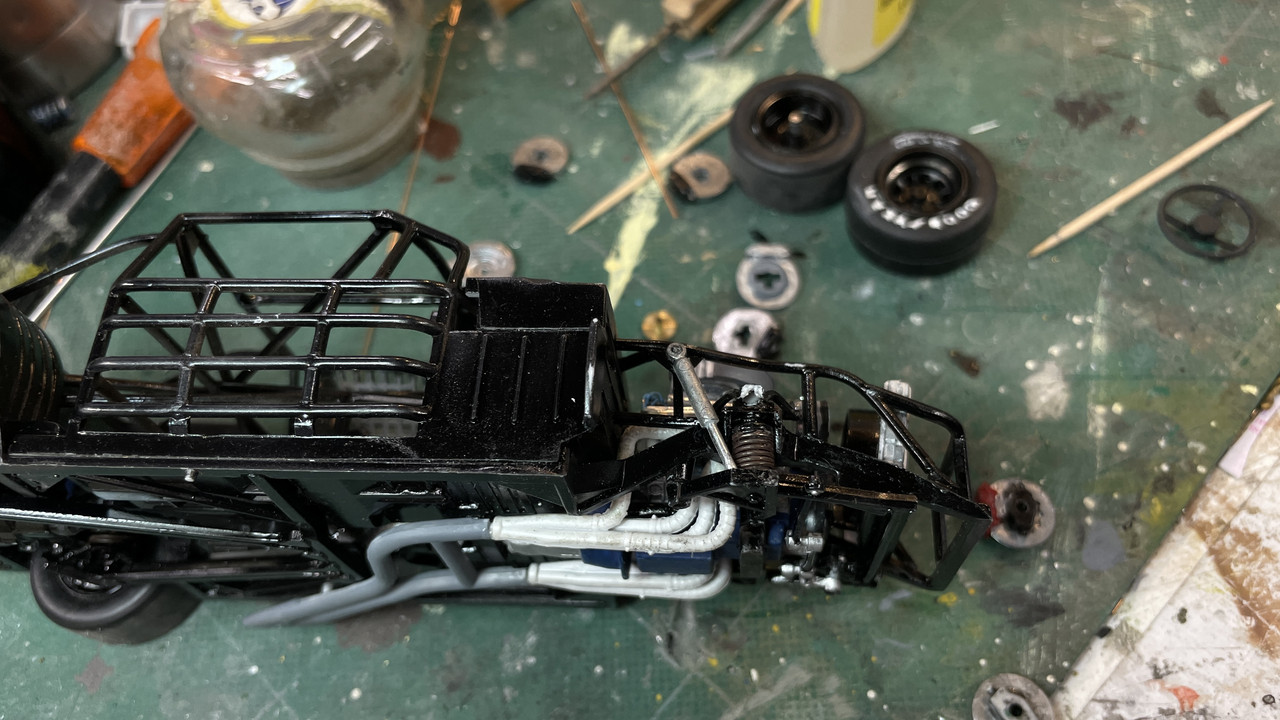
Kodak Olds NASCAR Racer Start-to-Finish Build

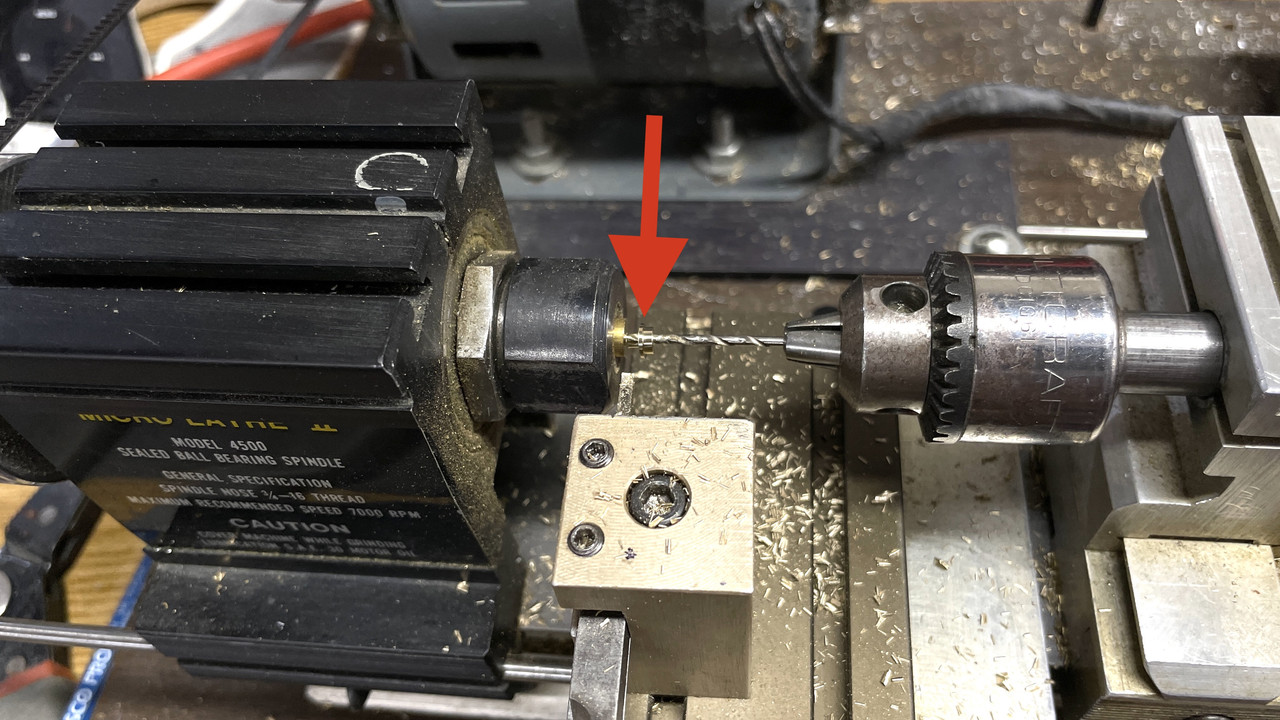
Machined and built the front springs. They are shorter and narrower than the rears. I used a smaller spring diameter and had to cut the length in half with a hard-wire cutter. Again I changed the scheme. Instead of machining the inner sleeve, I just machined the ends and used the steel shaft to both establish the length and serve as the mounting lugs. I drilled the stock first, then turned the .117" centering land and then the .160" o.d. I moved the cutoff tool over and cutoff the piece. After the first two, I added a twist (no pun intended) by letting the drill remain in the cut so when the work piece parted from the stock, it didn’t go into the ether. This worked elegantly.

I cut the land almost by eye so the spring just slid over it without much play.
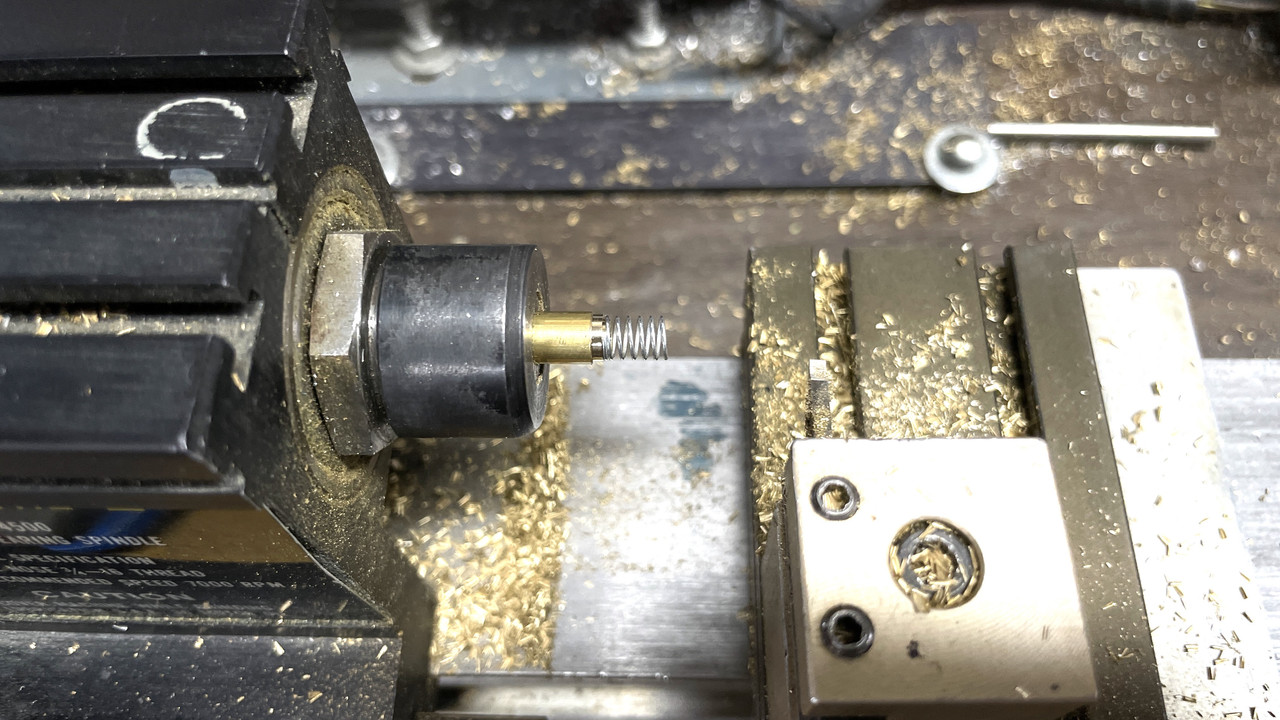
Here is the cutoff operation with the drill supporting cutoff workpiece keeping it under control.
I soldered on end onto the steel center rod, placed the spring and then soldered on the other end. I held the center rod in my PanaVise, and applied enough pressure with the RSU tweezers to set the spring compressed length. While holding it at this point, I soldered on the other end plate. This worked nicely and was simpler than yesterday’s method on the rear springs.
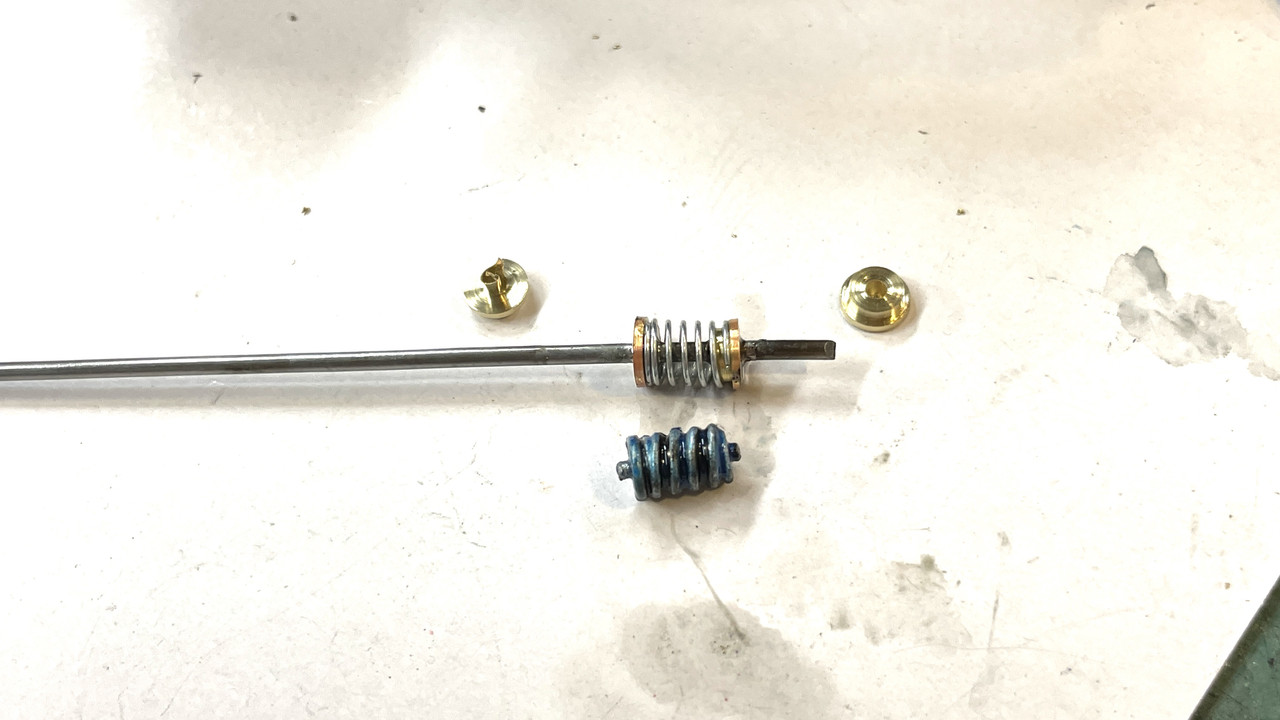
Afer soldering I clipped off the excess center rod with some beefier flush cutters.
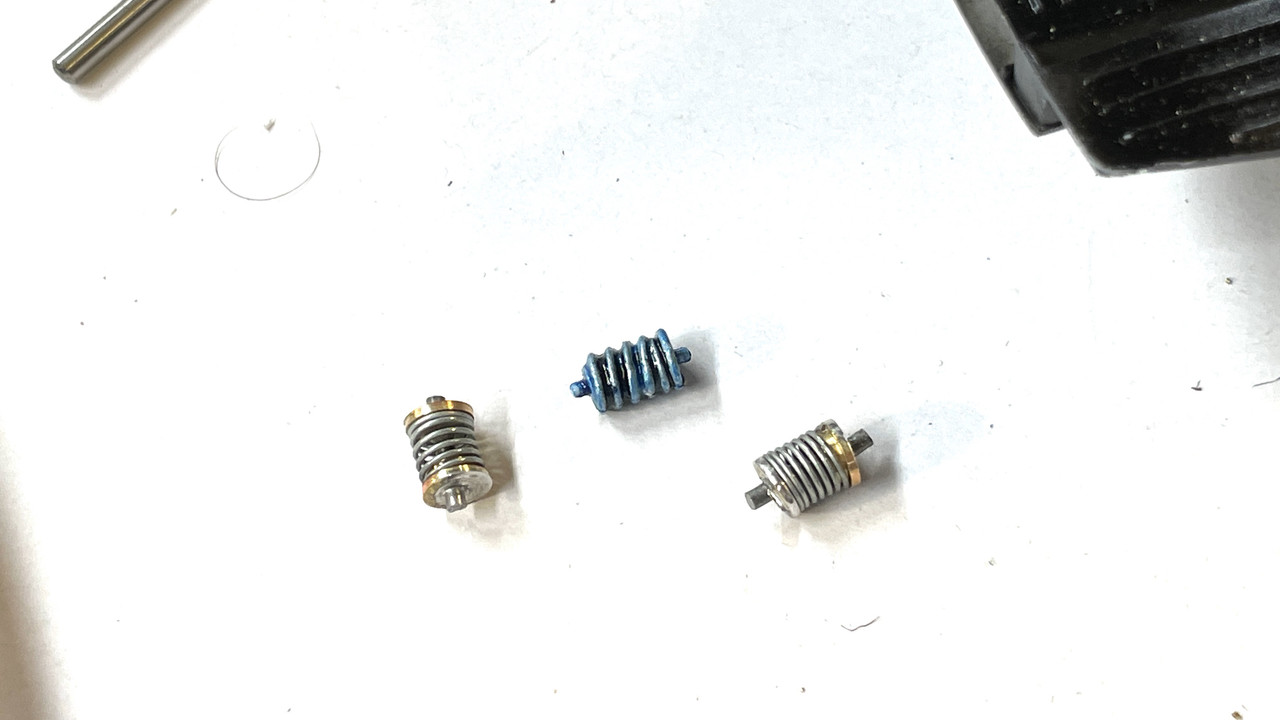
They compare reasonablly well to the kit parts. My springs have more turns, but I don’t care. Chemically treated these like I did the rears.
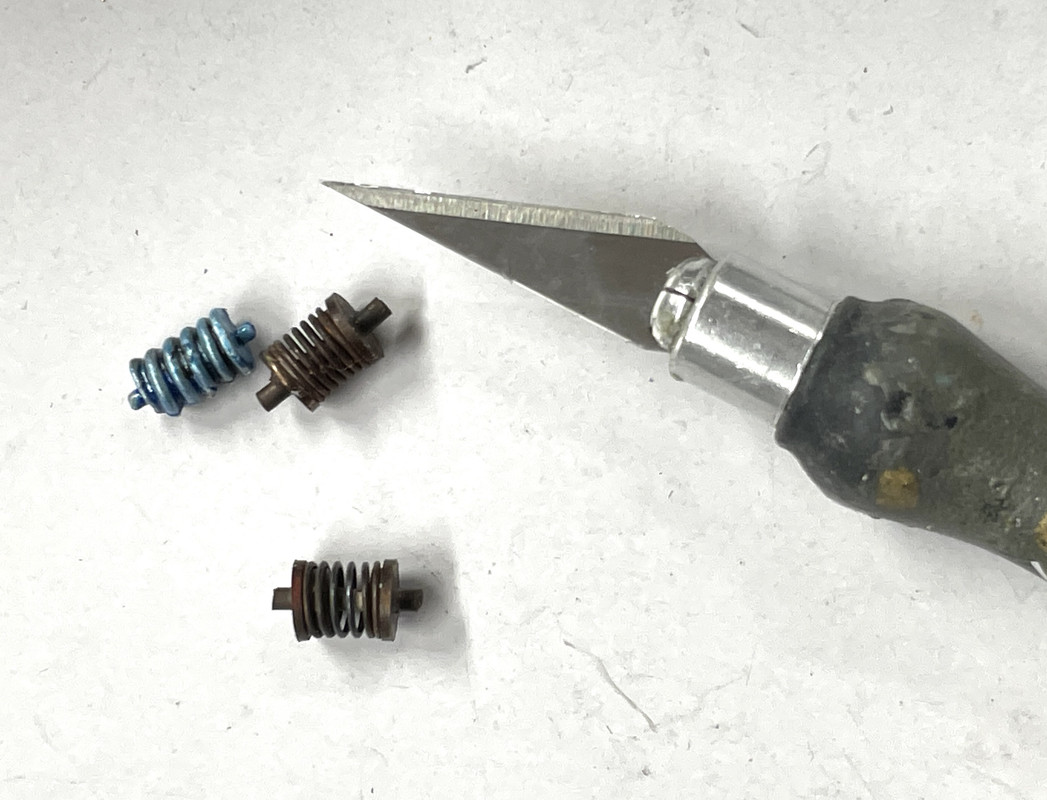
With the machining jobs done I turned my attention to remaking that broken shock. This little job took more time than the front springs. It wasn’t hard conceptually. It was hard because I kept breaking solder joints or losing tiny parts and had to make stuff over.

The scheme was cut a piece of brass tubing on the power mini-miter saw as the end lug and solder that to a piece of properly sized brass rod (3/64"). Easy peasy. My first attempt was using a larger tube for the lug because I couldn’t find the one piece of 1/16" brass tubing that was floating around the work bench. I drilled out the plastic shock cylinder for this rod and measured the exposed length of the piston rod on the unbroken shock. My first attempt had the rod very long and was going to cut to length after soldering.

My next attempt had the rod the correct length. This actually was easier to solder holding the rod with the RSU tweezers and pressing it lightly against the lug that was held with a T-pin.
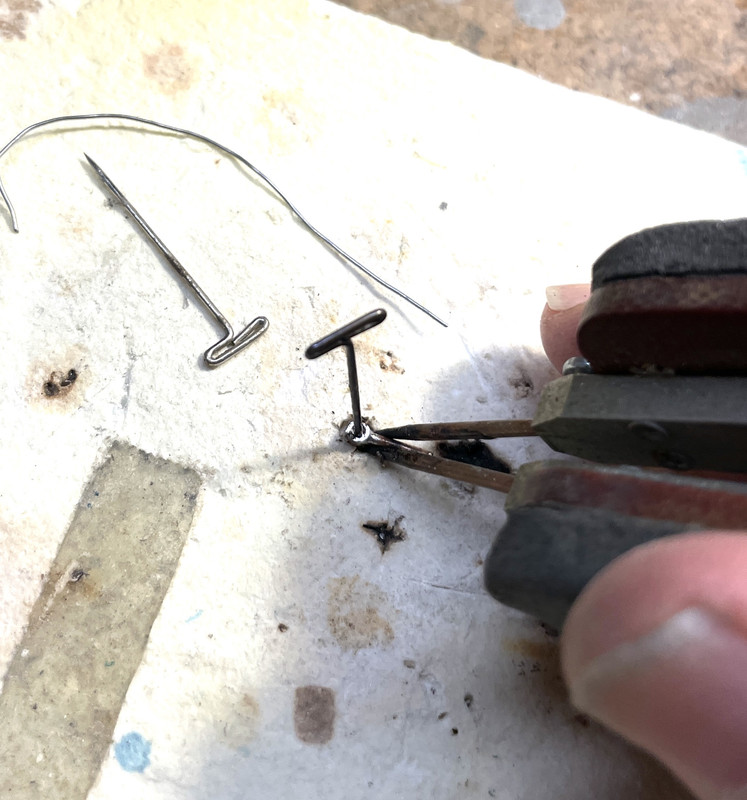
I attempted to install this repaired piece in the car, but the lug was too deep. I took it to the belt sander to “lightly” reduce the thickness. This didn’t work! It broke the piece apart and through the lug end into the ether.

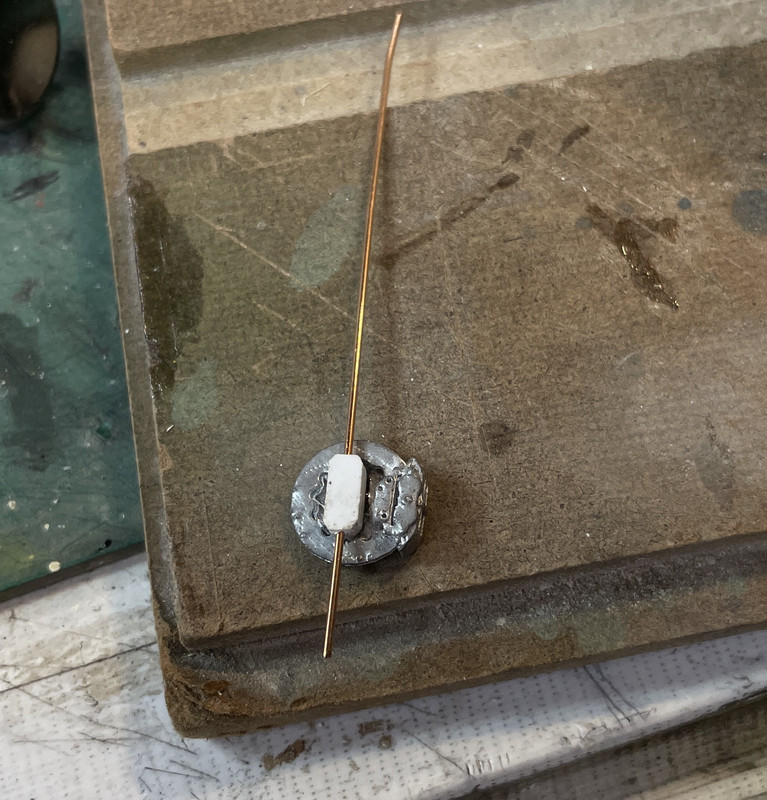
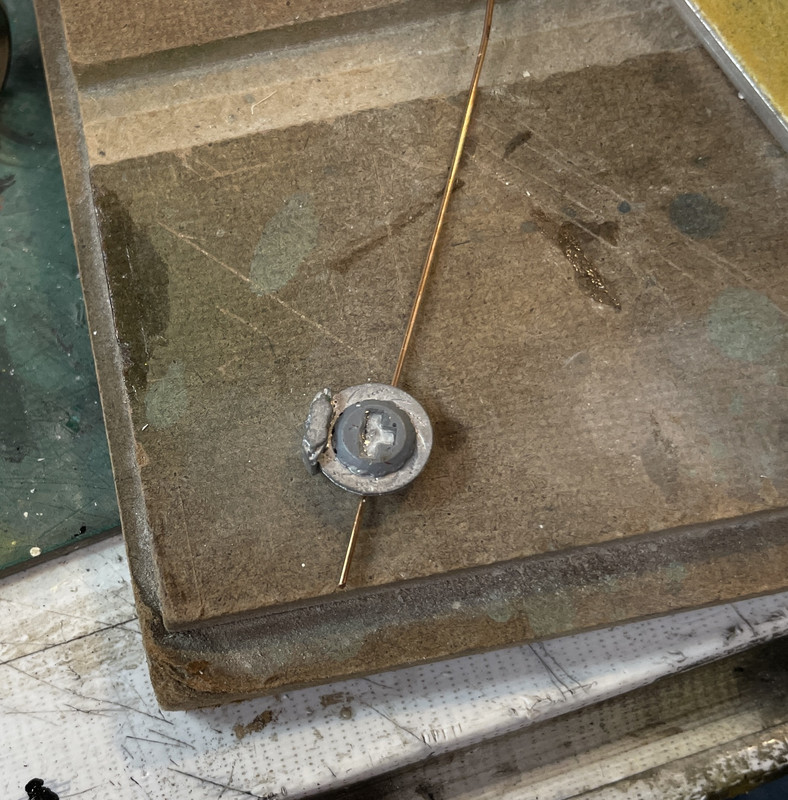
My next attemp had me soldering the cross-pin into the lug, and using this “tail” to stick it into my soldering pad. That stablized the lug end, and then soldering the piston rod as before. This worked!

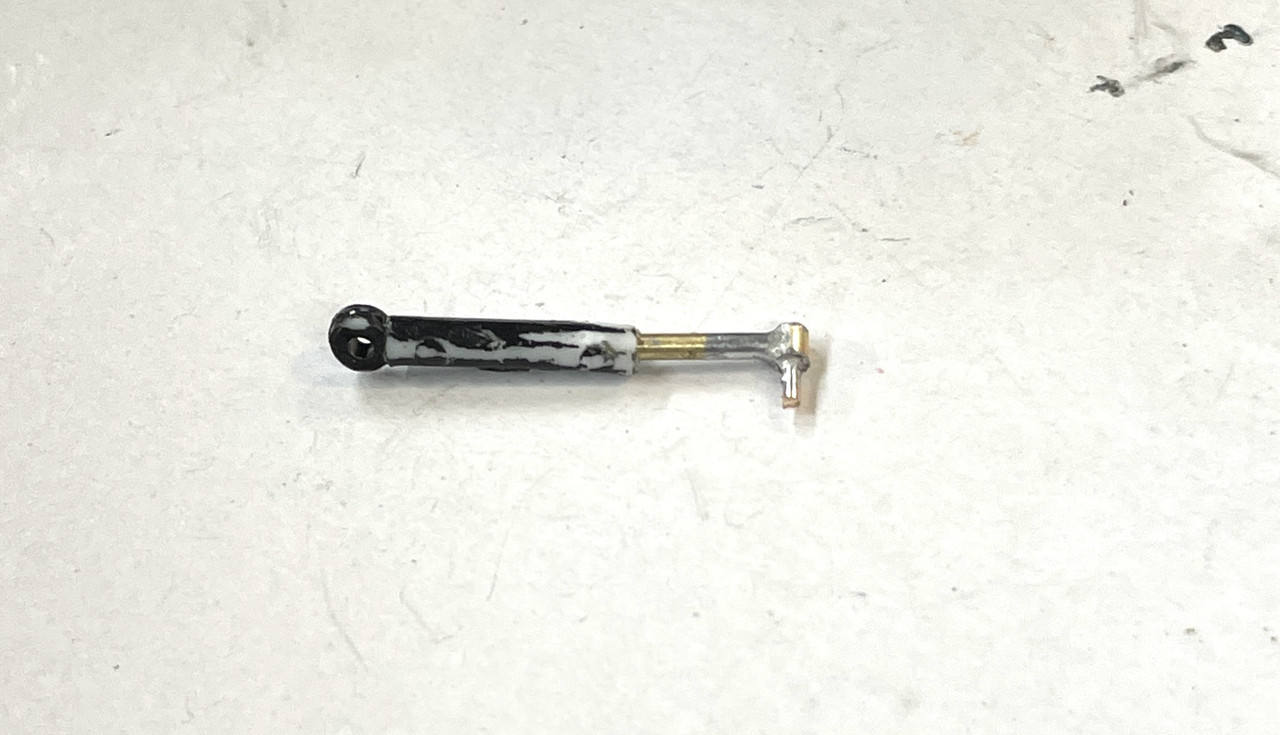
This is the completed shock not yet painted.
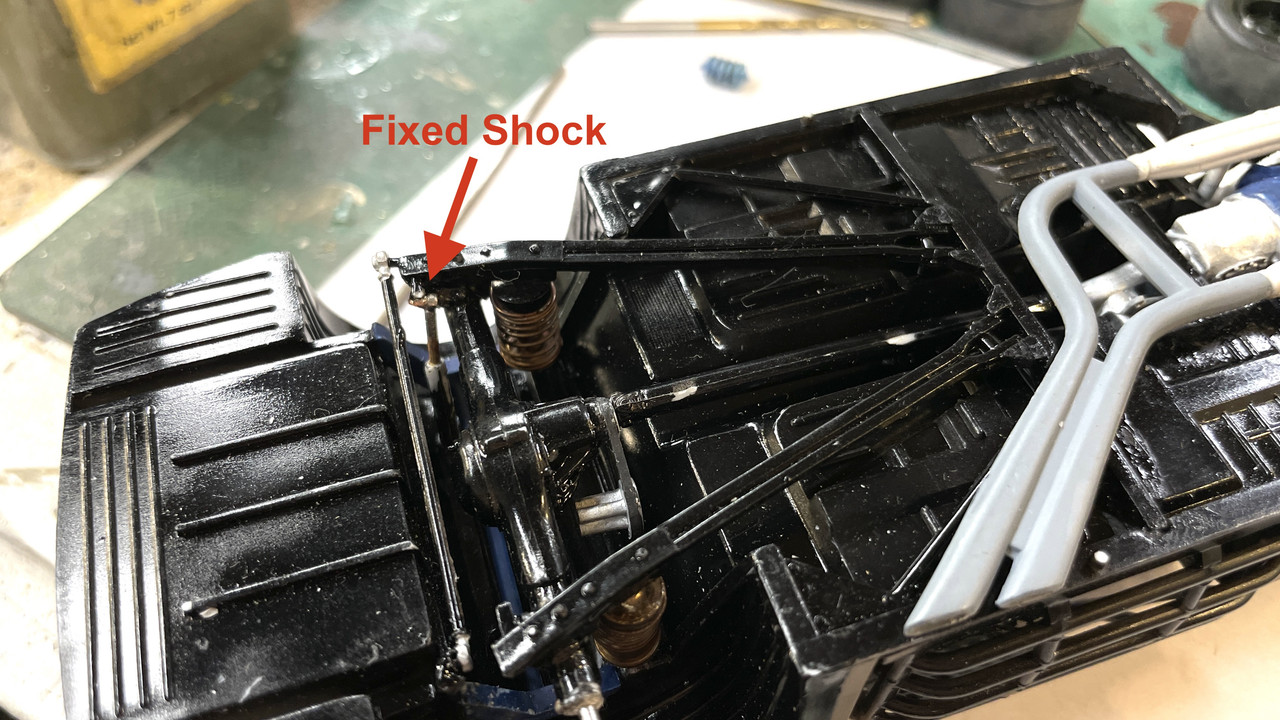
And the shock installed. This wasn’t easy either since the shock mount also had been partially broken in all the tummult. Medium CA with accelerator is holding it together. After repainting I’m hoping that the true poor condition of this joint with not be too evident.
Everybody have a safe and fun weekend. See y’all on Monday.

Lot’s of modeling going on here. Looks good so far regardless of the challenges the decals are giving you.

keep up the great work!

Thank you! More modeling today and more wrestling with those &%#)&@) decals.

I didn’t like he kit’s disc brakes at all. I decided to draw some new ones and 3D print them. I suspected that someone in the SketchUp World already drew some, but when I searched on their 3D Warehouse in a category that I suspected I’d find one, I only found one and it wasn’t sufficient, so I found a prototype on ebay and drew it myself. Then I had to draw a reasonable caliper. This time, I searched “no category” and got a page of disc brakes with calipers. I used one that I thought would work. It’s not a bona fide NASCAR brake.

And a bonus was the fellow who drew it did it so it could be printed (all solid, no reverese faces, etc.). I had to adjust the size to the kit’s brake diameter. It had a center hole, but I didn’t worry about that.

This drawing contains several things. The very large disc is my version before I found the nice drawings. It’s scaled 100 times larger than the 1/25 scale part I was making. You do this with SU. It doesn’t like to draw arcs that are too small. The trick is you draw the begining of the job in the scale you want and turn it into a component. Then you copy it and enlarge it as many times and you think you need to get it to draw properly (typically 10 or 100X). You then open the copy and do all your drawing on it. Being a component, every thing you do to the big one is also happening to the small one (like magic). When you’re done, you just delete the big one and the perfect 1/25 scale version is sitting there with all the detail. It’s a SU quirk (no a bug, just a feature). While it doesn’t like doing the original drawing in a small size, it has no problem duplicating all those small curves that are done on the enlarged version.

If you look carefully you can also see tiny 1/25th scale parts, and the beautiful downloaded ventilated disc assemblies.

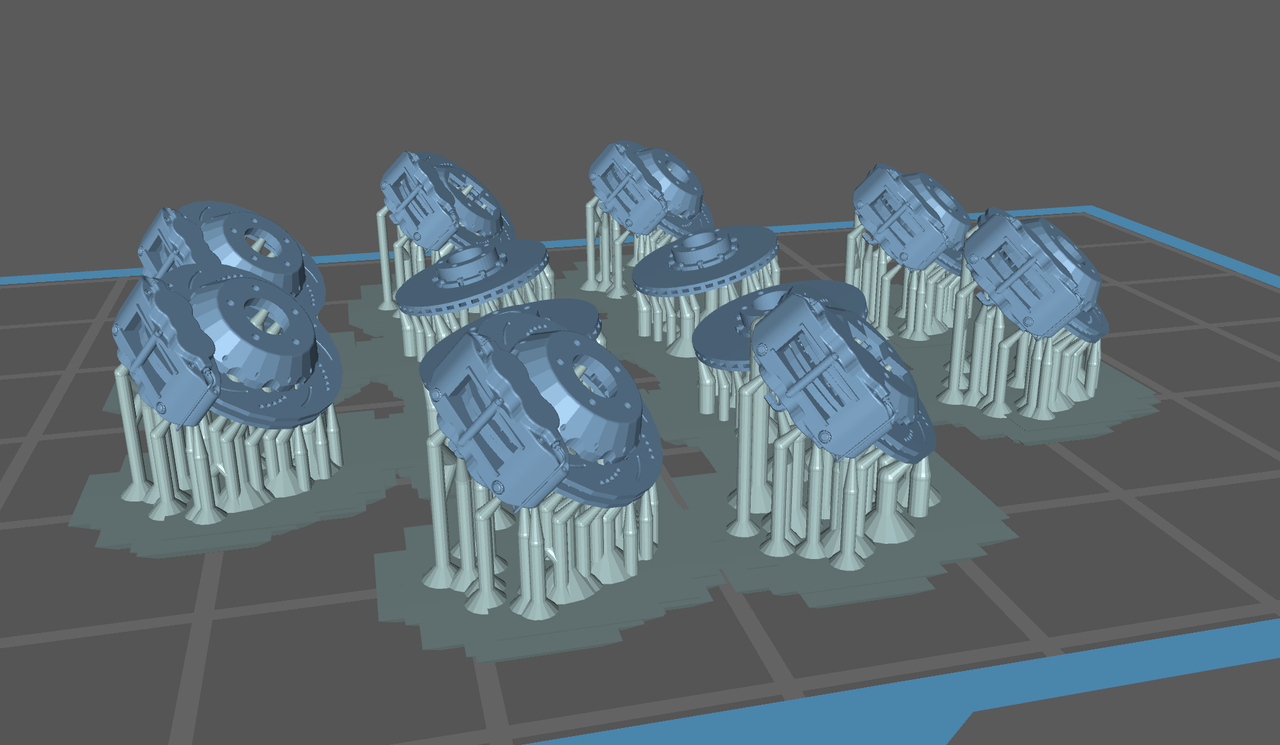
I had first loaded my version (without calipers) on the ChiTuBox Slicer, and then added all the new ones. I modified the holes in one style to conform to the front spindle part of the model.

I put all of the supports on manually. The Slicer shows you where any overhangs or islands would form by highlighting them in bright red. The brighter the red the more severe the overhang. I used mostly light supports, but placed a few medium ones in strategic locations.

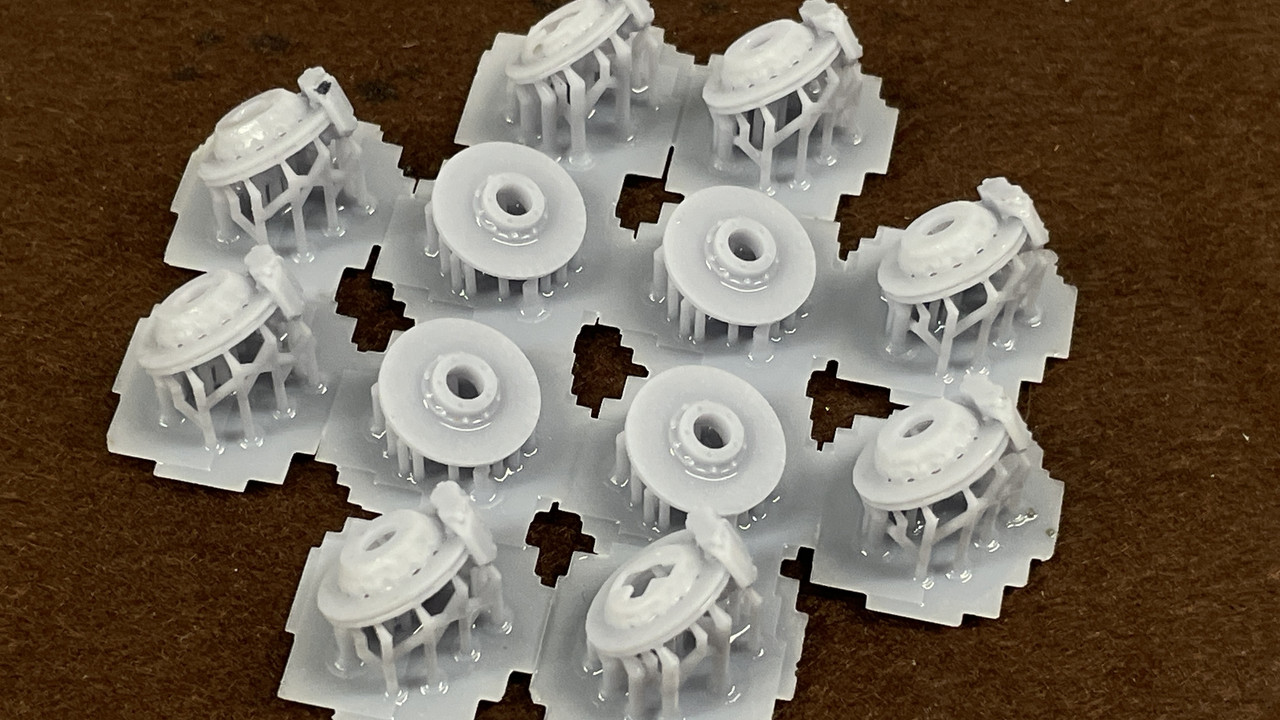
Here’s the output.

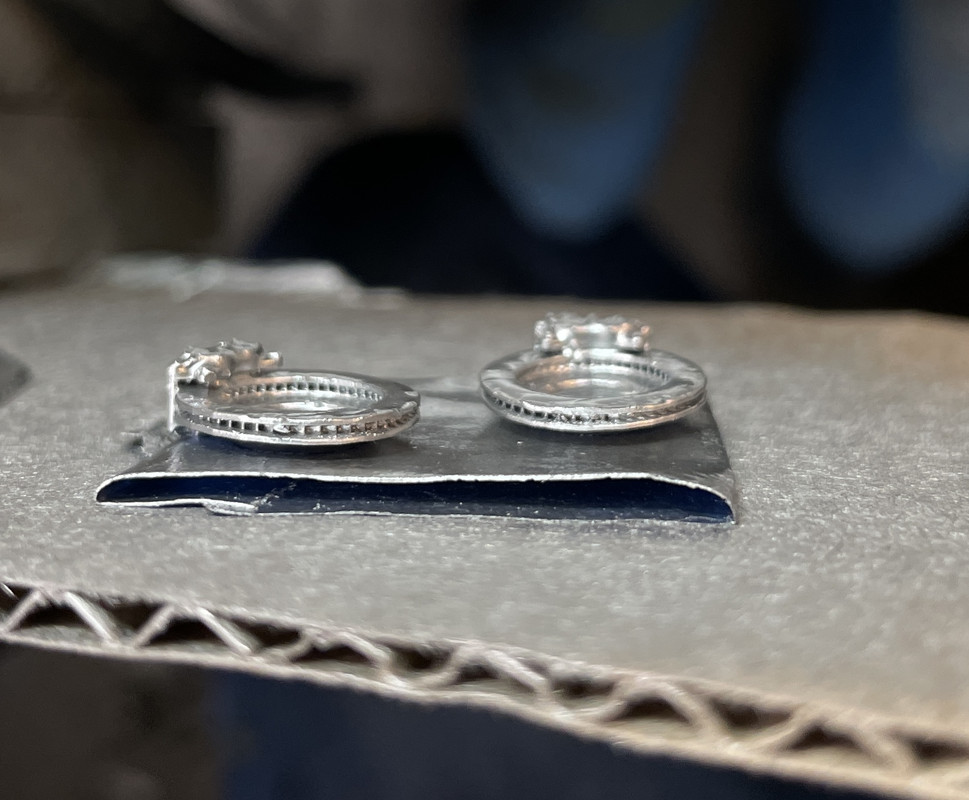
Prints were successful, but the cross-sections were a little thin in some critical locations mainly how the hub ties into the surrounding flanges.

It’s nice that you can make out the ventilation ribs and cooling channels. After painting it will be interesting to see how well they look. After reinforcing the hub area with Bondic UV Curing Filler, I attached the kit’s steering knuckle. I also had to do some minor surgery on the spring pockets in the front end frame to accept my homemade springs. My springs were marginally fatter than the kit’s and needed some relieving to fit properly. Used the Dremel with Flexi-shaft and 1/16" carbide router.
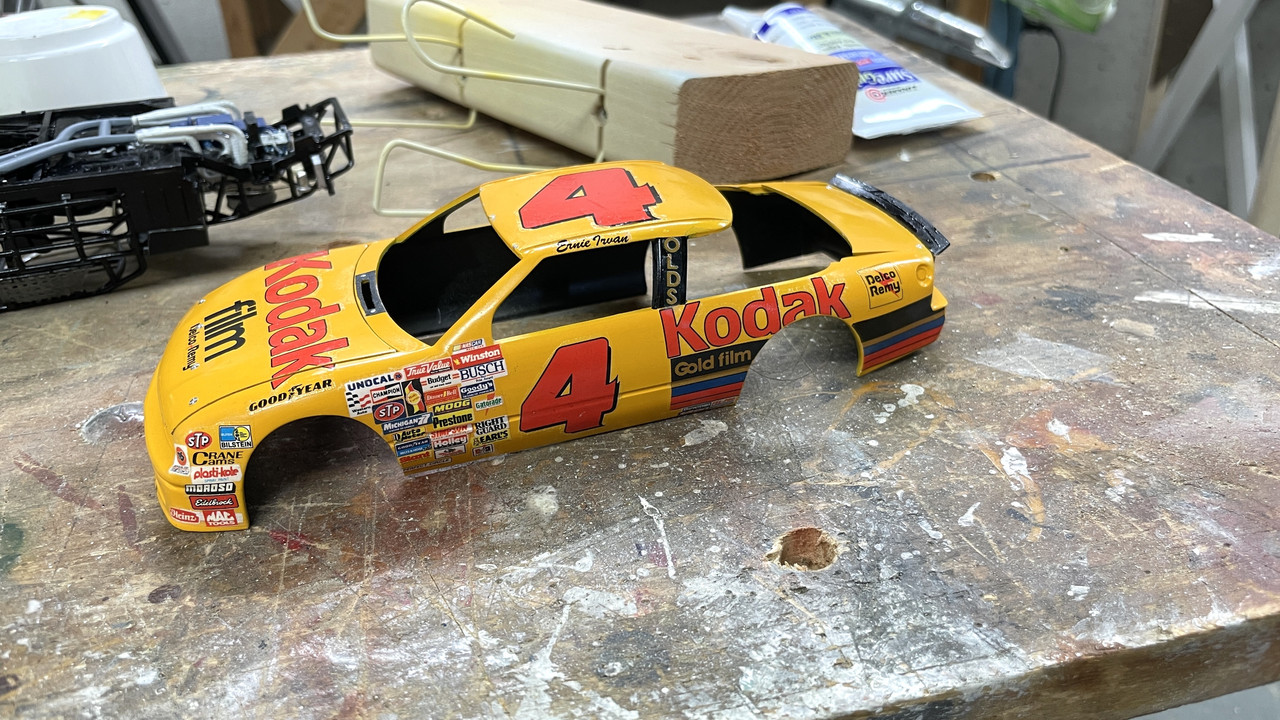
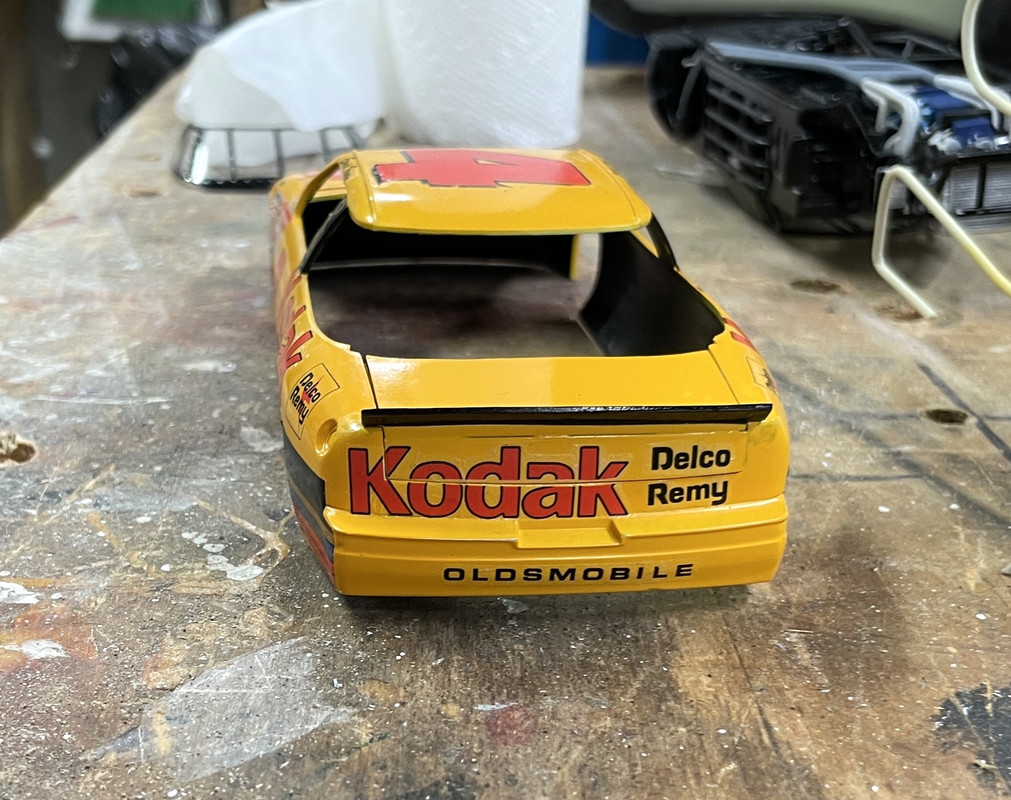
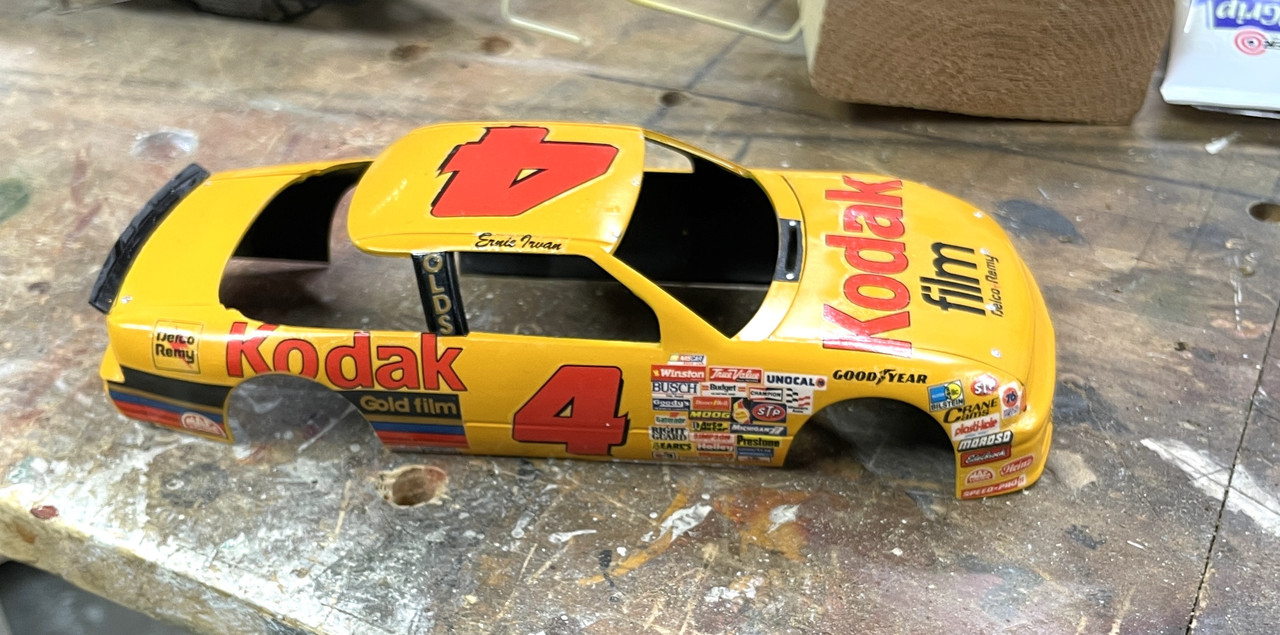
While this all was printing, being cleaned or post-cured (about 2 hours), I did all the rest of the decals. It was a pitched battle that lasted until the very last one, but I prevailed. Next time this happens, I am definitely going to make my own decals. These were a royal pain in the butt. And the car has LOT of decals.

One of the “OLDS” decals broke apart in the “door” pillar (in quotes because NASCAR doesn’t believe in doors.), the “Kodak” decal on the right side, and chunks of several other decals all over. The MicroSol Decal Coating did work.

Next session I will finish up the front end and the chassis will effectivley be finished.

Until next time.

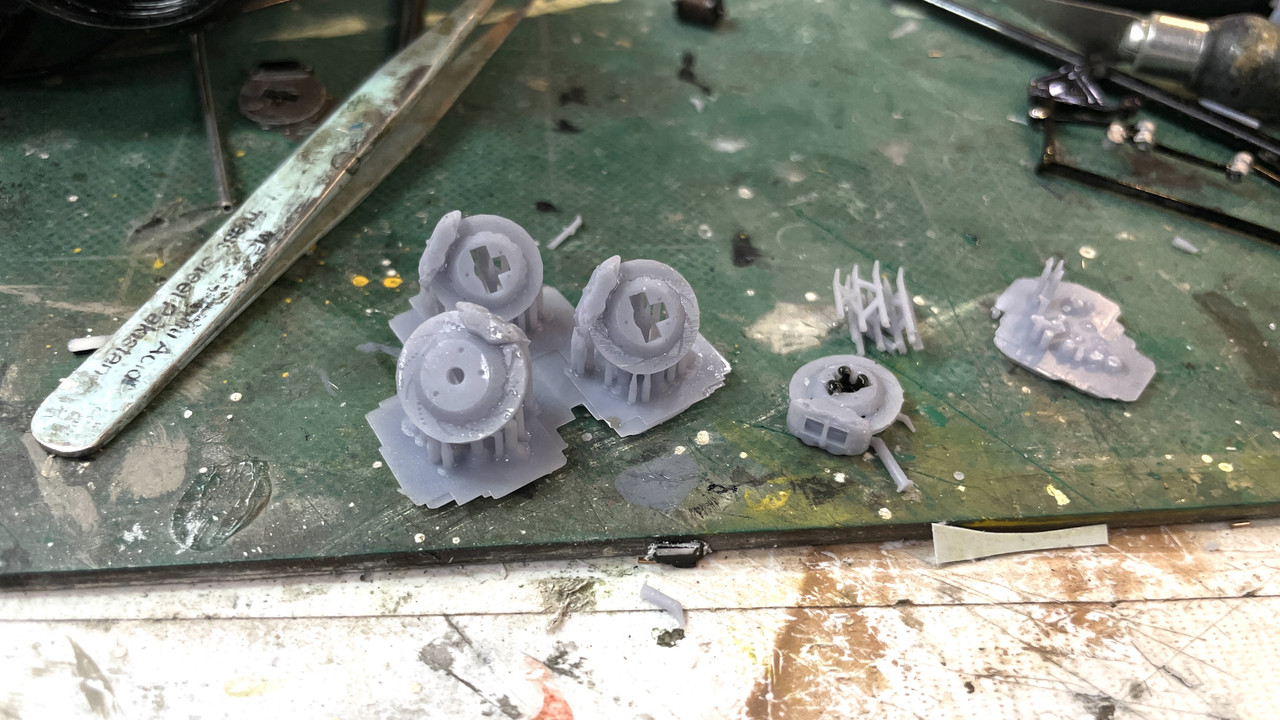
I needed to reprint both front and rear brakes. The rears didn’t really fit and the fronts didn’t either, and were weak. I revised the drawings to beef up the center hub and changed how the rear brakes go onto the rear axle housing.

The rear brakes now slips nicely over the axle housing and the axle protrudes enough to hold the wheel.

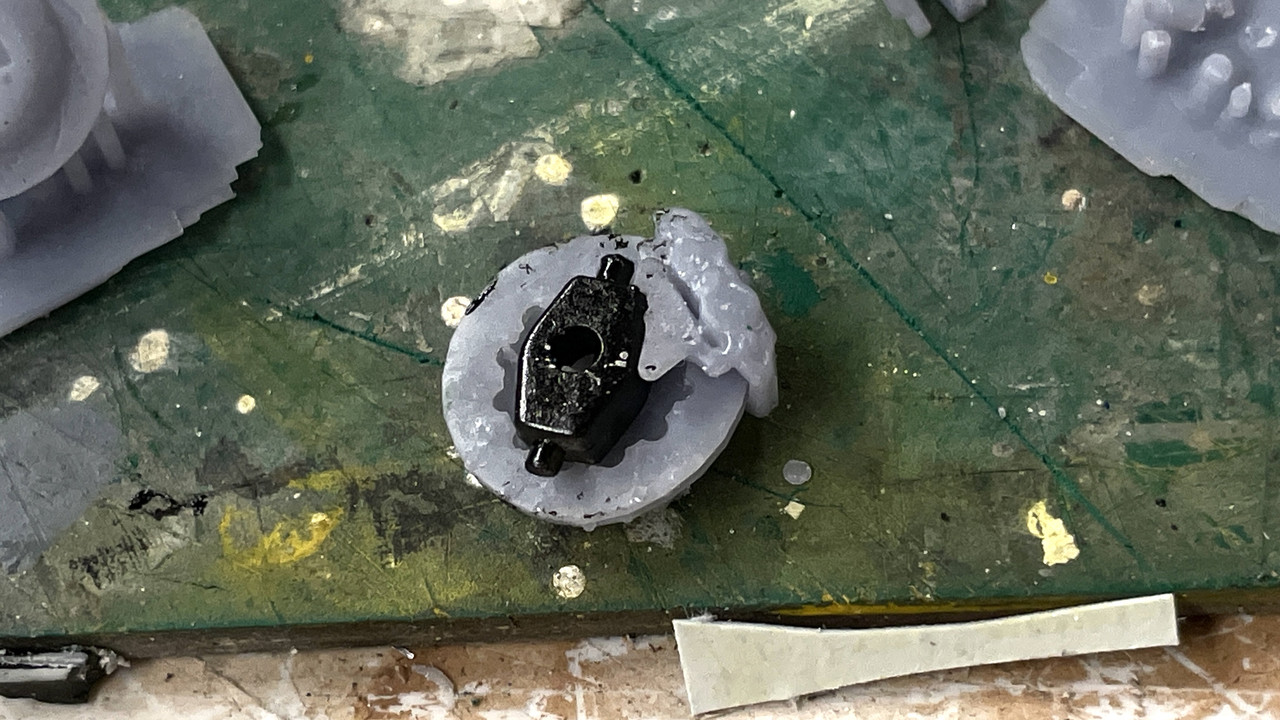
However, the front brake, while being more robust, has the caliper in the wrong location and it fouls insertion of the spindle into the A-arms. Since the caliper is integral to the disc in my print, I had to go back to SketchUp and rotate the caliper to the 3:00 position. It’s on the machine now. Print takes about 1 hour 10 minutes. I’m printing at 30 microns per layer since it’s such as tiny part. At this resolution, the tiny vent holes in the disc’s surface actually are holes. When the printer is working well it’s just marvelous.

Here’s version 2 and the interference.

The beauty of building your own parts on your own printing system is the ability to do it over and over until you get it right. The downside of building your own parts is the ability to do it… you get the message. As usual, a blessing and a curse.

Coming along very nicely.

Thank you.

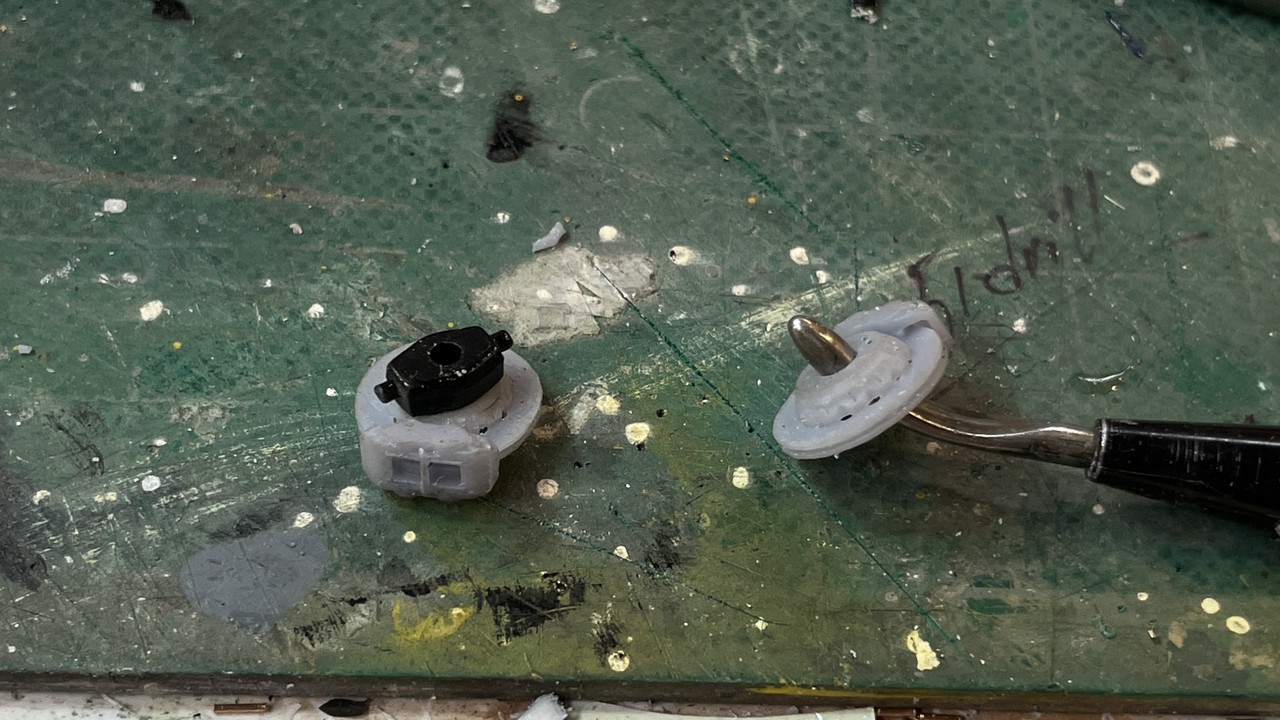
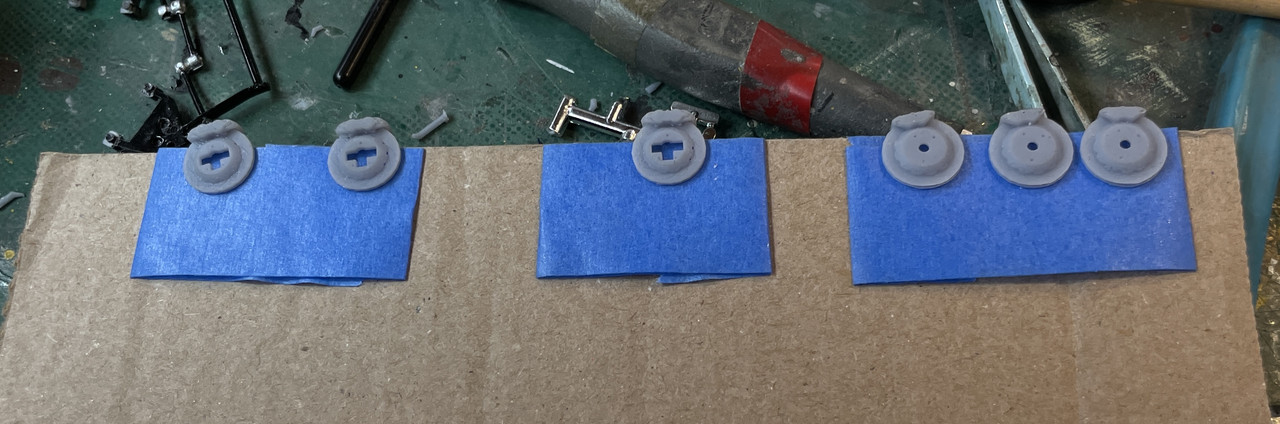
The new front discs are correct and really nice. I post-treated them (to finally harden the semi-hard UV resis), cleaned up the small amount of support debris and got them ready for the first coat of paint. I always remove supports before post-treat. After treating, the parts can be a little to brittle to take the shock of support removal and you can lose details.

My slight enlargement of the T-slot was just enough to let the steering knuckly fit wihout side pressure.

I painted the one side, let it dry enough to handle, flipped them and did the second size.

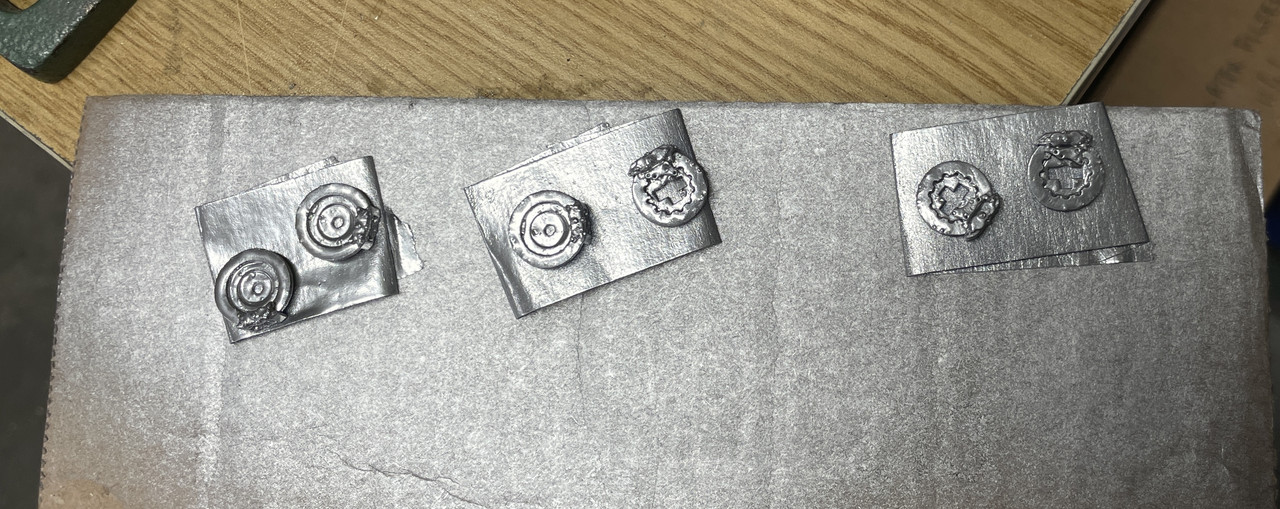
The paint was not fully dry in this image and is still hiding some of the nice surface detail. I’m letting them dry overnight before doing the next colors. I’m painting the hub part steel and the calipers bright red.

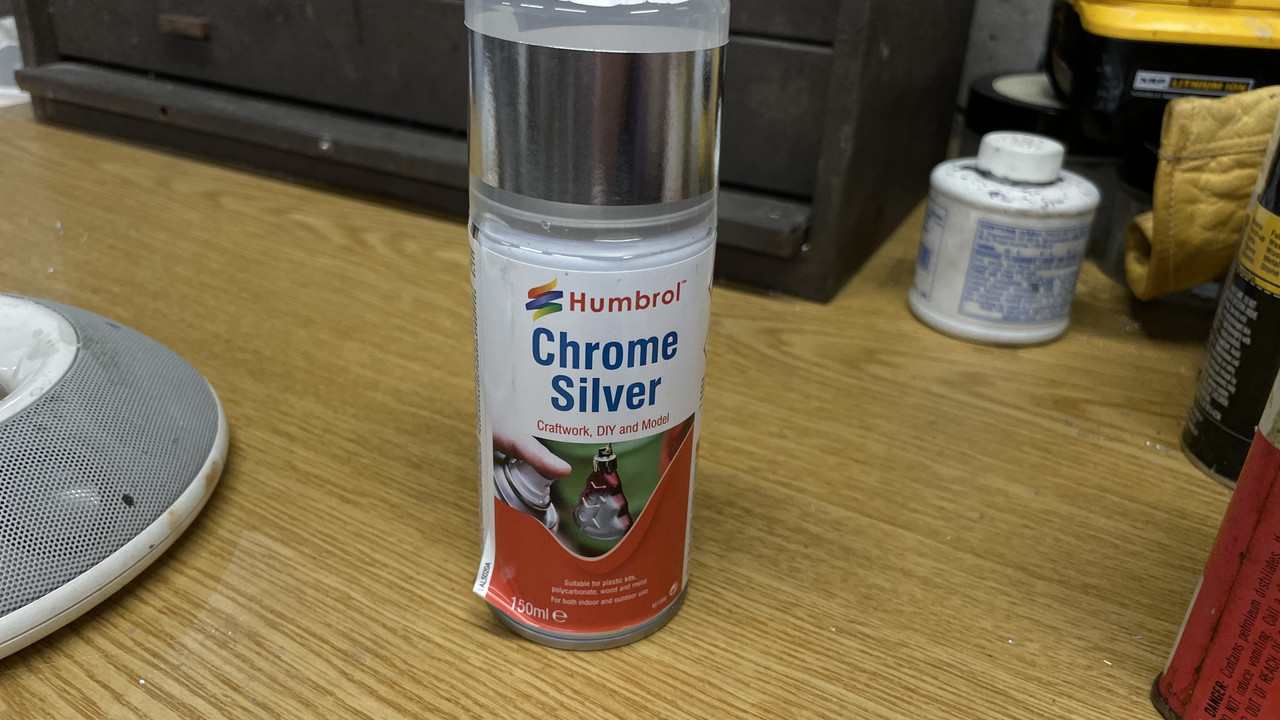
I’m trying a new chrome paint by Humbrel and it lives up to its reputation. It’s very bright and nearly as bright as the Molotow pen.

When I said that printing could resolve the cooling fins, I was not kidding. This is a detail that would be impossible by any other method including investment casting or resin molding. You couldn’t created mold that would have those internal details in a single part. They’re even curved as they would be on an actual disc.

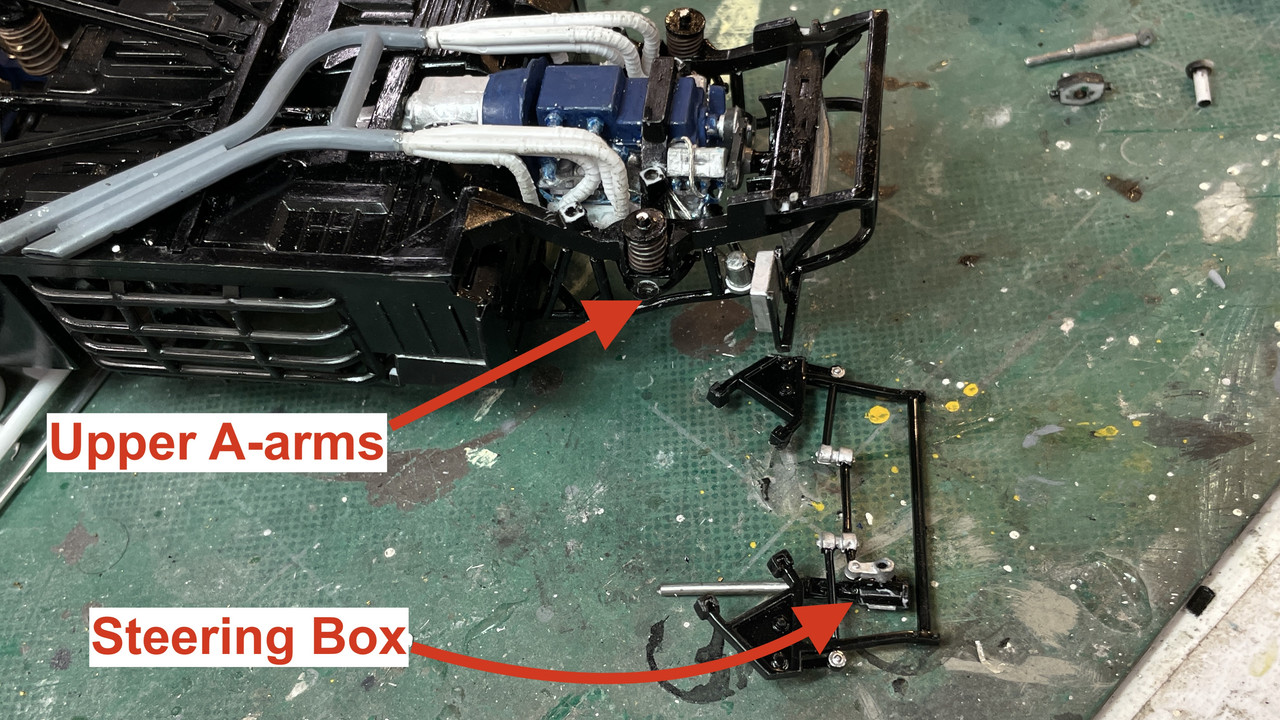
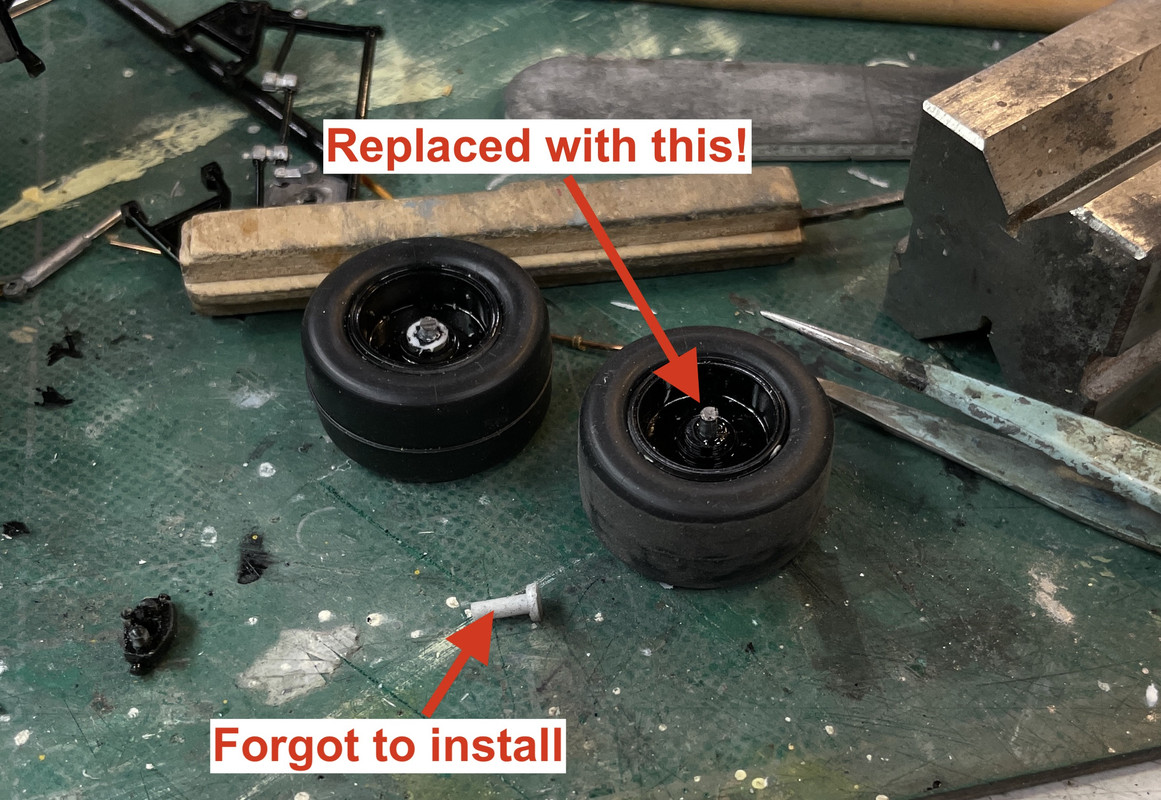
While this was drying I continued working on the front end. Besides the left exhaust falling apart when I was trial fitting the steering gear and lower A-arm assembly, and forgetting to inserting the spindle into the front wheel rear half, everything worked well.

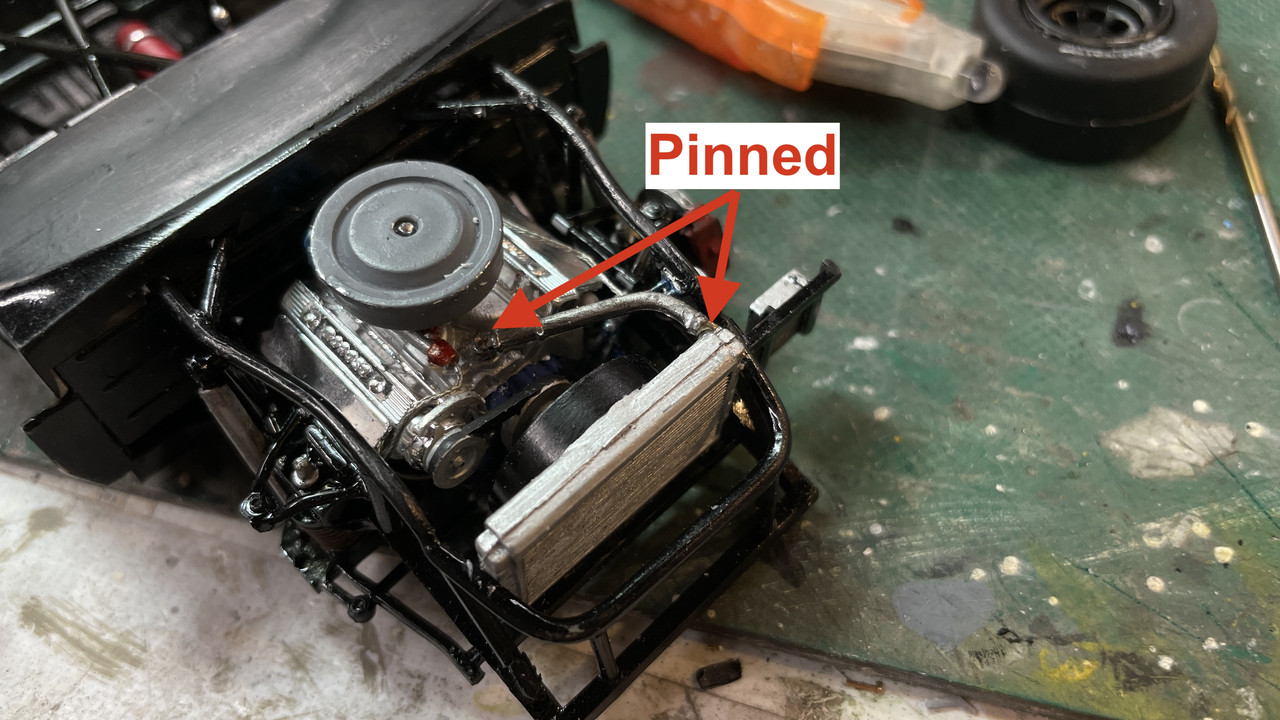
As with the rest of this old model, steering gear mounting, other than into the steering arm, was ambiguous. There was not much to clue you into just where on the frame it tied in. When trying to make room for the steering shaft, it popped the tenuous left manifold off and that took the collector too. I ended up pinning the collector to the frame with a 0.032" phos-bronze rod, and cleaned up the manifold mounting surface of old glue and put it back together with CA. This was at least the 3rd time that manifold came off.

I got the upper A-arms in place, trial fit the shocks and let it all dry until tomorrow to glue it all togther.

The plastic spindle was supposed to be captivated between the front and back wheel parts, but I glued them together before putting it in. I didn’t realize the miss until I was noodling how the wheels attach to the steering knuckle. For some unknown reason I was thinking the spindle went behind the knuckle and attached to the wheel. Instead, it protrudes out of the wheel itself. I tried in vain to break the glue joint between the wheel haves, but as Murphy would have it, the only glue joints that fall apart are the ones the MUST stay together. I cut some 5/64 steel rod to make some pins of the right length and then CA’d it into the wheels.

Because of this blooper, the front wheels will be permanently glued and unable to revolve. There’s no reason for rolling wheels on this model anyway. The parts are much too fragile to take any form of “play” activity.

With a tiny bit of fussing, the rear end was assembled with the new disc brakes. Looks decent.

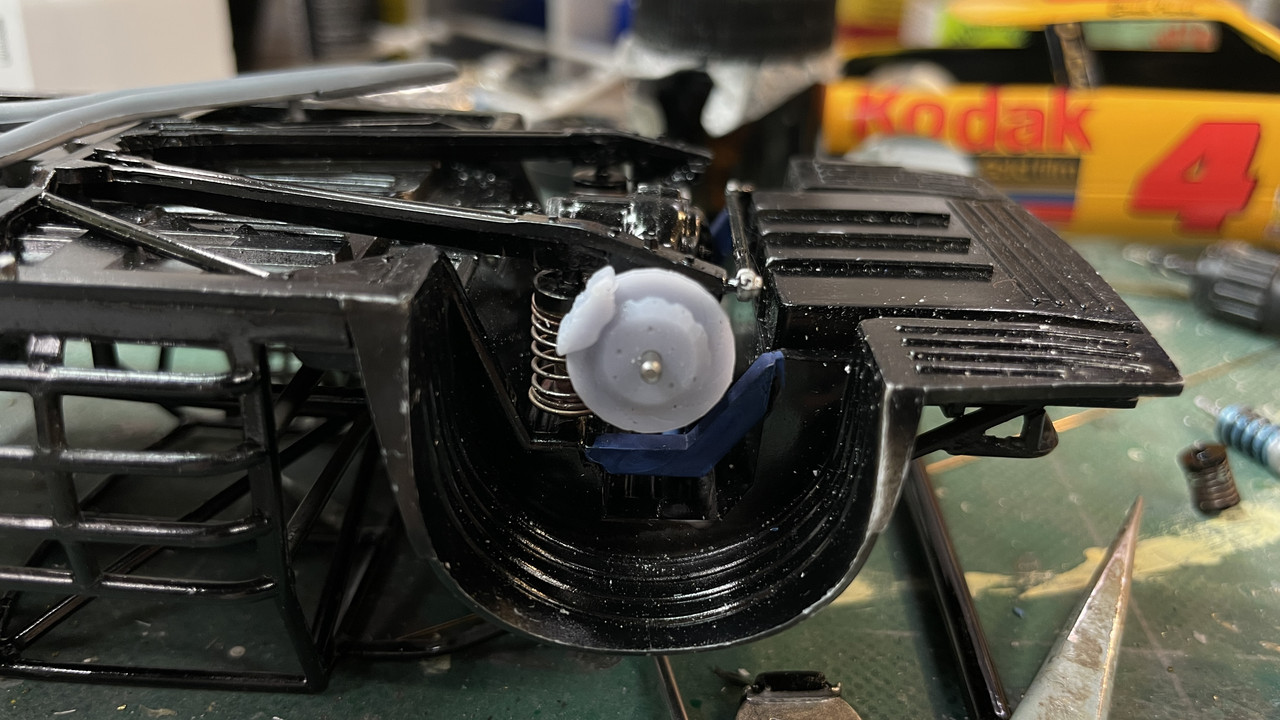
Next was the front end. My new brakes are still too big to nestle into the wheels. While I could have shaved off material from the calipers to get the to fit, I decided to use the original kit brake for the right wheel and will display the left wheel removed showing off the more detailed custom disc assembly.

I realized that attempting to install the springs and steering knuckles on both sides and THEN place on top of this the entire front end lower asssembly, I chose to install those that part first including the trapped shock absorbers first. The upper A-arm is very flexible (too flexible) and it will spread enough to insert the knuckle and attached brake. I’ll do that on Monday. The whole thing was stubborn to get settled in with some tension imposed by my custom springs, so I’m giving it the whole weekend to fully set.

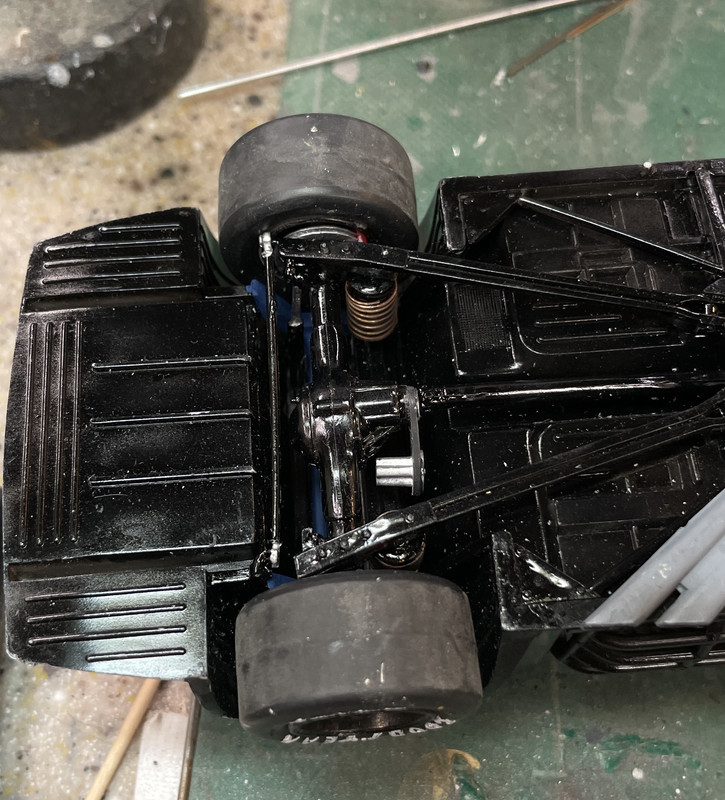
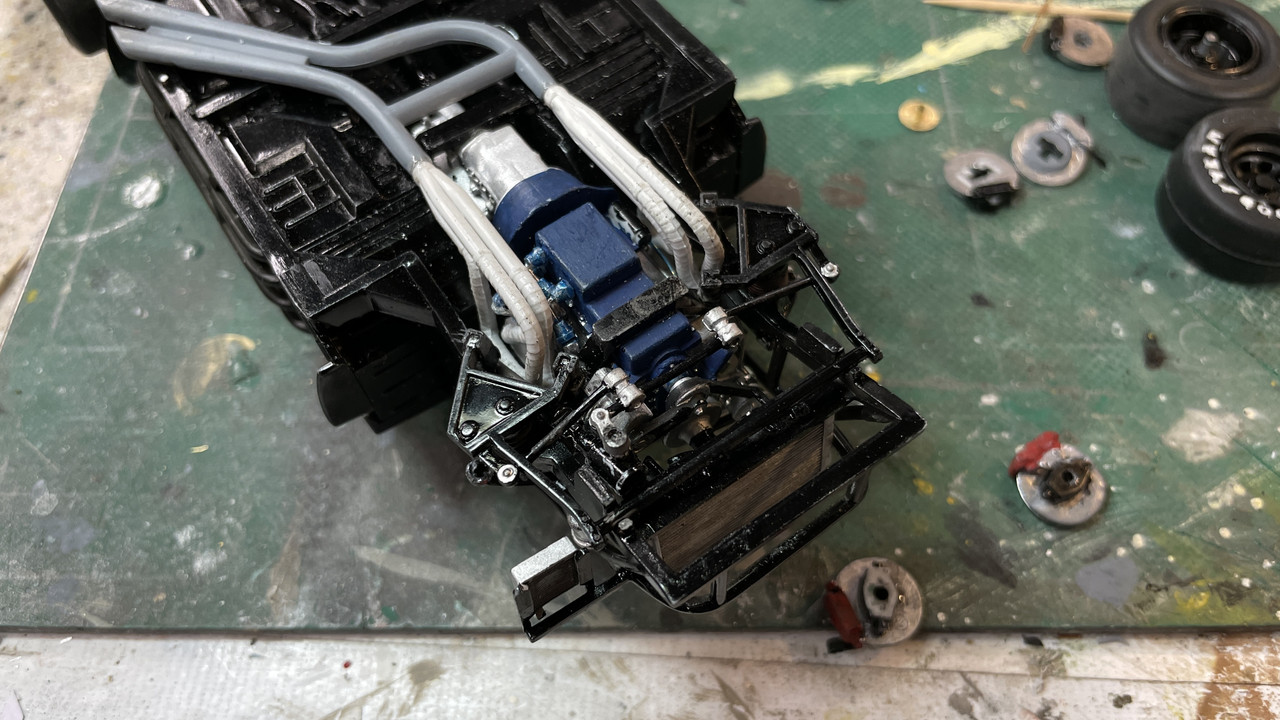
And the underside:

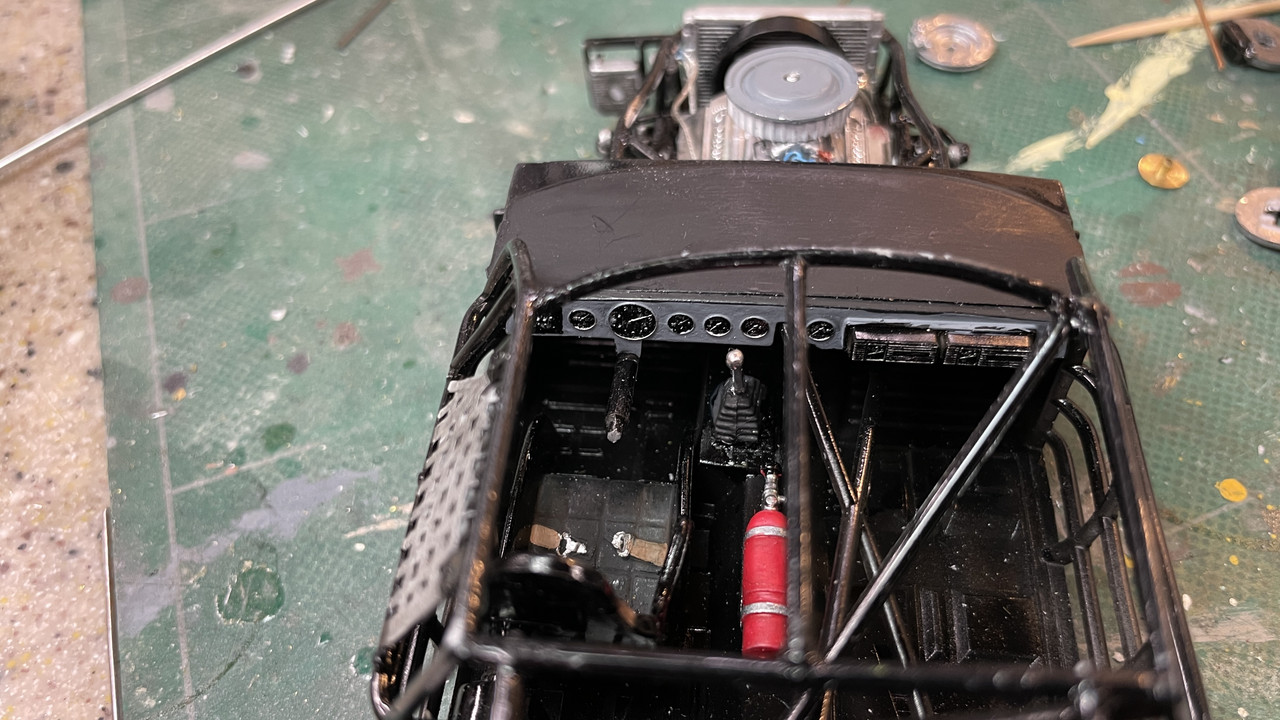
The thing I did on the punch list was install the steering column. It probably should have gone in sooner, but it wasn’t much of problem.

The front wheels and steering wheels are the last things to go in. And there’s the rear view mirror, which I may leave out since the mount is dubious at best. It will have to be wired to stay put.

It’s coming along nicely. Are you using photo references or personal knowledge of the colors and details? I’m more of a “looks like the drawing in the instructions” kind of guy when it comes to building cars.

I also heard that Jerry Davis died last week. He was club president when I moved here. Haven’t seen him in at least a dozen years though.

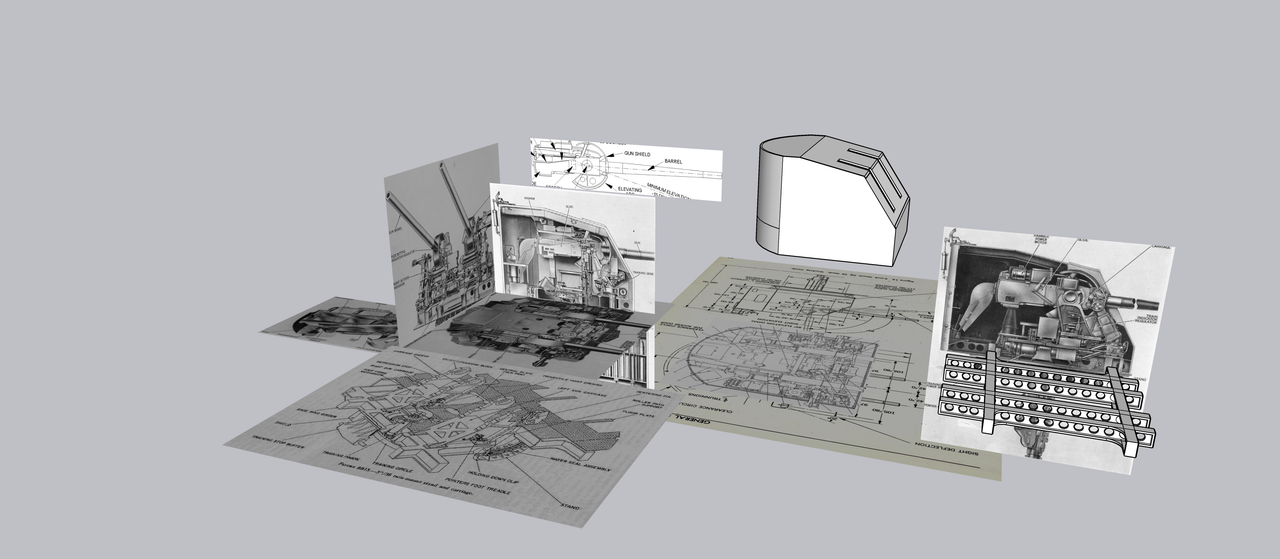
I’m using as many reference photos as I can find on Google. The box top and sides had photos of the actual car. I post this on KitMaker as well and some folks posted pictures of this car in a museum. I’ve gotten pretty good at ferreting out images online of the various things that I do. Next up is either the Takom Apache (1/35) which is in the stash (very small stash) or another turret master project. I’ve been green-lit by the Battleship New Jersey Museum and Memorial to permanently display my next model: Takom’s 1/35 5"-38 Twin Turret with the full interior down to the magazine done by me, like I did with the 16" turret.

I’ve started doing the drawings for all the 3D printing, but really can’t proceed too far without the kit in my hands. I learned the hard way that designing before the kit arrives just means a lot of mistakes and re-designing. Right now I’m just noodling the sub-frame that holds the gun mounts, but without the kit, I don’t know how long the elements need to be.

As for Gerry Davis… We’re very sorry for his family’s losss.

A lot of our club is in that age group where bad things can happen… me included. I turn 78 in two weeks. Strangely, I’m actually healthier than any time in my life. Go figure. I’ve been a member for going on five years, but do not remember meeting Gerry.

When I arrived at Knox and joined the club, I was one of the “young” guys and I turn 60 in February.

I got to ride in the Toyota Red Bull NASCAR when it was on Knox way back in 2010 or 2011. Hot as heck and quite a stiff ride, but I got to ride in an actual race car!

One thing I noticed is that the finishes on that car weren’t that well done. I guess I expected show car level finish and saw race car level instead.

Your build is coming along great.

I’ll follow your turret build with great interest.

EDIT: My Facebook memory feed said my NASCAR ride was 14 years ago today!

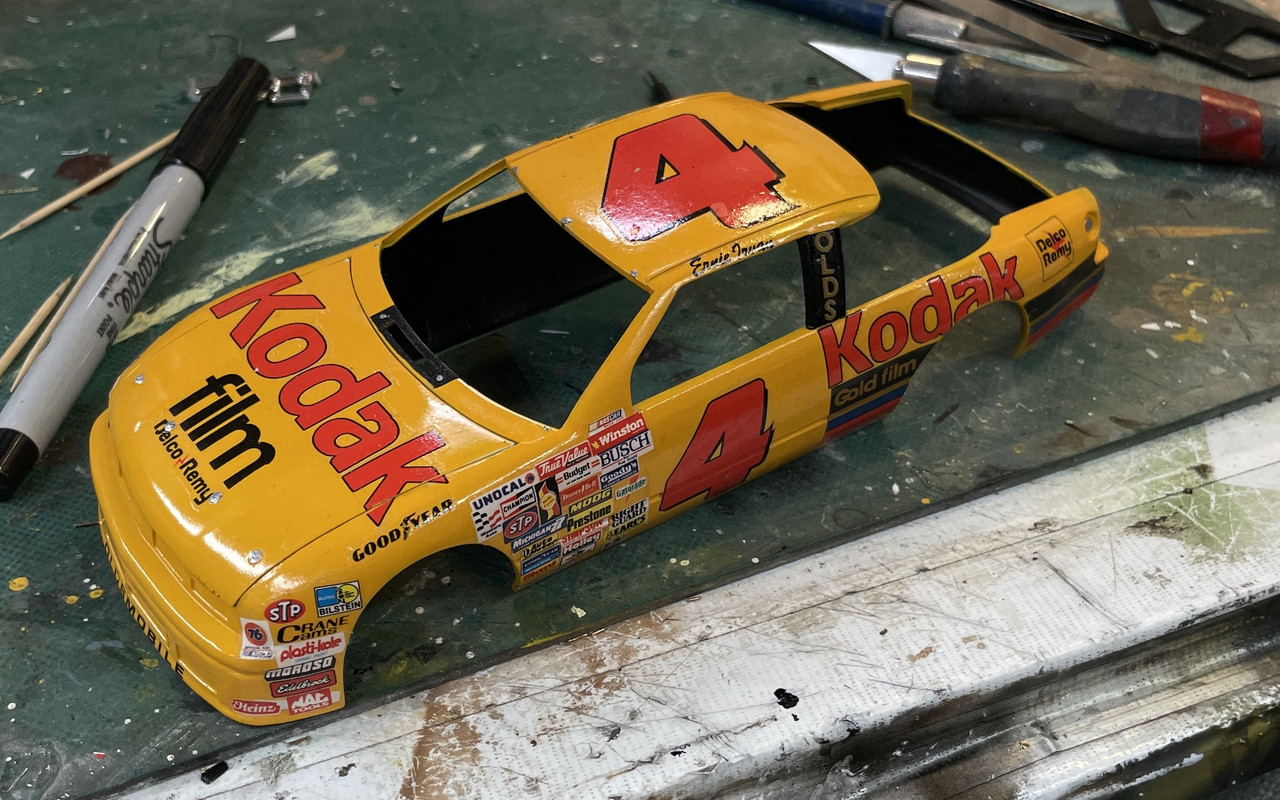
Put the first gloss coat on the body. And of course, before the Alclad AquaClear was fully cured, I dropped the darn thing on the floor (jelly side down) and it picked up some floor muck. Not much, just enough to make me grumpy.

I put the pieces under a cardboard box so it would fully cure without dust, but then I took the box off to check it, knocked the body holder which tipped over and dumped the model and hood onto the floor. DOH! Should have left it alone. My ADD rears its ugly head again.

Tomorrow I’m going to give it a light polishing and then apply one more coat. I then have to paint the front vents with a flat aluminum/steel color and the body should be finished.

While that was drying I “attempted” to put on the front spindles and mount the tires. The “” are intentional. While fitting the two sides (one with the kit’s disc and the other with my custom one), the custom fell off. I spent the next 20 minutes sweeping, crawling, checking my clothing, etc. Nada, bubkis! I gave up and fabricated my own steering knuckle to fit nicely within my custom disc. I then used 0.032" phos-bronze wire as the king pin (even though modern cars use ball joints). This created a fully functional steering hub.

From the front I just CA’d the knuckle into place with medium CA and accelerator. After this image I painted the caliper bright red.

I drilled the upper and lower A-arms for the metal rod. I partially drilled the center to accept the steel pin I was using as an alxe (0.073"). I then installed it and clipped the excess metal sticking out. Wheels were glued with Gel CA and accelerator as the hole was a little larger than the pins.

The opposite side went on with the previously built kit parts. The new work is much sturdier.

During the handling I knocked off the radiator hose. I found it on the floor when searching for the steering part. It was a dubious joint to start with and was fixed with my usual method of pinning with some 0.022" wire.

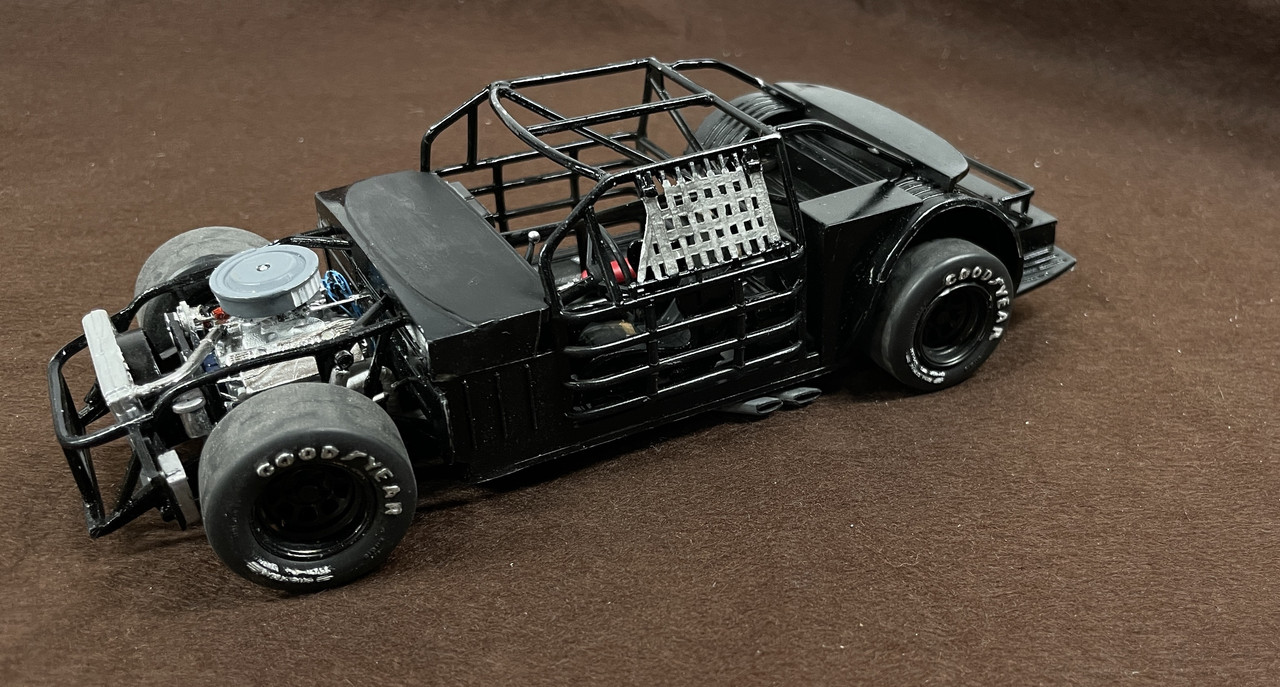
With the wheels installed it was time to take some complete chassis pictures. I also added the last part, the steering wheel.

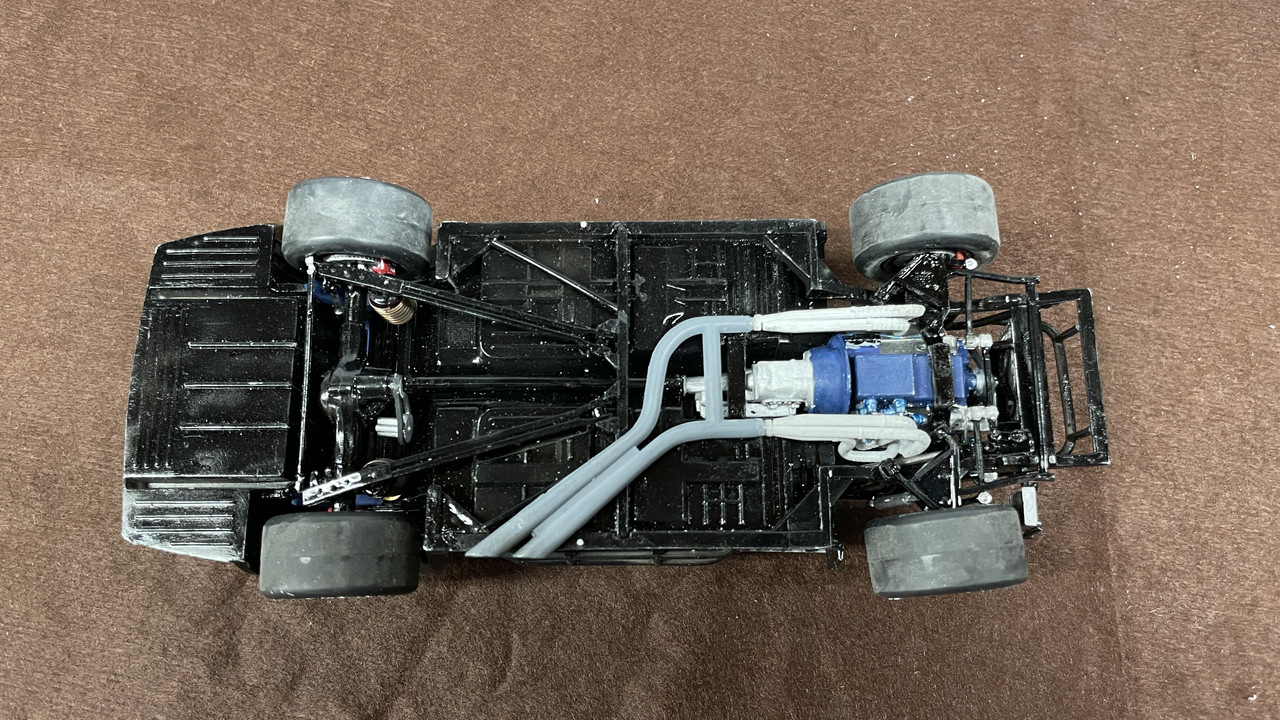
And the underside. It’s really not as dusty as these pictures seem to show.

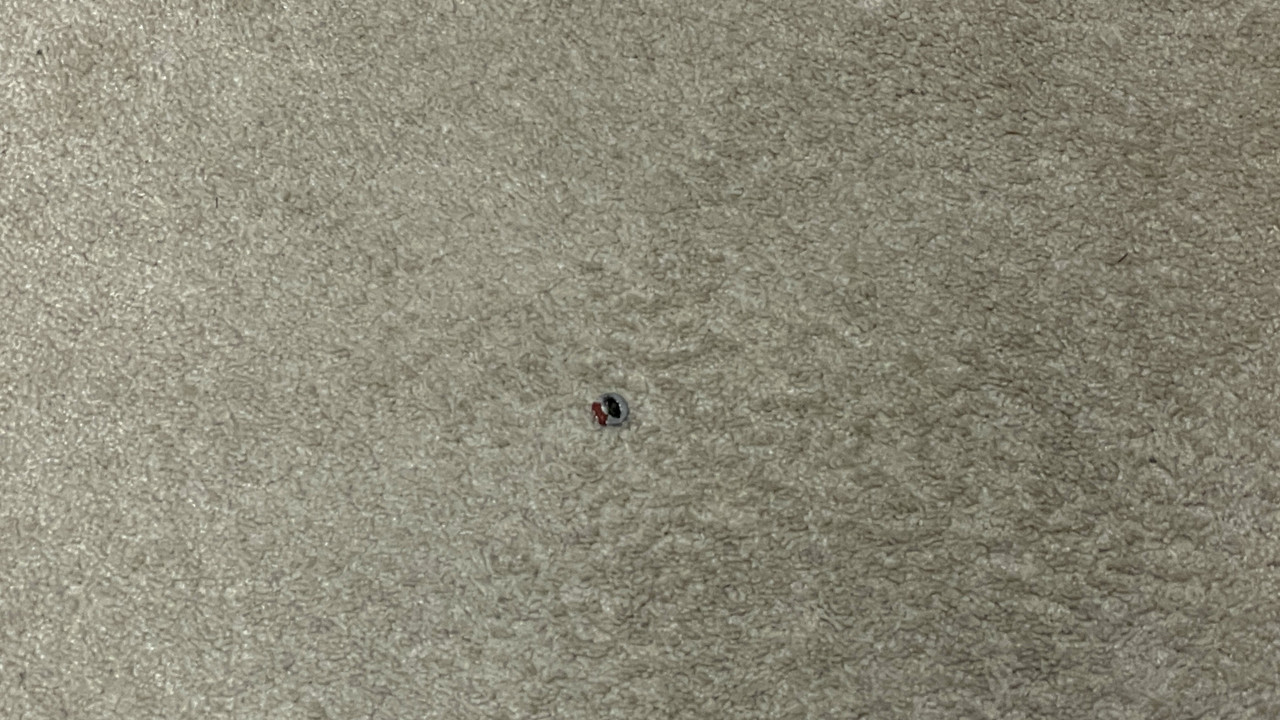
And then I ended the session and went upstairs to change out of my gross shop clothes, and looked what popped out on the closet floor.

The *%)UY%@ part was hiding in my clothing anyway. I really did check my clothing and I don’t have cuffs. Furthermore, my flannel shirt is out, not tucked in, so it theoretically blocks parts creeping into my belt line. Not this part! This thing really was hiding. Too late! That ship had left the dock, was replaced and no longer needed.

If it’s any consolation these things in 1/1 crash into one another, into the wall and slide on their roof . So it could be said that accidents come with the territory.

Yes! That’s certainly true, but not when they wheeled out of the shop before the first race. I tend to make my models in pristine or near pristine condition. While I do weather, I am very judicious in the amount.

I decided to NOT attempt to wet sand or do any further polishing of the gloss coat. There was too much texture in the decals and I felt that any attempt to rub out the surface would actually cut into the decal film. Instead I went on to finish the last bit before body and frame mating. This was painting the metallic vents in the front.

I thought about hand-painting, but decided spraying would give a more uniform finish. And that required masking. I used Tamiya rattle can Silver Leaf and I’ll go back and do some panel line accenting on the vents after they dried. Should have hand painted them!

I used Tamiya tape and Tamiya Flexible tape to mask the detailed portion. And then I made a near-fatal mistake in using 3M Blue Tape to cover the rest of the exposed areas. Here’s the tape job:

Here’s the paint:

And then the beautiful results:

Can’t expect masking to better than that!

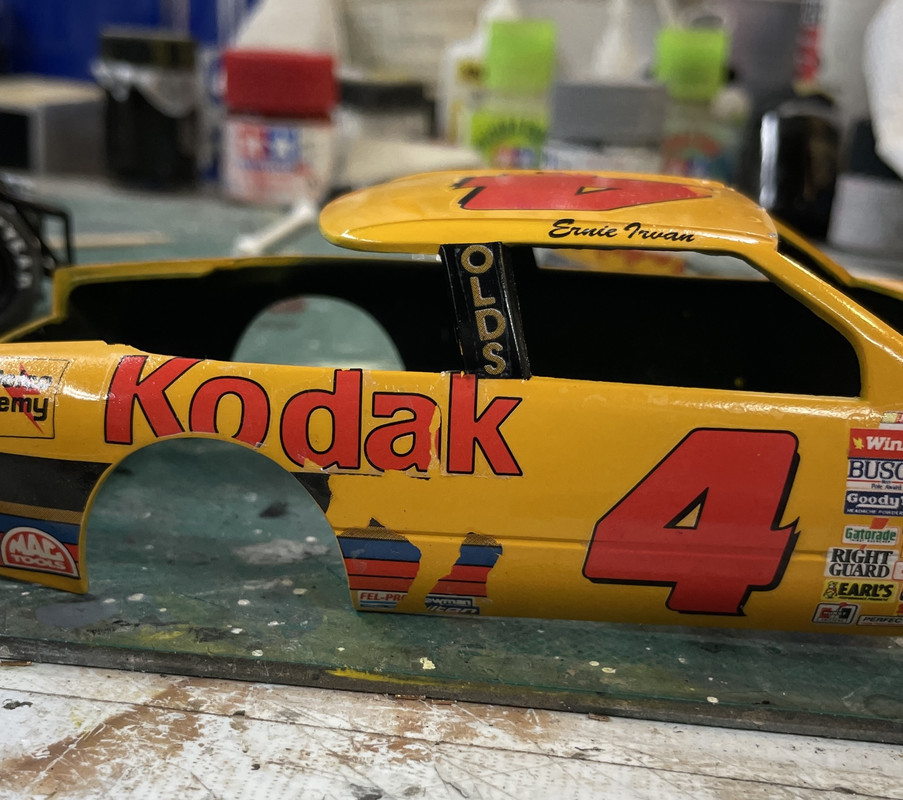
And then… I started removing the blue tape first. What a screw up!!! The blue tape had way too much tack, and removed large chunks of those onerous, annoying and miserable decals.

There could be a happy ending to this mess… As I was concerned about the decals age, I had made a color scan of the decals before using them. If you have access to any photoediting software and a decent scanner (found in almost every inkjet printer on the market today), save yourself a lot of heartache and scan the decals before the build. You never know if you’ll need them.

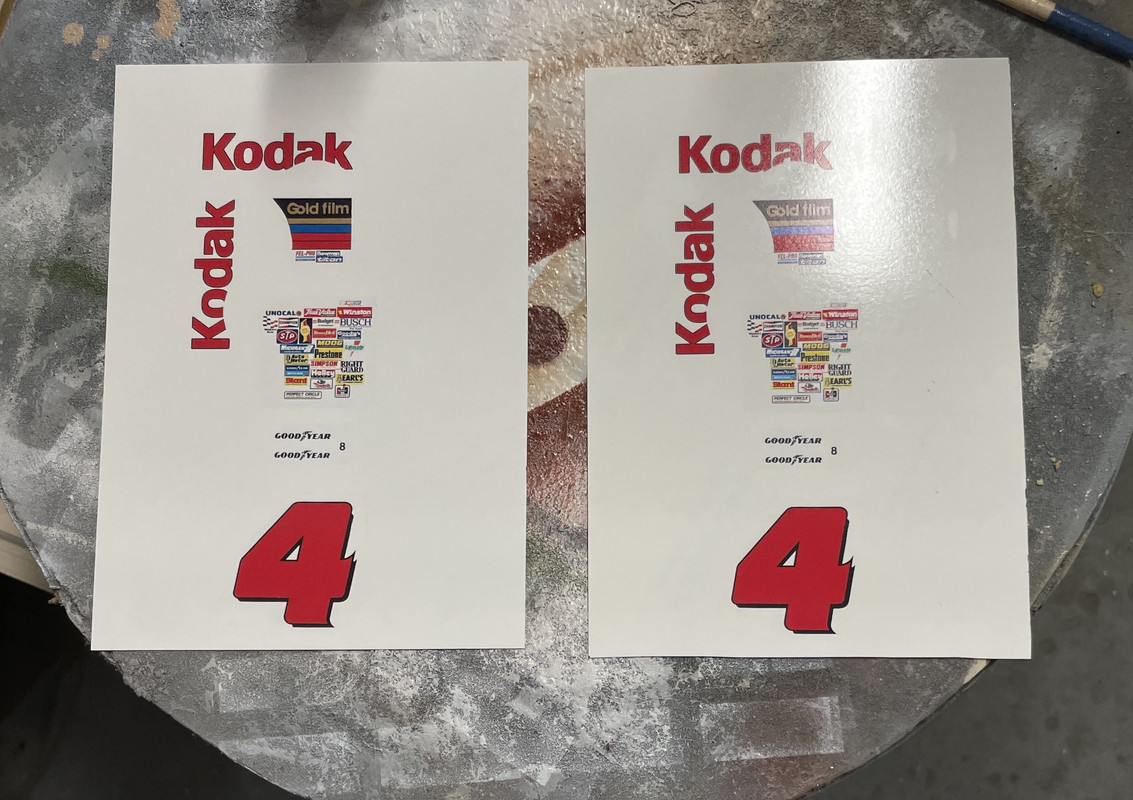
In Corel PhotoPaint I masked and copied only those images that were wrecked and made my own decals. I used both clear and white background sheets since some of the decals had images with white in them. It makes for a very fancy cutting operation to remove the decal from the white backgrounds to preserve just the parts with the white. Where there is no white (the “4s” and the color band Kodak Decal) I used clear.

Before printing them I went into the software to remove any blemishes on the originals. These decals were rotten messes. All show and no go! Regardless of all this work, the new decals are going to have to go over the old ones. I believe the registration will be okay since the scanner is quite accurate.

I should have hand-painted those grills! And I proved that any further surface treatment to those decals would have ended up with the same mess. This car needs to be finished by Friday so any setbacks now are not welcome… actually, they’re never welcome.

Oh… and one more thing. I made the above decal composite from memory. When I took them downstairs to coat the with MicroSol Decal Film Protectant, I looked at the body and realized that I missed one. I reprinted the sheet with the missing decal (another one of those massive product sticker decals.) I will coat that one tonight so it will be ready to go tomorrow.

The repaired decals worked… but it was not easy.

The color denisity of the inkjet decals was not very deep. The result was having to double them up. Added to that was printed out the sheets on clear and white background film yesterday, only to find out that they were all clear. The film I had cut up to 5 X 7 was clear, not white, but I had put it in the white product packet.

The registration was remarkedly good… not perfect, but good enough.

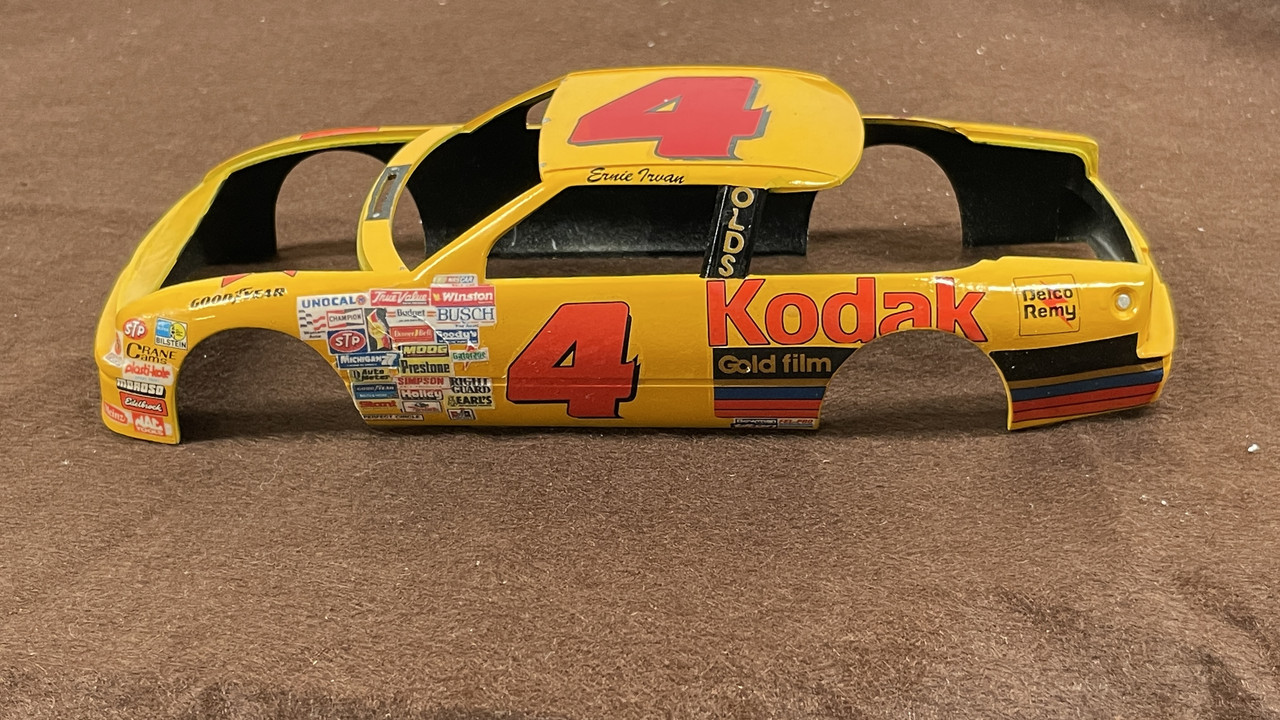
The right side was the most challenging. The originally applied “Kodak” text was the one that had parted in two. When I applied the new decal over the old, it didn’t register in length. I then realized that when I put the two halves of the broken decal back together, I slightly changed their overall length. I fixed this by cutting the new decal (after it was already applied, I might add) and slightly spread it apart so it re-registered. It’s not perfect, but will work without close inspection.

The striped decal was so gone that I removed all of it. BTW: I did lightly sand with 4000 grit wet-or-dry sanding cloth to knock off the underlying decal’s irregularities. I used Microscale’s Micro-sol before applying the new decals. The clear-backed “Gold Film” stripe’s color density was so bad that it needed another on top. I found one piece of white background decal film and was able to re-print those that needed white (all the sticker decals) and was able to overlay the white background over the previously laid down clear background. The “a” in “Kodak” shows the slight registration difference.

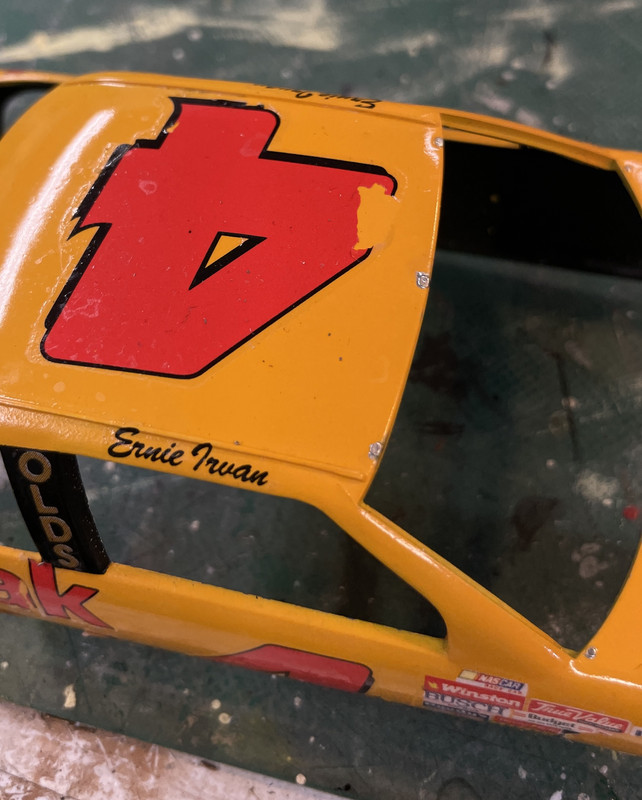
The big “4” on the roof came out fine when laid over the existing decal. You can see this on the below image.

On the left side it only needed the sticker decal. In order to make this look reasonable, I had to carefully trim the white background away from any areas that would have shown body color. This was particularly tricky around the “Gatorade” sticker.

While these were all settling down, I finished the last little bits: the clear fuel piping that’s in the “trunk”. These “cars” don’t really have trunks.

I’m letting the decals fully cure overnight, and will give it another coat of Alclad Aquar Clear tomorow. That will again cure overnight and I’ll join the body to frame on Friday. Friday night is the competition. I don’t expect to win. This model is not my best work.

I started work on the Takom 1:35 AH-64D Apache by filling my homemade sprue holder. I will be working concurrently on the Apache and the 5-38 turret since I’m waiting for the kit to arrive. I generally don’t like to build two models at the same time, but I’ll make an exception in this case. BTW: I’ll be doing a state-to-finish thread for both of the these projects.

Great save!

Finished in the nick of time! Got the hubs painted, joined the body to the chassis and glued in the windows. This baby is as done as it’s going to get. If I had more time, I was going to try and craft some NASCAR hood hinges. Not happening.

The box top showed the wheel hubs to be shiny so I added that with decanted Molotow ink.

I glued in the windows using Testor’s Canopy Glue. Good stuff and doesn’t damage clear parts. Has a reasonable tack so the parts sort of stay put while it cures.

While I’m not happy with the finish due to all the decal woes, I’m going to live with it and let the chips fall where they may vis a vis the model constest at tonight’s meeting.

Up next are two projects: I’m building Takom’s 1/35 AH-64D Longbow and have started design on another massive cutaway gun turret project that’s also going to the USS New Jersey Museum ship. I’m posting my usual comprehensive build threads for both here on FSM’s Forum.

AH-64D

https://cs.finescale.com/fsm/modeling_subjects/f/16/t/192524.aspx

5"38 Twin Turret Cutaway

https://cs.finescale.com/fsm/modeling_subjects/f/7/p/addpost.aspx

Turned out great. Sure looks the part - and I like the stance. BTW the link to your cutaway isn’t what it’s supposed to be

Try it now! For some reason, all the text I wrote on the first post didn’t take and the post was never uploaded.

https://cs.finescale.com/fsm/modeling_subjects/f/7/t/192531.aspx

I was told last night at our modeling club meet that my kit arrives at Scale Reproductions, Inc. this week. Then the fiun will really begin.

Looking good from here !

Superb!