Imai Golden Hind 1/70

I’m starting my build of the Golden Hind now…and though I don’t plan to keep a complete Build Log this time, I am making a few changes to the kit, and thought it would be good to highlight some of these mods here…

Some of these changes are going to be new challenges, so please bear with me!

Here’s a list of some of the things I’m going to try:

-Furled sails (done that before, but this time, I’m puttying in the masts locator slots for the topsail yards, and making new ones in the lowered position)

-Using wooden deadeyes, making chainplates, and rigging shrouds and ratlines

-Replacing belaying pins with brass aftermarket parts

-Wooden display base with brass pedestals

-Rigging for gunports

-Rope wooldings on the masts

-Trying a new kind of paint (Vallejo Model Air acrylics)

Anyway, some of this is new to me, and I hope I can pull it off! I welcome any helpful hints, or guidance along the way.

Here’s a few pics of some preliminary work I’ve done:

Some of the molded belaying pins were broken when I got the kit, and the pieces were MIA, so I decided to cut them off, drill out the rails, and replace the pins with brass parts from Model Expo Since I’m adding real chain chainplates, I wanted to put the “front strip” on the channels to help keep the lower deadeyes in place…I had some Evergreen styrene strip, so I cut some lengths and glued them to the front of the channels…they still need final shaping and, of course, nothing’s painted yet… So this is the beginning…should be exciting! Once I get some more parts prep done, I can lay down some basecoats, and I’ll offer my opinion of the Vallejo paint.

One thing you need to think about, Dave, is the way the sails are furled. During this period each yard was normally just about half the length of the yard below it. So the foot of the sail would be twice as wide as the head - and furling the sail up as a bundle on the upper yard wouldn’t work.

The solution was to gather the clews (the lower corners of the sail) into a bundle lashed to the heel of the top mast. The sail was bundled up into sort of a T shape, with the top of the T being the upper yard. The clews, with the sheets and clewlines attached to them, stuck out from the bottom of the bundle. Ina small ship the topsail yard sat on, or a couple of feet above, the railing of the top.

I’m working with my phone, which doesn’t let me post pictures from the web directly to the Forum. Next time I’m at the desktop computer Ill find some pictures that explain how a furled sixteenth-century sail looks. The process isn’t really difficult. If you google some pictures of the “Jamestown ships,” the Mayflower II, and the Elizabeth 2 (not to be confused with the QE2), you’ll get the idea.

The golden rule in making furled sails: don’t make the bundles too fat! The bundles for the topsails should be just about the diameter of the topsail yards.

Good luck.

Thanks, John.

I did notice how narrow the topsail yards are, compared to the main yards…with my previous model sail furling (the Santa Maria…seems so long ago!) I actually just used a shorter “sail” to begin with, so when it was furled, it wouldn’t have that sleeping bag look…it seemed to work okay.

But I don’t know what you mean about the T shape of the 16th century furling style…I looked up some google pics, but I didn’t see anything like what you described…do you have any specific ideas of where I can look for reference, in case I decide to try that avenue?

Thanks!

Dave

Dave,

Here’s a painting by Willem Van de Velde the Elder - from a later period, but the principle is the same:

bmagblog.files.wordpress.com/…/lenoxorhamptoncourt-scaled1000.jpg

You can see how most of the topsail is bundled up into a vertical bundle, with the clews sticking out. Sort of like two letter J’s, one of them backwards, stuck together.

Here’s another one:

http://www.topofart.com/images/artists/Willem_van_de_Velde_the_Younger/paintings/velde027.jpg

Notice also how thin the furled sail is when it’s bundled to the yard.

Here’s a good shot of the replica Susan Constant and Godspeed, at Jamestown:

http://www.williamsburgprivatetours.com/wp-content/uploads/2011/04/jamestown.jpg

If you look carefully you can see that the topsails are furled just like the ones in the Van de Velde paintings. And the furled courses are bundled tightly to the yards. (These ship, incidentally, have a couple of rigging features that aren’t authentic, and were added in the name of safety: they have jackstays and footropes on their yards, neither of which had been invented at the time of the actual ships.)

One of the most common mistakes among sailing ship modelers is to make the bundles of furled sails too fat. If you’re walking up the pier behind one of the Jamestown ships, you’ll have trouble seeing that the furled sail is there; the bundle is, if anything, smaller than the yard.

The Jamestown picture shows one big reason why that system of furling was used in those days. Those topsail yards are skinny - so skinny that they might well break under the weight of a man. I’ve watched the Susan Constant’s crew furl the topsails. Two guys standing in the tops can do the job, without going out on the yards.

Since you’re getting deeper into the sailing ship world, I’ll recommend a book: Seamanship in the Age of Sail, by John Harland. It’s a terrific work, showing through contemporary and modern drawings all sorts of details of how rigging works. I think it’s out of print, and used copies aren’t cheap. (The cheapest one I found in a quick web search is $69.00: http://www.bookfinder.com/search/?ac=sl&st=sl&ref=bf_s2_a1_t1_1&qi=O3S9Uj00u2ftQ4MdesUmVE9Xyzo_3197690279_1:2:7&bq=author%3Djohn%2520harland%26title%3Dseamanship%2520in%2520the%2520age%2520of%2520sail%2520an%2520account%2520of%2520the%2520shiphandling%2520of%2520the%2520sailing%2520man-of-war%25201600-1860%252C%2520based%2520on%2520contemporary%2520sources ). But if you can lay hands on it (maybe through a library) it will be a huge help to model building - and keep you up late at night studying the pictures. Fascinating stuff.

Hope that helps a little.

Looking good Dave.

Steve

She’s gonna be a beauty, Dave. BTW, I’ve posted pics of my Black Swan, if ya wanna take a gander!

Thanks for the pics, John.

Very interesting stuff. Perhaps I’ll experiment with that method of furling the sails.

Yes, the book you recommended is pricey! Maybe I’ll see if the library has a copy…I’m in the habit of reading from my limited stack of shipmodeling books at bedtime each night, and I’ve been through several of them several times by now…need something new, though I should mention that Mondfeld, Mastini, Landstrom, and Petersson are my faves. I’ll probably pick up that R.C. Anderson book that I keep hearing about, for my rigging edification.

Dave

Update:

I took advantage of a day off from work to get all the basecoats airbrushed on the Golden Hind parts today…took a few hours! But it was a great opportunity to test the new paints…Vallejo Model Air acrylics.

I realize that the following might be better suited to a different area of the forum, but oh well.

So my initial impression of the paint is good…which is a relief, because I’ve heard varying accounts of its performance. The Vallejo Model Air line offers many, many color choices, which is my primary reason for trying them out. Here’s what I’ve gleaned so far:

+Sprays well through the airbrush, with no sputtering or spitting, and none of the six colors I used required any thinning. But they do separate after a time, and require thorough mixing before use.

+Easy cleanup. (typical for acrylic)

+Lays down pretty well.

+I had no problem with switching between Vallejo, Model Master, and Tamiya, and then back to Vallejo, just a simple cleanout by spraying some water through the brush. (compatibility seems good)

+Doesn’t dry too fast…which means it probably bonds better to the plastic, and also doesn’t get dry on the nozzle/tip of the airbrush and cause spraying problems…it was very easy to use.

+Tons of available colors! Lots of variety!

+Metallic gold came out really well. Acrylic metallics have a tendency to be troublesome, either they’re uneven, or the flakes separate really fast, or they just look crummy and bland. The Gold from Vallejo was easy to use, didn’t run, and made a nice solid coat…still, it’s acrylic, and it doesn’t have that super-shine that enamel metallics can give. Very good for an Acrylic.

There are a couple of things that sort of concern me:

-It’s not what I’d call a good hiding paint. The same color sprayed on parts from differently-colored sprue parts come out very different. Recommend primer for continuity of color between different molded colors…which is a drag. I don’t like to use primer, because I feel like every coat of paint applied lessens the crispness of detail on the parts. The main reason I use an airbrush is for the super-thin coats that can be applied. I find Model Master to hide under-colors quite a bit better.

-The finish of the paint seems to be more or less Satin, instead of a flat sheen. Which is kind of weird, since all the colors I used are tans, browns, sand, etc., colors that would generally be flat. The bottles don’t indicate any level of sheen (flat, semi, gloss, etc.)…so I’m probably going to be hitting it with some Dullcote at the end. Perhaps it will flatten out after a day or two?

-Kinda spendy…Vallejo was almost 4 bucks a bottle(17mL), compared to MM, which runs almost a buck cheaper (14mL) at my LHS. Not hugely expensive, but it’s a consideration.

Here’s a pic showing some of the things I mentioned.
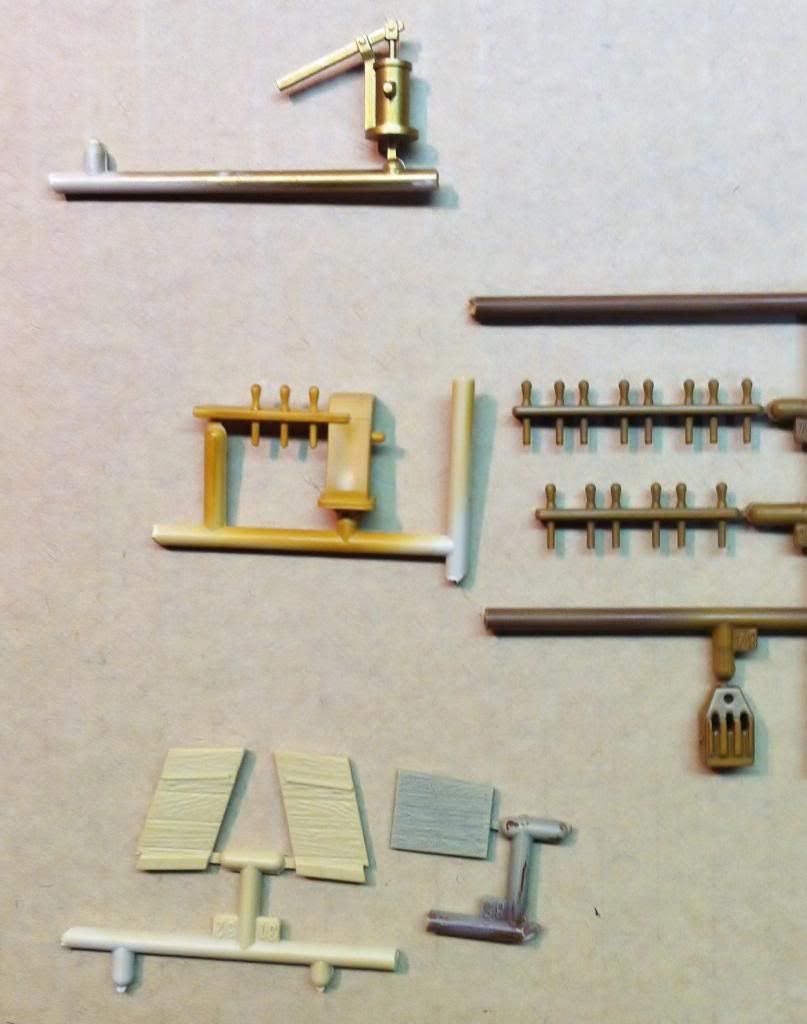
On top, you can see the pump I painted with Gold. I know the pump would not be gold on a ship. but maybe brass (?)and I wanted to try the gold out, anyway. Below that, you can see to different sprues, each with some pinrail parts. Believe it or not, both of those sprues were painted with the SAME COLOR! Yes, so you can see how the underlying color of the molded plastic has a dramatic effect on how the Vallejo paint looks with a standard coat. And below that, another example of the same situation, this time with a different paint color. Two different sprues, molded in light and dark plastic, and the paint leaves a markedly different tone on each. Something to consider if you’re going to use Vallejo paints.

Anyway, that’s my impression of the Vallejo Model Air paints…pretty good stuff, but there are things to consider, especially when it comes to the color of base plastic. Once I get into some detail-painting with a brush, I’ll update on how this stuff works OUTSIDE the airbrush!

Thanks for looking in!

David

Dave,

The color difference between the sprues is phenomenal! If you hadn’t pointed it out, I would have sworn they were two different colors.

If you don’t mind some suggestions, I would use a primer, especially with the brass belaying pins. I would also etch the metal with some vinegar to give it tooth so that the paint has something to grab onto. I know what you mean about the build up of paint hiding detail, which is why I prime with Tamiya’s Fine Gray Primer. It’s a bit pricey, but, I really like it because when it dries it tightens up so you are not losing too much detail and being a neutral color it can go with the majority of top colors.

On the pump, especially for this time period, the trunk and lever of the pump would be wood, the upper collar and the connecting metal and rod would be a black iron. The outlet, I would would drill out , but that’s just me.

She is looking good so far, the brass belaying pins are sweet and look so much better than the original plastic ones. I really like your idea of lowering the topmast as it should be. I will have to try that out on one of my future builds,

Steve

Steve-

Yeah, the color difference is ca-razy! I just went over some of those parts with a second coat (brushed on), and it made them look a lot better…that’ll do for now. But, if I continue to use the Vallejo paints on future projects, I’ll definitely have to use a primer. They are thin, and brushing them on to bare parts would take a couple of coats… That Tamiya Fine Gray Primer…is that a spray can, or does it come in a bottle?

I’ll add some wood and flat black to the pump, but I’ll leave the gold on the body of it…I like it! Probably will open up the outlet, didn’t even think of that.

Hey, do you think Blacken It will work to etch the brass pins? Am I right that Belaying pins are usually lighter colored than the rails? More of a natural wood color?

I’ve done furled sails on a couple of my previous builds, but didn’t bother to lower the yards (though a few people mentioned it!)…it wouldn’t nag me if they were left up, but since I’m trying new things with this one, I figure it’s an obvious choice…and not hard to do.

Now that the basecoats are done, I get to proceed to my favorite part: Detail painting and washing/weathering!

Blacken-it will work on the belaying pins all right, but I question whether that would be appropriate. The earliest references to iron belaying pins that I’ve run across dates from the 1770s.

There is, in fact, some argument about whether belaying pins were used at all in the sixteenth century. If so, they probably were wood; the traditional woods to the purpose are oak, elm, and locust.

Rigging a model with lowered yards isn’t one bit more difficult than rigging it with the yards raised. Essentially, all that happens when the yards are lowered is that the halliards and lifts are slacked off. And you’d never see raised yards with furled sails on them. (On board the replica Susan Constant the topsails can’t be furled until the yards are lowered to within reach of the guys standing in the tops).

You do need some kind of reference book with rigging diagrams in it, though. One that would be a big help is a volume in the Conway “Anatomy of the Ship” series, the one about the Susan Constant. (So little is known about either that ship or the Golden Hind that the drawings in the book could represent either of them.) The R.C. Anderson book is a classic, but it deals mainly with larger warships of a later period. Other good sources (which don’t cost anything) are the photos on the websites of the various replica ships -the Jamestown ships, the Mayflower II, the Elizabeth 2, and, of course, the Golden Hind replica. Those are operating ships, and the guys who sail them have found out (sometimes the hard way) that the authentic ways are the ones that work best. Sometimes the only ways that work.

Looking for some opinions…

Paint scheme.

I’ve been looking at web images of the Golden Hind, trying to find inspiration for the color scheme…basically, there seems to be an infinite combination of differing paint patterns…any combo of red, blue, yellow, or green…and no two models or paintings seem to be the same.

The hull has plenty of scribed-out areas for the diamond-patterned ornate decoration…the box art shows red and yellow, which I might go for…but I wondered if anyone has any input?

The bottom line is that, as in respect to so many other features of that ship, the color scheme is up to you.

You’re quite right; there’s virtually no reliable contemporary information about Tudor ship color schemes. As I understand it, the Tudor house colors were green and white. Most good models I’ve seen have at least one row of green and white triangles. But I’ve seen plenty of other colors on models and in old paintings.

Complicating the problem is the story that Drake disguised the ship to look Spanish. Heaven knows what that might have meant in terms of colors. And at least one modern scholar has cast doubt on whether Drake actually changed her name to Golden Hind. (Her original name was Pelican. That critter had symbolic significance to Queen Elizabeth,) In any case, I question the hind figureheads and stern carvings I’ve seen on lots of models and full-size replicas. Ditto the Elizabethan coat of arms that sometimes shows up as a transom ornament. That hardly seems likely for a ship that’s trying to look Spanish. (The excellent Revell kit has a pretty hind figurehead and an exquisite coat of arms on the transom. If I ever finish the one I started several years ago, I confess I won’t the heart to ditch them.

There’s even room for doubt about the color of the underwater hull. The tradition among Modeler’s is white or tallow color. But recent scholarship suggests that “dark stuff,” a foul substance containing tar, sulfur, and horsehair, is just as likely.

Stuff like this. To my notion, makes this sort of subject particularly fun. You can paint that model pretty much any way you want, and nobody will be able to prove you’re wrong.

:slight_smile:

Yeah, I suppose I’ll just come up with something that I like the look of…which is more or less my M.O, anyway…

You bring up another point I’m considering, John…the underwater hull. On a couple of my models, I’ve masked and painted a lower hull color, with the BHR it was a light grey/beige, on the Medieval Thomas it was the dark stuff color…and on most of my builds I’ve just left the hull color throughout…

Perhaps the Modeling Majority can influence me as to whether it’s important to add a lower hull coating, and also, which color would be more appropriate? I figure if I’m going to paint the waterline and below, I should do it now, before I get into detailing the hull (which is apparently going to be an exercise in patience and meticulation [new word])…

Thanks,

Dave

The problem with any sort of bottom treatment (other than copper sheathing) is that if you make it realistic it will look like h[cnsod]l. Airbrushed, dark red modern hulls look beautiful, but let’s not kid ourselves into thinking that a real hull that’s been in the water for a wile actually looks like that.

My little Hancock shows one approach: a gently weathered tallow color. Since those days I’ve learned that “dark stuff” would be at least as likely for that period. But I’ve never been seriously tempted to adorn a model with miniature barnacles and seaweed. If some modeler wants to try it, I’ll be happy to admire it, after I get through grossing out.

Which is a fancy way of saying - do the bottom however you think it looks best.

Well, it’s been awhile since I posted any progress on this baby…truthfully, I haven’t had much progress, been super busy between work and prepping the house for painting…

Anywho, I did get the hull and stern together, and mounted them on the base today…Made the base from a walnut board routered with an Ogee bit, stained it, and scored a couple of brass pedestals from MS…

The paint job took more time (and patience!) than I expected at first, and I was worried it would be sloppy…but after a couple of passes and some touch-up, it turned out okay, in my humble opinion :slight_smile:

It’s hard to see, but I actually did mask off the underwater hull with a super light MM Radome Tan…it looked like a nice contrast to the rest of the hull coloring…until I applied oil paint for weathering. Somehow the MM paint seemed to darken more than the Vallejo paint when touched up with oil paint…now the colors are almost identical…interesting. And it just shows me another nuance to using different paints…Model Master apparently reacts more to oil paints than Vallejo.

Now that it’s on the base, the next step will be to install the channels, and then immediately begin fashioning my homemade chainplates and installing lower deadeyes…that will be my first of several “never before attempted” mods I’ll be making with this kit. Should prove to be a good learning experience!

Thanks for looking!

Dave

Impeccable David!

Below the water line does look lighter to me, but subtlety. You are truly becoming a master at this staining technique. I just picked up an HO scale schooner from BlueJacket that has some parts that should be mahogany. I will definitely shoot you a PM for advice when I get around to it.

Thanks, Arnie! I’m glad you like it so far.

:slight_smile:

Hi;

I use - Are you ready for this ? Rustoleum light grey primer on everything .I have used it since I found it over forty years ago . It still works great on figures and model cars,planes,ships and whatever .wood as well.

Try it . The light grey (pearl grey ) is great for ship models and stuff , and I use Vallejo paints as well as other brands over the top of it . It accepts All overcoats and is great on metals .

By the way the suggestion of using " Blacken - It " as a metal toner is a good one .I even used it on chromed and stainless tweezers to dull the glare ! Tanker-Builder

Here’s a surprise !

If you decide to do another IMAII ship be advised .I have used regular furniture and wood stain on the plastic they use and it gives phenominal results .I have found using a mix of dark cherry and mahogany gives a very old look to the wood grain .

The other thing about this plastic formulation is it’s sensitivity to paint thinner .You might say really ? This is good .Yes , the plastic then allows you to use the kit color ( what it’s molded it ) and then wash with thinner dirtied up with black and brown paint , Three parts paint -each color, and one part thinner .This makes for a very old looking ship model !

The other thing in passing is this .You can use the rub on silver and gold antiquing creams for an old gold or silver finish .The best ones I’ve found are the " Run n Buff " brand . Tanker-Builder