This Americas Cup has been incredible. I have completely thrown over work in order to go to the races. Its like NASCAR for free, only much better because of the backdrop.
I have lots of piccies but I won’t bother you all since they are online too.
This Americas Cup has been incredible. I have completely thrown over work in order to go to the races. Its like NASCAR for free, only much better because of the backdrop.
I have lots of piccies but I won’t bother you all since they are online too.
Yes, I saw that! the hydrofoil pylons are so small it sometimes looks like the boats are flying over the water. And, the boats are somewhat reminiscent of Klingon Birds of Prey!
Great stuff. And the TV coverage is excellent, too.
GoPro posted a video shot with their cameras on Oracle Team USA’s boat that’s fun & interesting to watch.
I didn’t know there was TV coverage other than local!!
Back in the mid-80’s I watched one of these races. They televised them late at night US-time, and I was flipping through channels and came on it. My first thoughts: “sailboat race! This should put me to sleep in no time!” Several sleepless nights later, the race was over. I was absolutely captivated at the racing strategy and speed, even if it were at only a few 10s of knots then.
I’d watch them again, if I could, but haven’t found anything on TV.
Gene Beaird,
Pearland, Texas
Here is a link to the schedule:
http://www1.skysports.com/other-sports/news/12992/8904172/2013-americas-cup-schedule
Here is a link to foiling footage:
Wow, thanks for posting this! I watched the youtube footage.
Having sailed both mono hull and hobie cat sailboats, in addition to trying to learn R/C helis, it almost looks like these boats are a wonderful mix of all three! Keeping the bow from dipping while on the foil must be quite the focused effort; definitely a 3 axis affair! Hats off to these guys!
So today the first race was won by the Kiwis. It stood at 8 to 1; first to get nine gets the trophy.
But the second race was called at the start because of high winds. So the spectator fleet all sailed home past where Ms. Morrison and I were seated.
And look at this:

Spectacular! Look at the rake on those masts! Thanks for posting!
Another good day, but only one race as the second was called for excessive wind speed.
We had lunch on “pit row”.

Bring your own container…

Afterwards, we looked at this treasure.
http://s295.photobucket.com/user/6134rdm/media/IMG_1651_zps0c9753d9.mp4.html
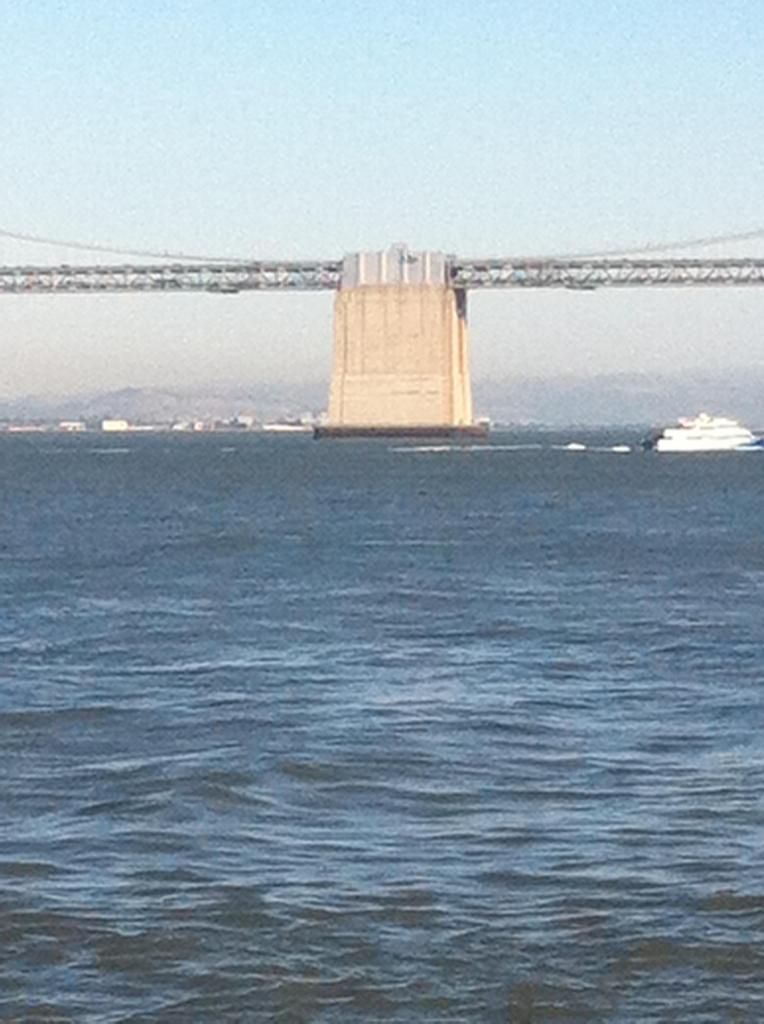 Although not an official part of the course, here’s the “Ranger” mark.
Ha Ha! Smart guy…
This is all getting a little tedious I must say. Hopefully it will be decided next week, before the weather turns rotten.
On the plus side, I just picked up a Revell America for cheap.
I’ve started to plan the build and set myself the first obstacle. I want to build her with the sails on the booms. But the masts have cast sail hoops on them.
The sloop looks really good, to my eye, with that big stack of hoops at the base of the mast. So I need to decide whether to carve off the hoops, or replace the masts. I’m thinking the latter…
As someone who has built some masts (including some 1:1 scale ones), I can offer some observations.
One, do not start with a round dowel.
This is totally counter-intuitive. But, very few dowel out there are straight, and the few that are seldom stay that way. For another, masts taper, some less, some more, but all do. Lastly, ‘round’ masts need all sorts of flat places to attach things to. On a round dowel, flats are made by subtraction, which gets to be a pain, as the round dowel wants to roll around.
What to do?
Old, old, trick–in Ship Modeler’s Shop Notes–is to make a jig. A 14-18" long 1x4 will work. This needs a 90º V groove down its length. This should be about 1/4" deep. A 90º bevel cutter in a router, or two passes over a table saw will work. A metal pin or a tiny screw in one end of the groove will serve as a stop.
Then, you get some square stock a bit bigger than needed, and a hair longer than required.
Lay the stock in the groove and plane the corner that is exposed. Rotate and repeat, you have an octagon. This can be repeated to make a 16-sided shape, which cant then be planed to round.
Now, the clever thing to do is to lay some paper tape along the jig, and mark out the lengths needed on the tape. To get real spiffy, spot things like the cheeks for the cross-trees . Take the razor saw and carefully saw down to the depth, width, and,–particularly for America–angle of the cuts. Pare those off, and file flat. Square stock is very nice for laying out and boring holes for sheaves through the mast, too.
With the “bits” cut out, you can then plane a taper in., one flat at a time.
This can be very satisfying work, and the results show.
Thank you Mac. I have read a little where taking square stock and drawing the profile on the sides gets you quickly to the octagon stage. I will follow your advice, and the v groove table is a good idea.