How many of you still use Paint Brushes?

I ask out of curiosity:

I see many benches around me, even at the Museum I am President of. What I see is total disrespect for one of the most basic tools in our tool-boxes.

What do you think a paint Brush is? Is it a hairy ended tool for “slapping” on pigmented material called paint? That’s the phrase I Usually hear. And on some models that is what we must do to achieve the textures and look you want.

Bye the way, What type of brush do you use for that? There as many sizes of brushes as there are models of PanzerKamphWagen 4s! Each one has a suggested or planned use. Here’s an interesting thought, I bet a great many of you would be afraid to ask your ladies to share with you. Look at the different brushes they use, to coin a phrase" To Put on their Face"

I have about twenty different sizes of “EYELINER” brushes to paint fine details on the many 1/350 and other size ships I build. I have six dedicated " BLUSH" brushes for dusting and weathering my models. Why Make-Up brushes? They are made out of finer hairs of whatever critter they use for bristles. I think some of my “EYELINER” brushes are made from “MINK”, they are so costly.

The key to them is softness. Now, let me cure you of a terrible affliction many of you have. It’s how you clean and store those wonderful tools. Do you lay them down and then let them get pushed all around the work area sometimes getting the bristle area jammed against something? Don’t say no! I have done It many times so I am sure you have too.

I got taught a very important lesson when I was restoring a house built in the 1880s. I had to hire a painter to help me out. The fellow showed up and I thought I was going to have help him out of his truck. I thought he was to old to be the guy I had hired. He spryly jumped out of the old 49 International with the very well kept tool boxes on the bed-sides.

He walked up very fast and we shook hands. I took him around and showed him what we needed. He said “Okay,I’ll be here in the morning at seven” I was there when he arrived. The first thing he did was pack up all the paint I had there and said they were the wrong ones for the colors we wanted.

He brought in the ones he wanted to use. Spread a canvas sheet on the floor and proceeded to lay out brushes and paint matched to where it would go. The brushes surprised me. They looked like brand new ones. When asked, he assured me some were over twenty years old.

He then surprised me with a very good education on the care of brushes, separating the ones for different media and throwing away the Foam faux brushes laying around explaining they were for dummies and just trash!

When we talked over lunch he showed me some of his detail brushes he used on murals and such for touch-ups and re-viving them. I couldn’t believe many,“Red Sable” were over twenty or thirty years old just like the bigger ones.

I learned that day NEVER to push the bristles down to the bottom of the jar of thinner when cleaning them. I learned to roll them gently bristle downward with thinner till the thinner ran of as I pressed them into a towel( Paper) and then rolded them then too. Then Put them in another jar of thinner , rolled them again and then Blotted them clean.

He also showed me something important. NEVER put more than a quarter of the bristle length in the paint,That it wouldn’t get into the base of the bristle in the ferrule( The Metal Band around the bristle Base). He said once that happened, it would continue to build up from capillary action from the bristles till it ( The Brush) was rendered unuseable!

So clean them gently, Use good Quality brushes and clean well and care well for them. There’s one trick he showed me also. Remember how stiff and in shape the brush was when you bought it? It was dipped in water and shaped and dried before packaging.

I personally( here goes the yucky part ) Spit on mine and shape them with my lips. I now have some pushing thirty years in use! One more note( MINE) Never just clean brushes used in acrylics in plain water. Use Dawn and wash them gently( The roll method) and Put tubular shields on them to protect the bristles and stack bristles up in a small narrow glass or cardboard tube cut for this purpose. Happy Painting!!
One of my other pastimes is writing icons.

My icon brushes go in for a regular Blessing by Fr. Brendan.

That’s all I use them for, and the paint is acrylic so they are easy to care for.

I also have some brushes I use for gold leaf work. Some are for applying the sizing (glue) and a couple never see paint. I rub them gently on my cheek to get a charge, and use them to pick up the leaf.

I have one for wood glue, and one that’s a donor brush for it’s black nylon bristles.

I feel that brushes are essential to modelling. There are just some things that cannot be hit with an airbrush. I take care of mine, I have several but I only use one or two of them. Unfortunatly I don’t brush large areas as I did as a kid but brushes really come in handy for more than just scrubbing pigments into crevices.

Good tips, all.

Good of you to take the time to detail the “magic” of caring for paint brushes. Like you I was fortunate to learn how good a friend a brush can be if treated with proper cleaning and respect. That goes for all sizes, from modelling to house painting.

I’m always amused and dismayed by the lack of knowledge many folks display about brush painting in general and by how few seem willing to devote any energy to getting good results.

Thanks for the “old school” tutorial!

I definitely use them for figures and detail work on small items.I like to attach my tools on vehicles and paint later,also pick out deck details on ships with brushes.Also for washing and stumping.But all overall painting with an airbrush.

Hi There, Bill;

Yeah, I use a Blush brush for the very thin foils and such too.

I have about five in holders on the backboard of my bench that I use regularly. I consider them supplies but by taking care I don’t replace them very often- except those I have marked for dry brushing. Those I use up at like year interval. Fortunately, fairly cheap brushes work okay for that task.

One of my favorite modeling tasks is painting the gilding on old sailing warships with my best small brush. As my fingers get old I am less good at it, but still able to do it.

I paint miniatures for gaming and fun, so I have a few brushes on hand. I’m probably due to pick up a few more.

I used to use brushes for all my model painting, until I acquired my first airbrush, Christmas before last. I only use them now for detail work, weathering, and touch-ups - basically jobs that need precision, control, and/or minute amounts of paint. I have some that I’ve had for so long I can’t remember how many years, and look after them well.

Using an airbrush in my small apartment would be super inconvenient, so I have had to rely on rattle cans and paint.

I have a dozen or so brushes, but time and again I find myself using just five of them: a #4 Simply Simmons Round brush that comes to a fine point for detail work, and four Artist’s Loft Angle Shader brushes, sized 3/4, 1/2, and 4, and another size-6 Filbert brush. I’ve purchased all of them at Michael’s in Vancouver.

Bob

I use paint brushes all the time. I paint figures, but I use them on ordinance, airplanes, ships. An airbrush can’t paint the instruments on an instrument panel.

As far as caring for them goes, I would not use Dawn or any dishwashing liquid on my natural hair brushes, because dishwashing detergents all contain de-greasers. You want to replace the natural oils on the hairs of the brush to help preserve them. That’s why there are soaps and preservatives sold to clean and preserve brushes, and help them last.

I know a French figure painter who uses olive oil to treat his brushes, after cleaning them. I often use skin oil, by rubbing the sides of my nose with my fingertips, and then shaping the bristles back to a point.

I use Nr 1 and Nr 2 rounds made of Kolinski sable, for use with acrylics or oils on figures. I’ve got a couple of Windsor & Newtons, and then some others by smaller or obscure makers.

I use other natural hair brushes-other sables, or fox hair, of various sizes, for general detail work.

Oho!

Baron, Thank you sir! I had forgotten about the nasal oil method. I think I will go back to it. I only use oil based enamels anyway. I am getting into Acrylics slowly. If they don’t brush well they get discarded.The brush cleaned and reset, and the Acrylics given to my landlady for her crafts!

Same here. I have a lot of brushes but that’s for when one starts to bend too much or spread out. I take better care of them now but I still have backups. Most of my brushes are the cheaper sables or synthetics and they hold up well, they get a cleaning with Master’s soap then a bit of hair conditioner worked in. When I moved away from enamels for brush painting my brushes were able to last longer.

A lot.

me too .

Hi Knox;

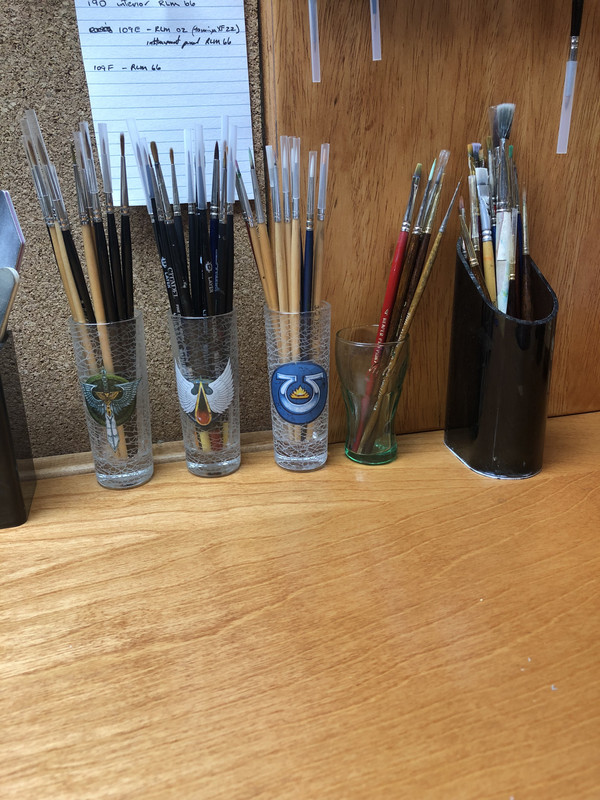
That looks like the shelf next to my bench almost. I have seven bottles( Empty Turtle food Bottles) ( I have a RED EARED Slider critter.) and they are there with their tops cut off and full of different brushes. I use a lot of Make-Up brushes on figures so a shorter bottle there.

Each one is labeled with the type of paint they are used in. That way I don’t even microscopically Cross-Contimanate them.

I use them on models to some extent and in fly rod building. No magic stories, they’re a tool, a means to an end… .

Oh My;

When’s the last time you created a new rod from Bamboo? Mine is about sixty five years old now, and is still lively!

I’m not new to fly fishing but rod building has been maybe 25 years or so on again off again. I’ve just gone through about a five year flurry of it and started turning my own cork grips to the feel I like and some other family likes. No bamboo here TB. Actually bamboo has had a resurge over the last couple of years or so but I’ve never built one. I’ve built glass rods though. Most have been graphite, sorry !