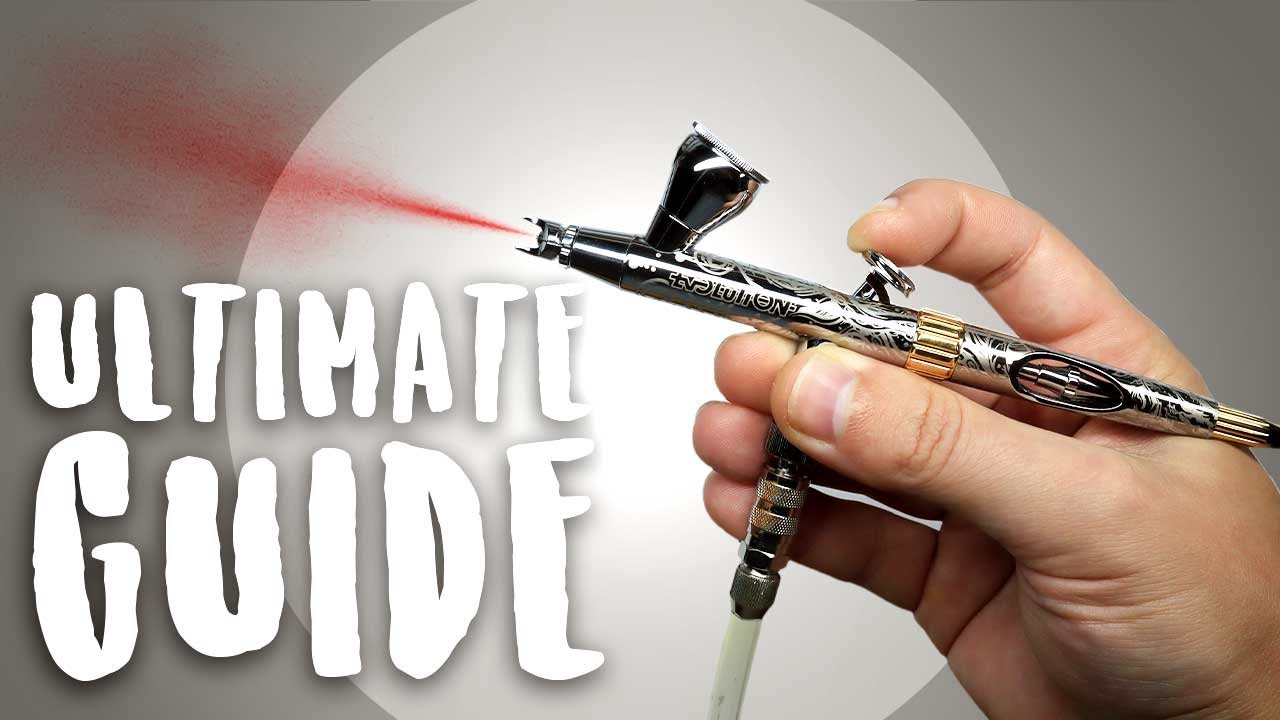
Basic knowledge (which I don’t have) question. How does the trigger work? I recently bought a Iwata entry level brush, dual action, gravity feed. Do you regulate the amount of paint by trigger pull or is it all or nothing and you regulate via compressor?
I am unable to gt a consistent amount of paint via trigger pull. Sometime yes, sometimes no. I can’t figure out what the variable is that I’m missing.
a dual action airbrush trigger operates in two planes. 1, simply depressing the trigger downward allows the air from its source to flow through the nozzle of the airbrush. It does not control the amount of paint flow from the paint cup. 2, moving the trigger forward and backwards moves the needle within the nozzle allowing paint flow through the nozzle. The further back that the needle is pulled, the greater the amount of paint that can flow through.
The airflow through the nozzle, combined with the needle movement, is what gives your airbrush the ability to spray the paint. Its a learned muscle memory for whichever hand you use, and takes practice.
So it’s like going to Carnegie hall. I bought some 8x14 artist board to practice on. I hope the skill comes soon. My wife is pi**ed about the ROI so far.
Paint mix and thinner ratio are important in consistent flow,some paints like Vallejo require flo-improver.Air PSI needs to be right.These things vary from brand to brand
With a dual action airbrush pressing the trigger downwards controls the amount of air and pulling the trigger backwards controls the amount of paint flow by pulling the needle backwards.
Consistency mainly comes down to how thin the paint your spraying is. Acrylic paints are tougher to get a consistent paint flow compared to lacquer but in general a 50:50 paint to thinner ratio is usually a good start. On top of this the psi your spraying at can’t be too high or too low. Most people spray at roughly 15-25psi but it depends on the airbrush, paint and compressor.
I recommend watching this video to get the basics.
Most paints could probably use a little thinning for airbrushing, even those that are advertised as needed no thinner. Tamiya’s acrylics are intended to be thinned for airbrushing, though some modelers don’t. That’s probably what you’ll find, that in the end, it’s each modeler’s own experience, and each will be different. For me, I use Tamiya, the old Model Master enamels and acrylics, and some lacquers. My own experience is that I’ve needed to thin at a ratio of 1:1 down to 1:3, thinner to paint. But even that can vary with things like humidity. I use a Paasche VL, which is siphon-fed and dual action. And I do must of my spraying at 18 to 20 psi.
I don’t use any other adjuncts, like flow improver, retarder, etc. Just thinner and paint. Again, that is my experience, I get my best results that way.
You really need to practice, experiment, and find the combinations that work best for you.
Yes, practice, practice, practice, and then practice some more. Paint types and brands vary in how well they play with your airbrush. Certain brands are less compatible with the novice. At first stick with the proprietary thinner for your favorite brand. As you gain experience you might then want to expand your paint and thinner types.
Like Tony said, thinning ratios and air pressure are important as well. Thin fine works needs thinner paint and lower air pressure. Larger area coverage is best done with higher pressure settings and paint that is not as thinned. Your own local climate will come in to play as well, with humidity playing a part, as will air temperature.
Start simple with monotone or two or three color schemes large schemes, then work your way up to more more complex work.
A lot of great feedback. I just hope I live long enough to put in the practice. I remember B&W film shooting/developing took years of practice before I could routinely get results that were saleable, let alone reproducible.