I did a final test round doing only 3 thin coats of clear. This time with a splash of white gray underneath the clear to add some contrast. Results were effectively identical to before.
Since the process was the same I’ll just present the final card.
The hazing after cleanup is a little more apparent in this test. Other than that, no issues.
The only shortcut I took was using my paint dryer to accelerate the drying process of the paint and clear. It was pretty much only a few hours after applying the clear that I started the testing.
@Edbert , I think this supports your theory that the clear was just too thin at a single coat. Since you have your paint mule you can test the theory out there. I’d be really interested in hearing if your experience changes with the additional coats of clear.
I’ve ordered something described as a very mild “odorless mineral spirit” and definitely plan to test before putting it on my Thud. But I am hopeful that a colder thinner and heavier glosscoat combination is the answer.
I will definitely post here and cannot overstate my thanks for the help and guidance!
(at one point I was considering linseed oil as my thinner, but a 4-week drying time is a turn off)
Probably a good thing you chose not to use linseed oil. It is an exothermic compound. It’s not likely to cause spontaneous combustion of your model, but I suppose it is theoretically possible for it to get warm enough to soften the plastic. Perhaps an experiment for the future?
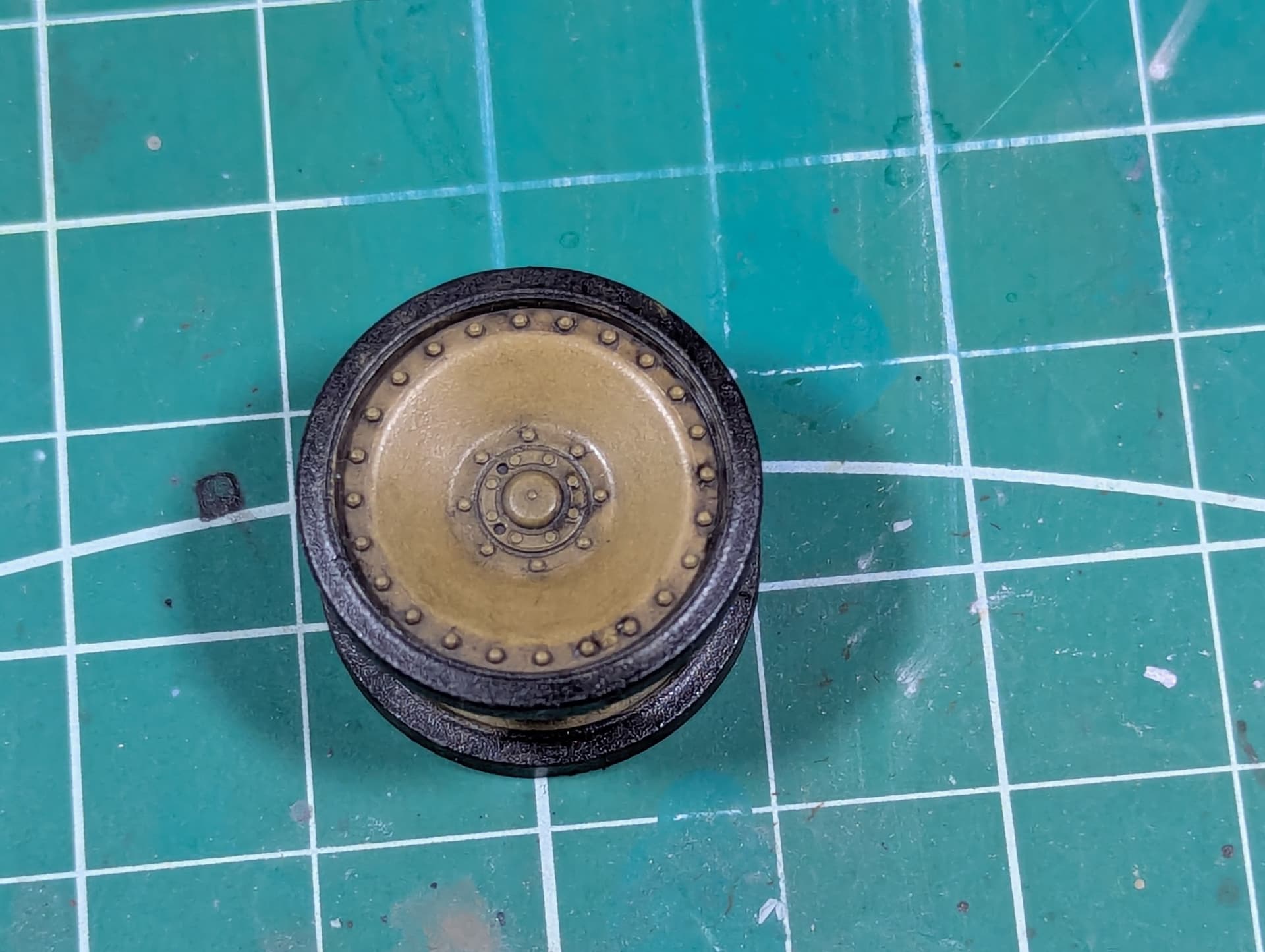
I tested the theory on my mule and results were good enough to put it on a current bench item. I’m building the Meng Panther Ausf.D. here’s the results of the 1st very limited test.
Not sure why it looks pixelated online. This was using Tamiya panel-liner which is hotter than my mineral spirit wash I will use on aircraft, but I rubbed pretty hard with a Q-tip on the flat bits and there was no sign of the enamel thinner “eating” my clear.
I am thinking my core issue is that I applied the clear coat WAY too thin. When I did it this time (X-22) I was worried about orange-peel or drips. It did not happen, but I was scared. I learned to use an airbrush “properly” using Doc Martin inks on Illustration board, seeing that much spray (seeing ANY visible spray) is alien to me, or it was.
I will post pics as I get the courage to “shellaq” (showing my age with that term?) the paint jobs on my Thud. But I think that with the help of you kind folks that this is the answer.
That’s great! Really happy to hear both of your tests turned out well. The results in the photo look fantastic!
I got my first airbrush just a few years ago and I’m still learning how to use it. You’ve got the right idea though. Practicing with it off model to understand what good looks like.
Shellac is awesome stuff. Especially for applying a French polish to woodwork. Creates a beautiful finish that I’ve never been able to replicate with modern urethanes.
I’d say you’ve got it nailed! Ditto to @PhoenixG – that wheel looks great.
As an aside, the few times I’ve tried to “overdo” a gloss clear like Future or Vallejo’s poly clears, I’ve been amazed at how hard it is to do. They just keep laying out smooth no matter what I do, lol.
The turpenoid works well with artist oils and hasn’t eaten through any of my acrylic clear coats yet. I’ll use it with the Dot Filter Weathering technique.
You can also try a sludge wash which works similarly to the Flory wash. There was an article on it hear but I’m not sure if it is accessible any more with the new web site. You use a 2:3:5 mix of water, dish washing soap, water based paint. I used the cheap craft paint you can buy at Walmart, Michael’s or Hobby Lobby.