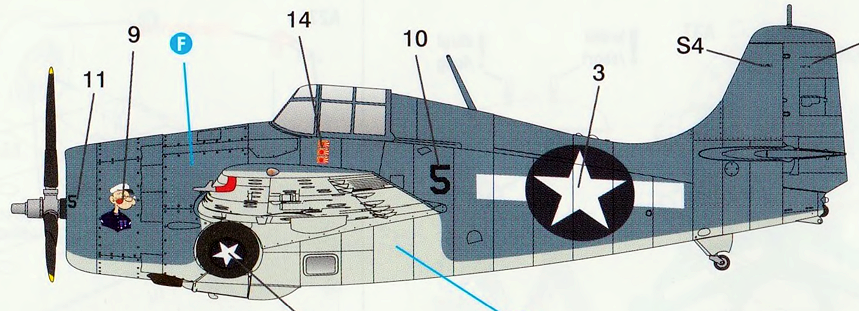
For this edition of the Annual GB 26/27, I chose to build the excellent Grumman F4F-4 Wildcat from Arma Hobby (kit 70048), representing an aircraft from VMF-111 (Marine Fighting Squadron 111) piloted by Sam Folsom, based in Western Samoa, during the spring of 1943.
The Wildcat was the main carrier-based fighter of the US Navy and the US Marine Corps during the early years of the Pacific War. Even when facing more maneuverable opponents, such as the Mitsubishi A6M Zero, it stood out for its structural robustness, good pilot protection, and ability to absorb damage, which often allowed the aircraft to return to base. During the most critical moments of the conflict, before the large-scale arrival of the F6F Hellcat and the F4U Corsair, the Wildcat was essential for maintaining the combat capability of the United States Navy’s air forces.
The F4F-4 version, introduced in 1941, became the most numerous variant of the Wildcat family. Its main distinguishing feature was the STO-Wing folding wing system, which significantly increased the number of aircraft that could be embarked on aircraft carriers. The model was equipped with a Pratt & Whitney R-1830-86 Twin Wasp radial engine of 1,200 hp and armed with six Browning M2s. 50 caliber (12.7 mm) machine guns mounted on the wings.
The chosen example belonged to the VMF-111, a unit of the Marine Corps deployed to the South Pacific during the expansion of American operations in the region. The aircraft features the classic blue-gray over light-gray scheme, characteristic of the early years of the war, combined with the national insignias already adorned with the white side bars introduced in 1943. This combination makes the aircraft particularly interesting, as it represents a transitional period in the evolution of the markings of the United States naval aviation.
The idea is to carry out a build that is practically out of the box, taking advantage of the excellent details offered by Arma Hobby and aiming for a historically accurate representation of the aircraft. I also intend to explore moderate wear, consistent with the operational and climatic conditions encountered by the marine units in the South Pacific.
Technical data of the Grumman F4F-4 Wildcat
- Manufacturer: Grumman Aircraft Engineering Corporation.
- Role: carrier-based fighter.
- Crew: 1 pilot.
- Engine: Pratt & Whitney R-1830-86 Twin Wasp, 14-cylinder radial.
- Power: 1,200 hp.
- Length: 8.76 m.
- Wingspan: 11.58 m.
- Height: 3.60 m.
- Empty weight: 2,674 kg.
- Maximum loaded weight: 3.617 kg.
- Maximum speed: 515 km/h.
- Range: 1,360 km.
- Operational ceiling: 10,360 m.
- Climb rate: 11.7 m/s.
- Armament: 6 Browning M2 .50 caliber (12.7 mm) machine guns
- External load: up to 2 bombs of 100 lb (45 kg) or auxiliary tanks.
Data from the Arma Hobby kit
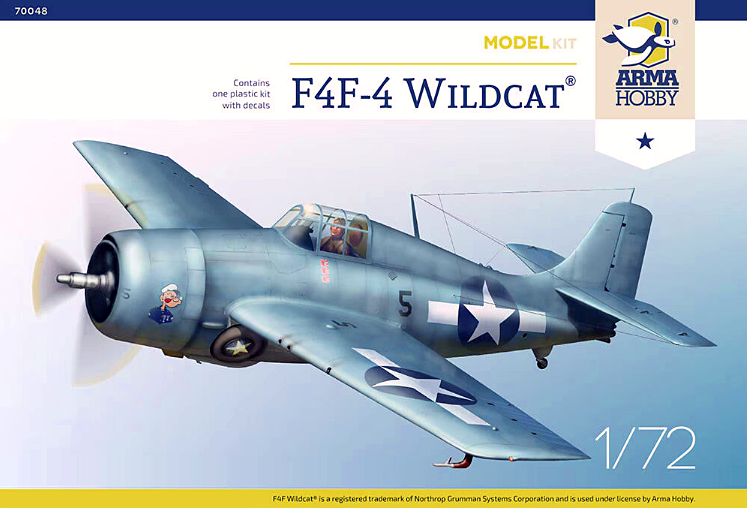
For this build, the F4F-4 Wildcat from Arma Hobby (ref. 70048), in 1/72 scale was chosen.
Arma Hobby has built a very good reputation in recent years, and this Wildcat is generally considered one of the best F4F kits available in this scale. The shapes are accurate, the panel lines are fine, the surfaces feature subtle rivets, and the level of detail is superior to that found in older kits from Academy, Hobby Boss, and Airfix.
The cockpit is well-detailed for the scale, the radial engine has good definition, and the transparencies are thin and well-molded. The fit of the parts is considered good, although the landing gear assembly requires attention during assembly due to its characteristic geometry.
The kit represents the F4F-4 version, equipped with Sto-Wing folding wings and six .50 caliber machine guns, a configuration used by the US Navy Wildcats during the 1942 battles.
In summary, it is not a perfect kit, but it is among the best options currently available for those who wish to build a 1/72 Wildcat, offering good fidelity, detailing, and relatively easy assembly.
Soon I’ll start the assembly and share the progress here.