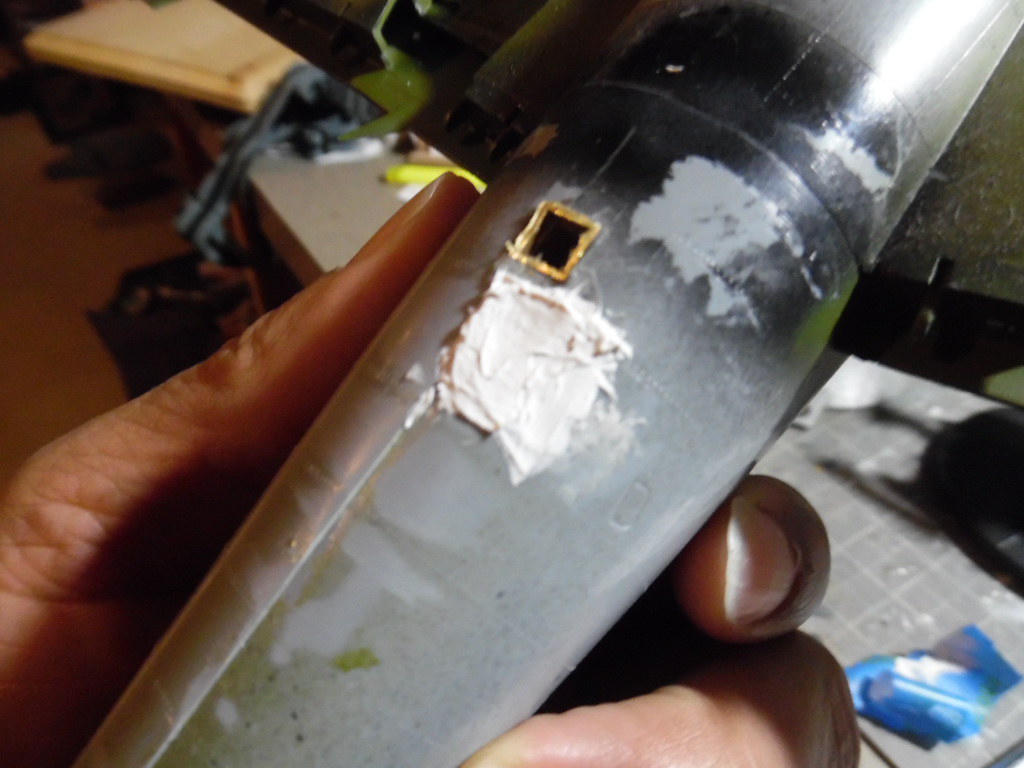
In the process of using my motor tool to remove the metal brace for a model, it gouged the plastic and left about a 1/4" hole all the way through the model. Would you recommend using tamiya putty to fill the hole or is this more of a millitput fix?
Edit:
Forgot to add that the model is already sealed (1/32 Hasegawa F6F-5) and the wings attached so I can’t get to the back of the hole.
Take the area in Question and Make a perfectly square hole. Fit in a plastic patch of the same size.(Note:The hole needs to have chamfered edges. So the patch won’t just fall through. The patch has edges to match) ( Kind of like putting a newer car windshield in) Then .010 plastic sheet behind it larger and glued well. This makes a solid patch that is blended by either Tamiya Putty or Sprue Glue!
Now you know Why I NEVER use a Dremel close to a model’s surface, It’s too easy to do this. Remember the lowest RPM for a Dremel is 5000! This is still too fast for plastic or resin, really. Plus this speed generates heat which is Detrimental to accuracy! That’s why My Dremel is an older model single speed, with a foot controller from a portable sewing machine. It has been flawless for over thirty-five years and allows speeds in the 20s to 50s instead of a base of 5000!
Most model putties have a habit of shrinking as they dry/harden. This includes both solvent and epoxy putties. The trick is to use the smallest amount possible to fill and smooth. I think my approach here would be to initially fill any gouge or hole with some CA and accelerator. Sand and repeat until the gouge is filled. CA can polish well and may work by itself, but a top coat of your favorite putty will fill any residual scratches left while working the CA. The putty will feather well and can be used to restore any contours lost in the filling/sanding operations
I would also go with CA to fill the gouge just as Ed Grune suggested by using CA and hardener on an initial filling to give the final filling a backstop. Then fill the remainder with more CA, with that coming out just above the rest of the surface. Don’t use accelerator on the final filling though, as that can sometimes turn the CA rough and jagged. Let the final filling cure on its own, preferably overnight. Then you can scribble all over and around the little CA repair blob with a black sharpie to act as a level indicator. Then gently wet sand with progressively finer grits of sanding stick (I prefer using Micromesh sticks for this) until all of the black sharpie is gone. Then spot prime with an airbrush and you should no longer see much of that gouge.
When filling sink marks and abrasions with putty, I’ll also take some masking tape and make a ‘mask’ around the booboo. That way, when you add the putty, it’ll sit a few mil proud of the surface you’re working on, so even with shrinkage, you’ll get to the proper surface quicker.
Since it’s stated in the OP not that this is a gouge but a hole right through to inside the fuselage that is already together, that being the case a plug is the answer. Then putty any imperfections left behind once sanded flush…
cut a piece from flexible compatible plastic or card wider than and a little longer than the hole.
Put a loop of cotton or thin wire through the piece, like you would with a button.
Curve the piece & feed trrough the hole, then work back so that the hole is covered, glue the edges of the repair patcgh while keeping the ‘button loop’ tensioned.
Remove/cut the thread, once you have filled the patch.
Thank you everyone for the answers. It is all very much appreciated and Tank-Builder you didn’t miss part of the question. After your first response I edited the question to note that the fuselage is joined and there is no way to get to the back of the hole. Important information to have that I forgot to share, so that is on me.
As it stands, I was able to get the hole plugged using putty, since th edges were beveled on some sides (not a straight hole). I will be letting it dry for about a week and see how it sands. Now that being said, if the patch doesn’t work, I will definitely be using the drywall fix method. If nothing else, this is just a lesson learned and a chance to lean some new skills in case it comes up again! [:D]
Here is a pic of the fix. Putty so far seems to be working, but I will definitely be keeping an eye on it and prepare to use the other fixes suggested here.
Cause I have something to share here. I made a similiar patch of all putty built up slowly on a ship’s hull. When done I did the first leveling sanding and covered it in a thin application of Super glue and a wee bit more putty.
I did this twice. After that I finished and painted and no one could find it. Try it. Maybe that will work for you too! The C.A. seemed to make the molecular structure of the putty stronger-I dunno, but it worked!
I will say though, I did not knock on the surface to see how strong it actually was. In sanding and finishing no cracks appeared.
Just a pass along that for now it seems that using putty seems to be working. I have so far sanded it as flush as I can get it. I will prime it and see how it looks and go over the model again as needed. I most likely will use the method using superglue a smentioned earlier.
Again, thank you everyone for the help and suggestions.
Again everyone, thank you for the help. I was able to fix it and I’ve already primed and started the marbling for the primary color. You can barely see where the damage occurred… in my opinion.