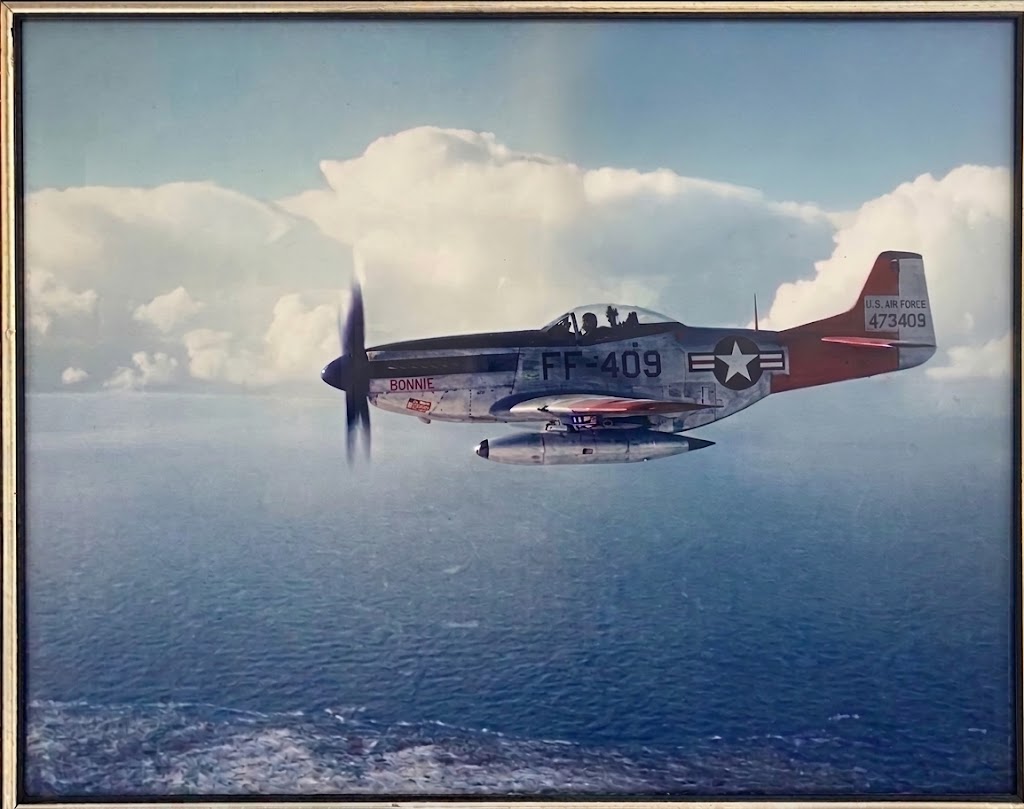
Hello, I’m building the Tamiya F-51 1/72 kit and trying to duplicate a picture of one that was deployed to Iceland in late 1952.
What’s got me stumped is the size and shape of the external fuel tanks.
I have a couple of books with other pictures of the Mustangs in Iceland also with the same tanks, but they don’t mention the size or where they came from.
They are definitely not the same as the ones you typical see Mustangs carrying… i.e. WWII era drop tanks or the larger paper mâché.
Any thoughts or ideas would be appreciated.

1 Like
It is likely they are something from the Korean War with an extended middle section, called Misawa tanks.
1 Like
Hi Texan_ll!
Do you have any information on the origin of your photograph of the Mustang with the arctic-paint sceme or do you have a higher resolution version?
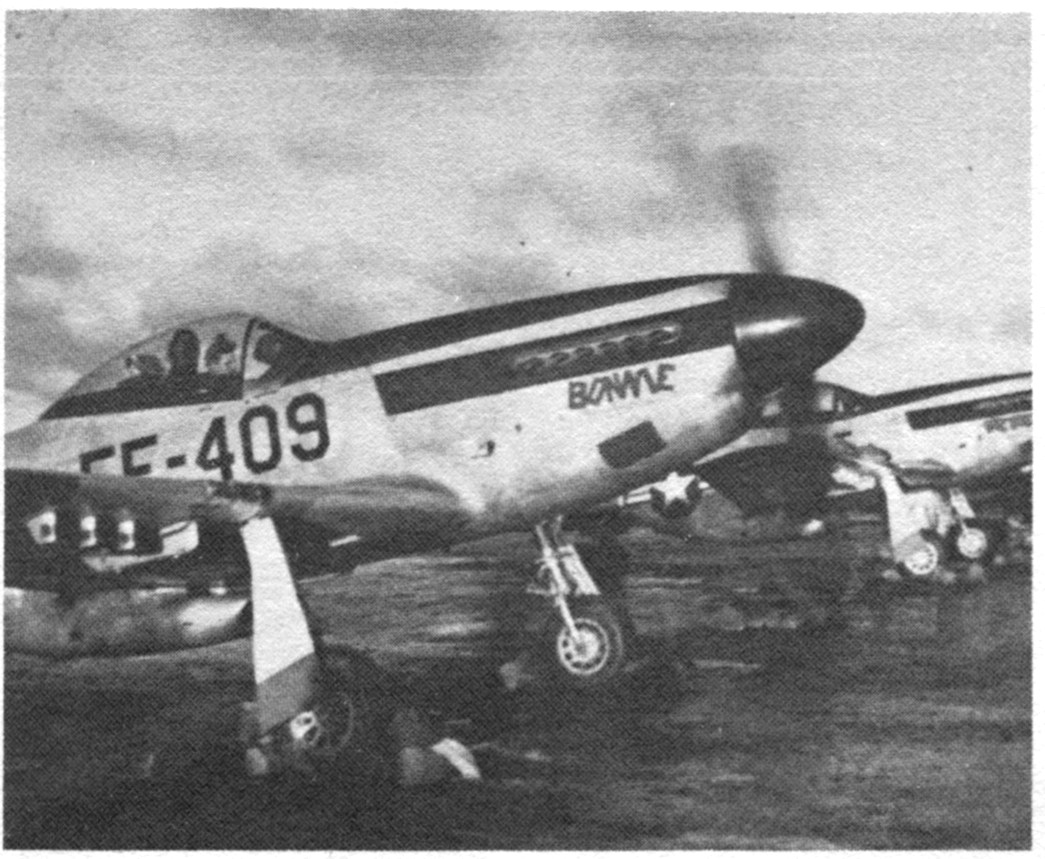
According to the list of serials of the Mustangs which served with the IDF (Iceland Defense Force) in Iceland, 44-73409 was one of them. The aircraft in the photograph does indeed seem to have the buzz number of FF-409 and the serial number on the tail seems to be 473409, which would confirm it to be one of the IDF-Mustangs!
More on the Mustang deployment to Iceland in 1952-1953 here File:192d Fighter-Bomber Squadron, North American F-51D-25-NA Mustang, sn. 44-72843, 44-74482, 44-74880, 44-73788.jpg - Wikimedia Commons
1 Like
Hey Texan,
Seeing that your post was almost a year ago, I have a feeling that your build has already been completed.
On the off chance no, I agree with John in regards to the Misawa tank which was used on the F-80Cs.
With that being said, I found a couple other related photos of the 192nd F-51 in Iceland and the tanks look a lot more slender.
I looked at all the Air Force aircraft from the 50’s and earlier 60’s(just in case) and nothing comes close to that style.
So like the F-80Cs Misawa tank which were built in counrty, I have a feeling that those particular tanks were made in Iceland.
As for tank size, maybe 108 or 110 gallon.
Happy Modeling,
Mike
1 Like
Hello Texan_II
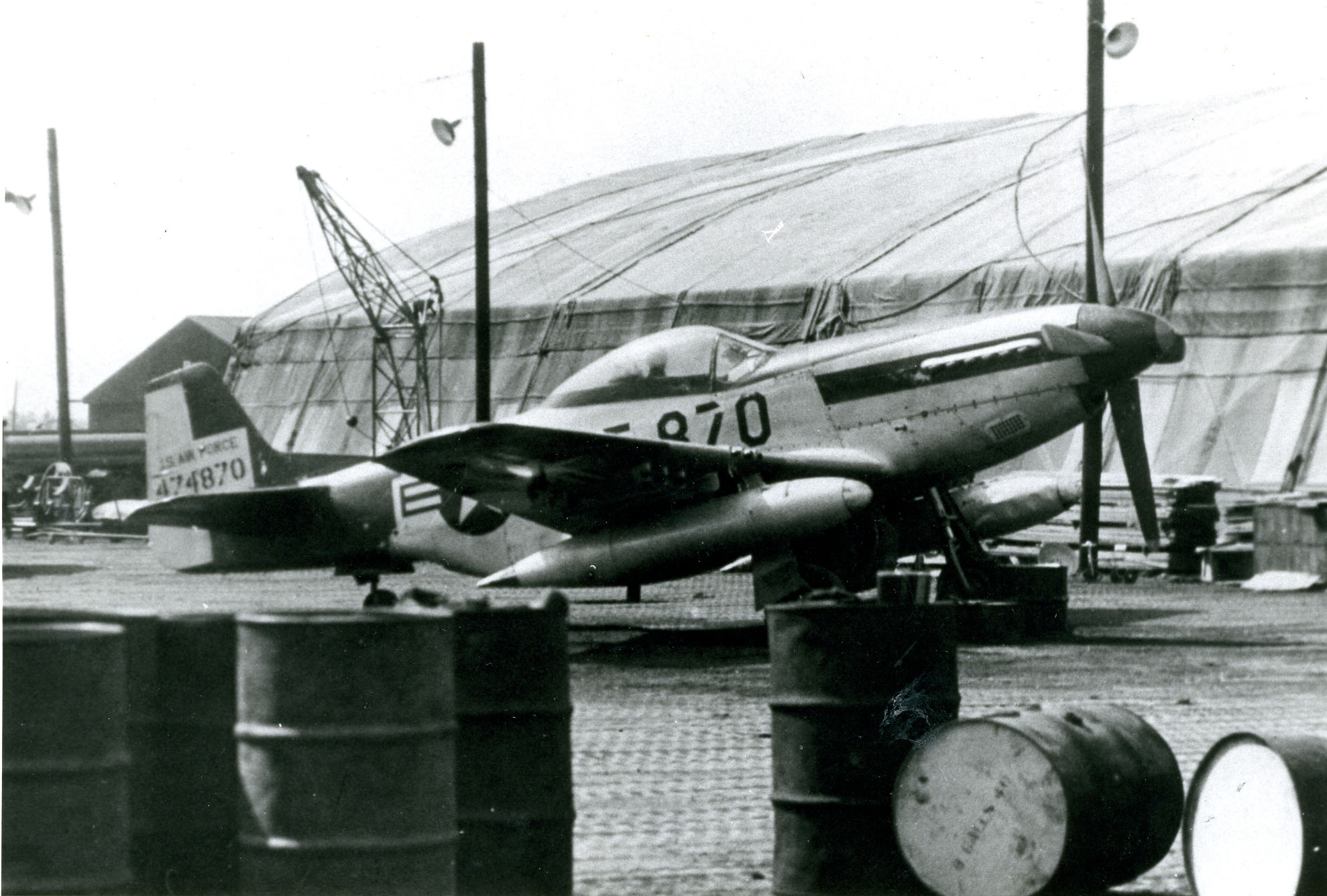
Here is a photograph of FF-870 / 474870 at Renfrew in Scottland in 1953 with the same kind of external fuel tanks as mentioned in your post. In his documentation of the Mustang deployment with the IDF in Iceland Col. Robert Gruenhagen states (quote):
"The aircraft served until April, 1953 and were replaced by F-94B interceptors assigned to the 82nd FIS. The Mustang unit designation changed to the 436th Ftr Sqdn on 1 December, 1952.
The Mustangs were flown to England, (Renfrew) and transferred to AMC at Brookley field, Mobile Alabama and eventually to Norton AFB Sam Bernardino California were they were scrapped in May of 1954."
1 Like
Texan_II
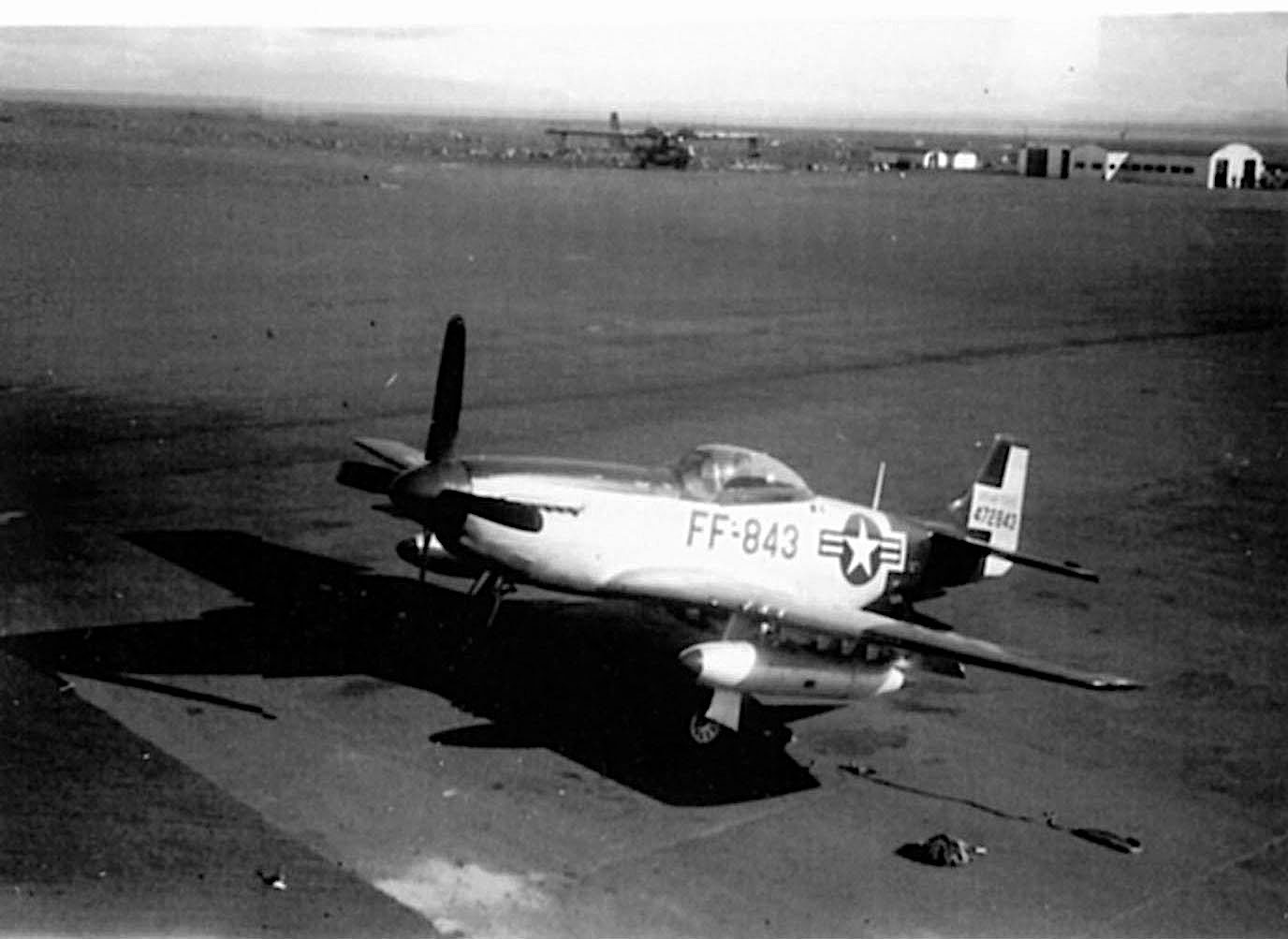
Following is a collection of photographs of the IDF Mustangs at Keflavik air base during 1952-1953, all with the same kind of external fuel tanks as mentioned in your post.
3 Likes
Hi BJB, I appreciate the information. The picture I posted is a picture of a picture and obviously lost some resolution. I’ll try enhancing it, but my computer skills are limited. That said, the picture was taken by a squadron mate of my sisters-in-law dad who helped fly the airplanes from GAFB to Iceland and was based there. I’m trying to duplicate a model of the airplane to give to her. I haven’t made much progress lately, but am down to painting the arctic red, and kit bashing some external tanks. Oh, and find some decals.
1 Like
Hi Texan,
If this was a 1/48th build, I’d have all the stenciling for you minus name and the data stencil.
With that being said, I looked through all my decals that I do have in 72nd, and nothing.
I have a few for the F-80 and the T-33 but the sheets have multiple aircraft so neither sheets have enough “Fs” to work.
The fuel tank is still getting me. I’ve been digging and checking out what the F-86, F-89, T-33 has and nada.
None of those aircraft have anything remotely similar so I did more diggin.
I have a 72nd Hasegawa T-37 and i looked at the secondary wing tanks.
Cut the fins off and I think it could work or as they say, close enough?
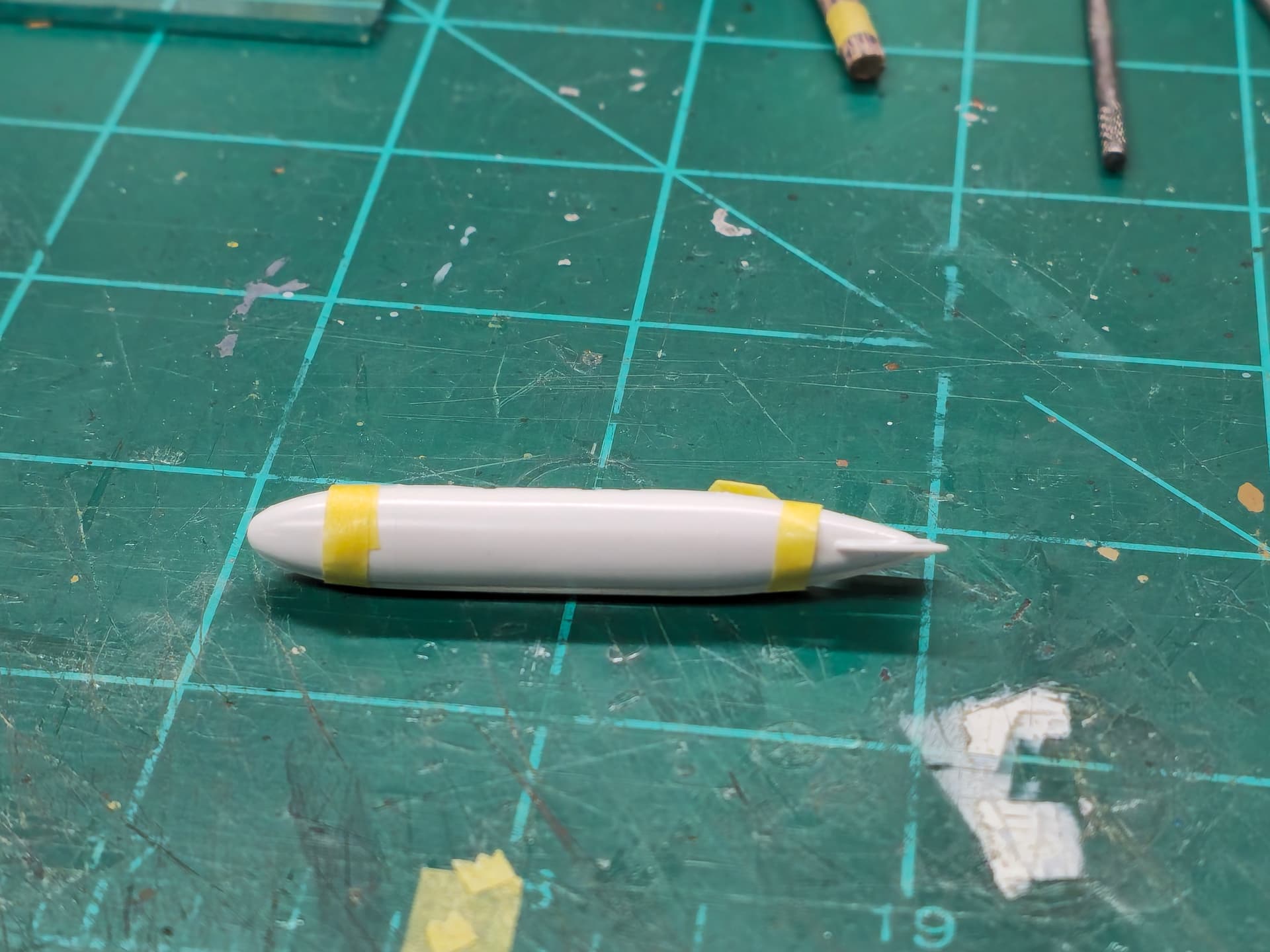
I’m still going to say that those were manufactured in country (Iceland) or revamped ferry tanks.
If you think that these will work, you can have them!
Happy Modeling,
Mike
Hi Texan_II
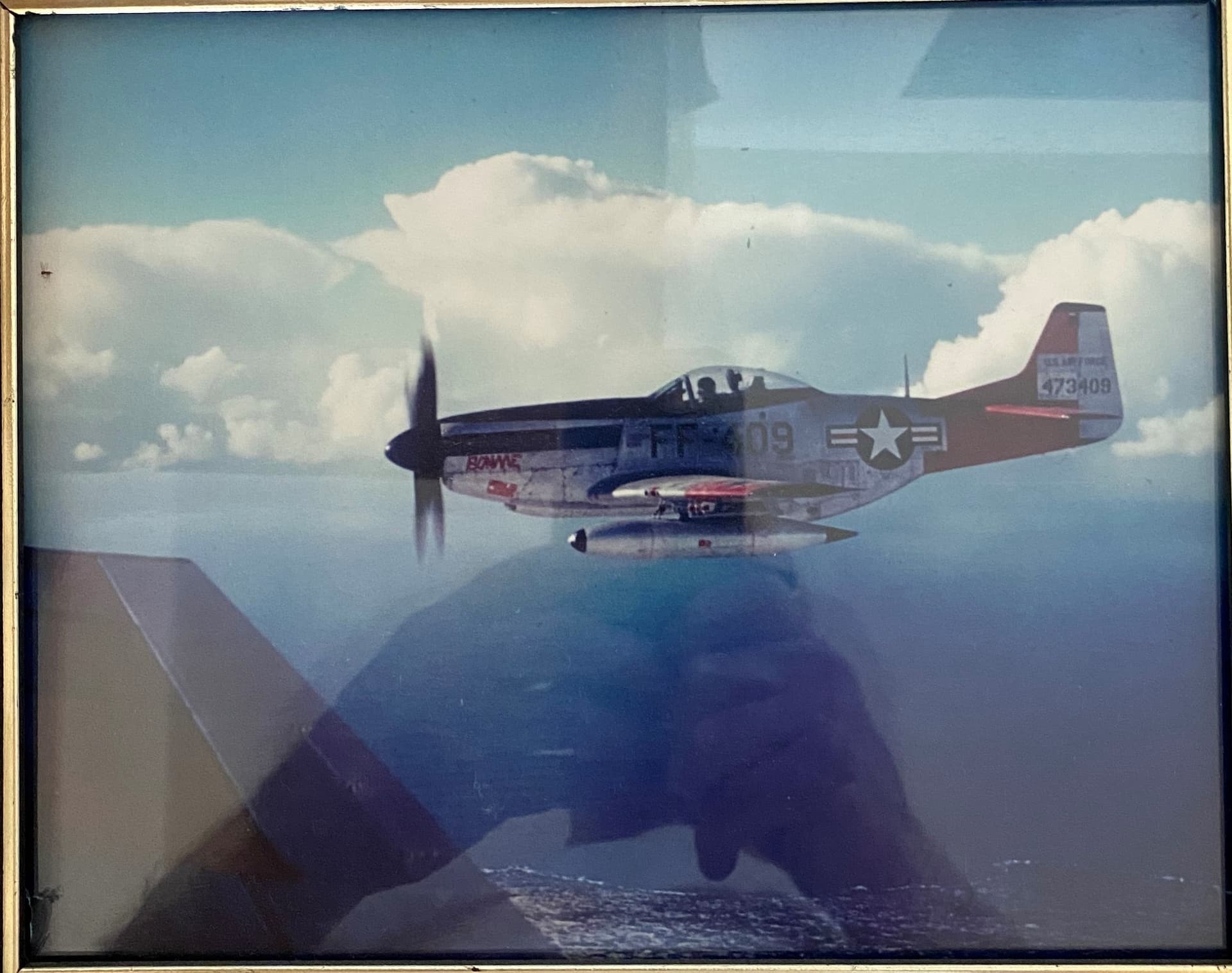
Here is a photograph of FF-409 / 473409 “BONNIE”, i.e. the exact same Mustang as in your photograph. You might even be able to identify the pilot sitting in the cockpit!
This photograph stems from Col. Robert W. Gruenhagen’s book "MUSTANG - The Story Of The P-51 Fighter". Col. Gruenhagen was the flight chief, line chief, and quality control inspector of the F-51 Mustang squadron stationed at Keflavik airbase in 1952-1953.
2 Likes
Hi Texan_II
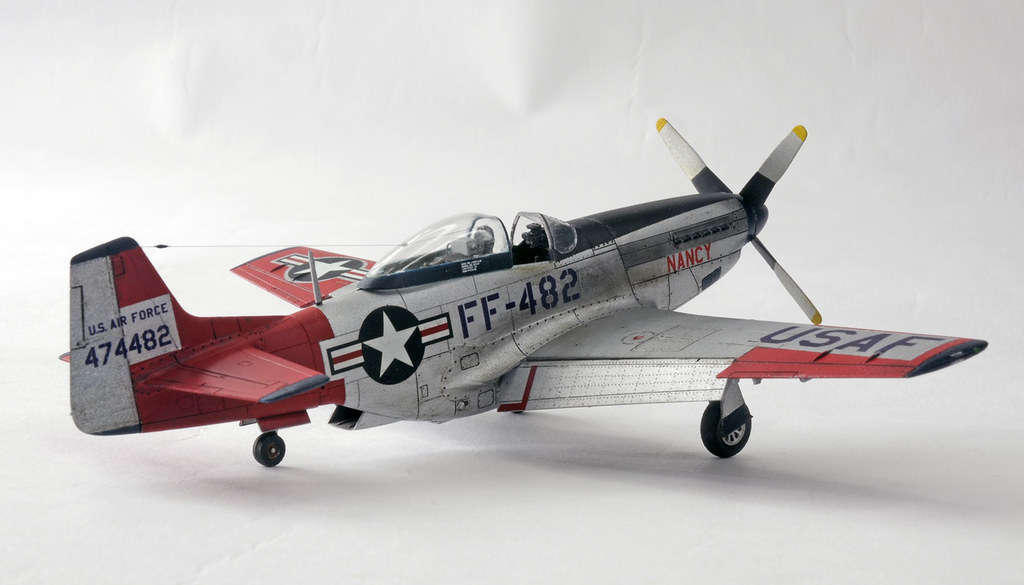
Here is a beautiful and authetically detailed 1:72 model of a IDF-Mustang (NB. not mine!). More photos are published in the Britmodeller Forum
3 Likes
Thank you Butz, I think those will work. I messaged you.
1 Like
Hi BJB, great picture! I found that book early on in my research for the model and thought it would be really awesome if the guy in the cockpit really is my sister-in-law’s dad.
Thanks for the help,
Great P-51 build. I also like choosing different or unusual topics to build. I’ve also seen on the web a recently restored P-51 named Val-Halla painted in the IDF scheme that I believe is based in Washington state.
1 Like
The “Val-Halla”-Mustang (P/F-51D-25-NT, s/n 45-11525, N151AF) has a color scheme and markings in close reminiscence of the IDF Mustangs of the 131st Fighter-Bomber Group (FBG) stationed in Iceland. However there was never a F-51 with the nickname ‘Val-Halla’ actually stationed in Iceland!
“Val-Halla” was owned by the late Maj. Gen. and Apollo 8 astronaut William „Bill“ Anders who was stationed in Keflavik AB in 1958 with the 57tfh FIS “Black Knights” flying Northrop F-89 Scorpions of the Iceland Defens Force IDF, which also had an “arctic-red“ color scheme while in Iceland. “Val-Halla“ is now a part of Heritage Flight Museum.
Greg Anders, son of Bill Anders, tells the following story about how the paint scheme and the name of “Val-Halla” came to be (Source: „Warbird Stories: P-51 Mustang Val-Halla“):
„So, in 1995, when Bill was restoring what would become “Val-Halla,” he took the paint scheme from his F-89 and reconfigured it for a Mustang.
At the time, Bill and his team didn’t have any pictures of the Mustangs’ paint scheme in Iceland, so they worked diligently to create as accurate a design as possible.
“We were at the Reno Air Races the first year (Bill) was racing, and then this fella came up to us. He said, ‘I’m sure you’ve got a lot of these, but I’ve got six pictures of the Mustangs up there in Iceland,’” Greg Anders said. “We’d never seen any of those pictures, so we were pleased to learn the paint scheme was actually very accurate to the original Icelandic paint scheme. So, kudos to my dad and our artists and understanding what the Air Force standards were.”
The name “Val-Halla” was both a nod to Bill’s wife Valerie and his time serving as the United States Ambassador to Norway.
“As is common with most fighters, naming an aircraft is often a reward and a way to honor the pilot’s bride,” Greg Anders said. “But Valhalla is also the term for Viking Heaven in Norse mythology, so my father created ‘Val-Halla’ to pay homage to both his wife and his deep connection to the region.”
Bill served as Ambassador from 1976-1977, and during that time, Greg and his siblings often heard stories about Valhalla and the many Norse gods as they became immersed in the culture.
There was never a P-51 ‘Val-Halla’ stationed in Iceland, but that makes our ‘Val-Halla’ unique to (Bill’s) story.”“
Source: „Warbird Stories: P-51 Mustang Val-Halla“
1 Like
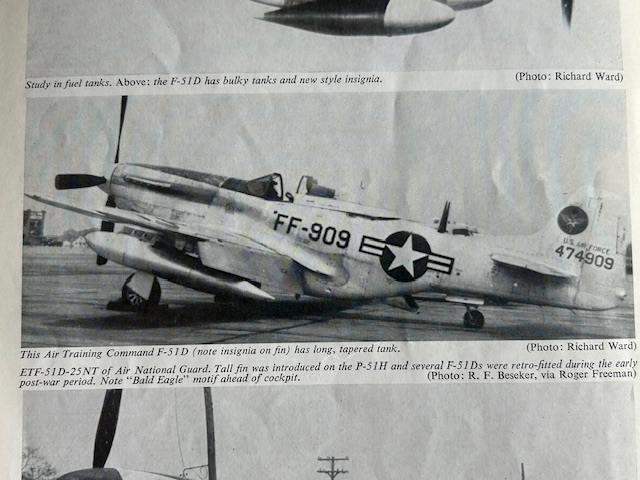
While continuing to research the unusual tanks I found this picture of the “long tanks” on an ATC P-51.