I’m sorry for the off topic post. I know this isn’t model related, but it is helicopter related. I also know there are a lot of CH-47 folks here, so bear with me.
I have watched the video in the link below three times, and I still cannot figure out what they are testing. They DESTROYED what seems to be a perfectly good airframe. Does anyone have any background on this video?
I tried to find a better copy of this video on a different website, but I could not find one. I hope this works okay for everyone.
I don’t know what they were testing either, but I don’t think I would like to be in a helo that does that 2500 feet in the air! [:O] It looks as if the resonance was causing massive vibrations ultimately ripping the frame apart. I don’t know if that makes it a good test or a bad test. If it helps save airmen’s lives than I guess it’s a good test.
Although I can’t get the video to play, I think I know this video, and what they’re testing here is a phenomenon called ground resonance; engine or transmission parts that are “out of tune” and cause a violent shudder that vibrates the whole machine to death.
One way to solve it, is to lift off. Ground resonance, as the name already suggests, cannot occur when airborne.
I’m not a technical guy though: someone else might clarify this further.
Well, you got part of it right. Engine and transmissions “out of tune” (whatever that means) have nothing to do with it
Ground resonance occurs in helicopters with a fully articulated rotor system when an unbalanced situation in the rotor disc occurs. Having the wrong cyclic and collective inputs that result in hard ground contact usually causes the problem, but on aircraft with hydraulic dampers on the rotor blades (to dampen blade lead and lag) that are improperly serviced can contirbute to the problem. Improperly serviced landing gear struts (on aircraft that have them) can also contribute to the problem if they aren’t properly serviced
As has been mentioned the solution to getting out of ground resonance is to bring the aircraft to a hover.
I have dial up so I wasn’t able to download the video, but I do know that Boeing has run several aircraft through dynamic tests to determine the ‘failure’ parameters of different components. I suspect that is what this video is of unless someone can shed more light on the issue.
A previously scrapped frame was used in the test, but I think it went a little further than it was supposed. I like the side view where you can see the side door flapping up and down!
PHEW!..I had to wait to get to my offiice at work to see that video.
I agree…if it was to save lives…sure DO IT!.. It was a bit creepy to see that airframe just come apart like that…untill you have been in a crash or in combat situations its easy to forget that Helos, fixed wing and some ground vehichles are just frames with thin aluminum or metal skins.
Cable High speed this Thursday!! YIPPIE!!!..had Verizon High speed till two months ago…we moved and our street does not support phone high speed…man…going back to dial up…well…it sucks!
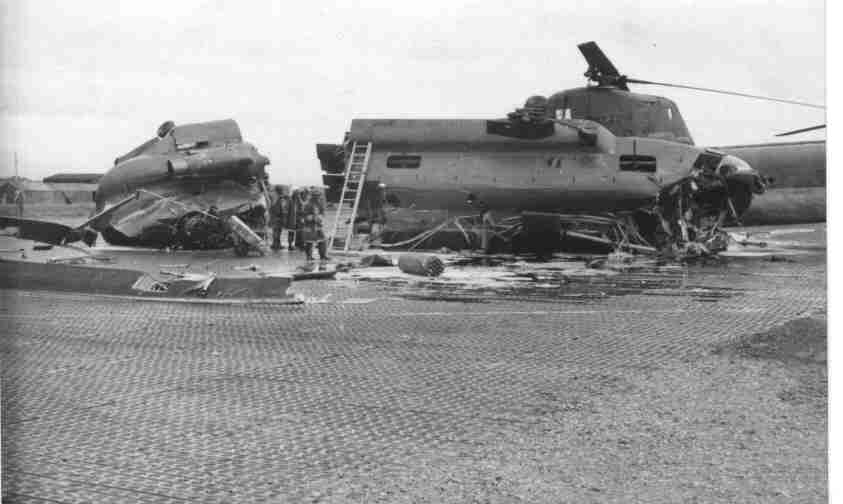
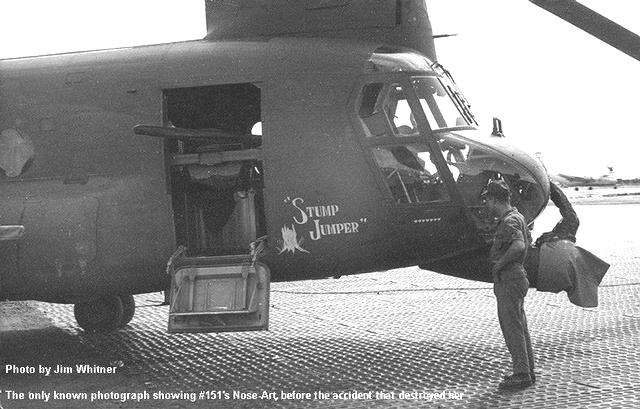
Oh yes… Ground Resonance can ruin ones day VERY quickly!! I remember the photos of #64-13151 when she taxied too close another parked Chinook and dinged her rotor on the aft blades… #151 literally disassembled herself within a couple seconds because of the out-of-balanced condition.
The only personnel injury happened to the Flight Engineer, Garnett Clark, who’s right arm was severed by a piece of the rotor.
#64-13151 was named “Stump Jumper”, due to a forced landing in which she straddled a tree stump. She was given her name while repairs were being made, and carried it only a couple weeks before being destroyed at Vung Tau.
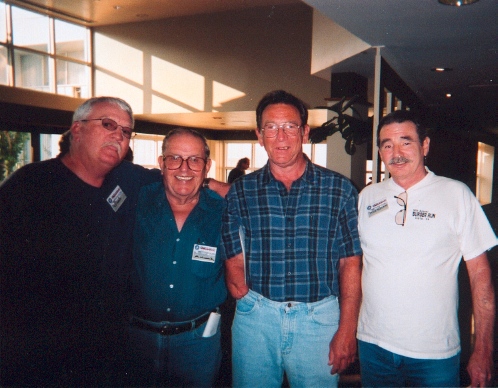
Here’s a 2001 picture of Ed Coberly, John Huddleson, Garnett Clark, and Mike Gegere. Ed was #2 Gunner on “Stump Jumper” that day, John was Crew Chief, Garnett was the FE, and Mike was #1 Gunner.
Wow, am I glad now that I posted this. I learned a LOT in this thread; and after a night of googling about and learning about some of the references that I didn’t exactly understand, I feel like I just got a crash course! (haw-haw-haw…sorry for the pun!)
The most amazing part about that film is if you havn’t noticed…is that the forward rotors seemed to stay intact, did not make ‘obvious’ contact with the aft rotors and where still spining at the end of the film!
If I am not mistaken it might be due to more blades on the rotor head. I know that more blades on a rotor system make for a smoother ride.
I’m giving my age away here, but I learned (the hard way) how to track blades on a CH-46 using the flag and pole, and masking tape coated pole methods. Then we had the Chadwick-Helmuth strobe set up using a strobe light and reflective tape attached to blade targets. That was pretty much standard on '46s AND '47s up until the mid to late 80s when we started using accelerometers located along three axes where we were more concerned with reducing vibration rather than ensuring that all blades were within certain tolerances in the rotor tip path plane.
The company I work for now has some pretty slam bang stuff that will usually give good results in as little as two or three run ups. (A far cry from what seemed like endless days “chasing” climbing and diving blades…)
ooooops sorry for the rambling…just another old phart who missed his meds [:I]
Up to now, I’ve only read the forum so alert me if I break any rules. I felt compelled to respond because I happen to know about this video. I played a small role in events that lead up to it. Ground resonance was not the object of the test, only the outcome. First off, the a/c was not exactly flyable from the beginning. It was involved in an incident that ended in a hard landing which did some damage, not all of it visible. The a/c could have been repaired but there was a requirement to update ballistic testing on the Chinook, so this a/c made a good test subject. I was reassemble using unserviceable parts but was good enough to perform unmanned ground runs in order to shoot at it to see what happens. I don’t know how much was actually fired at it prior to the video but its obvious that it was teathered too tightly to the ground and as they say, the rest is history. Hopefully this quenches some of the curiousity.