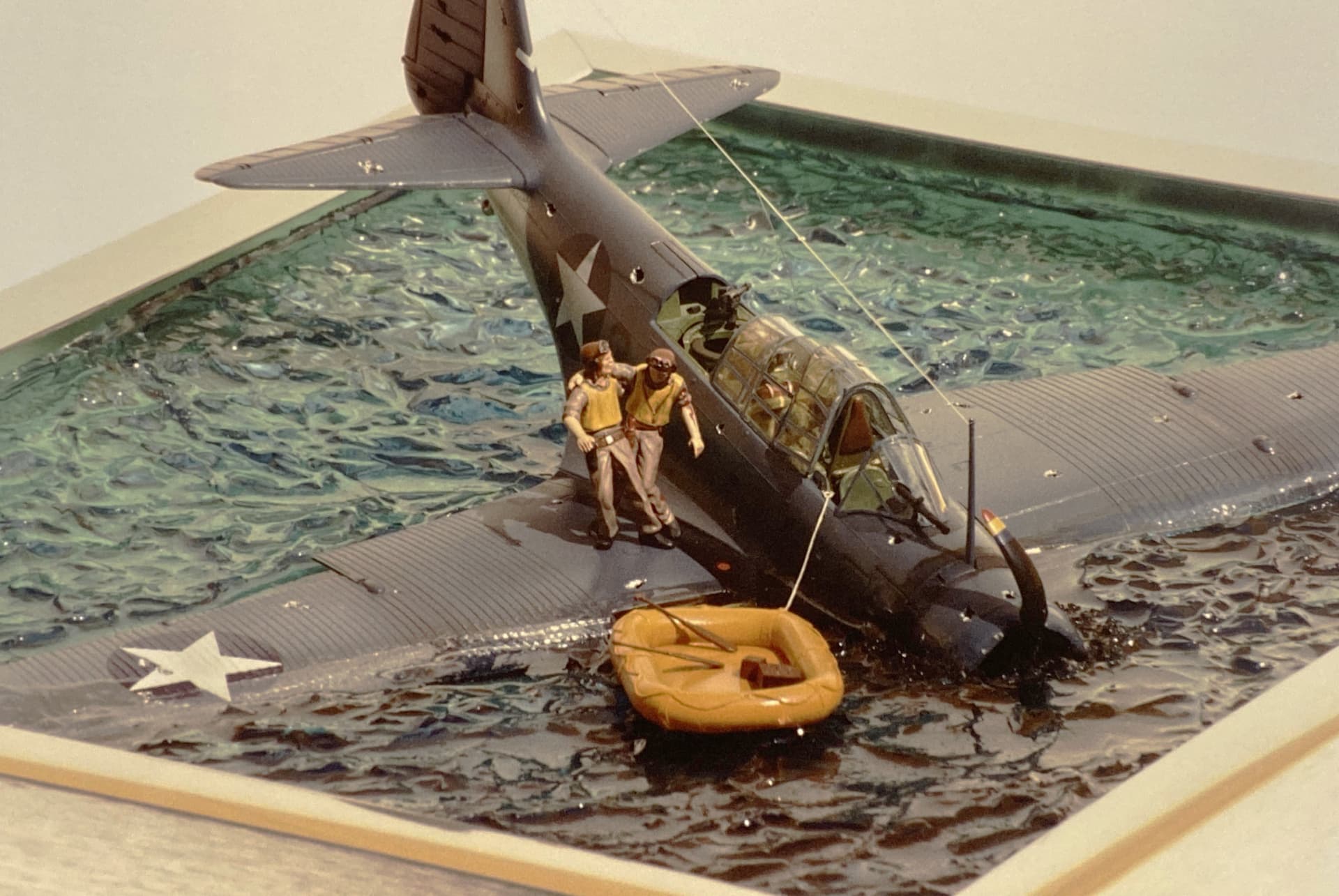
Below is a photo of a 1/48 scale diorama I built in 1992 trying to duplicate what Shepard Paine built for Monogram Models in 1974. I’ll be the first to admit my work has issues and is off the mark, but it was my first try at working with epoxy resin to create water. It was a really messy material to work with.
The Setting
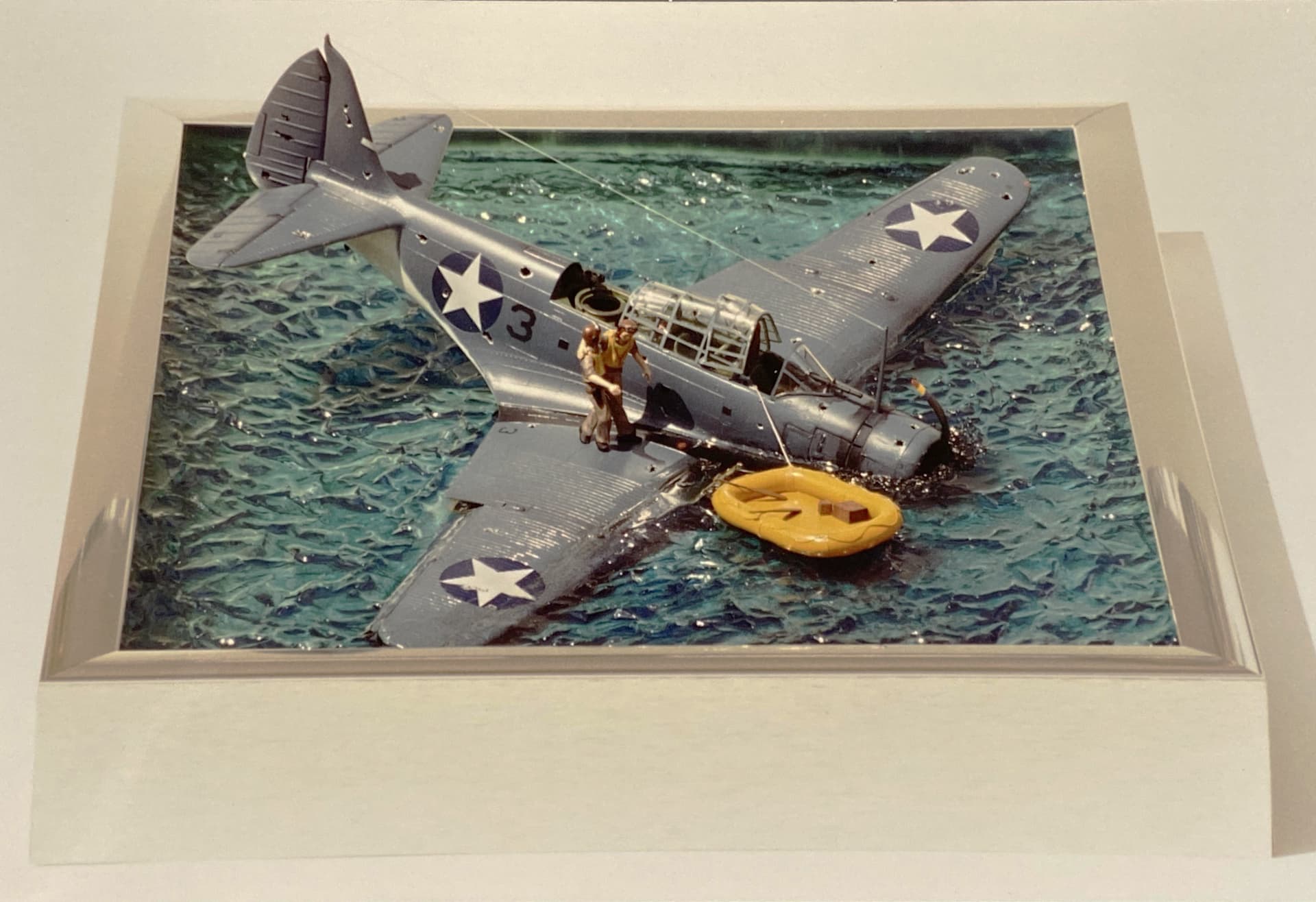
The diorama depicts a Douglas TBD-1 Devastator torpedo bomber that has been shot down on June 4, 1942, during the Battle of Midway and made a forced water landing. The rear gunner has been wounded and the pilot is assisting him to the life-raft before the airplane sinks. It does not represent a specific aircraft from the battle. And yes the rear gunner station should have twin .30 caliber machine guns instead of a single one. I hope you enjoy the photo.
Phillip11
Karljeff72/keavdog/Tim/Toimi/Aggieman/Stikpusher-Thanks for the kind words and compliments. I was trying to duplicate Shep Paine’s work but his is a lot better than mine!
keavdog-A George Gay diorama per the image you posted would be cool!
Below is another photo of an overall view of the TBD diorama.
A note for anyone interested in George H. Gay - he attended the same university as I did, Texas A&M, way back when the school was known as the Agricultural and Mechanical College of Texas.
On a related side note, only 3 TBD’s ended up in this manner. 1 from Torpedo 6 ditched on the way back to USS Enterprise, while both survivors from Torpedo 3 had to ditch as well.
Aggieman-I did know that from reading his book. In fact, I think his nickname in VT-8 squadron was “Tex”.
stikpusher-Thanks for noting this. Another “fun fact” is one of the Yorktown’s ditched TBDs (side code T-2 flown by William Esders) stayed afloat (for hours) in the water until he was rescued. Ditched planes usually sink very quickly but the floatation gear worked and after being rescued the ship’s crew had to use small arms fire to sink the plane.
mustang1989-Thanks very much for the compliments. I used a resin casting material I got from a craft shop. The resin was mixed with a hardener (very similar to 5-minute epoxy) and cured slowly. The material stunk to high heaven and was very messy. That was a long time ago and I am sure there are better options now. Blue food coloring was added to the mixture and it was poured in multiple thin layers. To create the “waves”, crumpled up aluminum foil was laid over the final top layer in two sections and pulled off after the mixture had jelled but before it hardened. I just followed the steps S. Paine laid out in his “how to diorama” book.