Well as some of you know I was in the market for an SU-27, and today I went. The only one they had was the 72 scale Hasegawa, and it was 50 bucks. Considering the innacuracies and the scale, someone musta bumped their head.
So I picked up Academy’s 48 scale F-15C/D kit. Upon opening the box, and reviewing the instructions and the parts, everything looked quite nice. The seats leave alot to be desired but most kit seats do. The instrument panels on the other hand look pretty darn good. Easily as good as most Tamiya offerings if not better. Then I looked at the lower fuselage, and I almost threw it in the garbage. What a waste I thought, this nice kit and they can’t get the gear wells right. Just a pair of small openings. Most of the bay is molded shut. I have a Tamiya Eagle here as well as the 72nd scale hobbycraft, and I’ve looked at REvell’s recently, and they all show a much larger gear well.
So then I think back to the times when I was on McChord AFB in Tacoma Washington, and they have a couple of these things sitting out near their museum. I was quite young, but I still remember it, and I remember the gear doors all being open. I live very near the Portland Air Base and I see these things takeoff all the time, but by the time they get overhead, the gear is retracted so no help. I can’t even drive by thebase and take a look because believe it or not they have a 25 foot tall hedge on the otherside of a moat. Yes you read that right. A moat.
Anyhow, I did some looking around online, and found that actually Academy has it correct. On the ground it’s just part of the doors that are open. This was a bit of a surprise to me. It shouldn’t be though because most people model the P51 wrong. It’s modeled on the ground with inner gear doors open, yet with original video and video of repro aircraft, these doors are closed on the ground. Upon takeoff they open up to allow the gear to retract, and before landing they open to allow it to extend and then reclose again. Perhaps it’s clearance issues, but I’m surprised Academy is the one that got it right. Or so it appears from this photo.
I am not sure on the F-15 but, I have seen and read that Mustang doors will open up on the ground because hydraulic pressure will bleed off and the doors will open because of gravity. When the engine starts up, the hydraulic pressure returns and the doors close. I have seen film clips showing the start up and the doors if open will close pretty soon after the engine starts.
Normally the main gear doors are closed on the F-15 except when the gear is cycling. The primary reason is aerodynamic - to reduce drag and not have the doors out in the wind acting like speed brakes when the gear is extended during flight. It isn’t that uncommon as a design feature. Just off the top of my head, the RA-5C Vigilante and B-25 Mitchell come to mind as other examples.
Obviously it is possible for the doors to be opened on the ground for maintenance, etc. so modeling it either way can be correct depending on the context. I haven’t built any F-15’s lately, but I do remember that the first generation 1:72 Hasegawa F-15’s could be built either way.
It makes sense on the P-51, I suppose it depends on HOW you are modeling it. Most don’t realize that they close. The pressure bleeding off makes sense though. I had no idea abuot the F-15 until I looked though. When I first opened it up, I was figuring it was an academy screwup. They’ve done it before. Can only design a kit as good as references available I guess.
To make the gear doors stand out a bit more though from the rest of the panel lines, I’m deepening the lines, other then that I’ll leave it as is.
Remember that the P-51’s that have their inner gear door sag & drop is the Merlin engined planes, the earlier Allison engined planes hydraulics held pressure far better then the Merlin engines. As for the F-15’s their gear well doors are closed & locked after gear has cycled in either direction but the strut doors are open only when the gear is down, the only time the gear well doors are opened is that if maintance is being performed in just that one well and the others are closed.
But monogram didn’t get the wings right though. There is supposed to be a seam where the wing meets the fuselage. They got the shape of the wing right though.
My father was a Eagle Keeper in the AirForce so I know a bit about F-15’s I even have a Crew Chiefs manual on the F-15A through F-15D that my father got when he was a crew chief on the 94th TFS Squadron Commanders aircraft. Even has all the locations for the Remove Before Flight flags. And I also suggest investing in the Eduard Big Ed set for the F-15C/D it has alot of good interior and exterior details as well as the canopy masks and etched Remove Before Flight flags.
Not going to invest in the big ed kit for this guy, maybe the next one I do. Althuogh the locations for the remove before flight tags would be cool, I have some I printed out, I plan on using. For the most part though I decided this bugger would be OOB. The hard part right now is going to be masking the natural metal area in the back, finding out where to mask it. I’m being smart enough to paint the metal and mask it before I glue any of the fins on, LOL.
Only real issue I’ve had this this kit that is a biggy is the lack of any kind of locator for attaching the nose to the fuselage, it’s just a butt joint. I’ve got a couple of layers of superglue as well as a few applications of plastruct weldene, hopefully that will work, but I fear one day I will pick it up by it’s nose after it’s finished and off it will come. I have some idea’s to make it stonger during the next build of this aircraft. It’s nice enough to build again.
I will be using the turkey feather cans this time around, even though they aren’t correct, as the correct ones don’t assemble together at all, they don’t fit. Next one I do I’ll get some resin pieces. Probably a resin cockpit as well.
I also forgot that Eduard also does the FOD covers for the intakes which will be necessary in a ground maintenance dio. But some of the RBF flag locations are on vents which will need covers made to put over the vents and covers that go over the AOA sensors and the Pitot tubes on the fuselage.
I will be using the turkey feather cans this time around, even though they aren’t correct, as the correct ones don’t assemble together at all, they don’t fit.
fantacmet, the F-15’s never had the turkey feathers on the outside of the burner cans. the The turkey feathers were used on signal engine acft to smooth out turbinace. The F-15’s engines show all of the nuts, bolts, bridge work and braces on the outside of the augmentors. Good luck on your F-15 and keep us posted on how it comes out. Charlie P.S. I work on the engines for the USAF.
I seem to remember the early F-15A’s had the turkey feathers and they would “stick” so they were removed on them and subsequent models. I scratch built a set of “featherless” cans in 1985. Not at home to check my references. I do know you can see on the turkey feather hinge brackets on the ring at the base of the cans on the A models. I have a some pictures of a F-15E in 1992 I’ll check to see if the hinges are on it.
I found a reference to the removal of the “turkey feathers” on the F-15’s in the Squadron Signal Modern Military Aircraft series on the Eagle by Lou Drendel. He states in 1979 with the newer models of the F-15C’s and D’s entering service they decided in a move to cut maintenance hours on the F-15’s the external engine nozzel flaps (turkey feathers) were removed. It resulted in a 10% savings in engine maintenace hours and a dollar savings of $1200 for each for the 17 per engine flaps. The slight increase in drag was well worth it. So according to Lou prior to 1979 you can build F-15A’s and B’s with the turkey feathers installed. Where I got the “sticking” from I don’t know. CRS! Just like to keep “history” straight. Too many rewrites!
The turkey feathers on the A and B were always sticking and cracking. The grease used between the feathers had to be put on at the end of each flying day. The heat caused the lube to thicken and causing the feathers to stick. It was a constant pain to remove them, get them repaird and put back on. For some reason the feathers on the F-16 did not have that problem. Eventually they were removed from all F-15’s in US service as well as some other countries.
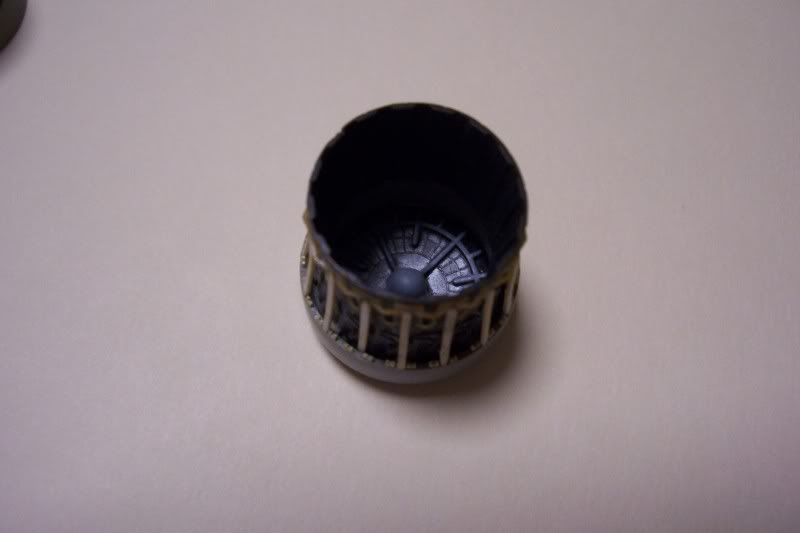
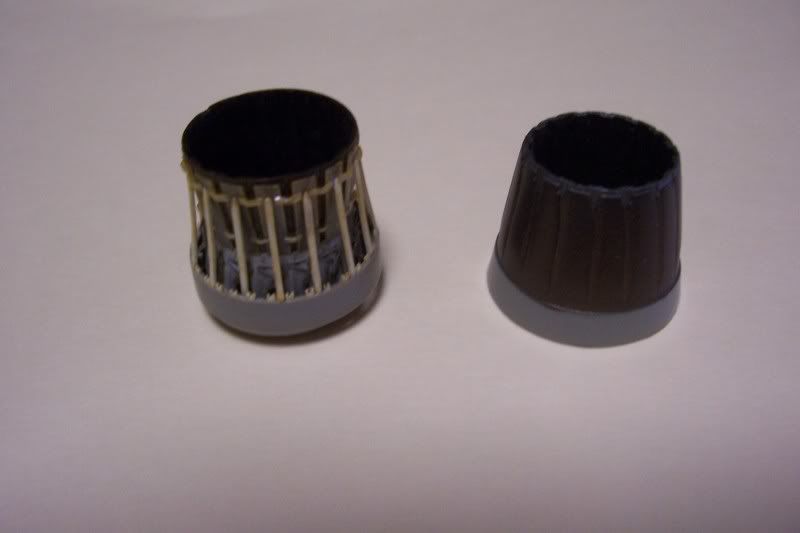
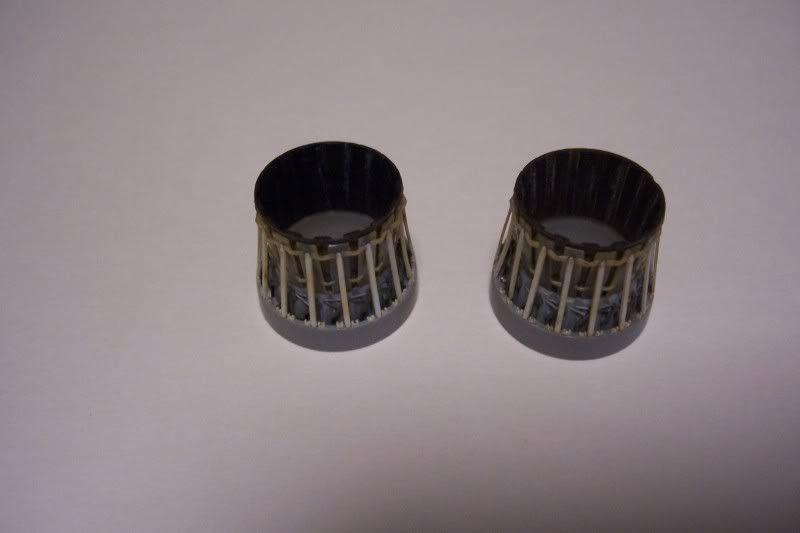
Thanks for the “inside” shot. I can’t seem to locate my pictures at the moment but drug out my scratch built 1/48 afterburner cans and took a few shots. Best I could do with the wife’s old digital. I think there are about 170 pieces per can. I used the base of the ones in the Monogram F-15C kit and removed the “vanes”. Took the cans from an ECSI F-4 kit reversed them and glued them to the Monogram base and then started adding pieces. I’ll have to build the rest of a F-15 to go with them one of these days! Heh, heh!