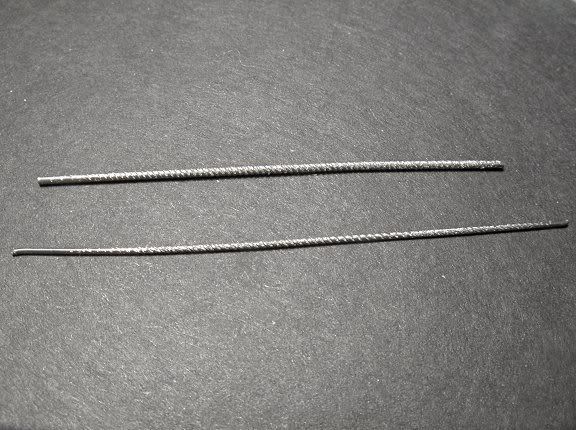
Was braided stainless steel wire ever used for aircraft fuel lines and ignition wires in WW II? I’ve seen it on modern restorations, but obviously, that doesn’t mean it’s period correct. I was thinking of using the 1/24 braid intended for 1/24 cars for detailing on 1/24 aircraft. However, first, I want to be sure it’s accurate. Can anyone enlighten me?
There may have been some late '40s aircraft that used it. But remember that it was expensive and early production aircraft were not designed for long term use…they were expendable weapons like tanks and rifles. Once control was established and the loss rate diminished, less losses meant fewer aircraft needed to be produced, which opened up more available resources.
Most high pressure lines were solid tubing, or reinforced hoses. As the processes developed the things like steel braided hoses (which have a “plastic” liner inside) came into being.
Just revisiting a tip I posted long ago by saying…if you can get your hands on almost any old oil seals from a local garage/service center…they make the best hoses after what Gerald just mentioned. Seal springs can be tough to work with, but more natural looking than anything I’ve seen. Round wound guitar strings (E, A, D and G) are a good bet, but tend to bend into angled bends if you aren’t careful.
If you use strings…‘massage’ the piece you want into the basic shape you need before gluing
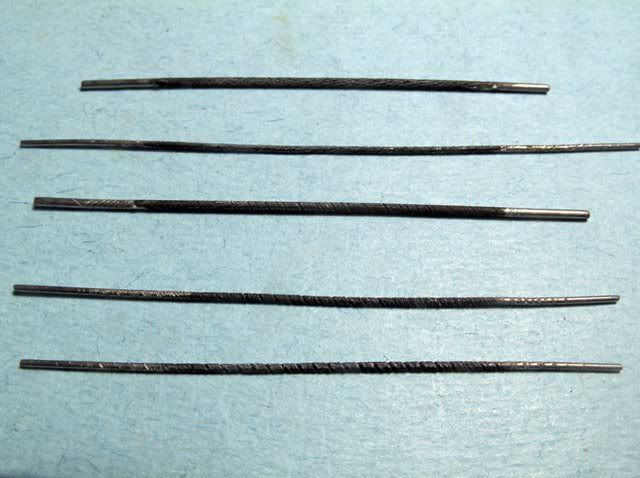
You can simulate a reinforced hose with solder that has been rolled under a coarse file. Do it on something like a cutting mat so the solder rolls and not slide. You get different patterns by changing the angle of the solder in realtion to the cuts of the file. Flat black and a light gray dry brush is all you need.
Many thanks for the info, guys. Since my last posting, I’ve been pouring over the details of period photos of engines in the books in my somewhat limited library. As nearly as I can tell from these grainy photos, most fuel and ignition lines were sheathed in plain metal tubing – probably aluminum. Found one color photo in which the tubing covering the ignition wires looks like brass. I guess that answers my question.
May have been brass or copper depending upon the duty of the line, but the more I think of it…that solder idea is a winner! My oil seal spring idea is accurate for some things…but the solder can be adapted to anything!
to take this a step further, I had the chance to get a very close look at some jet engines built before the end of WWII (Whittle Jet engines built in the states). Cannot remember any flex hose period on them. They used 1045 hydraulic tubing (seamless and drawn over a mandrel) was bent to fit whatever aplication they needed. Reason I remember it so well was that I found a couple thousand feet of it in a storage area, and promptly stole it. The stuff bent like wresteling with a twenty foot python, and was actually older than I was (still had the mil spec contract data cards with it). But I think the first engine I saw with stainless braided hose on it was a J33 or maybe even a J47.
just another note here. The fuel lines used on those engines were copper plated steel, and I think they still are. I got ahold of a later batch that was annealed and copper plated, and bent like it was wet pasta.