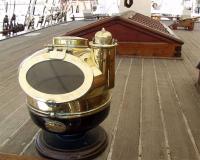
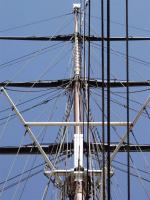
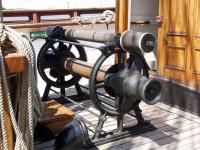
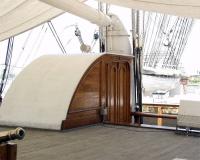
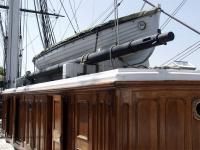
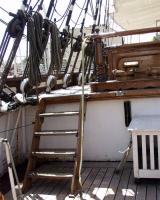
Can someone help me, as I’m trying to figure out the deck house colours and masts so I can complete this before I start doing the rigging.
I have had a look at some models on the net and had a read of the 1/96 cutty sark forum topic here but I’m still confused by this as people are saying they a white and others are saying they are teak colour.
BMK, no one can tell you the correct colors of the deck house colors; because they vary from one time period to another. The CS is over 140 years old. You need to do your research and determine what time period you wish to represent her. Sometimes they are white, sometimes they are varnished, and maybe sometimes they are teak! Narrow it down to a time slot, or a particular configuration which pleases you, and maybe we can be more helpful.
As shipwreck has said, they are both sort of right. Her deckhouses were varnished at Greenwich, but if you look at this photo (one of the few of her taken while she was working as a clipper), you can see that the panels were painted white.
Did we not determine from the thread on this from early this year or late last year, was the only thing we knew for certain was that the cabin roofs are not Blue?
(This is a translation aumática)
When you restore or rebuild a ship or something else responsible architecture and ensurethe original colors, is part of its competence
If one that is complicated. Especially by things which have great age.
Let us imagine restoring a building first erected in 1890. If we restore it to historical accuracy, how much accuracy should we apply? Should we remove the electrical wiring; the plumbing? Do we need to restore gas lighting , if used? I have some experience in this in my architectural practice.
With ships, it is equally complicated. Some wooden ship design is predicated on use of leaded paint. But, government regulations on leaded products are complicated at best.
This has cropped up a mere 150 miles south of me, where the Galveston, Texas seaport museum has the restored Sailing Ship Elissa. Or had. The hull has been found to be unseaworthy. But, to the point, Elissa started life as a steel-hull barque. When she was found in a Greek ship-breaker’s yard, she had been chopped into an motor vessel.
So, historically, one could restore here to either state. For the museum, it made sense to restore her to an in-between state, as an engined auxiliary barque.
With Cutty Sark, there is evidence that her deck houses were both painted and not pained. And also part-painted–there were fashions for this in maritime service. And, that’s all before we get into how many deck houses Cutty ought have. Which complicates things.
Try to track down a book by Author Noel C L Hackney that was published in the 1970’s by Patrick Stephens Ltd here in the UK. It’s long out of print so look on ebay, secondhand book shops, specialist nautical book shops or at model shows if anyone is getting rid of a copy. The book is all about building the excellent Airfix Cutty Sark kit. It will give you all the painting information that you could want in great detail, that will be just as good for the Revell kit and any others for that matter. Another, possibly more readily source of information is a set of excellent plans by George Campbell. I bought my set on the Cutty Sark a number of years ago, so look at their website.
Not only the colors, but many other things changed frequently on ships of that era. A change of master/captain often led to a lot of changes. Even with the same master, paints and varnishes in that era didn’t last long in the outdoor environment. Examples of more extensive changes were that new masters often changed rigs from ship to bark or vis versa. Other, less dramatic changes to rigging were frequent. Deck houses and deck accessories were often structurally changed or re-arranged.
One option for a contemporary museum ship is to build it as it sits and acknowledge that fact. Else, almost anything goes!
Off on a tangent, a note about standing rigging color. There was a discussion in this group a couple of years ago about the color of “tarred” rigging. Someone pointed out that the resin/pitch used was actually brown. Two years ago a big operation sail visited Duluth and I got aboard the USS Niagara, a meticulously researched replica. The standing rigging was black. I asked one of the crew about this. She had been with the ship since reconstruction, and said the rigging was indeed brown when the pitch was first applied, but that once it had been in sunlight for a period of time, it rapidly turned black!