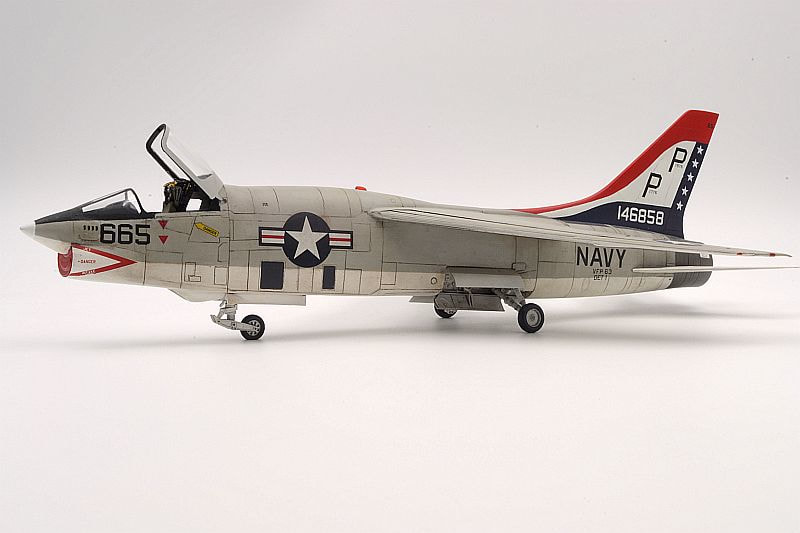
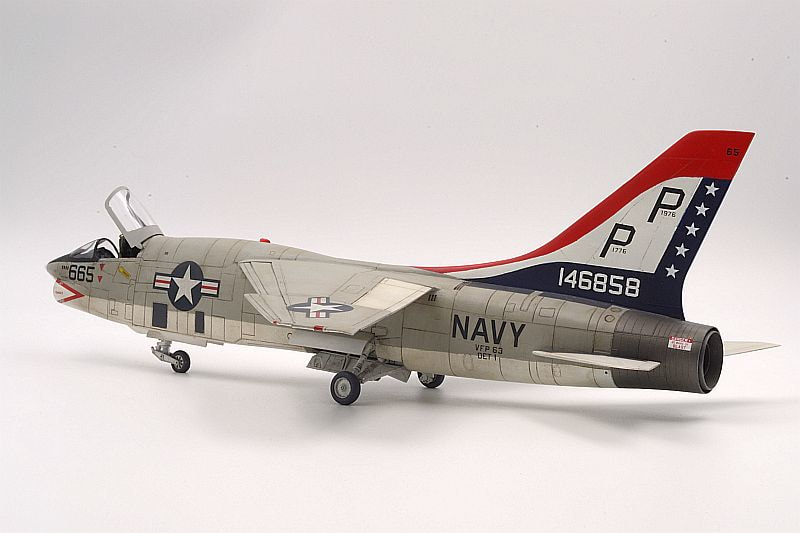
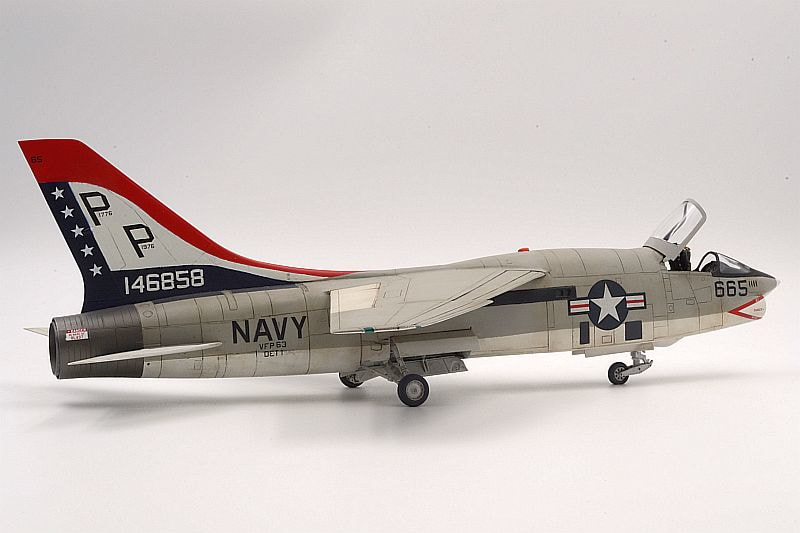
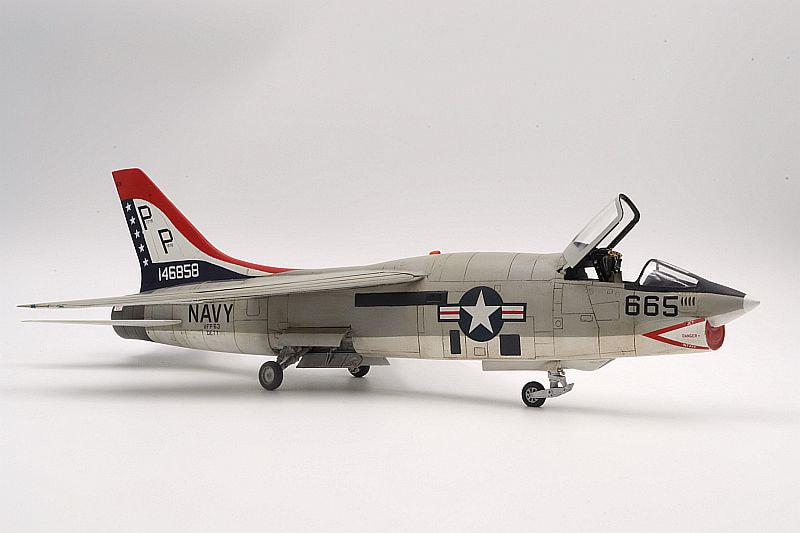
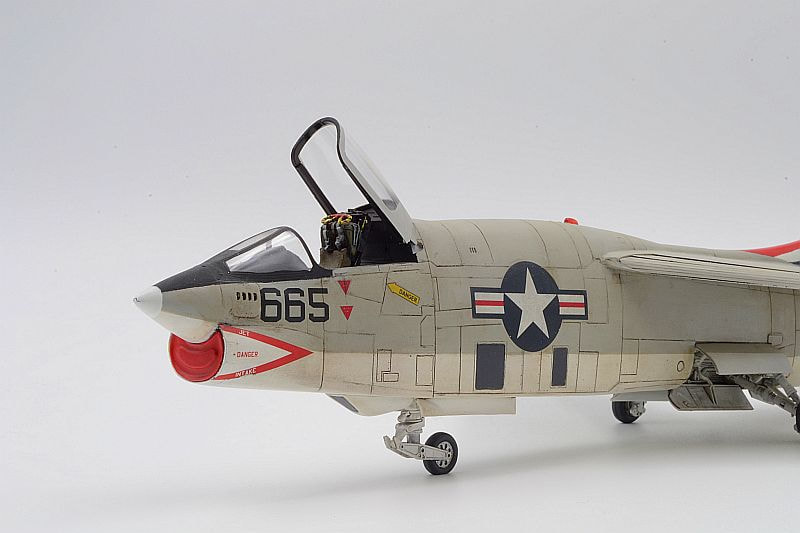
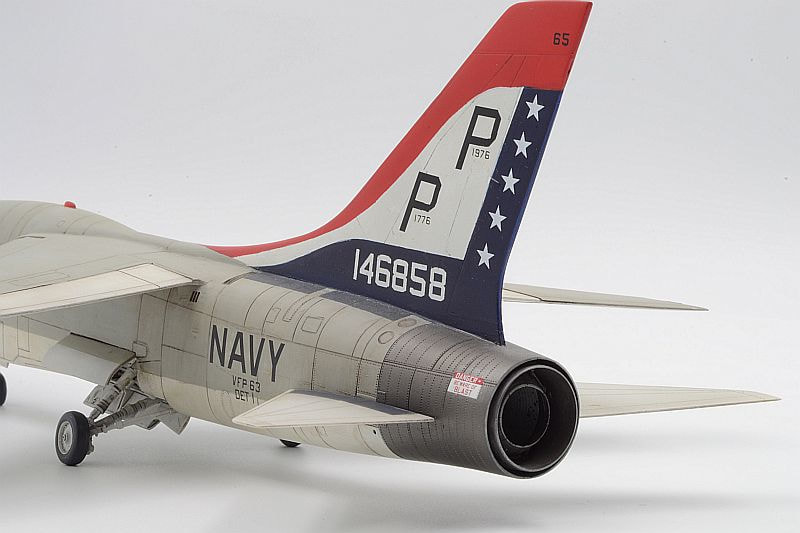
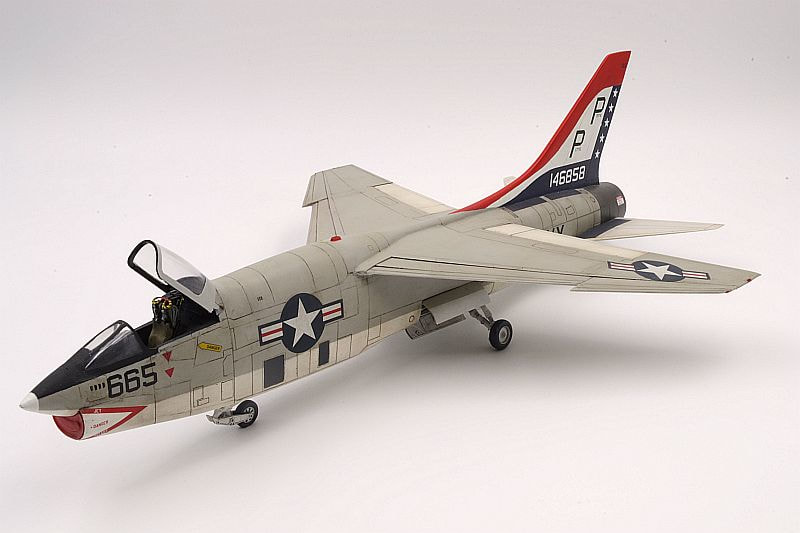
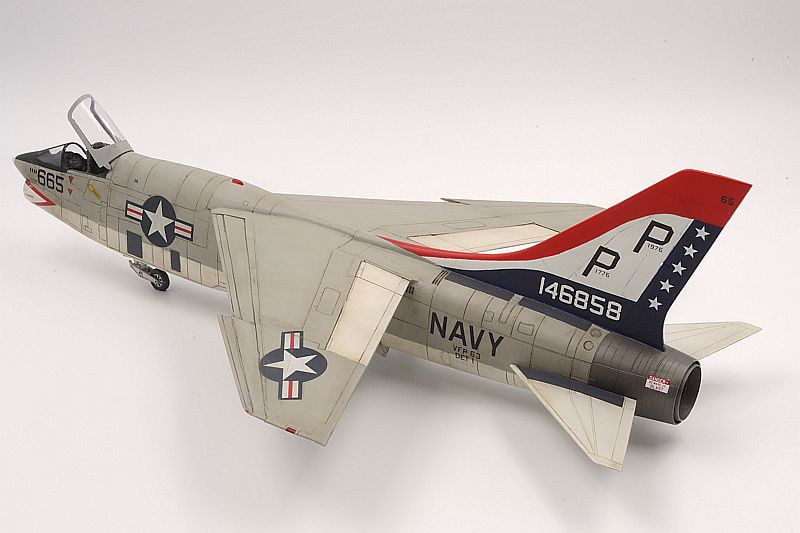
I’m beginning to sell off my collection of models, so I’m taking nicer photos. It’s been a long while since I’ve posted this originally, so I thought I’d repost to show the better photos. This is Hasegawa’s 1/48 F-8 with the RVHP conversion. I used the Steel Beach intake plug because, well, I hate doing intakes. It’s painted with Aclad White Primer and then MM Acryl Light Gull Gray and Semi Gloss White. Markings were a mix of paint and the spares box.
AHHHHHHHH!!! Say it ain’t so, Joe!! Why are you selling these beautiful builds, Darren?? How could you even stand to part with any of them? They’re gorgeous!! I hope all is well, and that nothing adverse is causing you to sell your awesome collection of builds.
If I may ask, how did you come to build this one without the ventral fins? I’m certainly not criticizing, and I know that every modeler builds to a different level of authenticity, but this a/c was an RF-8G. As built, that would be an RF-8A. This was actually kind of a strange one…as these were fitted with afterburner cooling scoops on the titanium section as part of the rebuild to -G. But this plane did not have them. Found a photo from 1976, painted exactly as your model, and it had the fins but no scoops. Found another photo from its previous livery in 1970 and it did not have the scoops then either.
I believe it’s still around today. If memory serves, it was a gate guard at MCAS El Toro, and last I remember the plane was being trucked to Alameda, and was supposed to be restored for display on the USS Hornet. I’m going to check with some guys who are involved with that bird, and someone might be interested in buying the model to put on display. As soon as I hear anything, I’ll try to put them in touch with you.
I originally built this as an RF-8A off the Enterprise as part of an air wing build I was doing. When I started my Bicentennial builds, I couldn’t find another RVHP conversion, so I repainted the one I had done. I think I just overlooked the strakes. I’ll blame it on ignorance of the subject. I may see if I can scrounge up some strakes and put them on.
Joe Baugher has it at Flying Leathernecks Museum at Miramar. He doesn’t denote it as being converted to an RF-8G. I will have to ask a friend of mine about it tomorrow who was a G model plane captain on the Oriskany and the Midway 1970-74.
This a/c was converted into a -G model around 1968, but for some reason, not all the way. This one did not have the afterburner cooling scoops installed–at least, it did not until much later. Here’s a photo of 146858 in flight, from 1970:
This was before she wore the bicentennial style paint. Here’s a shot of her in the same paint scheme as the model was done in, has the fins but no scoops:
Now, here’s where it gets a little strange. An RF-8G ended up on display at MCAS El Toro in the mid=80s. It carried 146858 on the paint job. This is an RF-8G for certain, and this one even has the cooling scoops. Here’s a photo:
Joe Baugher does show that 146858 was at El Toro, and then went to Flying Leathernecks, so chances are good that this is the correct plane. Somewhere along the way, possibly after the plane was pulled from service in 1982, someone stuck the cooling scoops on it. No -A models were built with the fins as best I can recall. Also, the -A model had a sabre-type fuel drain installed, port side, right where the ventral fin actually mounted on later models.
My plane captain modeler friend said that his G models on the Oriskany and the Midway never had the scoops 70-73. I think I will try and get Kiwi Resins 1/48 G conversion kit, and do the Midway’s USAF exchange pilot’s bird.
Here is supposedly 146858 at the Museum showing the scoops:
Thanks for the great info. If you build larger scale models, Fisher Models has come out with an absolutely gorgeous looking conversion to turn the Trumpeter 1/32 F-8E into either an RF-8A or an RF-8G…just learned about this myself and this is the only model I want to buy right now. It looks to be VERY well done and it has all the parts you would need, even the multiple “lumps and bumps” to do any vertical tail configuration the plane ever came with. There were several options for different antennas and bulges on the vertical tail of Crusaders, and all are included. Zotz also came out with a decal sheet for the RF-8G, with 6 options on it. Gonna be a bit pricey overall with the Trumpy kit and this, but man I cannot wait to see it on my workbench…
Historic Note: An RF-8 was flown from CA to NY in record breaking time back in the 1950s (1957 IIR). The pilot was awarded the Thompson Trophy. The USMC pilot was named John Glenn.
Ah, yes, Project Bullet. Supposed to have been a fighter and a photo-bird, but technical difficulties and all, so Glenn completed the flight solo. The aircraft he flew was later converted to an RF-8G, and was destroyed in a landing accident in the Tonkin Gulf, 1972. Somewhere along the way, a small plaque was attached to the side of the jet to commemorate Glenn’s flight, and over the years, some pilots who flew that a/c would send letters to Glenn to let him know that they had flown “his” jet.
Here’s another historic note…the Crusader was considered a really “hot” aircraft…meaning, only the best pilots could handle her. The mishap rate for this jet became a sort of perverse mark of pride for Crusader pilots. The Navy, in total, bought 1,266 Crusaders of all variants. Crusader pilots experienced 1,106 “major” accidents in them. In other words, the vast majority of the entire Crusader fleet was crashed one way or another…
The overall accident rate for F-8s was 46.70 per 100,000 flight hours. Some numbers for comparison–
A-4 Skyhawk, 23.36
F-4 Phantom, 20.17
F-14 Tomcat, 9.32
Flying Crusaders was definitely not for the weak at heart! The RF-8 lasted longer in the fleet, fighters were retired completely by 1976 but the photo birds stayed on for another 9-10 years. A total of 144 RF-8s were built. When the last one was flown to AMARC for storage, only 23 of those 144 were still in one piece. That’s one crazy record!
John Glenn had an office on the Ohio State U campus and I had an affiliation with the University and had a few wonderful occasions to talk to John Glenn. He mentioned those letters and still had them. He had a picture of an F9F5 that was autographed by his Ground crew in Korea. It was addressed to “Old Iron A$$”. He regularly came back with his aircraft full of flack holes. As a former ground pounder I find John Glenns positiuon that the most important mission that the Marine Air flies is the support of the “mud Marines” (guys on the ground). I appreciate that.
The record breaking flight got John Glenn a lot of publicity and that got him on the TV Game show “The $64000 question”, which he won, and that I believe got him selected for the Space program. And the rest is as they say HISTORY.
Lastly, and again, that is a beautiful RF-8. I have been trying to find one of those conversion kits without any luck.
John Glenn’s RF-8A/G was BuNo 144608 which was on the Oriskany in December, 1972. I will have to ask my plane captain friend if it was one of his planes when he was on the Oriskany earlier. I can check his Oriskany cruise book.
My understanding is that a plane captain was assigned to one aircraft at a time. Plane Captain is Navy speak for “crew chief”. My dad was a plane captain on an F-8D Crusader in 1967, while with VF-13. Incidentally, “his” plane was lost to a ramp strike, which is when the plane comes in too low or shallow and actually hits the after end of the ship. The plane hit the ramp, went into the water and was lost that way. Pilot thankfully did eject, and was picked up by the plane guard destroyer. This is similar to what happened to 144608.
I believe this is what 144608’s markings were when it was lost–look for #26 on that page:
Hehhehheh! Know whatcha mean. I told both my sons that I couldn’t afford to send them to college (at the time, I really couldn’t), and that they would need to join the military to get some college money. They both joined, and they both got their college money through their VA benefits. Most state National Guards have a good offer for college, too, and you only have to serve one weekend a month, and two weeks out of the year. Pays for an entire bachelor’s degree.
If the old memory serves me correctly the RF-8s played an important roll in the Cuban missle crisis in 1962, along with the U-2s. She’s a great old bird and again a great model.
 I may see if I can scrounge up some strakes and put them on.