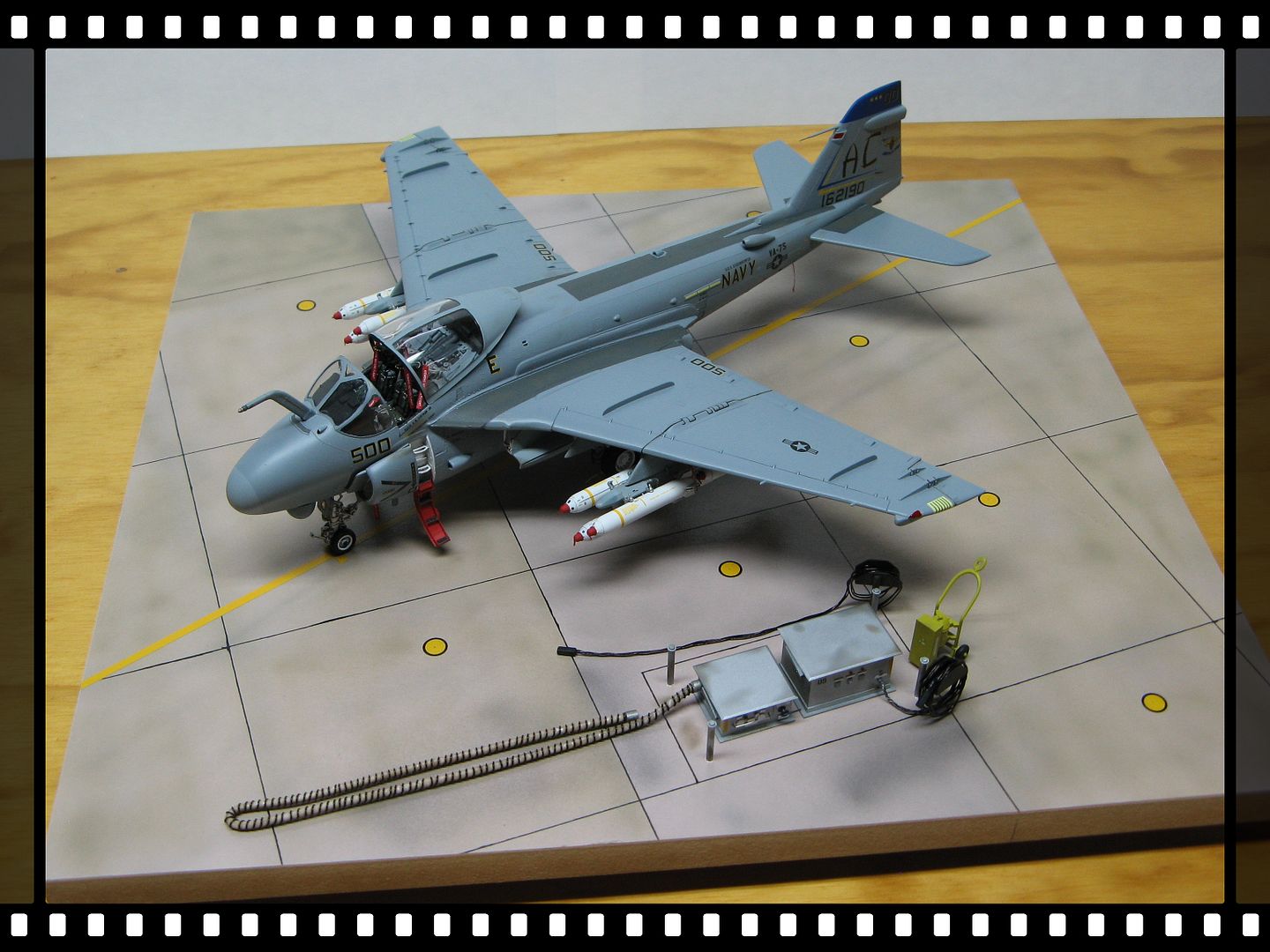
OK everyone, my F-111 is on the shelf, and I’m back at it with the Intruders. I can’t believe that it’s been almost four months since my last update!
I’ve been picking at plastic from both kits, but this update is going to focus on the Revell kit because it’s the one I’ve made the most progress on. When I last left you, I had to think of a plan to get the hook bay and belly insert installed. I’d heard that those two parts could be a challenge to install cleanly, so I wanted to spend some time on getting them right. Things were made more difficult when I discovered that the fuselage halves were a little warped.


So what I decided to do was glue in the cockpit assembly…


…and cement the forward fuselage around the radome to the forward edge of the nose gear bay. Then glued the tail from the aft end of the hook bay to the top of the vertical stab. I decided to leave the spine and the small section between the belly and hook inserts unglued. After dropping in the hook insert, I used a very thin metal ruler to press down through the unglued spine to push and hold the insert in place. With the hook bay pressed and held into place by the ruler, I ran a bead of liquid glue along the mating surfaces to secure it in place. Then I did the same with the belly insert. After the hook and belly inserts were successfully, and rather cleanly, installed, I cemented the spine closed. I think my approach got me some pretty tidy results.


As you can probably see, I still needed a little filler but nothing major.
After the fuselage was closed up, I glued on the canopy.

Unfortunately, my work resulted in a tiny boo-boo. Some liquid glue wicked between the canopy glass and the instrument shroud, resulting in a mar the extended slightly higher than the canopy framing. Most of the error will be hidden by the painted canopy frame, but some would still be visible. So, in an effort to hide it, I figured I’d place a “chart” in the area to help disguise it.
I have an old Verlinden accessory depicting maps and charts in 1/35. I don’t even know why I have it, since I build almost exclusively in 1/48. Anyway, I found something that I could use, and cut out a small rectangular section. My plan was to place it between the canopy and shroud, as if the BN had left it there. It was printed on cardstock and was too thick to use straight away, so I separated the paper into some thinner layers.

After carefully “thinning” the chart, I dropped into place.

Besides helping to hide my mistake, I think it adds a little visual interest to the cockpit.
While the glue was drying on the fuselage bits and bobs, I turned my attention to the wings. I got them assembled but noticed a couple of areas that needed attention. First, when dryfitted to the wing, I noticed a gap at the aft end where the wing structure didn’t extend to meet the fuselage above the exhaust shourds. So, I added a couple of small pieces of styrene to bridge the gaps.


I’ll be able to use a little putty and sanding to blend things together.
Secondly, I noticed that there is no engine assembly, and the engine opening extends all the way into the wing and fuselage interiors.


So to make things a little less see through, I cut up a fuel tank from my U-2 build.

Then I slipped the cones into the engine openings from the inside to blank out the open spaces.


It’s not a perfect solution, but I think it works better than leaving the gaping maws visible to the public.
Here’s what things look like with the wings dryfitted into place.

So, that’s where things with the Intruders stand. At this point, I’m not sure if I’ll move my attention to the HB kit or keep on keepin’ on with the Revell. We’ll see where the wind takes me.
Of course, comments, questions, and criticisms are always welcome. Feel free to drop your two cents into the bucket on your way out. Thanks for stopping by and having a look-see. Smell ya later!
Cheers!
-O