Hi Folks, this is a topic that has come up a few times in the last 20 years on the FSM Forum without a lot of real science behind the answers. To this end, I thought I’d share the results of some of my practical experimentation wtih Vallejo Game Colour.
Can’t you just use the premixed Airbrush and Wash range?
I’ll preface this by saying that Vallejo Game Air and Vallejo Game Colour Washes are a thing, allowing out-of-the-bottle viscosities and pigment balance for airbrushing and washing respectively and you can avoid a lot of headaches by going down that path. This is especially true if you are painting an army or some other high-volume application that requires consistency of finish across the workpiece. As I’m only doing the miniatures casually, I don’t want to collect multiple lines of paint. Avoiding the price of convenience means learning to use Vallejo’s mediums.
A Caveat - Vallejo Game Colour vs Vallejo Model Colour
These learnings may not be able to be directly applied to Vallejo Model Colour as they have slightly different formulations. Game Colour is slightly more fluid than Model Colour, and has a resin-based formulation intended to make the finish more resistant to damage during frequent handling and transport for tabletop wargaming miniatures. This possibly contributes to the amount of “bad advice” out there, which might actually be perfectly suitable to the colour range being used by the person giving the advice. By all means try these ratios if you’re using Vallejo Model Colour, but do so knowing that I have not tested them on Model Colour.
An important note on measurements
Vallejo products come in dropper bottles, so the ratios described relate to the number of drops of product rather than a volumetric measure. It is important to note that thinners are unironically thinner than paint, so have a smaller volume per droplet. Even if we wanted to express the ratios by empirical volume, getting the products out of the dropper bottles with a syringe would entirely defeat the purpose and convenience of dropper bottles.
Water-Based, but not Water-Friendly
VGC’s are designed to be thinned with water and are intended to be used in conjunction with a wet palette, but I found that anything more than a 1:2 Paint-Water ratio caused separation of the paint structure. This meant washes intended to shade the crevices will instead highlight them as the matting medium separates from the pigments leaving the white stain you see below…
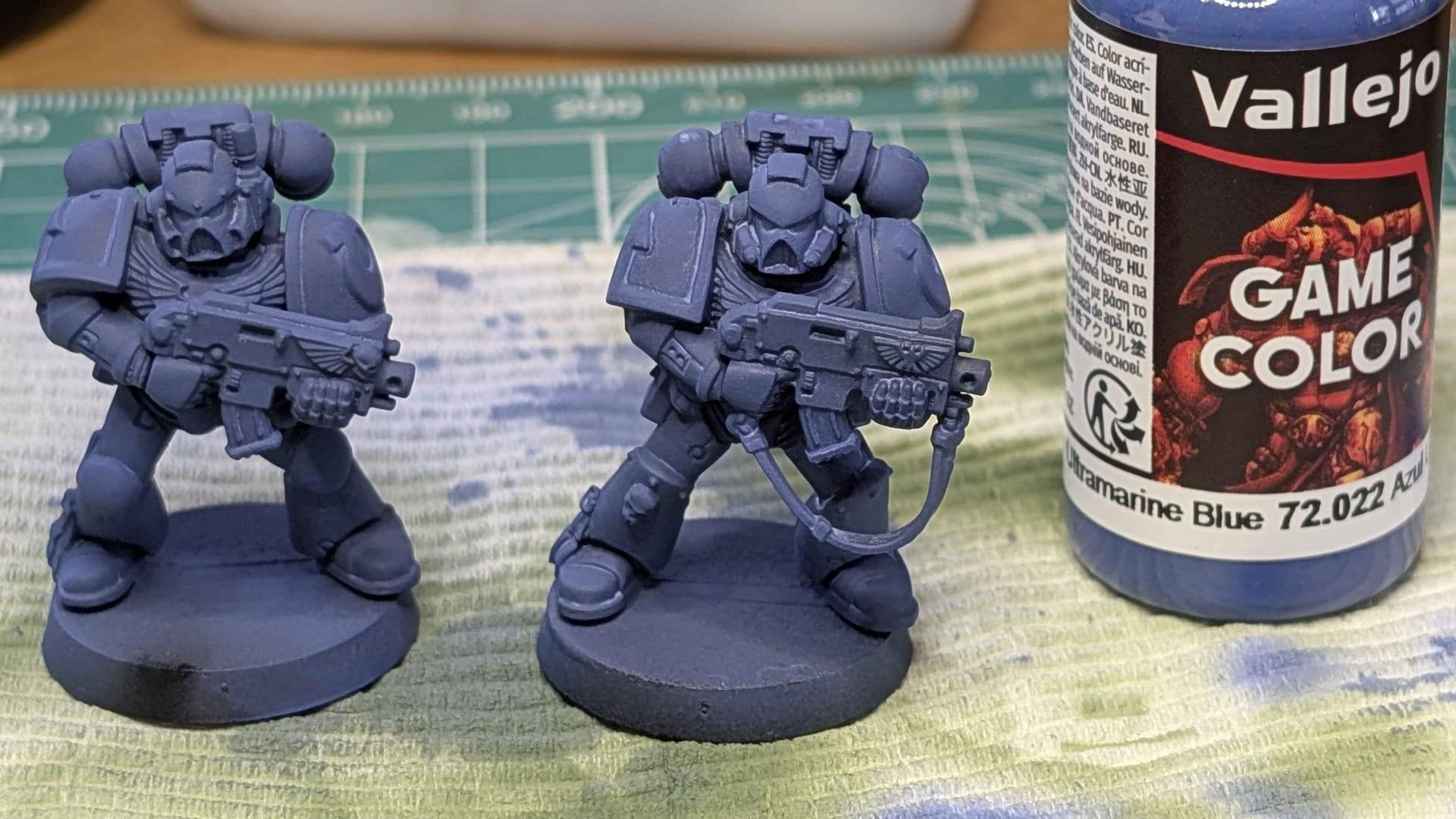
In this case, we had attempted to thin 72.022 Ultramarine Blue to a similar consistency with which we would airbrush Tamiya acrylics, only using water. Any pooling in crevices resulted in near immediate separation of the paint due to heavy dilution of the binder.
Using a wet palette and water over time you’ll probably get a feel for that saturation point, but I like working with thin paint. Rather than constantly living on the proverbial edge of paint stability, I want a bit of insurance that I’m not going to be bogged down in reworks. Fortunately Vallejo has a range of mediums available to help maintain paint structure and workability at a range of viscosities.
Airbrushing Game Colour without Game Air
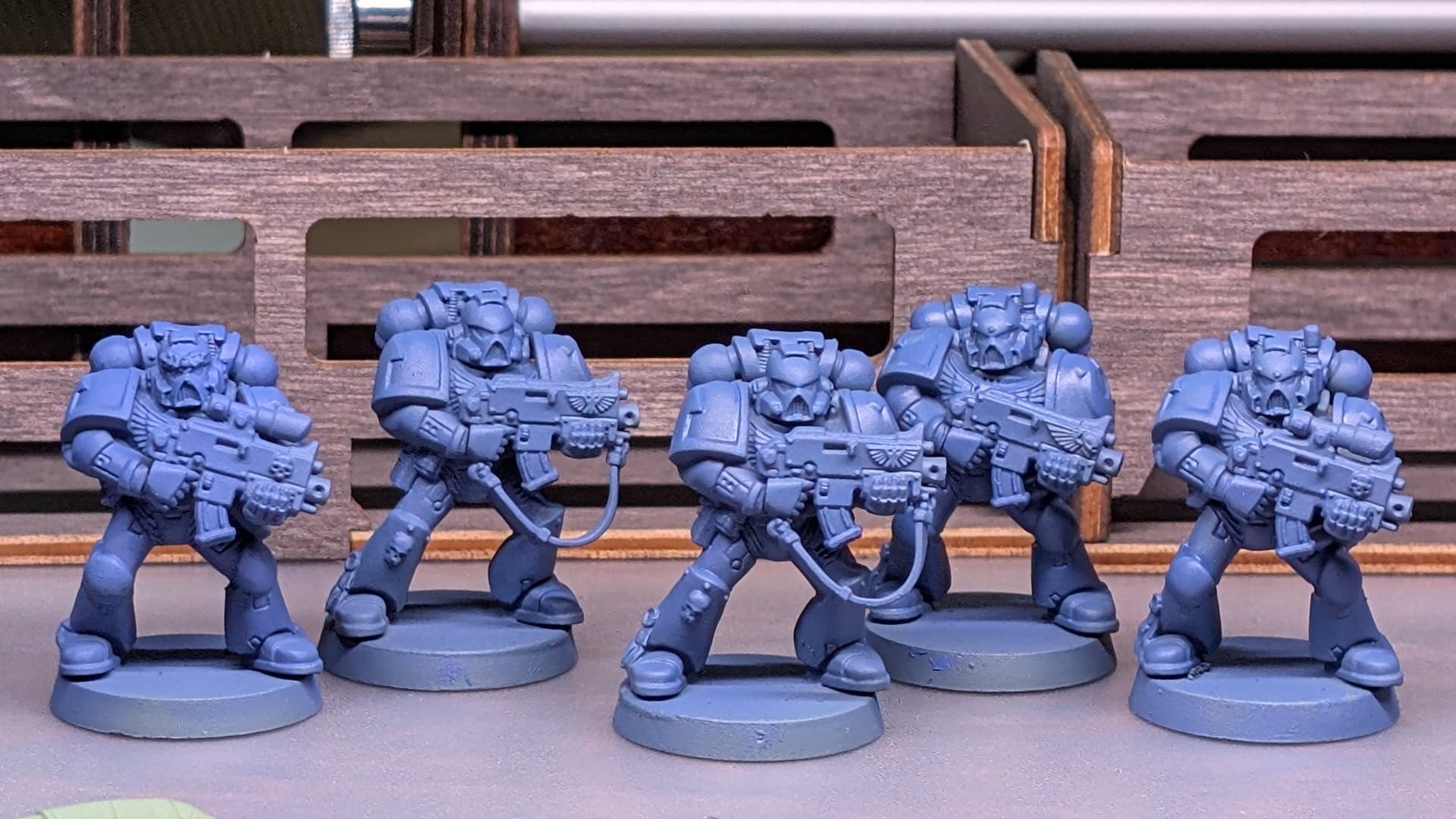
After some trial and error, we were able to get our airbrush to run Vallejo Game Colours properly with an even placement. We settled on this ratio:
1 part Flow Improver : 3 Parts Paint : 6 Parts Airbrush Thinner
Another important discovery is that these components need to be thoroughly mixed in a separate container before entering the airbrush. Unlike Tamiya acrylics, you can’t just dump thinner and paint in that order and then backflow air into the airbrush cup to mix everything. Trying that with VGC, you’re practically begging for a clog worthy of a full strip and clean.
Here’s our result to achieve a 72.022 Ultramarine Blue basecoat at the aforementioned ratio:
Washing Game Colour without Game Wash
Using VGC’s as a wash was a bit more complicated, and we approached this cautiously given our earlier experience with the paint separation. Again, some folks have reported great success just using a wet palette, but I like working with thin paint when I brush which puts me in a zone where that risk of paint separation is persistent. Working with a wet palette is also less about “the science” and more about “the vibe” so it’s hard to provide tangible guidance in that area.
Through trial and error, we adjusted the ratio of Paint (Vallejo 72.019 Night Blue) : Glaze Medium : Thinner until we were happy with the workability of the paint and way the pigment was sitting on the model
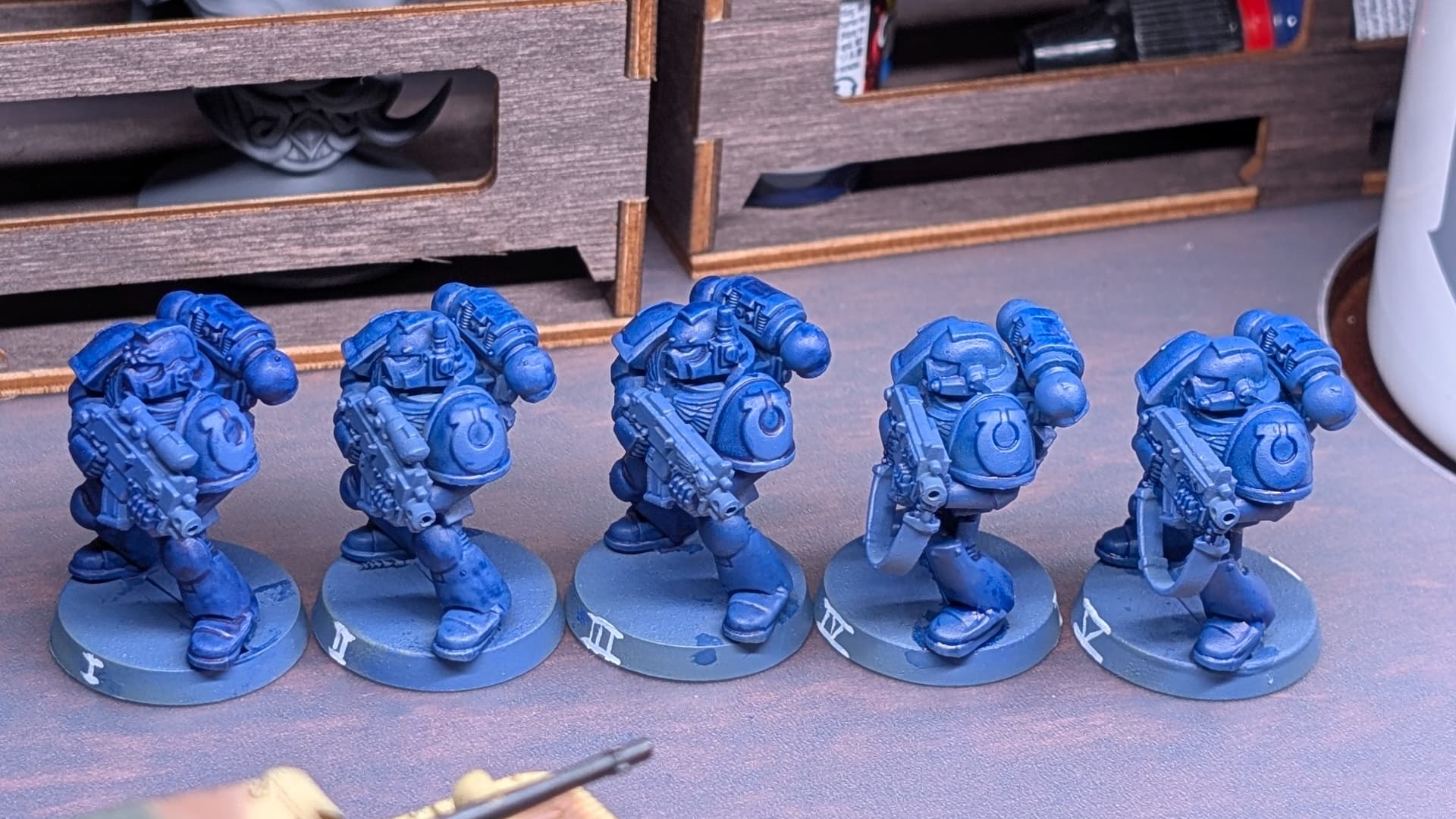
From Left to Right in a ratio of Night Blue : Glaze Medium : Thinner…
Marine I - 1:3:0 - Too viscous to use as a wash, pigment very heavy
Marine II - 1:5:0 - Pigment balance okay, but viscosity left a splotchy finish on smooth surface
Marine III - 1:2:2 - Better workability as wash, but crevices became heavily pigmented
Marine IV - 1:1:4 - Excellent workability but crevices weakly pigmented and paint separating
Marine V - 1:2:3 - Good workability as wash, crevices retain good amount of stable pigment
That extra bit of Glaze Medium made all the difference for Marine V, since the glaze medium provides the clear and colourless binder that prevents the paint from separating. In order to get a satisfactory product though, we needed that extra bit of thinner to space out the pigment compared to Marine III or the shade concentrating in our crevices becomes too intense.
In Defense of Glaze Medium
Unthinned Paint and Glaze Medium is the wrong mixture when we really want a wash in this application. But this sort of mix does have its uses. It essentially allows you to apply a product that pushes pigment into crevices without losing the control you get from the out-of-the-bottle viscosity. This quite desirable when you want to achieve the effect of a wash but confine it to a particular part, say if I want to shade the satchels our Ultramarines are carrying without layering up from dark-to-light the old-fashioned way. Washes on the other hand will tend to run wherever they please.
In Closing…
Again, were I to paint a whole Ultramarine Army, it would be more efficient to buy a dedicated airbrush or wash product and apply straight from the bottle. But painting with miniatures with VGC’s was only supposed to be a side hustle rather than an army-size commitment, so I’d rather learn to use the mediums correctly than operate several parallel lines of same-colour products
I hope this helps someone in the future who experienced the same first-time frustration with Vallejo Game Colour, supported by some backyard science and tangible results behind the multitude of anecdotes out there…