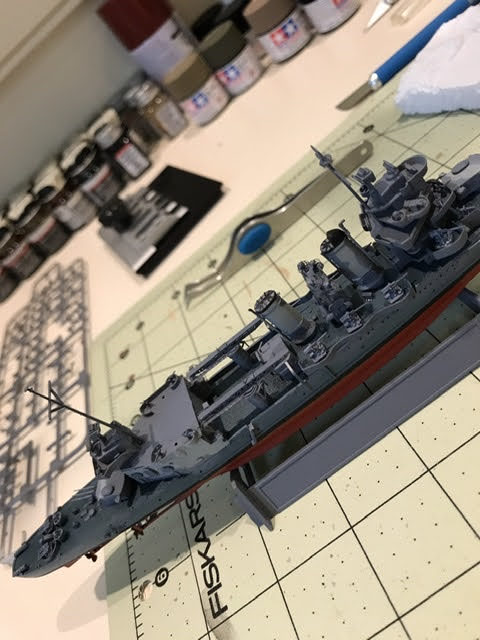
Trumpeter 05748 USS Quincy-CA39 1/700 scale General questions paint, etc

I haven’t built that model, only the bigger one. At the time I thought the bottom of the gray upper hull was about right for the top of the boot topping.

My own preference is to glue the halves together, fill and sand any gaps. Trumpeter ships made this way often have a little jog at the stem where the red part sticks forward a little. That has to be dealt with.

After I’ve primed and made sure the joint doesn’t show, I do the red/ gray/ black stripe bit.

And as I mentioned before, the stripe has level top and bottom edges and varies in width depending on the slope of the hull.

Looking at the dry fit you did of the two halves of the hull, I don’t think the stripe would go up into the gray part. The amount of armor belt above that line isn’t much, and the stripe should not be at the top of it.

Bill

yep, when i was dry fitting i noticed the stern poking out a little - something was off somewhere. i couldnt quite figure it out and i didnt want to start sanding too much to make it worse. But my allignment, front to back is off a smidge. For the black line im just gonna try to follow the paint diagram at the top of the thread. Its now glued and in the last pic. Tks!

Yeah, the hull halves, when split vertically almost never have anything to do with where the WL is–it’s usually at the half-depth of the mould, or wherever there’s no undercut on the mould.

If you can flind a side view plan, with some sort of scale, you ought to be able to find the WL versus a feature on the kit.

If memory serve (it may not) WWII USN used 6’ boot top for cruisers, which was 2’ below load waterline and 4’ above–cruisers often changed diplacement WL by 3 or 4 feet over a cruise.

With those values in hand, you go back to your reference plane and pencil (or scribe) the top and bottom lines, and that will sort the boot top out.

IIRC, “we” sorta decided that 12(mod) was Sea Blue on the hull, splotched with Ocean Gray, and the superstructure was Ocean Gray splotched with Haze Gray?

Were it me, my Order or Operations would be:
Boot top
Mask to bottom of boot top,
Hull red
Mask to top of boot top,

Shoot the deck blue down and mask it off.

Haze gray the superstructure verticals (angle up from below to help rptect the decks)
Mask the splotches of HG

Shoot the OG on superstructre and hull.

Mask the OG on the hull,
Shoot the Sea Blue on the hull.

Remove masks and retouch as required.

Now, I’d do that with very little assembled much, weapons, turrets, catapaults, fragile bits all not assembled --if only to smiplify masking. I would instal more “fixed” bits like gun directors, searchlights, etc. Unless they had a bunch of fragile PE, in which case it would be subassemblies that could get a coat of paint on their own.

Now, I tried to figure out the M12d on CL-52. She seemed to start the war with the scheme described above while in the Atlantic, but at some point the Captain started fooling around with hull painting ideas.

A lack of good photos (nothing like Wichita) makes this difficult, not to mention that a lot of the CL photos can be in dispute about which hull it was, where and when as there were so many of them.

I did find a forum dedicated to the discussion. Let’s just say they resorted to discussing BB-39s final colors when they were feeling especially Christian, otherwise…

So one side may have been 5-N from the boot halfway up, broken by a wave demarkation (chop) and 5-O above that. The other side the same with a wavy (swells) demarkation.

Tks CapnMac - so because ive already attached the shafts and props and screw guards any scribing and such is more difficult as i dont have a good way to hold in place w/o worrying about messing that stuff up. Gonna take the info you gave me and try best to mark and eyeball it this time w/o worrying about getting a percise exactemente specium… Live and learn - now i have a little better of order of operations for next time. So i have sea blue hull and haze gray splotches. I thought the topside was the same as the hull but looking again now, i think you may be right w/ the HG and OG. The shipcamelflouge site gives mention to the blue and grey being used and vice versa for hull but does no mention the 2 grays being used even though they do have an example of it on plate 19 i think.

As my father in law liked to say, We’ll see[:D]

Well, I was going off the one NavSource color photo, which shows splotches; the wavy pattern also has soem photo evidence, and makes for a good paint scheme.

Now, as to scribing, if you haven’t already, putting in the holes for the base you are mounting to would be timely. This is harder after the main deck is on.

Bill and Don both have some excellent examples of approaches for this. Some like epoxying a nut inside the hull, or you can put some bugle-head machine screws in and epoxy them to the inside of the hull. You can build up the attachment point with strip styrene or wod or what have you. You now have a fairly rigid index on the hull.

Bill will point out, quite correctly that this allows a temporary base to be attached, which can be clamped into a vise, or affixed to a building board with a perpendicular end on it the width of the beam, which allows laying the hull over on her beam without wobbling.

that temporary base also alows for lots of WL marking out, too, especially as it can be shimmed to whatever is required to get things level.

ok, got sidelined a little. but here it is so far. i hope it maches up with the superstructure. learing a lot here. Best when viewed at a distance[:)] Tks everyone!

getting close… This is where i am now. gonna do a few lifeboats tonight. the hanger section was a bugger - i guess i must have laid the deck a little too low as that section would lay flat on the deck.

so, it may be a little hard to tell from the pictures, but in the photo, the areas pointed to… What are they called and are the cooresponding areas in the directions backwards?

Those are the main battery gun directors. They are a combination of optical and radar systems.

The kit directions seem ok except note that for whatever reason both assemblies are drawn facing away from you, so the forward one points to the bow in the upper right, and the stern one points to the stern in the upper right.

As for the photo, be aware that generally these things got touched up by censors esp. in areas like these, so it’s a little hard to tell what’s what. It seems to me that the radar arrays on top of the optical houses are maybe missing.

Bill

Tks bill. Just noticed the difference. A little late as I’m not going to bust them off now. To me, the directions seem to have both backwards as it seems that the smaller part of the housing in the picture both point “inwards” not outwards… I also have PE kit 717 from toms modelworks. 3 parts it has are TDY jammer, TBS antenna and HFDF antenna. I couldn’t find where they belong or if applicable to this vessel. Do you by chance know where I can Ck.??

tks much.

To amplify on Bill the least bit, those batter directors pivot 360º so they can point right around the horizon.

The promary purpose of the directors was to locate targets for the big guns. They would also calculate the range to the target, the target’s course and bearing and speed. All of that data would be transmitted down to the Fire Control computers to be returned to the gun turrets as firing solutions (e.g. rotate turret to nnnº elevate guns to yyº elevation and powder charges need to be nn pounds for the range required.

Once engaged, the battery directors then observe fall of shot to improve the firing solution.

The radar units that started populating directors did so as they allowed some directionality to the radar, and for the existing trunking to fire control areas to run the wave guides down to the actual radar rooms.

Optical houses being different from battery gun directors? Also, I also have PE kit 717 from toms modelworks. 3 parts it has are TDY jammer, TBS antenna and HFDF antenna. I couldn’t find where they belong or if applicable to this vessel. Do you by chance know where I can Ck.??

Would anyone have a pic they might post is the scribes or jigs youve made to mark up the hull? Probably should have put this a new post. Sorry. Tks. Looking for ideas. Scribe the waterline.

If you mean the working base; yes when I can login again with my laptop.

If you mean the working base; yes when I can login again with my laptop.

So, after 4 days of no 'net (thanks at&t) and having to get logged back in, I can give 2¢ on this.

What I find effective is to get your mounting system installed. Unless I have a compelling reason not to (which is an essay unto itself) a pair of fasteners at 1/3 back from the bow, and a 1/3 ahead of the stern. Then set a bugle-headed machine bolt with washer into some epoxy through the bottom of the hull. I have found using bolts that are 3-5x the hull depth to be ideal. This can be snubbed up with a nut on the outside (put a dab of oil on the nut to keep the epoxy from gluing it on).

Let that set up good and strong.

Now, find some scrap lumber. In perfect world, that lumber would be a bit longer than the overall length of the hull, and the same width wide. Take another bit that same width and securly fasten it at one end or the other of the bas board so it makes an “L.”

Drill you base board to match your hull bolts. You want to sand the hull off the base board by some distance, that distanct can be set with brass or plastic tubing (I’ve used PVC) that you pinch between the board and the hull by using washers and nuts on the bottom of the board.

Now, that “L” leg can come in handy as you can lay the hull and board on its side.

Now, you go to your refernce materials. You will want a copy of those you can mark on. Lay out where your board aligns to the hull. I will then fuss the fit of the board with shims and washers until I can get the mounting base parallel to the waterline given in the reference. Adjust your baseboard refence line accordingly.

If your reference plan is not 1:1 to the model, I will put the conversions factor in bold ink somewhere handy. Measure the actual distances on the reference as accurately as possible (top of boot, bottom of boot, LWL, etc.) and label them on the reference. Now convert those to actual measurements on the model one at a time. (If your plans are 1:1, you can just use dividers.)

Ok, all that sorted, you just need to stand the hull on its base on a nice flat surface. Take your scribing tool–whatever that is–and shim/block it to the correct distance you need, and scribe in the line(s) you need on the hull.

Note that boot topping is fixed horizontally, not fixed in width, so in inverse plan view the boot top might be very wide.

So, yes, a ton of work. But, having that base gives you a lot of control on the hull. You can put it in an adjustable vise to leave your hands free. You can mash the vise down hard and not risk paint or details.

When you get to the finished base, you can decide on how to mount the things–tbes, blocks, finials, and those can be fit to the base and the hull. The embeded bolts give you the purchase to hold it down. Cut the bolts to fit the finished base and you’re all set.

Tks capn. That gives me a lot to go with. Appreciate It. Glad your up and runnin again.

Nice work!

You may be in luck with sorting out radar antennas for your kit. Since Quincy was lost in August, 1942, many of the kinds of radars and associated gear that were very common late in the war like the Mk.12/22 antennas and TDY jammers found in your cruiser PE set had not yet come into use at that time. Some had not even been invented yet. It is likely that Quincy’s radar fit was downright primitive and sparse. This should make for a much simpler effort with radar antennas.

Cheers!

Temporary base:

Scribing rig. This is shown after I had already marked the hull and applied tape, to illustrate the set up:

Masking at stern: