SPRAY PAINTS. Commercial or strictly model

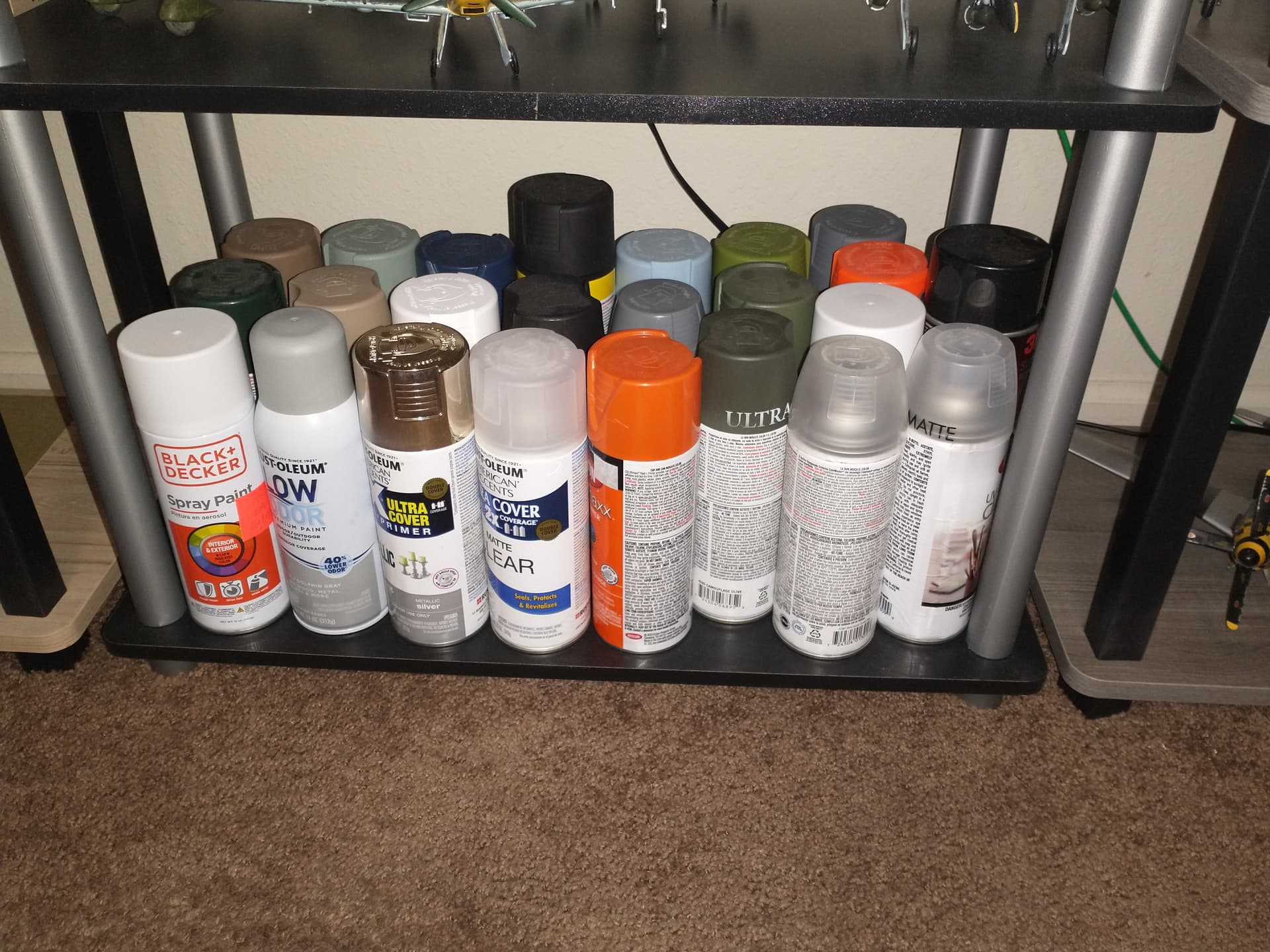
Hi everyone. It’s me again. The 61 year old rookie. I use commercial grade, Krylon or Rustoleum, spray paint to paint my models. One, because they don’t cost $10 to $15 for a small pint sized can, and you can find any color in the spectrum at Walmart, Lowes, Ace, Menards, Home Depot, my uncles out building, or from the sneaky guy who sells paint out of the back of his volkswagon.

The question I have concerning this spray paint, is it too much for the model to handle considering you will at some point add the decals…or Deckles as the europeans say. I watch the YouTube builds and every one of those things show a hand model painting with an air sprayer. It shows how nice and smooth he or she is lightly applying the perfectly thinned paint onto the surface as the plastic goes from molded green or gray to a beautiful shade of (you pick your favorite color).

One thing I noticed when I was finishing the Huey model the area near my skid mounting notches had turned white after I added the gorilla glue XL. I simply used a brush and sprayed me some paint onto a piece of well painted cardboard and fixed the issue. Do you recommend or steer clear of Commercial spray paints?

A lot of modelers use Krylon paints,of course with any spray can you need to be careful with buildup and runs.

1 Like

I’ve used all manner of “unofficial” spray paints on models. I really like using Rustoleum primers for most of my projects. One thing to be aware of is that I believe these hardware paints are a bit thicker than the ones specifically targeted for models.

Depending on the kit and how many coats you put on, you may start to loose detail. As with any spray can, it can be very easy to get runs or build up in the paint. I absolutely love the Tamiya sprays, but they are prohibited for sale in Canada now, Testors is a limited colour choice, other brands are difficult to source, so I’ve had to adapt a bit and I find that hardware paint can suit my needs.

1 Like

I started using the fusion brand when I noticed how well it painted over the basswood I was using to cover the deck of my model train track cleaning cars. It dried fast, great adhesion, easy to spray, but like a lot of commercial spray cans, if you don’t use it all, you can’t grab a used one off the shelf when you need it and paint something else. Even if they have half a can left, you can shake the can and the ball inside is clanging freely, and you spray and nothing comes out. I’ve tried to clean the opening, but it never seems to work.

2 Likes

Thanks to both of the replies. At least I know I’m not breaking any long standing modeling rules by using commercial paint. I usually prime with a light color primer because that makes painting with a brush later on easier for me because any dark color over a white color you can see where you missed a spot. Also, I’ve easily noticed “dots” when I have masked an area and covered too much.

2 Likes

Sounds like the compressed air has all leaked out of the can. I flip the cans upside down and spray for a few seconds to clear the nozzle before putting it away. This keeps a better seal on the air inside.

I’ve had partially used cans last 10+ years and multiple paint sessions this way.

2 Likes

Never used commercial spray paints. Mine’s all domestic!
As long as it’s says “safe for plastic”.

Just remember… light coats!

Gary

1 Like

I’m an ‘old hippie’ (66 in October). I know a lot of folks use ‘rattle cans’ for all manner of painting. Me? I hate that they pretty much ALL use VOCs as their propellants. It’s why many of those paints at a local store (like Wal-Mart) are locked behind a rack. That whole ‘sniffing glue and huffing paint’ concept hails back to my mid 1960’s entry into plastic model kits.

More importantly, to my view anyways, is that the level of ‘control’ you have with a spray can depends on distance from target. If you’re doing something at 1/24th scale or better, it’s not as much of a concern. If you’re just priming a model (or a lot of models) then, again, it’s about decent coverage at a reasonable distance.

My general dislike of using spray cans goes to pretty much all those things: VOCs (bad for environment, you and sometimes your model surfaces), hard to control the level of spray, overall, requires a fairly good, open space, lots of ventilation (and/or a mask) and if you don’t use it all now, hmm, you might as well forget about it later.

They ARE generally cheaper than the tiny pot/bottles that the model industry seems to prefer (I still have an old Testors bottle with a 15C stamp on it). In my stash of paints from yore, I have testors and Tamiya enamel paints. I still have some more than 25 years old that are still good.

I have now also claimed some newer acrylic paints, though have yet to test them out on anything – I’m really just getting started back into the hobby after more than those 25 years of inactivity. I snagged a decent airbrush setup (compressor, two airbrushes and one spray gun, hose and connectors) for $65 US. I’m just getting to the point of prepping up my own DIY spray booth for all that.

Spray cans really can lay down some paint and if you’re practiced enough, you can do a pretty standout job of application. Personally, that’s too much strain on my finger (the one holding the nozzle button) and the cans are not what I would call hand friendly when it comes to the level of fine detail I prefer.

As to a ‘rule’ I haven’t heard of any. I’ve been a ‘low budget’ and DIY guy since I was turning in Coke Bottles for 3C and 5C for the big ones and beyond. So finding a way to do what it is you are intending has been my ‘normal’ for all this time. If spray cans work for you, more power to you, I say. This hobby has only one real rule – do what’s right for you.

I prefer making dioramas and usually worked at 1/72nd and 1/35th scales. I use the 1/72nd for my ‘grand scenes’ and the 1/35th for smaller, more personal vignettes. Since I got the airbrush setup, I am very much looking forward to seeing how much practice I will need to ‘get good,’ although I cannot imagine just dumping all my brushes, even if I do. Still, I am fairly certain that I won’t even be using spray cans even just for priming.

That ‘old hippie’ in me can only think about the harm to the environment they do. :slight_smile:

2 Likes

My descriptive gene was not formed correctly due to lack of attendance at the school of reality. Commercial to me means sold at a store like Walmart and other hardware/household/grocery and supply stores. Domestic is a better description. You are correct sir, I am using domestic common spray paints sold at any hardware store. I guess the Tamyia and Testors and Vallejo are all specialty paints? Just curious.

2 Likes

“I guess the Tamyia and Testors and Vallejo are all specialty paints?”

Yes, sir. Vallejo is an old, established brand that were up on the shelves at my local hobby store (you know the kind, plastic model kits, science kits, rocketry, TRAINS and all manner of books on decals, paint schemes and wooden ship building kits) alongside Testors. Then Tamiya came along (late '60’s, early '70’s).

Those are known for being enamel based paints (requiring actual paint thinner to thin them out and clean brushes) and are definitely manufactured FOR hobby modeling. They have, from my perspective, gotten crazy expensive, but you do what you do and so you pay.

Newer Army Painter, Citadel and AK interactive paints are acrylic based and can be thinned with their brand of thinner (usually a water/alcohol mixture) and, while they do have lines geared towards plastic model kits, they are primarily aimed at Warhammer 40,000, D&D, Gunpla, Gundam and Mecha miniatures.

All this is farily fresh in my head as I have been spending a lot of extra time reading up and watching YT videos on the new models, paints, airbrushes, terrain and diorama building techniques as I initiate getting back into the hobby.

If you find yourself curious (*that’s a plural general ‘yourself’ there) I would highly recommend looking up Barbatos Rex on YT. He does some of the best and most comprehensive paint testing via airbrush mostly and also does some hand brushing to test out paints. He prefers enamel based paints (old school), but does a lot of acrylic paints as well. He’s very informative and for me, it has also been very educational just watching him use and test a plethora of airbrushes and tools as well.

1 Like

I pretty much always use a spray can for primer coats and generally prime the kit right on the sprues. As for final painting, I do use an airbrush or regular brush depending on the piece and detail. I used to use Testors ‘Dullcoat’ which prior to whoever they sold their line to was a great “dead flat” finish. You just had to watch that it didn’t go on too thick or you didn’t spray too many coats because it did tend to yellow. Since they changed the formula it’s not nearly as good.

1 Like

I hate firing up the airbrush for priming so I use Tamiya spray can primer, just dusting it on lightly,works for me

1 Like

In the entire history of me building models, I’ve only ever used the TAMIYA spray can primers. And probably still will in the future.
As for spray cans of colored paint, either Tamiya and/or Vallejo. I haven’t tried Revell yet.

@Chopper_Chief Sorry, I was mostly kidding. I forgot to put a (JK) or a :joy: after that comment.
They’re commercial paints sold for domestic use. I use them as long as they say for “use on plastic” along with other surfaces. They won’t eat the plastic and leave you with a melted mess!
Really, they’re fine as long as you spray lightly. May take more than one coat, but generally they’re okay to use. I use Tamiya as long as they have the correct color.

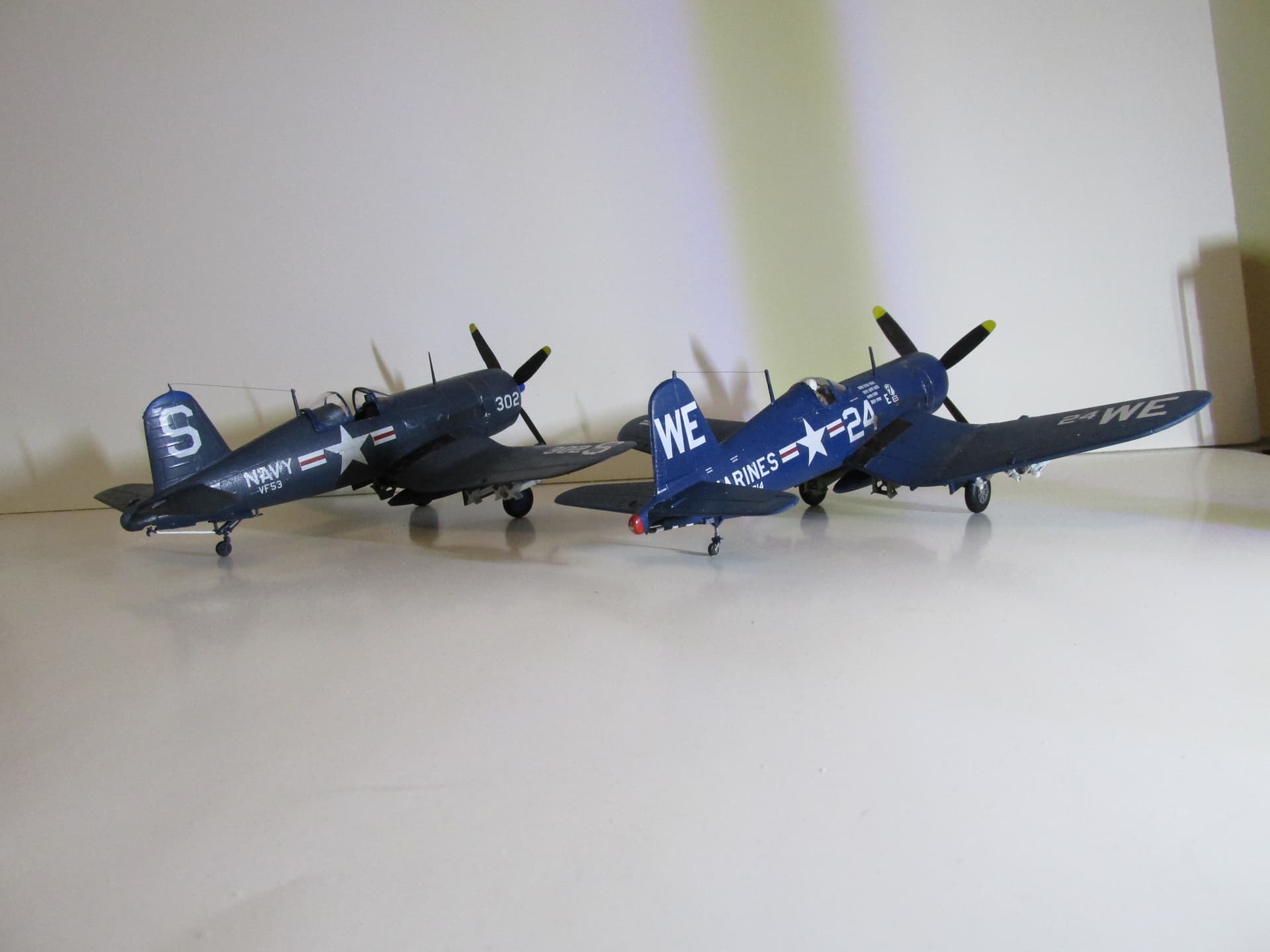
For instance, I used two paints on these Corsairs.

One was a Tamiya “Navy Blue” while the other was Krylon “Matte Ink Blue”. The Krylon is lighter, but does a good imitation of the correct color.

Gary

1 Like

Nice job. 214th Black Sheep. You’ll find that I am as easy going as they make them. Nothing really phases me. I have no problem admitting I don’t know something and the way I usually learn something is by showing my not so up to speed side. I’m about to attempt, attempt being the operative word in this sentence, to build a UH-1Y Venom Marine Huey.

Confusing doesn’t begin to describe the instructions. Option after option, small case letters with circles around them that the instructions didn’t bother to define what they mean. 8 different sprues full of parts. But parts that are pristine and look like parts, not cartoon versions of them. Instead of “well, it needs seats, here, this is a seat.” Academy did their homework and crafted as true a seat as plastic and size would allow. Not a lot of cleaning I can see. Parts easily cut a way from the sprues. But options. Every step comes to a door number 1 or 2 or 3. As for painting, everyone who replies has answered my question. Yes John, you can use domestic home project spray paint to paint your models. Now if I can just get some of these special glues people like to use to actually stick and hold. Gorilla super glue XL likes to leave a foggy mark on your paint.

2 Likes

Well, Academy is not known for their superb models, so good luck with the UH-1Y! Personally, I just am glad to get one together as I am not the best modeler. Spray paint or best quality airbrush, I would find some way to screw it up. Still, they say practice makes perfect (unless you want to perfect bad).

Gary

For gluing plastic to plasic, stick to specifically made model glues. Tamiya’s extra thin liquid is probably the best and easy to use. Simply touch the wet brush to the two parts and capillary actions will draw it in between them. For PE to plastic, use superglue. For clear parts, PVA glue is best as it will not fog nor mar them, and can be rewet and wiped off if it smears.

Actually, their newer models are very good, I would say better than Tamiya’s newest kits. Their older kits were pretty bad, but they have greately improved. Thier UH-1Y is a very nice kit.

Gary I very much appreciate your advice and your honesty. That’s why I joined this site. I apologize to anyone who read my prior post. I misunderstood the English fella when he went over the sprue Dx2. I am also aware that B had some parts you’d need to finish the 1H version. I failed to mention that but had already posted when I remembered. As for the model having extra parts, that’s not a problem, I just like to know going in there are things I need to know going in.

Oh, before I forget, and I already had but remembered, thanks for the help with the road signs. Information is power. I just wish my breaker box wasn’t wired wrong.

I watched the video where the expert assembled the UH-1Y, and he taught me how to use Tamyia’s thin glue. I have some of that and will use it myself. A friend of mine has been helping his son put together fantasy figures for a world called Warhammer. He put me on to Citadel plastic model glue. Great system as far as administration. Small bottle, ergonomic shape, basically a hypodermic needle minus the sharp part as a means of application. Wasn’t fond of the cap removal that protects the needle. I figured it needed to be pulled upward, but when I did, the needle came out of the glue bottle. But, it went back into the bottle too. When I used it, I like to have never got the glue to the tip of the needle, but when I did, it kept coming. Same thing happened with that watch glue I wanted to use for windows. Once the glue started, it didn’t want to stop. But, if you can manage the needle administration method, it is great for precise application. The problem with the glue is that it is that type of glue that dries fast, but hardens slow. I found out how that is a problem when I glued my tail rotor to the drive shaft. I thought it was on, only to watch it succumb to gravity and fall off. So, I got the super glue and put it back on and now it doesn’t spin. But it doesn’t fall off either.

Everyone told me about Elmer’s being a good window glue to prevent fogging. I heard of canopy glue from Evergreen. It’s basically Elmer’s but dries fast, dries clear, and doesn’t fog. Daddy like.

To answer the public service announcement I just got concerning several replies to one topic. I like to answer the individual who replied, not all 4 individuals who replied. One may be replying about my concern over one thing, another may be answering a question I had two or three posts back, etc etc. But I’ll try.

I am going to just build and decal the Venom chopper. No paint, I need to figure out how to build it before I put clothes on it. I need the practice. I need to learn how to add decals. I need to learn how to read a complex set of instructions. I also like the detail and the craftsmanship and do not wish to screw up a beautiful aircraft model with lousy paint jobs.

And for future reference, and this is for anyone who reads this post,
Names John…John Spicer

1 Like