What paint are you using? Some are easier than others.
1 Like
Model Master until they run out then True North Precision paints all enamel and lacquer through the airbrush.
1 Like
I built the paint racks and exhaust hood
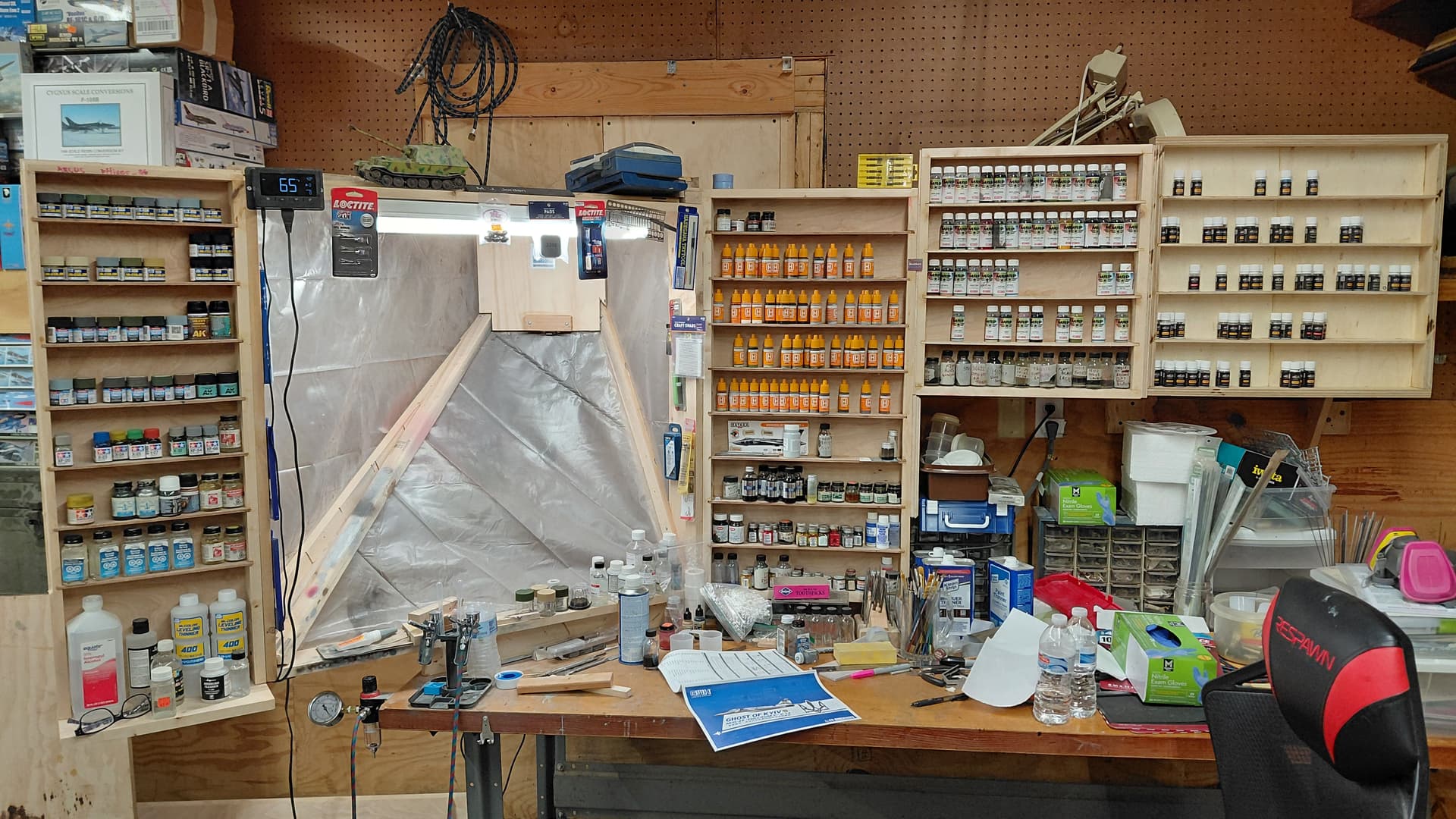
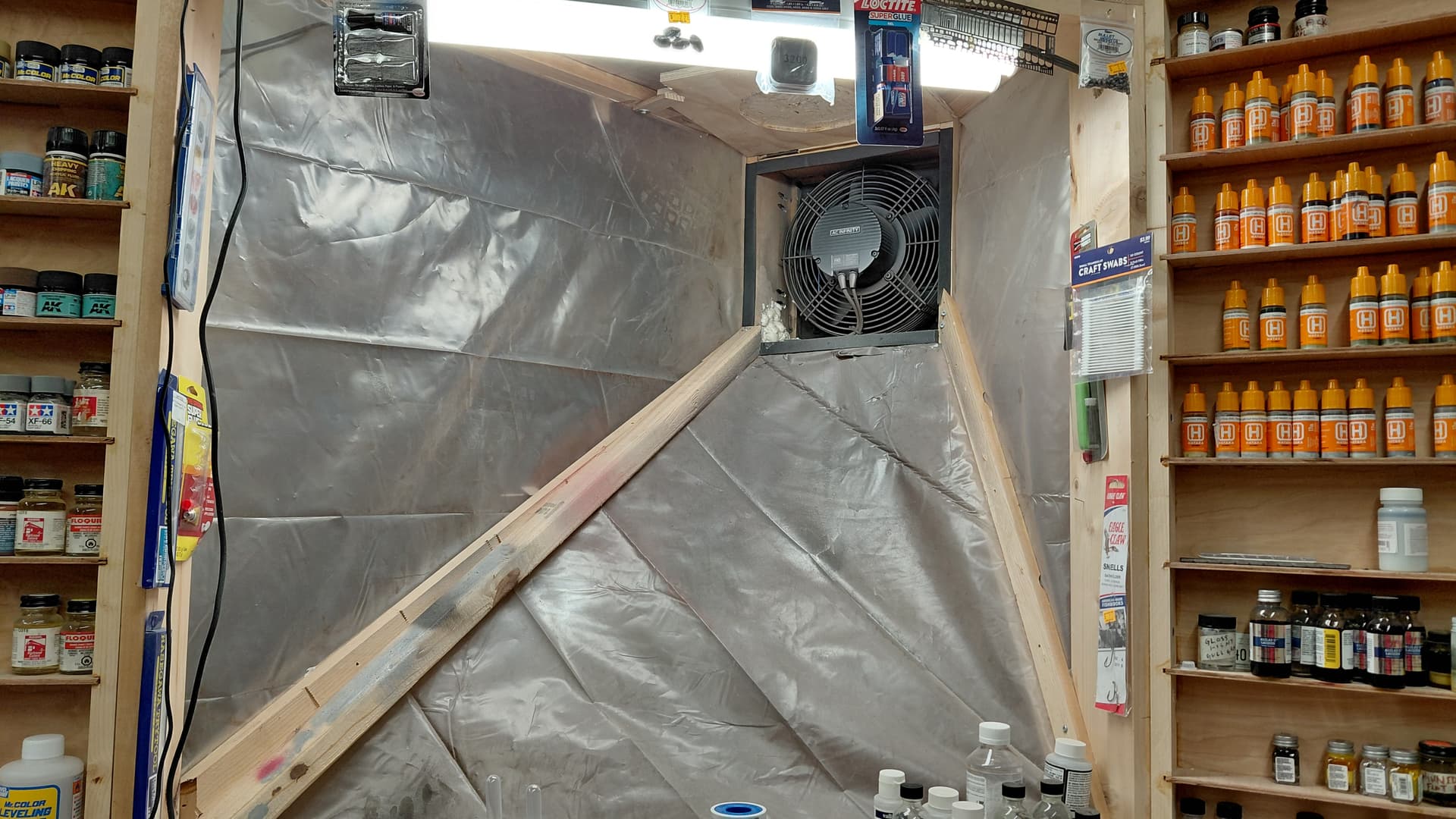
The back of the paint exhaust is covered by a door hinged at the top that covers a multi-speed brushless fan.
It vents outside the shop to a screened in box to keep critters and bugs out.
The tabletop I bought used and sealed it with polyurethane and the table legs came from my father. The paint racks are secured to the vent frame and back wall so they are pretty solid, I actually made them all with scrap wood and there are a few different sizes.
3 Likes
That is the Hasegawa F-4G it arrived at George A.F.B in 1979, I have my fingerprints on the actual aircraft.
1 Like
My favorite paints were pactra and gunze sanyo, unnnntil testers bought pactra and killed it.
Today my favorites are Hataka and MRP, and Tamiya enamels & lacquers.
For some reason I have a lot of issues with the rough grind of the model masters flat paint and even with a double action badger airbrush could barely get it through the airbrush.
1 Like
That’s an interesting booth design, Michael. I’m curious, did you build it like that to avoid any ducting? Typically you see the standard “box with ductwork to a fan,” this one took me a while looking at the full-size photo to realize what the design was!
1 Like
The fan has a digital controller.
So when spraying thinners to clean it I spray right into the fan throat at around 80 psi and the controller at 6, it really moves the air.
After cleaning the airbrush I drop the speed to 2 and vacate for a while.
I rarely apply more than three applications in a day because I use mainly lacquer based paints and I like to mask off areas only when dry.
For enamels it is usually 24 hrs between colors or the application of tape.
1 Like
Ok…I reread your question and…yes I did not want any duct work because it would intrude farther into the workspace and would not contribute to any efficiency to removing fumes. If anything would make it any more efficient, it would be a larger overhang but that would create shadows from the lighting.
The entire shop is lit from long diode high output strip lights, very bright.
1 Like
I have to say, that’s the most impressive spray booth set, I’ve ever seen!
Your father had great looking legs. Lol
Looking good. Airbrushing in a perishable skill. Practice often as you can.
1 Like
Great job, congrats!
An airbrush is an airbrush, the only one I really look down on was one that blew air over a cone to spatter paint like someone blowing paint through a straw.
Everything else is cake.
Personally I like the gravity feed cup with a cover because it’s easier to clean and maintain.
1 Like
I remember having a great deal of frustration painting silver enamel, no matter how long I waited to handle it, I always left fingerprints.
I just gave up natural on metal aircraft for YEARS !.
2 Likes
This isn’t true at all, in any sense really not just pertaining to air brushes. There are many quality and functionality differences in air brushes just like anything else. Some of the less expensive ones are very functional but to put them all in the same group is just silly. My very first airbrush was a master airbrush, actually I had three of them over the years, good starter product but once I made my way to an eclipse there is just no comparison in any aspect. The functionality, feel, manufacturing, longevity, product quality, ease of disassembly etc….isn’t even remotely close.
Not bashing the low end at all, they have their place.
2 Likes
Ok…single action, double action, side cups, bottle siphon, gravity feed, and needle sizes 1.5, 2.0, 3.0.
These are the variables that make the difference, the construction affects longevity and “feel” of the different airbrushes.
Weight has been a psychological marketing ploy from way back " weight = value" my first airbrush (which I still have and is still functional) is a Thayer & chandler model “E” which was chrome plated brass and heavy.
The Badgers I have are anodized aluminum and stainless.
The Iwata eclipse and Tamiya are chrome plated brass or steel , I’m not sure yet.
1 Like
Iwata airbrushes are triple nickel-plated brass. The needles are steel.
1 Like