Guys, Thank you for the help. I will accept any ideas on how to make damage look real.
The advantage I have is the wreck is covered in silt and sealife, so my detail will not have to be a precise as it would if I were building a damaged tank or aircraft. Learning how to though will be an advantage for future projects, so thank you for the suggestion to look for advice in the airplane and car forums
This will be a new experience to me and allow me to stretch my comfort zone. There are several areas of the bow and stern which still remain a mystery to me, and I will refer to to Yamato and Bismark which had similar torpedo damage.
TB,
I used to think turrets were attached, until the Bismark was found, then my paradigm was changed.
I think the first place to start, will be to research the deck layout and scratch the interior decks to insert into the bow and stern.
I’m probably late to your party, Steve, and I’ve managed to echo the replies to your thread in the planes section - but, have you taken a peek at some of the stuff posted to both the web and YouTube by modelers who have built dioramas of the Titanic? There’s a few out there depicting the ship breaking up and others showing her laying on the seabed. A lot of great ideas there for internal structures, damage, and weathering.
Suggestion- build a scale model or two of your scale model. Work out the general arrangement of the pieces and the major assemblies you need.
As you know, this thing left the surface relatively intact (full of holes) but blew up underwater and fell 3,800 feet onto a hard surface, no doubt twisting and turning all the way. Probably bounced some and flopped around.
You are certainly not too late. I read your response to my inquiry.
Groot,
Now that I’m on the right thread, I’ll continue my thought.
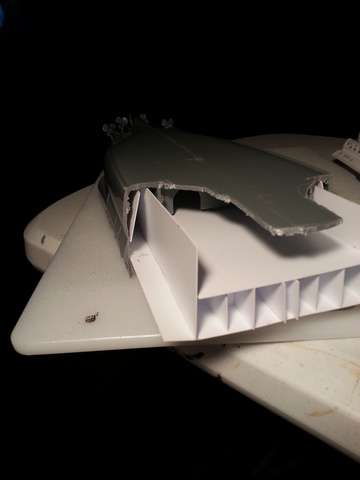
This is what I accomplished last night (the “deck” is not glued in at this time) I still have quite a bit to do here. You can see the torpedo belt area and the inner hull. I will need to remove this inner hull piece temporally to motor tool the side to open a hole, then install the twisted metal for the damage. There seems to be only one torpedo hit from wave 6 on the port side that i will need to simulate. There also looks like there are 3 near bomb misses on the starboard side the may have caused some dents.
Looking at the "hit: chart, the majority of the torpedo damage was on the port side, just about where I looks like the stern broke off, or blew off.
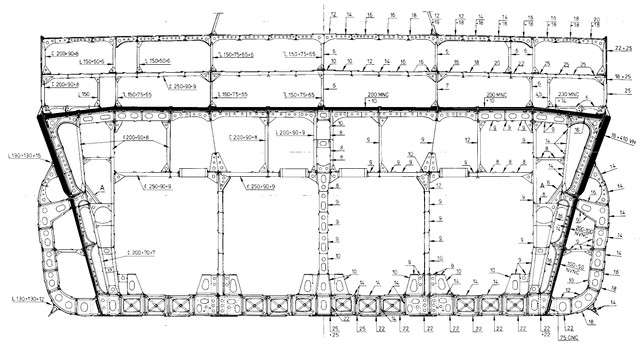
This is a cutaway of the mid-section I found which is the basis on my work so far.
Here is what I built last night. Most of this will be cut away and bent. Like I said, I still have a lot to do here and add more decks and bulkheads.
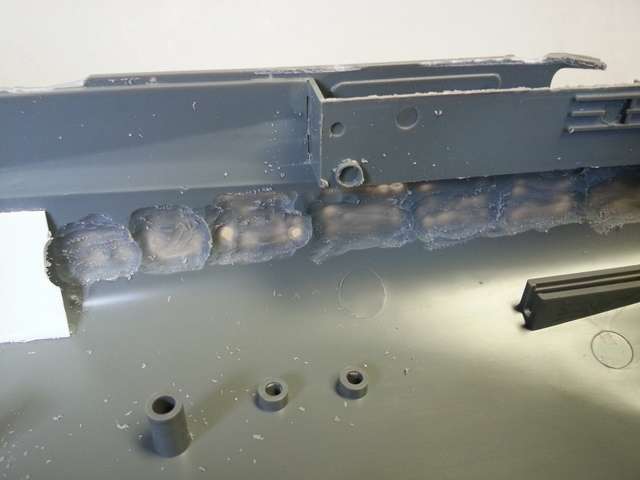
I ground the starboard side of the stern to help simulate the possible dents from the near misses (I’m assuming that there are dents after seeing the dent in the bow from a near miss). I thinned the side in squares to try to show the bulkheads. I don’t have any idea if this is correct or it will work, but I’m giving it a try.
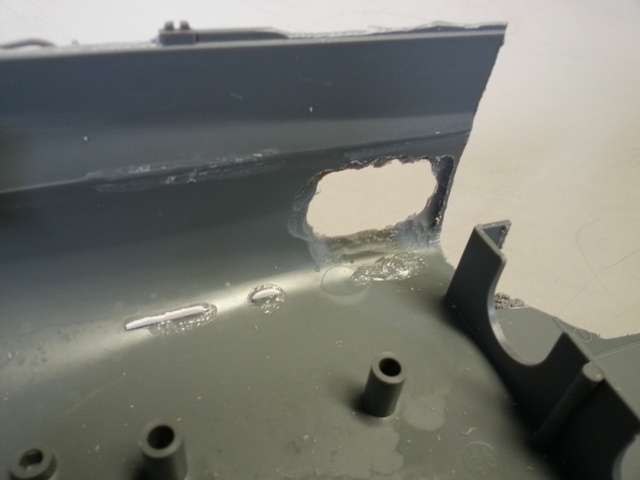
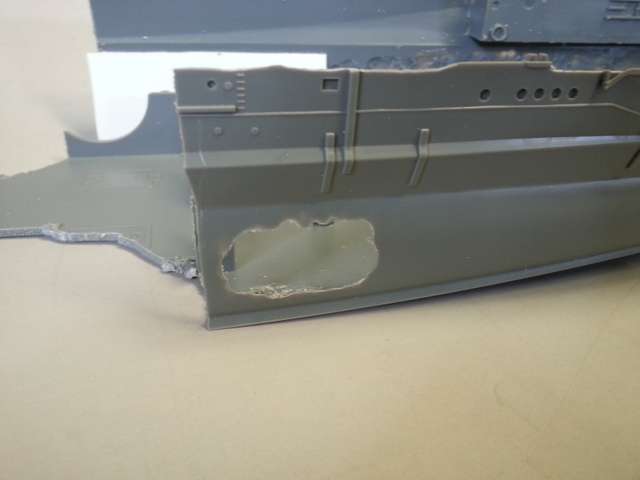
Next I thinned a section on the port and made a hole for a torpedo strike. I will overlay this with alumium for the outward damage. I will also make some inward damage on the inner wall of the buldge.
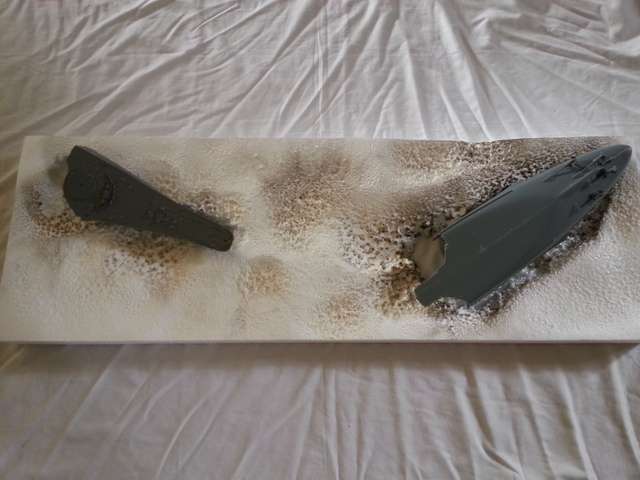
Now I know this looks bad, but this is the seafloor and the dio base. I took a piece of styrofoam and heated it up with my plumbers torch (that’s why it’s blackened and yes, there’s a hole in it). Not to worry though, as this will be covered in paper strips and acrylic medium, similar to what I did for the Indy. Once the pieces are laid in their spots, I will add some more medium and something for the silt. I’m not sure just yet what I’m going to use, but I’m sure the model railroading community has something that will work just fine. The base is quite large, but to keep this somewhat to scale, it needs to be.
This is looking cool already. I like the bulkhead idea with the thinning, if you are trying to simulate dents from a near miss, are you going to push the thinned sections inward? If the miss was external it should buckle the metal plates between the support beams for the hull. The work you’ve done for the decks and bulkheads already looks great. I’m gonna need more popcorn! [t$t]
I was messing around with a piece of soda can last night, cutting, bending, poking, trying to make it look real, then I thought, the 4th is coming up (fireworks are still legal here in Boise) why don’t I put a firecracker next to a piece, or inserted into a hole of a piece of soda can to see what the damage would look like. I may do that, depending on weather I could get away with it safely. Fireworks will go on sell here very soon. [^o)]
Yeah, I was thinking of placing the “device” in a medium cardboard box to absorb any flying shrapnel.
I played this song before when I was about 14 during summer break.
I had the brilliant idea to see what a firecracker would look like inside a 5 gal water jug (they were glass back then). So I placed the jug in the middle of the garage as my parents were gone at work, lit a firecracker with and exceptionally long fuse, I think I even attached another fuse to make it longer. I then dropped the explosive device into the jug and, here’s the good part, screwed down the lid. Luckily for me I had at least one brain cell working at the time and got behind the door to the house and watched around the corner.
KA-BOOM, the jug explodes into a zillion pieces (I must have been sleeping through the physics lecture which explains compression). Needles to say, I spent the next several days of my summer vacation clearing and cleaning the entire garage so there was not one sliver of glass left. I think secretly my parents were glad they had a reason to make me clean the garage.
I learned my lesson and will be careful if I try it, thanks.
It would be interesting to see the results. I’d just have to do it when my wife is gone.
I was researching some torpedo damage pictures and, of coarse, found a ton. This one seems to be one of the clearest, although I’d like to find and example of what our aerial torpedoes would do instead of one of those Japanese nightmares.
Steve, after seeing your last ship build, this will be one to follow. Looks like your doing plenty of research for this, I like it.
I have seen a dio of a sunken Sherman before, but I don’t think a ship. The Sherman was set is clear resin, or something like that, for the water. Will you be doing that or will you leave out the water.
I’ve seen that Sherman dio, it was done very well.
I will be leaving the ship out of “water” as It would take huge amounts of resin to cover this size diorama. What I’ve seen on Titanic and Bismark dioramas though, is what appears to be an algae green or blue sprayed on the set to try to simulate an underwater look, like you were looking at it with artificial lighting from an ROV. I was thinking of doing something like that, but haven’t decided yet.
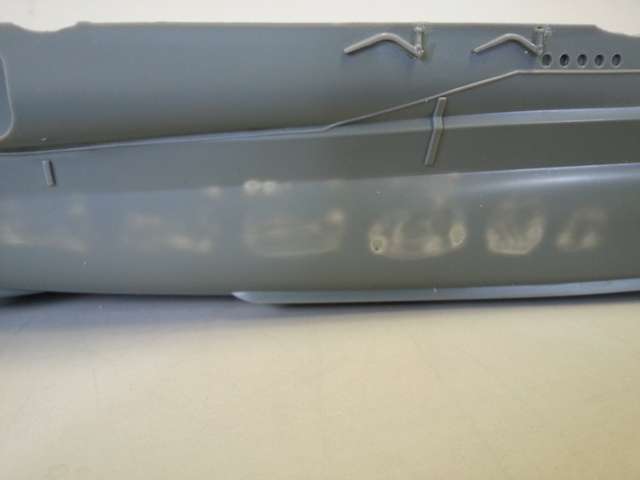
Here is the dented starboard side. I have some smoothing to do, but it will also be covered with silt .
And the torpedo hit. The outer plates are blown out, while the interior side and bulkheads are pushed in. Looking at the damage on the video, the sides are blown out, but let me know what you guys think. It is easily changed at this point.
A different view of the damage. I drilled holes into the “framing” in the torpedo bulge to try to dress it up a little. You can see the inner bulkhead.
And finally the framing structure and the engine room. Maybe I can come up with something to replicate the engines. This will be totally cut away and collapsed along with the keel. Studying the side scan sonar, it looks like the keel collapsed, probably during the impact with the sea floor.
Comments are wanted.
Steve
EDIT,
And here’s the sea floor with the acrylic gel and paper.