Nice build, Tom! Great to see it finished.
1 Like
I really enjoyed the history that came along with this one. My ancestry is Finnish, but I knew very little about Finnish armor and had no idea what a mishmash of equipment they operated. So I learned something along the way.
I also love seeing something come back from the Shelf of Doom after five years and actually make it across the finish line. Congratulations on getting it done in time for NordicCon tomorrow, and good luck!
1 Like
Thanks for the cheers gents! @Samphoto, I too am of Finnish ancestry and have been deep-diving into Finland’s WWII history for a couple decades now. It’s endlessly fascinating, even just from an equipment perspective.
Yesterday I got to do something really rare in my personal version of this hobby: put a finished model into the display case. 
On Saturday I managed to get the finished T-26 vignette to NordicCon without any noticeable damage despite the 11" tall tree trying to snag on everything within, somehow, 18". The tree also made it tough to find a place on the tables in the venue that wouldn’t block the view of somebody else’s work! And there was a LOT of excellent work on those tables. Keep your eyes peeled for Tim’s photos on the FSM main page.
Notable that at this show, only the vehicle is judged – there is no category for “vignettes” and I wouldn’t consider this a diorama, so it was in the “military vehicles” category. I entered the “intermediate” class, and took home a silver.
I lost some points for basic construction errors: visible gaps around the PE fenders, and more than a little misalignment of the running gear. Basic stuff for armor builds, and while I could blame 5-years-ago me, I have to admit I wouldn’t have noticed them at all if they’d not been pointed out. Getting feedback is awesome! EDIT: I just noticed that the first paragraph in the first post of this thread, in March of 2021, I noted that the fenders don’t fit that well. 
This was my first time in an AMPS-style judged competition, and if I had read the AMPS judging information ahead of time, I might have picked up an extra point for a “research bonus” by including my historical notes and reference photos. Next time!
Finnish T-26: “Going Abroad”
In the Winter War of 1939-40, the Soviet Union invaded Finland but was stymied by Finland’s fierce resistance. In the end, they were forced to accept only a thin strip of Finnish territory along the border rather than complete surrender.
In the summer of 1941, after Germany invaded the Soviet Union and Finland entered the Continuation War, Finnish forces crossed the 1940 “Interim Peace” border and retook territory lost after the Winter War. Later, when they crossed the “old border” into Soviet East Karelia, they sometimes called this “going abroad” – typical dry Finnish humor.
Like the tank itself, this project isn’t a reconstruction of a specific photo or known event, but instead a plausible scene: a Finnish T-26 tank, recently captured from the Soviets among dozens of others during the Winter War, following the advance in autumn of 1941 – “vanhan rajan yli ‘ulkomaille’” – crossing the old border, going abroad, in a sandy Karelian spruce forest.
The base is pink XPS foam carved to shape and coated with AK’s wet mud and dry ground. These are nice to work with – they smell and act like latex house paint, and cure into a hard, flexible shell over the foam. I added sifted grit and gravel from the gutter in front of my house (à la Shep Paine), and assorted organic detritus from the flower beds. I placed adhesive grass tufts randomly, and then filled in the gaps with static grass of varying lengths (what a mess – but worth it). Then I airbrushed everything with tans, greens, and yellows, aiming for a dry, autumn feeling.
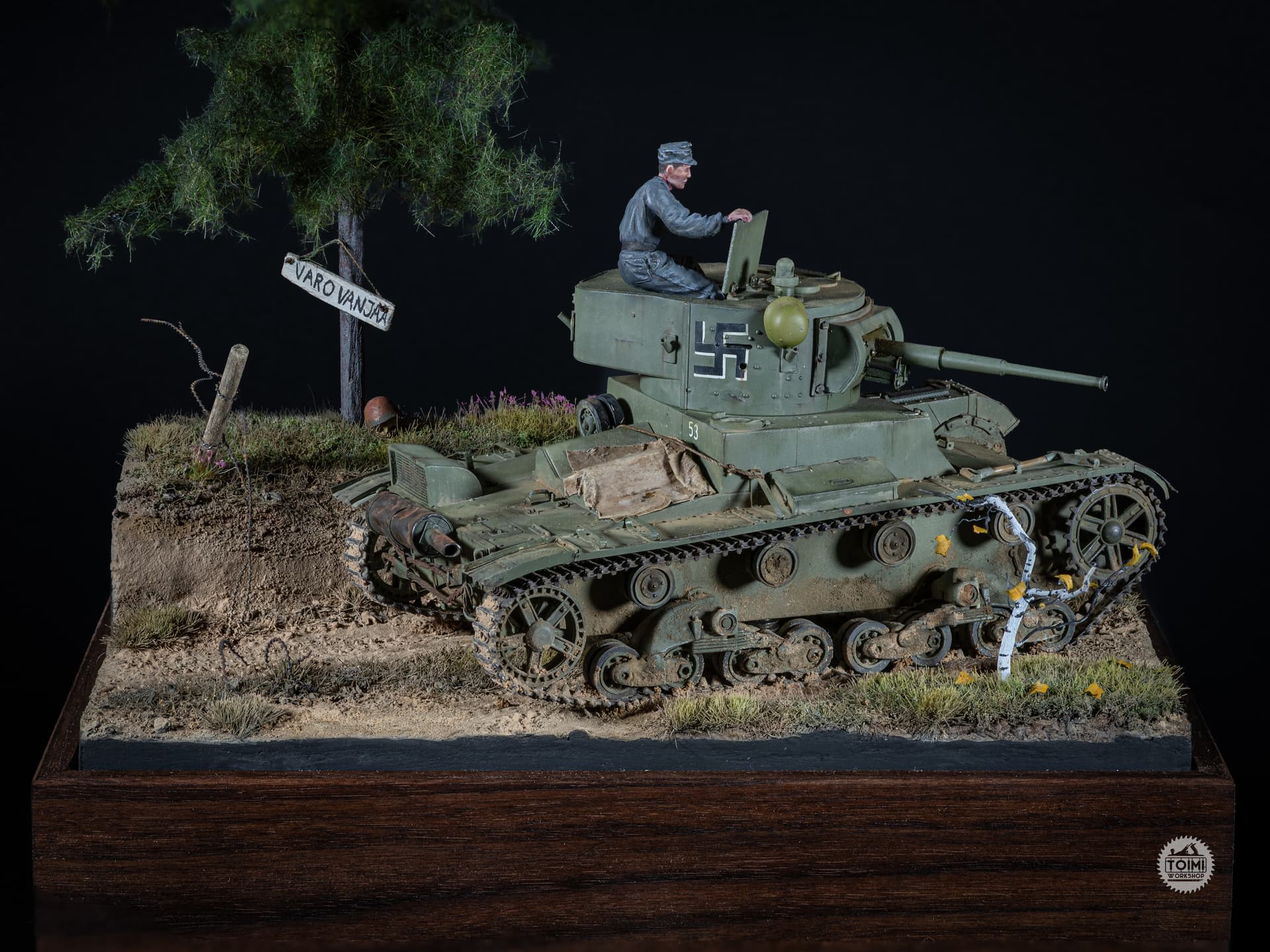
A hand-painted sign warns advancing troops that they’re entering the combat zone. “VARO VANJAA” translates (lightly sanitized) to “beware of Ivan,” and at the base of the tree rests the remains of a Soviet soldier and his rusty SSh-39 helmet, maybe from the deadly winter of 1939-40.
The helmet is from the Dragon “Soviet tank riders” set and the skull is from the spares box. I used AK’s “worn effects” fluid to chip the helmet, and rusted it with Vallejo acrylics and oil paints. The sign is a carved bit of coffee stirrer, painted and weathered. The rope is ship rigging rope, stiffened with PVA glue to give the sign weight. Research suggested that wild heather is a common fall wildflower in Finland, so for a pop of color, I brushed Citadel’s “Screamer Pink” onto the flower heads of Gamer Grass’s flower/shrub tufts. The “barbed” wire is Army Painter’s razor wire product, rusted the same as the helmet. For the fencepost I used a poplar dowel, painted using Adam Wilder’s technique.
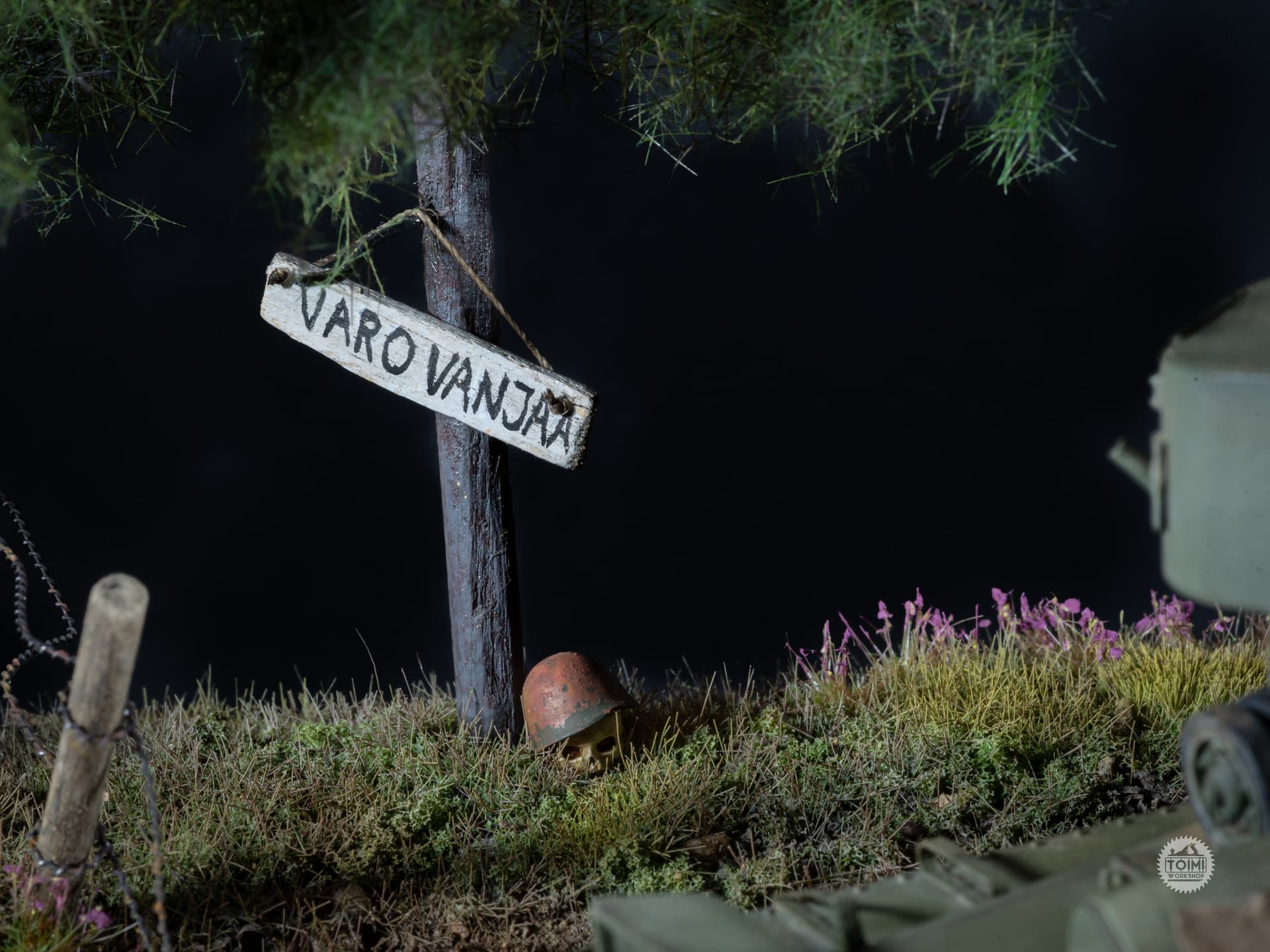
The Finnish boreal forest is distinctive, and quite similar to the forest I know best in northeastern MN, where my Finnish ancestors settled – so it had to look right. That means the “hero tree” needed to be a Norway Spruce, with a distinctive pyramidal structure, the limbs in regular whorls with drooping branchlets, and small, black-green needles. The bark is reddish gray and flaky.
I followed Boulder Creek Railroad’s tree tutorial on YouTube and I was astonished how easy it was to get a result I was pleased with. This one was my first try! (I also now have static grass glued to every surface in my workshop.)
This photo also shows a bad mitered corner on the walnut frame – not sure how that slipped past the QC person at Toimi Workshop – it’s me, I’m the QC person! The other corners are okay, which suggests my cuts were slightly off of 45°, compounded 4x… 
The Miniart 2017 “Finnish Tank Crew” kit offers good poses and excellent faces with plenty of character, but also melty, indistinct details, which makes painting hard. The hands are a good example; I should have spent more time re-sculpting the fingers. After seeing the crew figures on some of the builds at the show, I’m feeling both discouraged AND inspired to keep working at this part of the hobby. The thing I like best is the little blue and white roundel cockade on his hat.
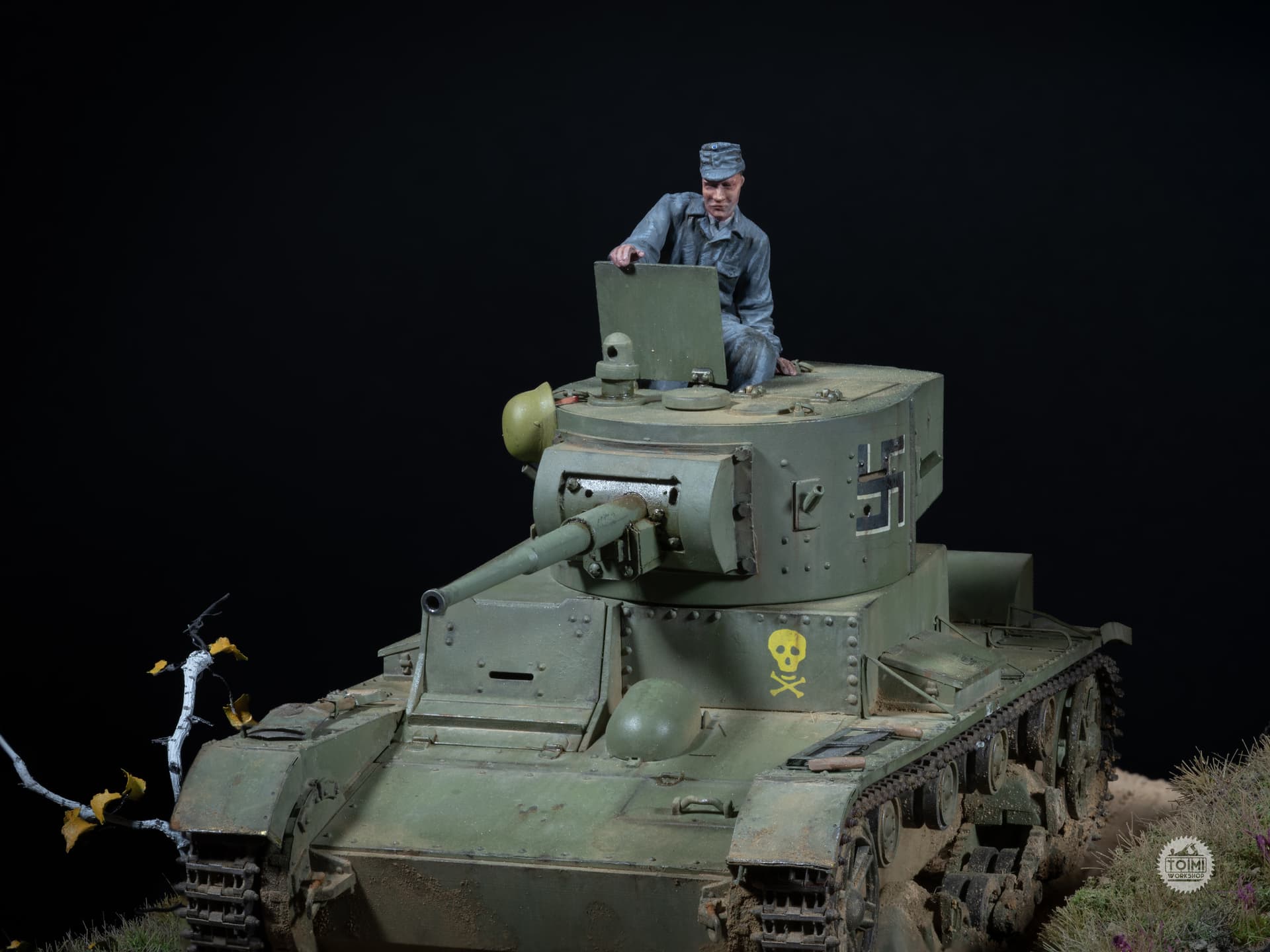
To lock in the “Fall 1941” look, I added a roadside gnarly birch sapling, its leaves yellow and falling. It’s a root from a seedling ash tree in my back yard (I have thousands), dried and painted, and the leaves are cut out with a Green Stuff World leaf punch, painted yellow, and given a brown oil wash. (That paint-curing food dehydrator works great for drying out natural materials in a short time for use like this.)
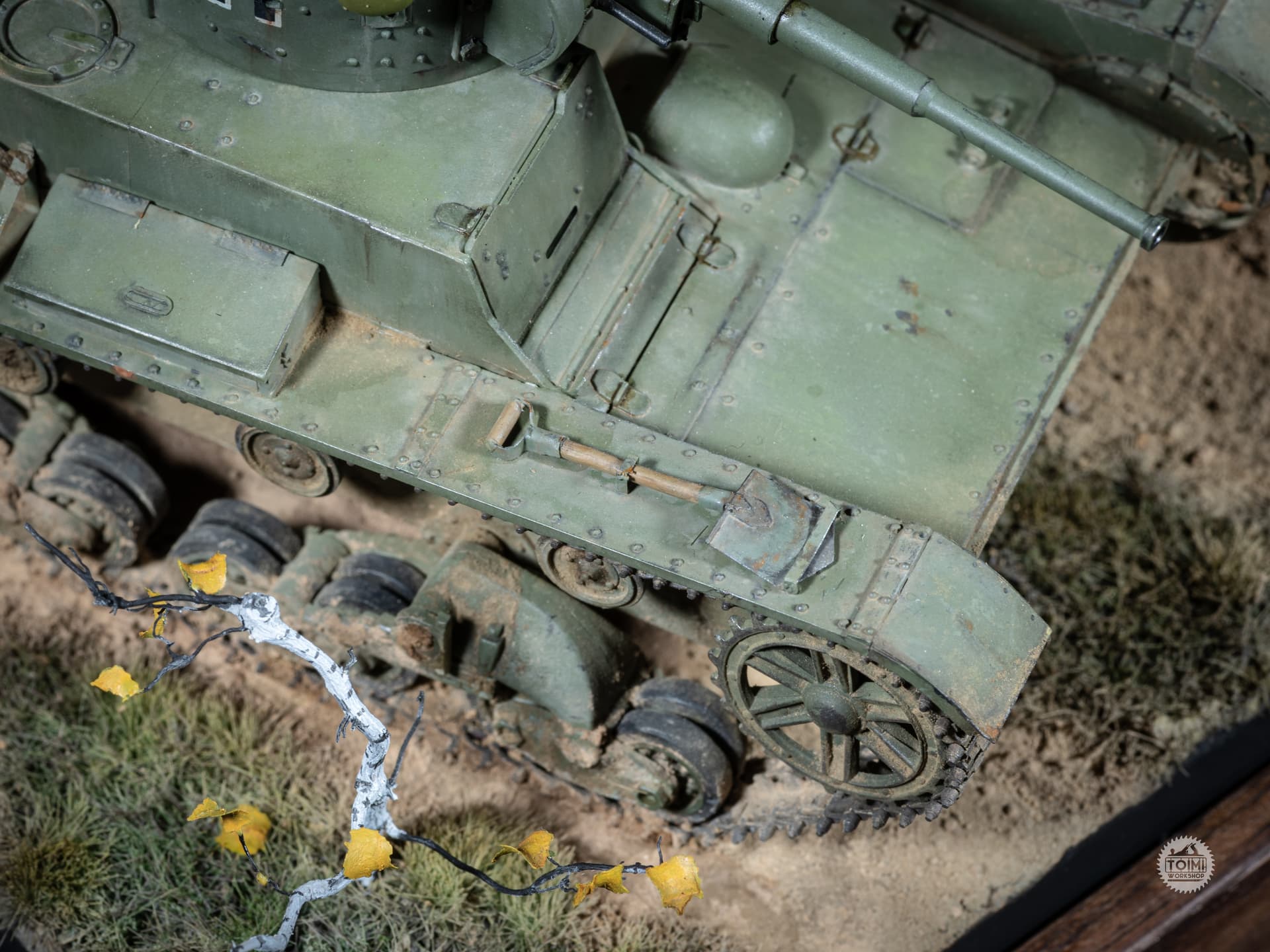
Vallejo and artists’ pastel pigments tied the tank to the dusty road and added some rusty texture to the exhaust. Oil washes and a little drybrushing added contrast around the track marks while keeping the dry, sandy look.
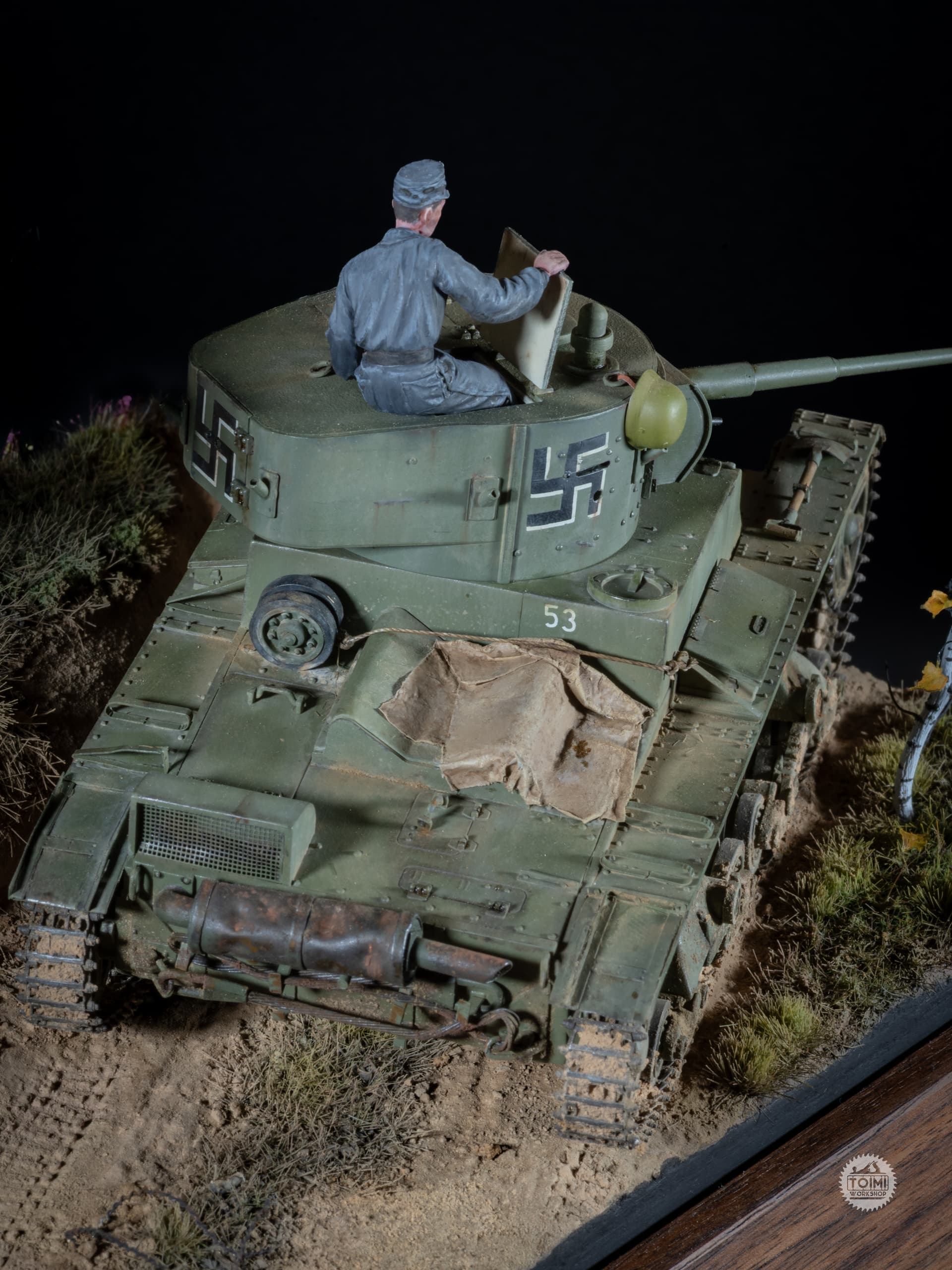
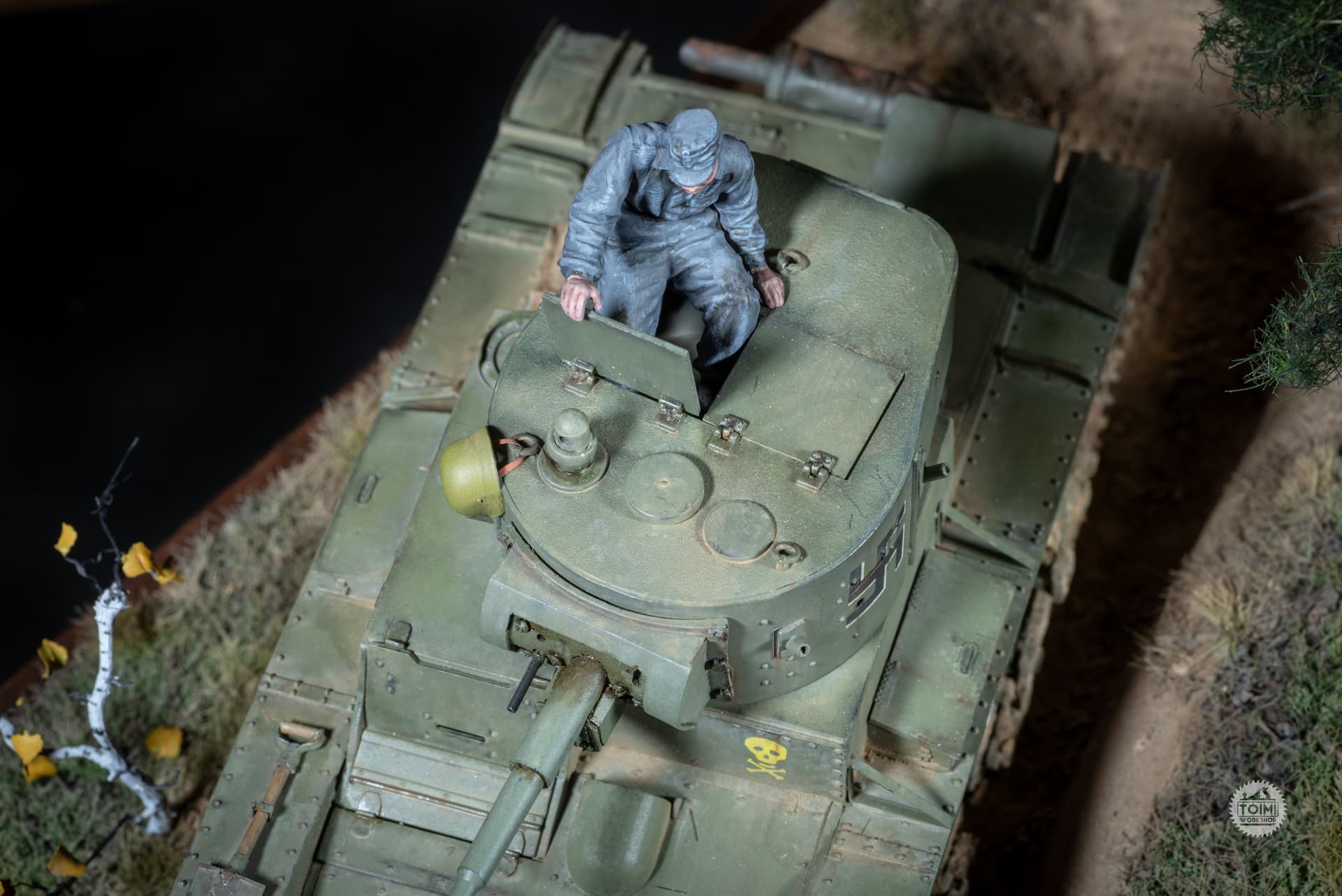
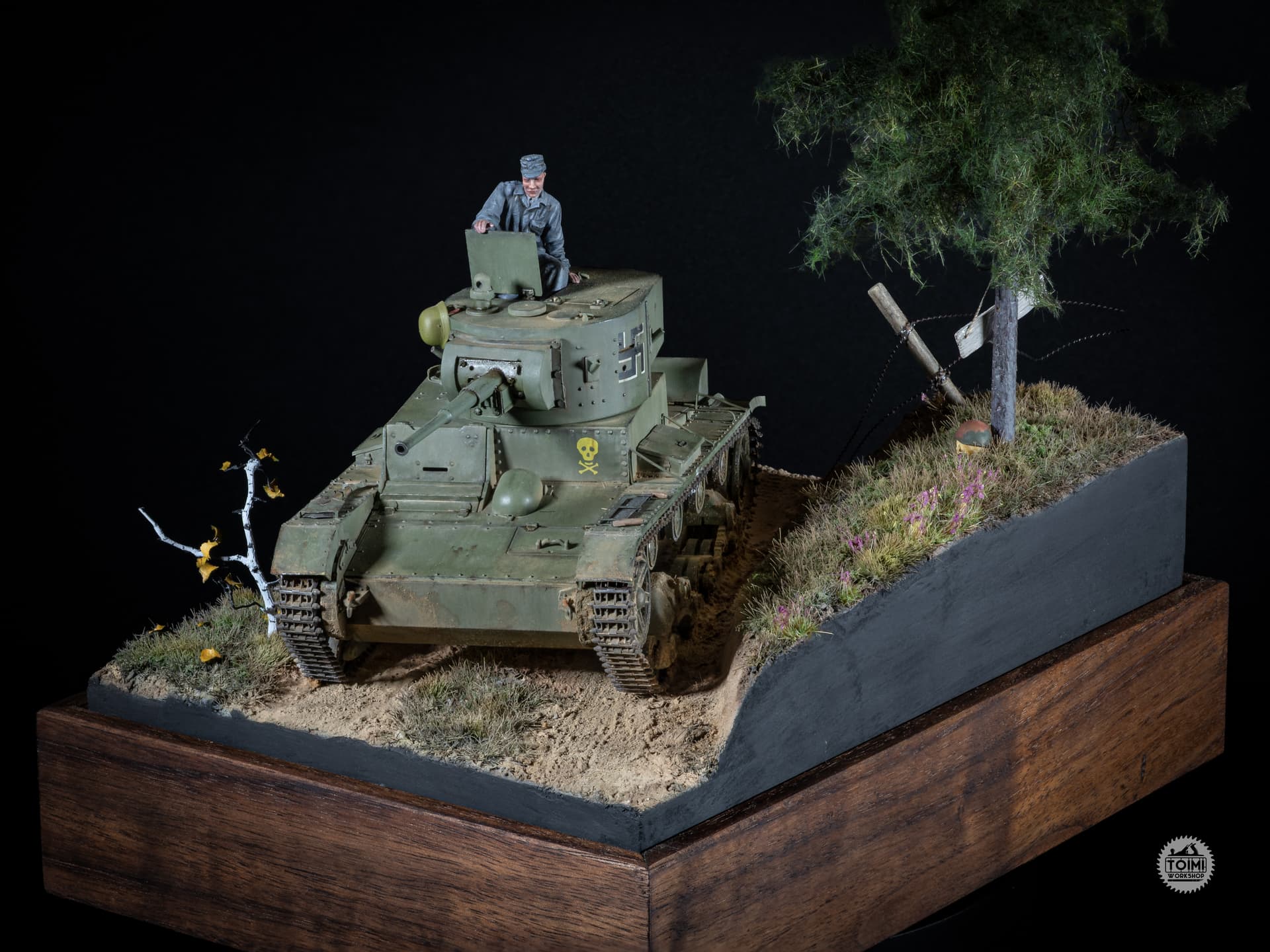
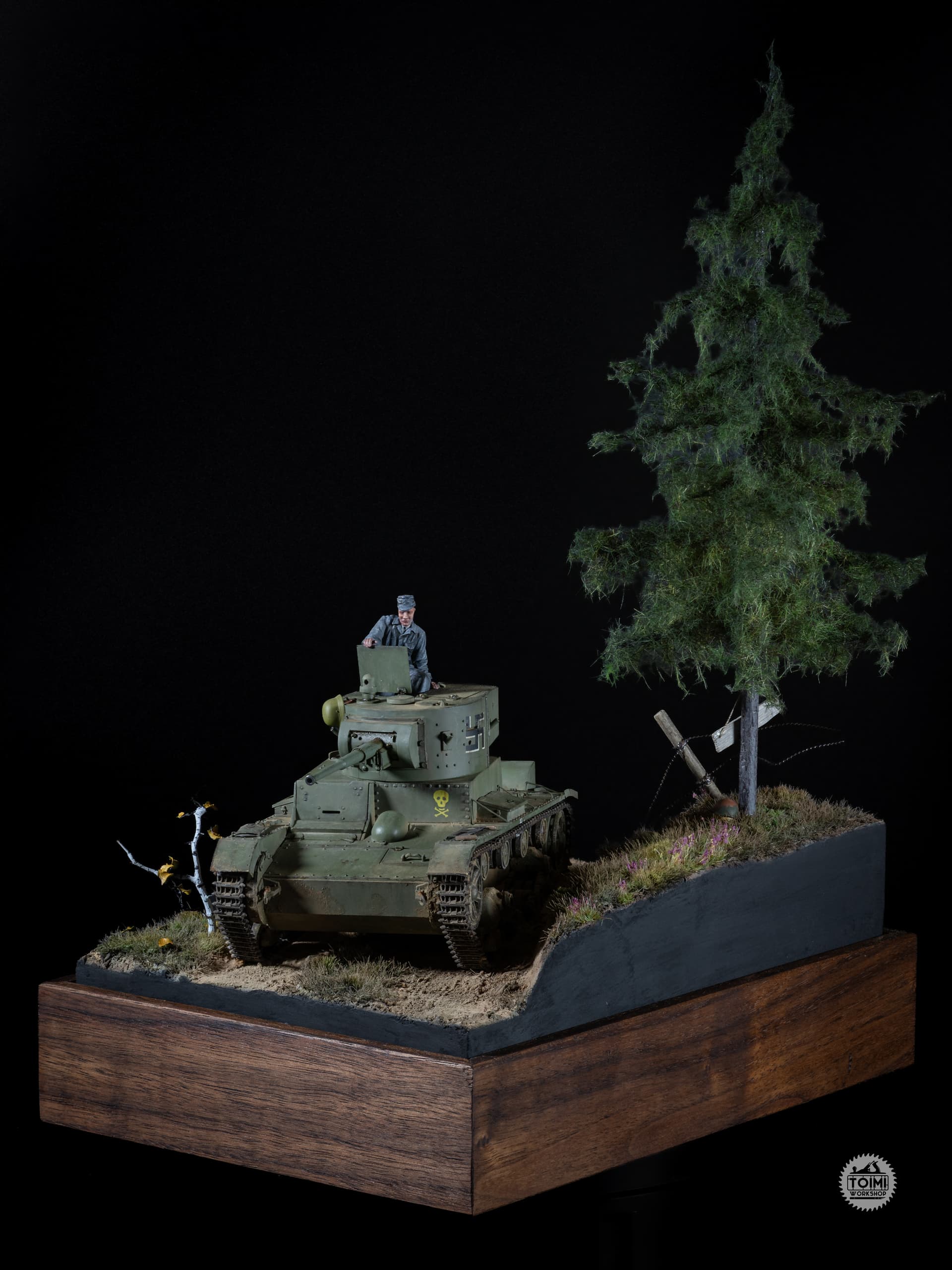
One major thing I’d change, if I were doing it again, is to simply flip the tank around end for end. I more or less made this whole thing up on the fly, but some planning earlier in the process would have avoided the photographer’s sin of having the subject heading out of the frame – which in this case also puts the crew figure facing away from the viewer when you take in the piece from the “front.” You can’t see the sign and the crewman’s face at the same time – he should be looking at the sign. Lesson learned there. Also, some thin sheet styrene carved to fit the terrain and painted black would look much cleaner than the painted foam edge.
I’ve been putting off this kind of terrain work for a long time, but I’m glad I finally jumped in. It’s really not that hard, but it requires getting messy and experimenting with what you have available. Like any kind of weathering, you work in layers, building up to a realistic impression. I’m looking forward to the next one.
Thanks for following along on this long build! 
4 Likes
I really enjoyed this post, and I especially appreciated the way you formatted it. Sometimes the really long posts are difficult to follow, but this one was very to get through.
The history was probably my favorite part. I’m of Finnish ancestry myself, so that immediately caught my attention, but I also really liked the way you approached the scene as historically plausible rather than trying to recreate one specific photograph. That’s exactly what I’m trying to do with a P-47/Sherman/Jeep diorama I’m planning right now — make sure all the pieces could reasonably have been in the same place at the same time, then build the story from there. This is my rough draft mock up of what I’m going for.
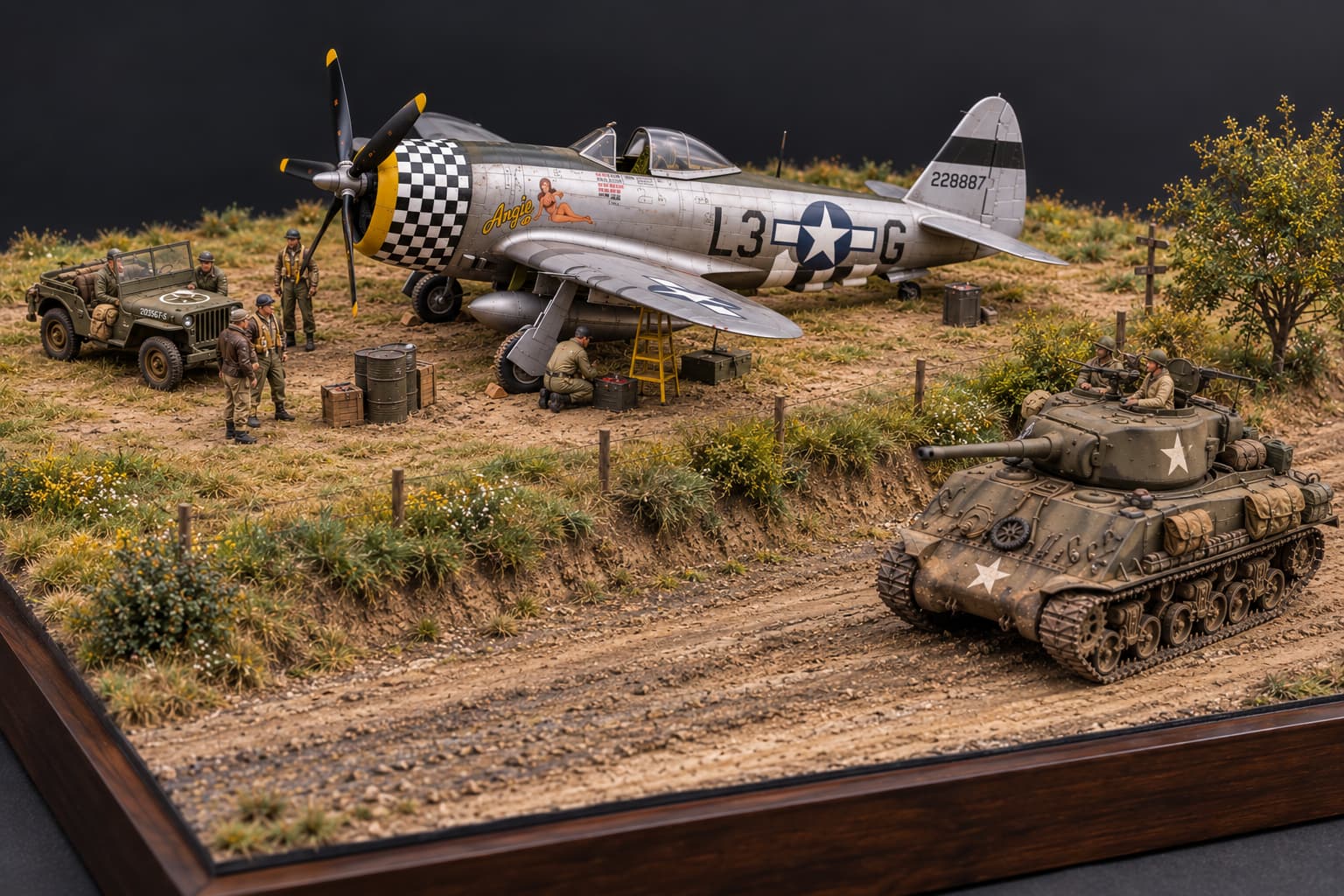
And the finished piece is really well done. The tank, figures, terrain and trees all work together beautifully, and congratulations on the silver — very well deserved.
Also, thank you for the YouTube link on making the tree. I’m definitely going to need that. 
1 Like