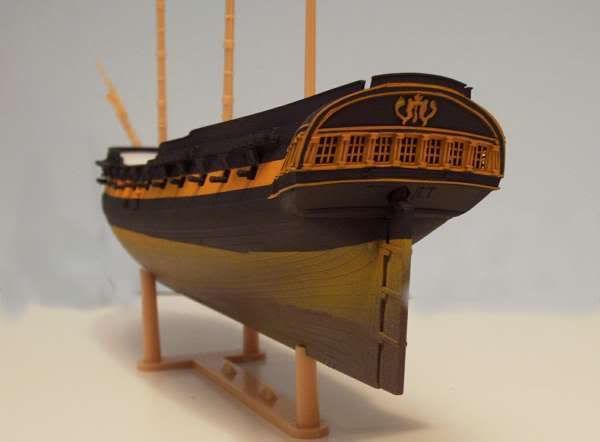
L’Unite was a ‘Corvettes 24 de 8’, in service from 1793 until captured in 1796 (Boudriot). The British uprated her to a ‘fifth rate’ or ‘frigate’ (Lyon). By this time she was effectively a sixth rate based on her 9 pdr. armament (but if my memory is correct, rating her as a fifth rate entitled her commander to a post captain slot)
L’Imperieuse was an 18 pdr. frigate in service from 1786 until captured by the British in 1793 (Boudriot). The British renamed her Unite in 1803 (Lyon). She was finally hulked in 1836 (Lyon) a remarkably long life - so much for the stereotype that the French built frail ships.
Ok,the Royal Navy themselves state that they had 4 ships named HMS Surprise (Surprize). Ship #1 was a small ship not a frigate. I know the # 4 ship was a “cut down” 64 or 74 gun ship to a “british 44 gun” aledgeitly (sp?) to compete with the Americian 44 gun frigates ,ie: USS Constitution. She was at Fort Mc Henry , Francis Scott Key was detained or her during the shelling of the fort.
Ok was there a ship named HMS Surprise that was a converted captured French frigate ? Is this a myth or fact ? Does any one have facts on ships # 2 and # 3 ?
I can’t sort out the whole story either, but a partial answer is: yes, there was a British ship named Surprise that was captured from the French. This, courtesy of Russ, is her Admiralty draught:
The label “SURPRISE late L’UNITE” appears clearly on it. There’s little room for doubt: this is the ship that (well, sort of) inspired the O’Brian books.
The careers and dates of the other Surprises ought to be in Lyon’s Sailing Navy List (and, for that matter, its older predecessor, Colledge’s Ships of the Royal Navy). I gather Schoonerbumm has a copy of the Lyon book; maybe he can help.
It sure would be nice if navies would agree never to use the same ship name twice. (I wish I had a dollar for every photo I’ve seen that purports to show the Yorktown that sank at Midway, and in fact shows the later, Essex-class ship.) Sometimes, of course, the re-use of a name is almost a patriotic ritual. But other times it just seems to beget confusion.
I think the most spectacular case of such mistaken identity I’ve witnessed was one I saw in the museum where I used to work. In the ship carving gallery was the figurehead from a big, early-twentieth-century luxury yacht named Mayflower. With my own ears I heard a visitor tell his kid, “look, Jimmy, this figurehead came off the Pilgrims’ ship!” Next to the figurehead was a huge photo of the vessel from which it had been removed - complete with belching smokestack. Oh, well…whatever.
John is correct. The plan in the link is certainly the ship that inspired O’Brien’s Surprize, but that is about all that can be said. From this point it is all a matter of trying to figure out where the Surprize in the plan stops and where O’Brien’s Surprize begins. Unfortunately, there is no way to know for certain.
Well, the Royal Navy was full of Surprizes… nine of them are listed in David Lyon’s ‘The Sailing Navy List’, serving from 1746 to 1837.
Three British built fifth rates, a 1741 Establishment 24 X 9, a 1770 Enterprise class 24 X9, an 1808 Leda class 28 X 18 (a sister to the Shannon).
A captured sixth rate upgraded to a fifth rate, the Unite 24 X 9 (french 8 pdr) rearmed by the Brtitish with 24 X 32 pdr. carronades, 8 X 18 pdr. carronades on the quarterdeck and 4 X 6 pdr. on the foc’sl.
A captured American Privateer
A captured french cutter
A British cutter
A captured French merchant schooner.
A captured American schooner on the Great LAkes
As Dr. Tilley points out the Unite/Surpris(z)e was the inspiration for Aubrey’s ship. The 1741 ships were from the Seven Years War, the Enterprize class Surprize was sold in 1783 and the Leda class came too late.
Of course O’Brian took liberties with the ship and her armament and Hollywood stretched them further. Even though ‘Master and Commander’ is a catchy title and was probably the most read Aubrey book, that title is incorrect for the story portrayed in the film. Master and Commander refers to the fact that the officer in command of a sloop (or smaller vessel) was not a captain and did not have a sailing master. One person was responsible for both functions. As a post captain, Aubrey was in command and would have had a dedicated sailing ‘master’.
I have the impression that lots of cooks stirred the broth of that movie. Somebody apparently got the notion initially that a Patrick O’Brian book would make a good movie, but picking one of the novels for the purpose apparently just wasn’t practicable. It’s fairly easy to reconstruct the logic that probably went into the eventual decision. The plot from The Far Side of the World offered a big, obvious attraction: it only involved two ships. But the Bad Guys in it were Americans, so something needed to be changed: the American frigate (obviously based on the actual Essex) had to become a French privateer. And the people responsible for the script apparently couldn’t resist interjecting little bits of plots from other books into the movie. They apparently were desperately worried that if they didn’t do everything just right, the thing would be a financial flop. And somewhere in the process somebody decided to put a title together out of two book titles. It is indeed amusing that the finally-chosen title has nothing to do with the finally-realized story. Unless I’m much mistaken, there’s not a single person with the rank master and commander in the movie.
The other side of the coin is that, in my opinion at least, the result was pretty daggone good. I’m not O’Brian’s biggest fan. (I like O’Brian’s books, and I respect his knowledge of early-nineteenth-century British history, but, unlike a lot of his fans, I don’t worship him. In the long-standing conflict between the O’Brianites and the Foresterians, I’m still in the latter camp.) But that movie is so much more believable than any other flick about sailing warships that it practically occupies its own planet. Hollywood has had a horrible time bringing stories like this to the screen effectively. The only other movies I’m aware of that even deserve to be mentioned in the same breath are “Damn the Defiant” and “Billy Budd.” (The latter is marginal. The distant shots of the ships in it are pretty hokey, but the depiction of naval life and discipline is excellent - and the acting is superb. “Damn the Defiant” is, in my opinion, an excellent movie - a good story, excellent photography, fine performances. The last shot always makes me regret that Alec Guinness never had the opportunity to play Nelson. But a frigate with a cargo boom on the front of its main mast???) I liked the British TV mini-series “I Remember Nelson,” but the budgetary limitations on it were glaringly obvious. And the old Gregory Peck version of “Captain Horatio Hornblower,” though lots of fun for audiences at the time, really doesn’t stand up to modern scrutiny. (I certainly wouldn’t want anybody to get introduced to the Hornblower series by that movie.)
To make a good movie about sailing warships, and make it appeal to today’s mass audience, requires an almost unimaginable amount of money. (The “Hornblower” mini-series on A&E cable shows what happens when people with good intentions try to make such movies without having enough money.) Those of us who are interested in such things should, I think, be grateful that “Master and Commander” is as good as it is - and that it did, as I understand it, make a respectable profit. If it had been a financial bust, it’s unlikely that anybody would ever try to make such a movie again. I’ve heard, though, that Peter Weir and Russell Crowe are talking about a sequel. If it happens, they’ll get my ticket money again.
Amen! There are so many little details that they got right for Master and Commander too. There’s an almost throw away scene when the Surprise has gone far south. It shows snow and ice on the ship with some sailors throwing snow balls. At the very beginning of that scene, you can see a poor sailor freezing while sitting at the head! [:)]
Another great, little detail is right at the end when everyone is assembled for the funeral. As the crew is reciting the Lord’s Prayer, the camera pans over a few faces. When they get to “For thine is the kingdown, the power …,” you can see that Stephen has stopped praying because he’s Catholic, and Catholics don’t finish the Lord’s Prayer the way Protestants do.
It’s a very little detail. Nowhere in the movie does it mention that Stephen is Catholic, although he does state that he’s Irish. Still, that particular detail shows just how much the film makers paid attention to details.
The costumes are great, the ships are great, the battles are great, and the characters are great.
That would be great! I wonder which book or books they’d adapt next. I’ve only read the first 8 novels in the series, but one featuring the women, especially Diana, might be good. I always picture Catherine Zeta Jones when I think of Diana. [:D]
I will respectfully disagree with your opinion of Master and Commander. Yes, the details are good. Yes, the battle scenes are remarkably well done. The film has a lot of little things to attract viewers.
But, and I am coming at this from the standpoint of one who has never read any of O’Brien’s books, what about characters? The film does little, if anything, to really develop the main characters. If you have not read the books, you can get lost pretty quick. I have no idea why Aubrey and Maturin are arguing about punishments and spying on the crew. Why? Because I have never read the read the books and I do not understand right off the bat the kind of relationship they have that allows the ship’s doctor to barge into the great cabin and grouse with the captain. I can get past this problem because I have read quite a bit on the period and on naval officers, but what about someone who is a lay person and does not have any basis on which they can understand these characters?
The main problem I have with the film is the story. Like you said, they wanted to find elements from O’Brien’s books that would attract people and yet not blow the budget. Fine, But, this film suffers the same problem they had with Peck’s Hornblower film. They ripped up two or three books and created a 2 hour screen play. There were scenes in the movie that had nothing to do with the main plot. I think the main plot was the chase the Acheron and take her or sink her. Fine. But what does Maturin’s little science expedition to the islands have to do with that? What does the young officer committing suicide have to do with it? And that wonderful little fully framed model that the two crew members just “knocked together” to show the captain what he was up against? That was useful in the story, but come now!
Well, I do not want to turn this into a debate on the merits of the film, but I just had to get this out. Sorry if its off topic.
I hadn’t read the novels either when I saw the movie. Since then, I’ve read the first eight of the series.
I had a very different reaction to the movie than you did. However, movies are like that – no movie will satisfy everyone. My wife is lukewarm toward the movie, but she does like the characters and their story arcs.
At least we both love Lawrence of Arabia and The Seven Samuri. [:)]
Back to the origin of this thread, I think it’s great to build a model of the movie version of the Surprise! For that matter, I’d love to see a kit of the Interceptor from Pirates of the Carribean.
I can easily understand why anybody who hadn’t read any of the O’Brian books would find the plot of that movie baffling. The moviemakers apparently assumed - for better or worse - that a large portion of the audience would be made up of O’Brian fans. Such people would know that the captain and the doctor are close personal friends. (Critics have commented at length that the series is a 21-volume rumination on the nature of male friendship - rather remarkable in view of the fact that O’Brian, an extremely eccentric and not-altogether-likable character, seems to have had few if any close friends of his own.) The two met at a chamber music concert, and discovered a mutual interest in that subject. (One of the least impressive aspects of the movie was Russell Crowe’s attempt to look like he was playing the violin. I speak as a former, extremely unsuccessful violin student.) The doctor, like many members of his profession in those days, is an expert on natural history. And - though this point doesn’t figure in the movie - he’s also a clandestine agent for British intelligence. (There’s one brief piece of dialogue in which he and the captain refer in passing to the fact that both sides in the war have intelligence agents. That brought grins of recognition from the O’Brian fans in the audience.)
The moviemakers must have been at least partially right in their assumptions; the movie apparently made lots of money. I repeat: I’m not among O’Brian’s biggest fans. But I have read some of the books (not all of them yet - though I’ve bought all of them), and I do recommend them to anybody with an interest in this area of history.
Regarding the old Gregory Peck “Hornblower” movie - one curious aspect of it is that Forester himself was credited with the screenplay. I don’t know who else may have had a hand in it; I rather suspect he got leaned on in various directions by the Hollywood moguls. But to my knowledge he never openly disowned the movie or expressed any dissatisfaction with it. I believe Forester moved from England to California for the specific purpose of trying to break into the Hollywood scriptwriting game. Several of his books and stories got made into movies, including the novels Payment Deferred and The Gun (movie title: “The Pride and the Passion,” with Cary Grant, Frank Sinatra, and Sofia Loren - a really awful flick) and the short story “Brown on Resolution” (movie title: “Sailor of the King”). If I remember right, the movie “Sink the Bismarck” also was identified as being based on Forester’s book. All those flicks got mixed receptions; the only Forester-based movie that was an unqualified hit, and has really endured, was, of course, “The African Queen.”
Now we’ve really moved off topic. Sorry about that; my fault.
I could go for that kit, “Pirates” was one of the more enjoyable movies of the genre.
I just might print out this whole thread, and keep it with the finished model. In reality there were too many “surprises”, and, as has been mentioned here and elsewhere, there was more than one “surprise” in the movie, each with some detail variance. While it makes building a model difficult, it also makes criticizing difficult. I guess I could be accused of taking the easy way out, bulding the ship based on the movie. I am about to begin masking the hull so I can shoot the second color. This will not be easy.
You know what might be fun? Make the Surprise the way she looked after her first encounter with the Acheron! I’ll bet the battle damage would be (if you’ll pardon the pun) a real blast to do.
I’ve always thought it odd that most people consider weathering practically mandatory for tanks and war planes, but wooden sailing ships get a free pass – they are expected to look almost pristine.
Oh well. Enjoy the build and please post some photos.
What I had in mind was a bit more subtle than that. I’ve read a number of articles in FSM about simulating bullet holes and battle damage in planes and tanks. I think simulating damage to the hull would be difficult, but not impossible. There’s an excellent video of a reproduction of part of the Brig Lawrence getting shot up by a real cannon here. It looks like hole in the outside of the hull are pretty small. Notice too the damage caused by grapeshot.
Damage to masts, spars, and rigging would probably be easier. I love how, in the movie, the Surprise is listing and looking oh so forelorn.
It would be an interesting project – one that I may try someday.
For me it was first the Hornblower books when I was in junior high and then I discovered Bolitho by Alexander Kent ( Douglas Reeman ) and I was hooked. Hornblower , Bolitho, Ramage, Drinkwater all are carbon copies of each other character wise but each story is excellent. Right now Im leaning to Dudley Popes Ramage ,story wise, as they are excellent stories. OBrians Aubrey is a different character in the fact that he is after prize money and is willing to be a little on the sly side where the other characters are the more honorable kind who wouldnt do anything to bring dishonor on their name, ship, or crew...... something sorely lacking today. The OBrian books are great in that they bring a different kind of captain and its refreshing to read them. I read the first book in the series in anticipation of the movie only to be totally confused in the story because it didnt match what I had read. Both my son and I were wondering what this story was only to find out later it was the tenth story in the series, not the first. The movie , for me, was excellent and my wife and family loved it. I can only hope they make more of them. The Hornblower movie of the 50s was excellent , for its time. Yeah, they fudged a little on the story line, but that was Hollywood in the 50s. ( A good example is "Captain from Castille " ...... its only half the story, the book is one of the best Ive ever read !!! ) So give them a break...... times have changed and be glad they made an effort. Its a job well done.,…
I agree with Armchair Sailor on all points - with the tiny caveat that Hornblower appeared a generation before Bolitho, Ramage, and Drinkwater. The first Hornblower book, Beat to Quarters (British title: The Happy Return) was published, I believe, in 1937. If I remember correctly, the other series started in the sixties. Forester, of course, was by no means the founder of the Napoleonic naval fiction genre. I think that title goes to Capt. Frederick Marryat, who was a veteran of the Napoleonic Wars himself.
I’m a big Dudley Pope fan. My only regret is that, probably for financial reasons, he wrote so much more fiction than non-fiction - because his non-fiction books are pretty terrific. I particularly recommend Decision at Trafalgar, The Great Gamble: Nelson at Copenhagen, The Black Ship, and At Twelve Mr. Byng Was Shot. Pope’s World War II books are good, too. Graf Spee: The Life and Death of a Raider (British title: The Battle of the River Plate) ought to be required reading for anybody building a model of that ship, and 73 North: The Defeat of Hitler’s Navy is a remarkable story of a decisive convoy action between British destroyers and German heavy surface units on the Murmansk run. First-rate stuff. Pope knew how to do his research, and he knew how to write - a regrettably rare combination of skills.
I have to agree with that also . My father had a collection of the Hornblower books on the shelf ( remember the teak colored hardbacks ? ) when I was a boy and I also read “Beat to Quarters” first. For me , I read " To Glory We Steer " by Kent after the Hornblower series… found it by accident in a pharmacy book rack.( late 60s ). What a great movie that would make........ a mutinous crew and a second officer who doesnt trust you… ah the story good movies are made from. The next 4 books are some of the best in the series and some of the best ever written. Just my opinion.