I stand corrected…I was thinking of the P-47.
I took this at the WWII museum in New Orleans. The F4U-4.
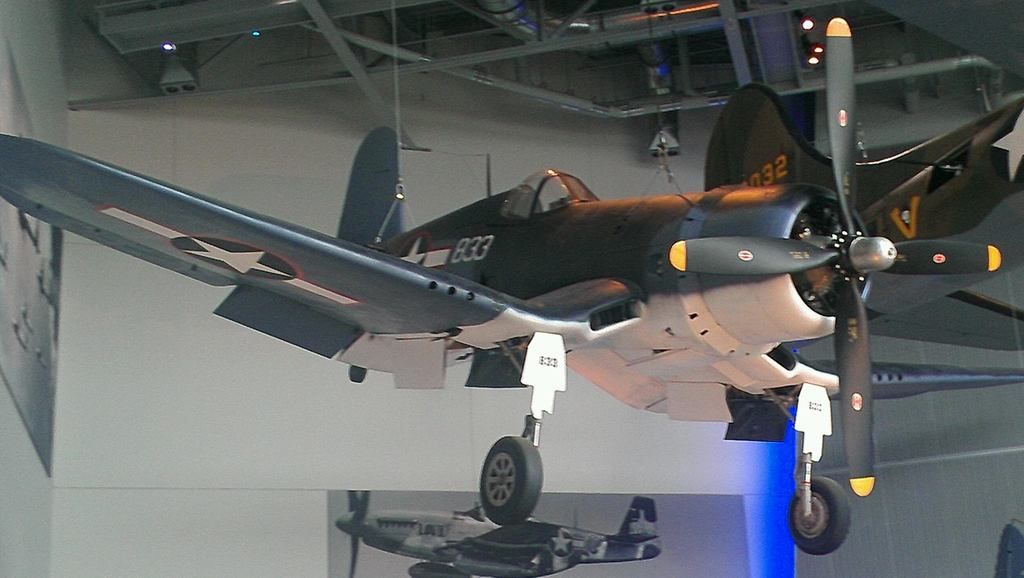
Four-bladed prop, but it has the -1 cowling…hmmmm…
I wish I could provide the reference, but an aviation magazine years ago referred to a US military study at the end of the war analyzing the performance of several U.S. fighters and the tests officially concluded that the Corsair was slightly better than the Mustang in a dogfight, but they were close enough that the pilot would make a more significant difference.
Interesting question. The mention of P-51s in the Pacific reminded me of something I had just read in the book “Wings of Courage: Tales From America’s Elite Fighter Groups of World War II” edited by Tony Holmes (2010, Osprey Publishing). In discussing the “Sun Setters” (specifically, the 15th, 21st and 506th Fighter Groups) and long range missions to Japan from Iwo Jima:
“Normally possessed of good maneuverability, the P-51 became something of a tail-heavy slouch when the fuselage tank was full, so it was imperative to burn off most of its fuel before encountering enemy aircraft in the target area.”
Never heard this before. Guess there are a lot of variables when comparing aircraft’s combat abilities.
Gary
Interesting. Good eye Mississippivol. I wonder if that’s really just a -1?
Gary. I remember reading they’d take off and burn the fuselage tank (85 gallon) first for that reason. They felt vulnerable until it was dry. That’s 500 pound of weight slightly aft on the CG.
Yep, that’s me! None more truer!! Ooh Rah!! Semper Fi!! Do or die!!
I was just noticing the same thing, Mississippi… Can’t even trust a museum anymore…
/
I believe that was the P-51H.
I don’t know, as this is the first I’ve heard of it. However, I did dig this up on the Wiki:
The addition of the 85 U.S gallon (322 l) fuselage fuel tank, coupled with the reduction in area of the new rear fuselage, exacerbated the handling problems already experienced with the B/C series when fitted with the tank, and led to the same fillet being added to -B, -C and initial -D-series versions in the field, to be standardized as a normal rear-fuselage airframe component on later production blocks of the -D version.
It does seem to indicate that there was a problem with handling when the fuselage fuel tank on the D model was full. It also explains why the fillet was added on the top of the rear fuselage. I did know the fillet had been added due to handling problems, but didn’t know it had to do with the fuselage tank.
As I wrote, it’s something I had not heard before.
Gary
I think the fillet was added because of the reduction in the side area when they cut down the fuselage for the bubble canopy. The fuse tank was a problem for stability, and they always drained it first. Also, the units in the Pacific used D models - the H was too late for WW2. I think the units were loosely called VLR units for Very Long Range, and if I remember right they used bigger drop tanks.
And regardless of which might win, I sure do appreciate being able to still see some of the old warriors in the air!
Considering the (behind CG) fuel weight on the P-51. People that fly RC planes have a saying “A nose heavy plane flies poorly, a tail heavy plane flies once”. Not sure how accurate that is in 1:1 scale however since I am not a pilot.
Chris
Probably referring to RC planes because of material they’re made of more than full size aircraft.
I LOL ed perfect!
In South America the corsairs shot down mustangs.
Also corsairs shot down other corsairs in South America.
I have the two models in 1/48 scale .One corsair has three kills.Two mustangs and one corsair.The mustang is elsalvador and the corsair from cost rica…hopefully I am right.There are so many South American air conflicts that it is confusing .Hobby craft also has a corsair in South American markings.
Mustangs from Peru had dogfights with A-37 Dragonfly.
The mustang is the better fighter on paper.But; With a good better pilot, it proves otherwise.