Thanks Josh,
If I can find some good reference shots then I will try and make it more accurate but if I can’t find anything then it will be done my way. [:D] [;)]
Mike
Thanks Josh,
If I can find some good reference shots then I will try and make it more accurate but if I can’t find anything then it will be done my way. [:D] [;)]
Mike
When I do mine, it’s gonna be pink with purple polka dots.
Then I’m gonna take it to a contest and get into an argument with a guy who will have inevitably told me that “there was NEVER a P-47 with a cockpit painted that way” to which I’ll retort, “How do you know? Were you there? Did you see EVERY P-47 ever made? How do you know it wasn’t repainted in the field?” To which he’ll retort, “But PINK and PURPLE polka dots?” and I’ll say “Haven’t you ever heard of a flying circus? Some of those fighter jocks were real clowns…”
All that just to cause trouble, cuz that’s what I do…
[:p][:p][:p][:p]
By the way, satisfy yourself and paint it the way you wanna paint it…
Fade to Black…
Thanks Steve.
Would you happen to have the photos that are in the Detail and Scale book of the cockpit? Otherwise I guess I will have to buy it.
Mike
Butch Schroeder of Danville, Illinios has a super restored P-47. He is a real stickler for originality and researches the colors quite extensively for his airplanes. He is also the owner of the fabulously restored F-6D of which some of you may be familiar.
Possibly a contact with him could give some insight to the proper color, and how it was replicated.
Another super stickler restoration facility is Yanks Air Museum in Chino, CA. They have a P-47D, and the YP-47M used in two aborted attempts at competing in the post war Bendix Race (it’s assymetric Curtiss Electric paddle blade prop, now fitted, is really something to see in person). These ships are on display, and the museum could be contacted by commercial means.
Lonestar Flight Museum puts out some beautifully operational restorations, however the airplanes are subject to some artistic license. Personally, I liked the chrome on their Tigercat! My personal contacts at the POF museum wouldn’t help with this as their stuff is painted from the Sherwin Williams catalog. But, who is to say their PRU Blue Spitfire is the wrong color, right?
Have fun,
Chris…
Rick,
Any chance you could scan that interior photo from Mr. Kinzey’s book and email it to me?
Thanks
Mike
Hi Mike, I missed your request before. Sure, at least I’ll try. My Scanner aint the best & you do get some changes on the web, but at least it will show what I mean. I’m not sure FSM allows attachments, so it might be better if you gave me your eMail address. I’ll try & see what happens.
Regards, Rick
Thanks Rick.
My email is airbrush4you@comcast.net
Maybe a picture of it with your digital camera would be better?
Your aircraft photos look great so hopefully the colors you are talking about will come through fairly well. If they look slightly different then just let me know what color needs to be added to come to the color in the book.
I sure appreciate it my friend.
Mike
I like that polka dot idea Steve!! That would be awesome, but you’d have to make some kind of modification to the rudder pedals so they could be worked with those big red shoes.
Um, I’m not touching the main debate. I’ve been around too long to know there’s no right answer unless you have the unrestored prototype of what you’re modeling sitting in your garage. Close is the best you can wish for. Closer is better. Exactly is unprovable. But I do know something about the Lone Star Flight Museum, and I can tell you that, like the CAF, accurate color matching takes a long, long, looooong back seat to mechanical considerations. So I would never base what I wanted to be an accurate historical replica on what sits in that great Galveston museum, or the Conf…Commemorative Air Force.
The one exception I will always trust is the Smithsonian Air and Space museum, for I have seen in print and with mine own gray eyes how carefully they remove flakes of paint, from the top coat down, coat by coat, until they reach bare metal, so they know every color the plane ever wore. And when they put it back on, they match the pigments with astonishing care. Read the book on their restoration of the famous Me-262 or their restoration of the FW-190. Both books are findable, I think. You’ll be amazed. It’s as though they were building a giant museum quality model with a million dollar budget.
I totally agree Tom.
I am not trying for absolute accuracy as some seem to strive for, as that is a waste of time to me personally. I can be building another kit while the “rivet counters” are still researching the paint colors on theirs. [(-D]
All I want is a a cockpit that is close to being accurate and that is good enough for me. The UV rays from the sun can change colors drastically over time so who is to say what it “should” look like. [;)]
Mike
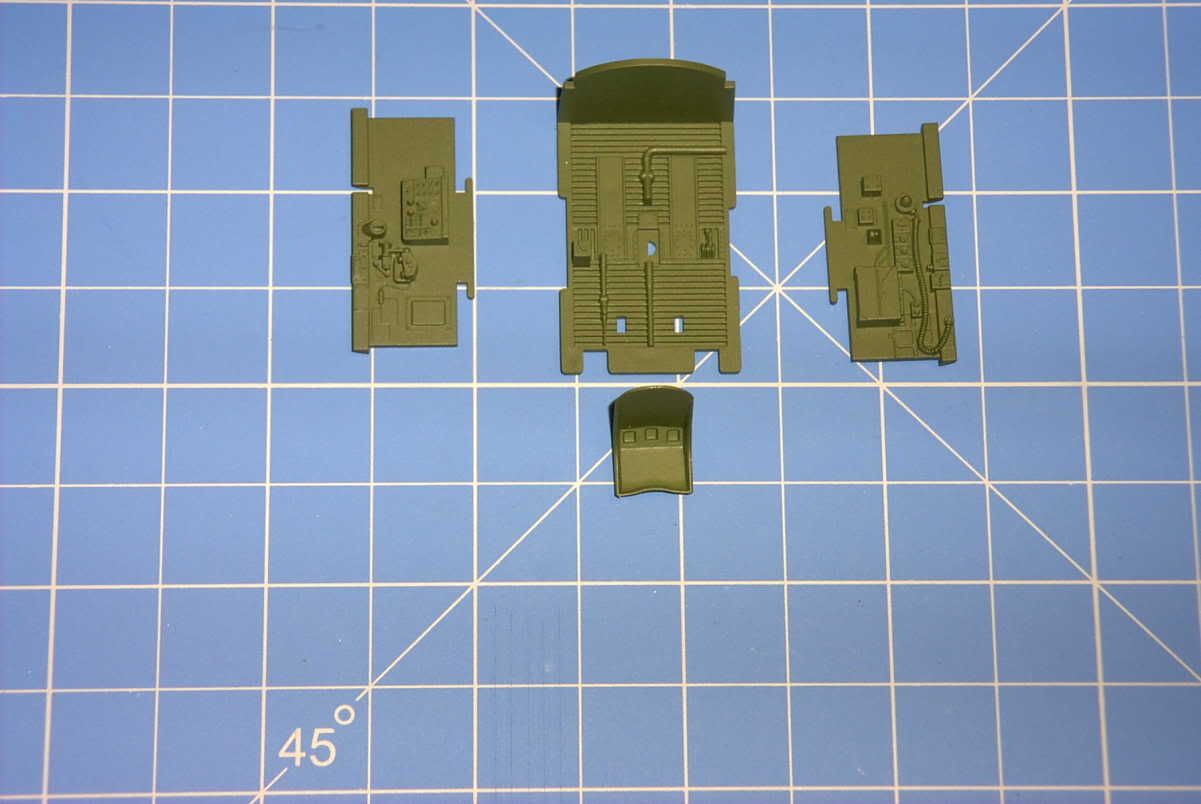
I shot these cockpit pieces last night with MM Acryl Dark Green just to see how they would look.
Since I don’t have good reference photos I thought I would ask your opinion of this. Too dark? Too light? Maybe add some blue?
Mike
Alright let’s try this.
Rick sent me a reference photo and I tried mixing 10 drops of MM Dark Green with 10 drops of MM French Blue and came up with this which is pretty close I guess. The color doesn’t come through as well on the camera as with the human eye but the color is a blue green really.
I tried shooting it at iso 100, 200 and 400 along with shooting it outdoors but I just can’t get this camera to capture the color as well as I would like.

What do you think Rick? [;)]
Mike
Mike:
I have that great coffee table book “Cockpits,” with all the WW II…well, obviously, cockpits. Some are restorations, and some are unrestored, all are well lit large photos on good paper. You’d be amazed at how many of the various American fighters either unrestored or restored by reputable restoration outfits/museums have exactly the shade of green you have showed here. It’s weird. We all think of yellowish-green or blue-ish-green zinc chromate type colors for aircraft interiors when, if you’re in one with original paint, a great many of them are quite brown or OD looking, especially outside any direct light, and especially when photographed with modern film. Mustang cockpits have this trait. The P-59 was another. And the P-38 is yet another, though it has a lot of black in it. I first noticed this one day while playing around in a C-46 and C-47 awaiting their fate in a fire pit. Both were wearing the same paint they had on when they went to war, and though this was the late 80s, and it had faded, I pried off the placards in both planes as souvenirs, since they were to be destroyed, and the paint was pristine underneath. No fading at all. And still had that brown/OD cast to it. And the aluminum that skinned the wings gave great contrast because it was identical to MM Chromate Green. You don’t start to see universally green U.S. cockpits until Korea, and right after that they started turning gray.
So this whole excercise, fun as it is to argue minutia (and admit it modelers, this is one reason we do this, for what is modeling but sorting out tiny details with our fingers, whether gluing little parts or typing an argument), is an excercise in futility, as John Dillinger said.
Time for me to throw my two-bobs worth into this debate,
When I did my Tamiya “razorback” I used Tamiya XF-53 olive green for the interior. Most P-47’s had an interior colour similar to the shade you’ve shown. However, the P-47’s built in the Curtiss factory had a standard green zinc-chromate interior. And since you probably don’t know where your P-47 was built, I’d stick with the darker green.
One thing I know is that the interiors weren’t painted zinc-chromate yellow. This colour was to reflective and black was added to give the more familiar green colour.
hope this helps.
Mike, looks close enough to me [tup]. Like I said in an earlier post, it’s an elusive color. The color pics I referenced are the only ones I have seen that are stated to be of an unrestored Jug. Now get to work on the rest of the bird [:)]. Can’t wait to see the finished model.
Regards, Rick
You know, there are lots of people, I’m not one of them thankfully, who’d be simply bored to tears by a discussion of the exact color of certain cockpits. My girlfriend would have rolled her eyes and walked off long ago. This is one of the reasons I love this forum. We’re kind of a rare group here.
That second color looks very good to me Mike. The first was okay, I think the second was better.
Thanks everyone for this stimulating topic.
I have learned a lot from you guys on this subject and am thankful for your input.
Mike
That’s great, Mike, but as Madda said – and this is a modeler talking who actually has a girlfriend, mind you – it is all, in the end, trivia. I find it boring to talk about how many angels can dance on the head of a pin. Now, the color of the seat that held the butt of a mid-20th Century Second Lt. – that’s something worth discussing over two whole days!
But, reluctantly seriously, I hope we are all more enlightened than confused. Personally, I’ll probably continue to gather photos, divide them by the square of personal pilot recollections in old magazines, subtract what the kit instructions say, and divide by the original factory specs, finally arriving at a color somewhere in the middle of all that.
Influenced greatly by what color the LHS has in stock.
Tom
Well I adjusted the color a bit more and came up with this shade that I am going with.
I was finally able to manipulate the photo with software to get the colors to look the way my eye sees them. I just had to add a little blue and green to the photo to make it look right. [:D]
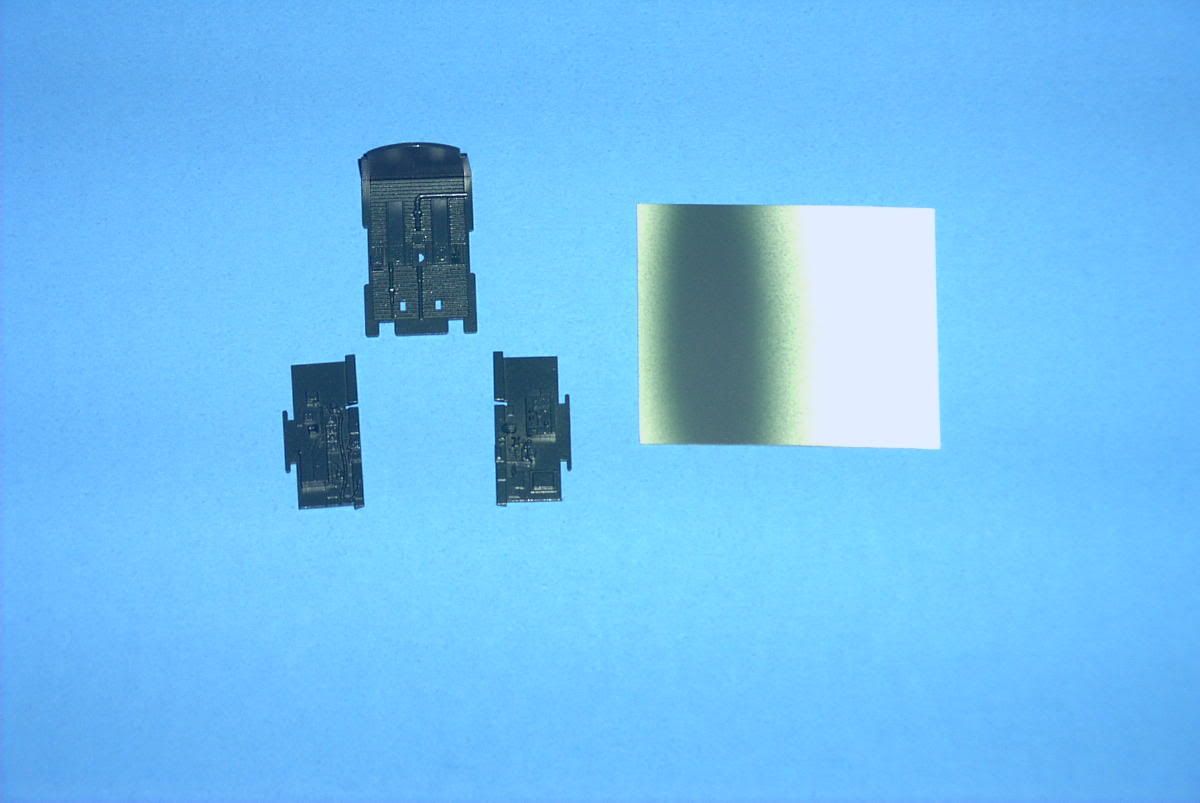
I mixed 12 drops of MM French Blue enamel with 10 drops of MM Dark Green enamel, added 11 drops of mineral spirits and came up with the color of the cockpit pieces above. I would call this a dark turquoise really as that is what it looks like in the refernce photos Rick so kindly sent me. Thanks again my friend. [;)]
The test piece of plastic on the right is the same color except that it has a coat of Pactra clear flat acrylic on it to flatten the color since the French Blue is a gloss color and resulted in a somewhat glossy finish.
I think this will work.
Mike
Looks like a good start to me Mike. Are you building it oob or adding some resin or photo etch parts as well?