Anyone Remember the Testors Plastic Airbrush

I’ve always had a fear of dual action brushes. I’m not good at doing one thing at a time, asking for two is is a lot! I fell down the Gaahleri rabbit hole during their big Christmas sale last year and ended up with a couple of dual action brushes. Turns out they aren’t all that complicated or hard to use. I’m still not the best but fairly often, the paint actually ends up on the model and doesn’t look too awful.

1 Like

I went down almost exactly the same rabbit hole with Gaahleri! My first one actually came free with a compressor, and then I started trying different airbrushes. Before long I had about four of them and wasn’t quite sure what I was going to do with all of them. :joy:

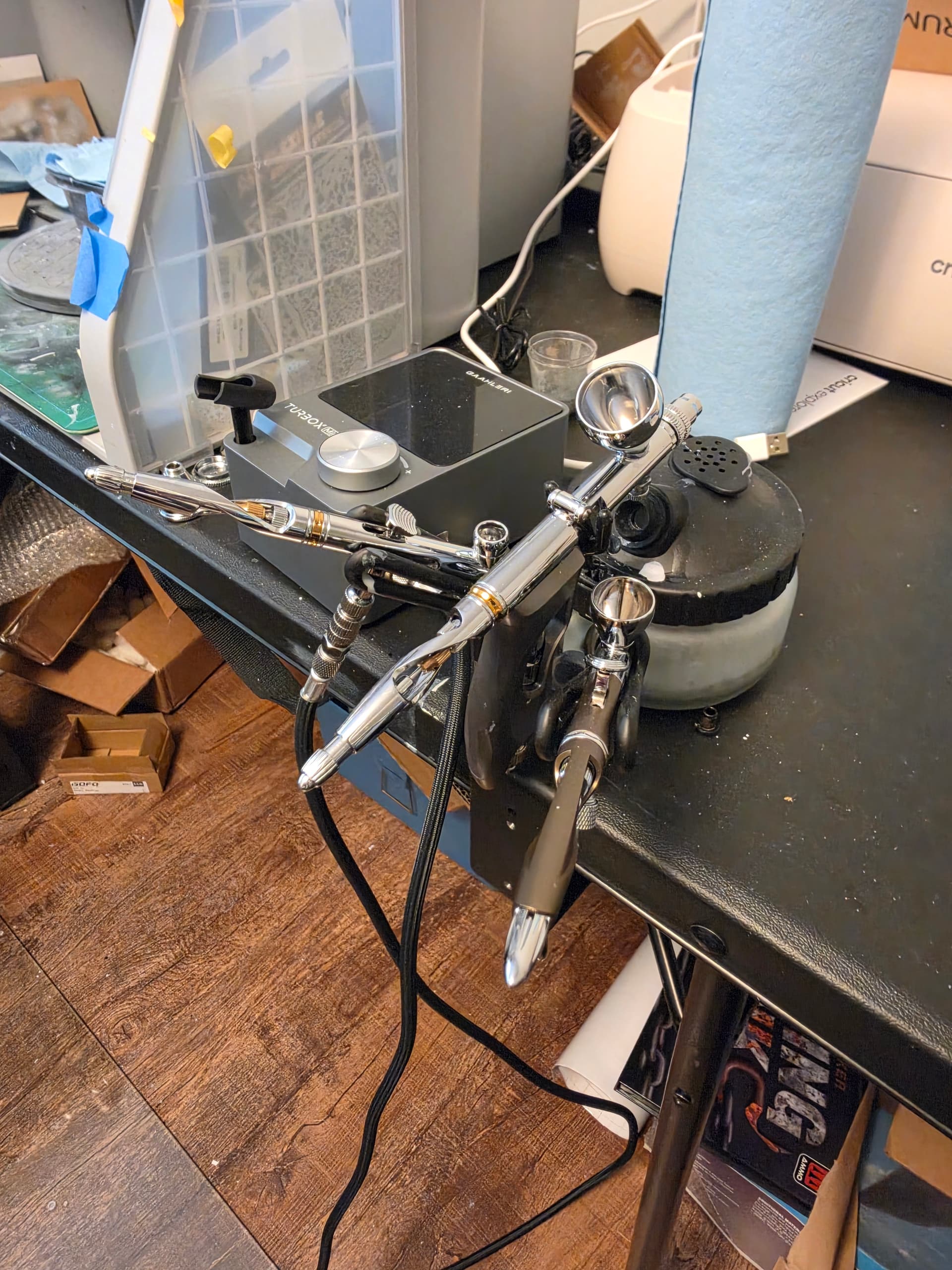
I’ve finally settled into rotating between three Gaahleri brushes: 0.5, 0.38 and 0.2 mm. They each have a different purpose, and I’ve found I really like working that way. The 0.5 is the Mobius TG trigger-style brush, which I’ve especially come to like.

Here’s my current setup. Apparently the Gaahleri rabbit hole isn’t such a bad place to end up!
1 Like

Lasermike, I know what you mean! I have a nice double action Iwata that works perfectly fine. It’s the operator that is faulty! I still don’t have that rhythm worked out in my my muscle memory, so I have opened the paint flow without pushing down for air a couple of times and got paint dribbling out of the nozzle.

1 Like

I had one of those - felt like a toy. Really nice wooden box though. My first air brush was a single action Binks Wren I saved up for and bought around middle school I’d say. I do 99% of my work with a single action Paasche H - such a workhorse and easy to clean. I have a few double action brushes and have some decent results but I just cant seem to clean them properly. So subsequent uses are less successful. I intend to watch a bunch of videos on the cleaning and care of these precision tools and master it. I have two brand new double action airbrushes I want to take care of properly.

2 Likes

I completely understand the cleaning issue. When I first started using dual-action airbrushes, cleaning them took an exorbitant amount of time and honestly made airbrushing a lot less fun (plus I wasn’t any good at really getting them clean).

Once I figured out a routine, though, that completely changed. I can do a normal between-color or end-of-session clean in probably a minute and a half or two minutes now, and even a complete deep clean only takes me about five minutes.

If you decide to give the dual action another try, I’d be happy to walk you through what I do. Once I got the cleaning part down, it stopped being a chore.

I’m definitely going to figure this out so please do let me know your routine. I’ve got this on the bench :grimacing:

1 Like

Nothing would happen - the ‘lifetime’ warranty was cancelled years before the Aztek went out of production.

1 Like

Oh, I realize that, I was just kidding.

What kind of paint do you use? It makes a big difference for cleaning.

All solvent based stuff: Enamels, Mr Color, Tamiya - I don’t use water based acrylics, couldn’t figure out how to make them work.

1 Like

Ah, okay. That makes a difference. My routine is entirely based around water-based acrylics, so I’m probably not the right person to give you a cleaning procedure for solvent-based paints.

I suspect some of the basic process would translate, but the cleaners and probably some of the steps would be different enough that I wouldn’t want to steer you wrong.

Interesting that you’ve had the opposite experience with water-based acrylics, though. I’ve gotten pretty comfortable with them and really prefer them in the airbrush.

I was cleaning my airbrush tonight and thought about your question again. My actual cleaning routine probably translates reasonably closely to what you’re doing, even though I use water-based acrylics. The main difference is that you’ll need to use the appropriate cleaners for the solvent-based paints you’re using rather than the water and acrylic cleaners I use.


First, get a large bottle of airbrush cleaner that’s appropriate for the paints you’re using. There are several different products available, and I’d stick with something recommended for the particular type or brand of paint you normally spray. I buy mine in larger bottles and transfer it into one of these squeeze bottles, which makes it much easier to use at the bench.


Second, these tiny pointed cotton swabs are incredibly useful for getting into the small areas of an airbrush. They’re sold for things like microblading and makeup application, and they’re dirt cheap—I think I pay about a penny apiece for them. I usually use one or two per cleaning.

I also keep a small plastic container with some rags in it that’s dedicated entirely to airbrush cleaning. That’s where the dirty cleaner, paint and other gunk ends up. I periodically throw the rags away rather than washing all of that down the drain and into the sewer or septic system.

Finally, get an airbrush cleaning pot, they are super cheep, like $10. You spray the cleaner through the airbrush into the pot rather than spraying it into the room. It catches the liquid and filters the exhaust, which is especially useful when you’re dealing with solvent-based cleaners.

Since you’re using Gaahleri airbrushes, which ones do you have? Do you have one of the new Aventus brushes, a Mobius, or something else? We may actually have some of the same ones. If we do, I can show you how I take mine apart and clean them so you don’t end up with paint getting stuck inside.

And if it would help, I can make a quick video showing you exactly how I clean and disassemble mine. That’s probably a whole lot easier than trying to explain every step in writing.

Also depending on what you already have and what you need, I’m happy to send you links to Amazon that I should be able to find for when I purchased all this stuff.

Thanks. I actually have a brand new Badger 105 and a new Iwata NEO CN. I also have a Badger Renegade Krome that I used a couple times and is in need of a cleaning to restore it’s excellent fine detail capabilities. A link to the swabs would be appreciated.

1 Like

Oh, sorry, I got you mixed up with another post that was talking about Gaahleri airbrushes. As for the swabs…

Amazon.com : Eyxformula 1000 Count Pointed Cotton Swabs, 4 Inch Microblading Cotton Buds with Wooden Sticks, Semi Permanent Eyebrow Tattoo Supplies, Precition Tip Micro Applicators for Makeup, Cleaning Nail Polish : Beauty & Personal Care

Interestingly, these are sold in smaller packs in hobby shops for about the same price as this giant 1000 unit package in the beauty supply isle. Seems like they are just buying in this same bulk package and splitting them up and selling them individually in the hobby market.

Thanks! Order placed - I’ll find many uses for this. My standard q-tip swabs fall short on many tasks.

1 Like

I suspect you will love them. I also use them for decal application as they have very precise little points that don’t damage the decal.

My first airbrush, bought around 1975/76, was a Badger single-action like this, used with a can of propellant. I distinctly remember the plastic being orange, but I can only find pics of blue ones, so maybe I’m mistaken…

1 Like

Very nice! I’m not sure if my first was a Badger or a Paache single action anymore, it’s been 30+ years but I do remember it was red! Funny how those things stick to you.

Mike G, my first airbrush looked like that! It came with just one glass jar and was sold in a blister pack on a cardstock header. It was under $10 IIRC. Propel cans also cost well south of ten bucks back in 1977.

2 Likes

I have a thayer & Chandler single action, two badgers a 150 & 200, a Tamiya 2.0 dual action that also has an adjustable hard stop and an Iwata eclipse 3.0.
The two I use are the Tamiya and Iwata and they are both on a manifold so I can (if I want to) switch between the two at will.
I freehand camouflage that does not have hard edges like an Avro Vulcan camo, all the SEA camo schemes are freehand.

1 Like