Who here has and prints their own parts when the need comes?
How hard is it to design or copy what you need to be able to print it?
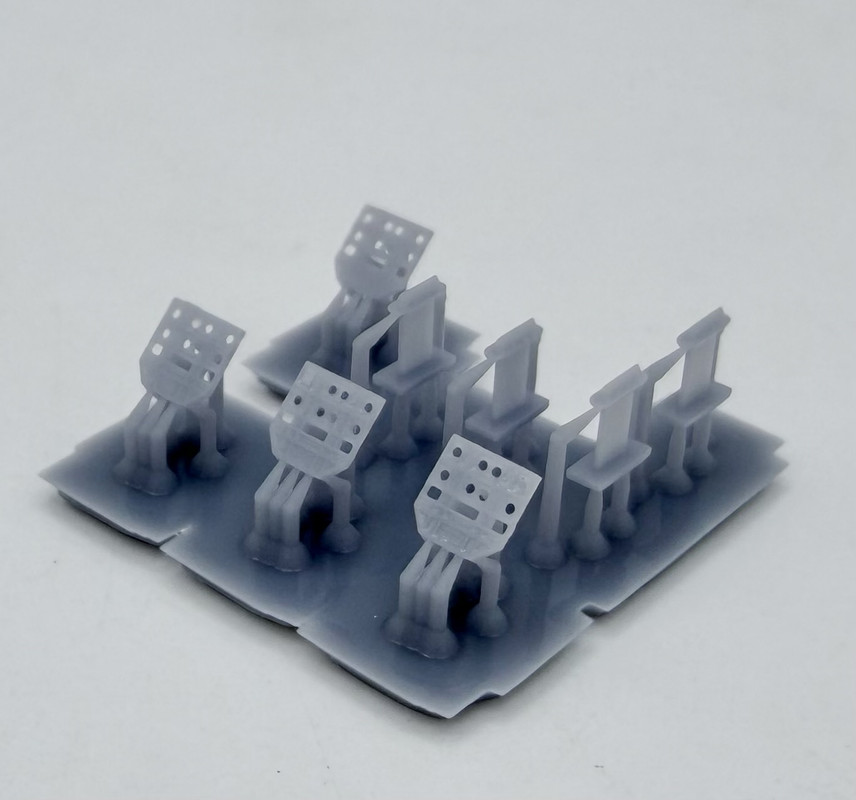
I’ll give an example; right now I’m in need of four mark VIII ww2 era navy torpedos and I realize the cost ratio for this one example does not necessitate the purchase of a 3D printer but over time it would justify compared to the cost of buying parts.
in my case I like extreme detail in the engines of my aircraft regardless of it being a radial, v-12,or a jet engine. I get a lot of satisfaction knowing how detailed my engines are but I digress, there are many more places a 3D printer shines.
If I had use of one close to me I’d buy the materials for the two of us or visa versa.
come next year I may just invest in at least a new used 3D printer rather than continue to cast my parts..
Is it simple enough to di that you could teach a ham fisted 10 year old how to do this? No! Im not 10 but when it comes to computers and tech I feel like a 10 year old…
I’m right there with you. I’ve been seriously thinking about a resin printer myself, and I’m starting to think the question isn’t necessarily whether it will eventually “pay for itself.”
Just last night I was trying to track down several aftermarket parts for an F-18 project. Some are hard to find, some are discontinued, and when you do find them they may be scattered among different vendors around the world. Then you start adding shipping to a bunch of relatively inexpensive parts. I’ve run into the same thing looking for figures and other pieces for my Little Bird.
That’s what is starting to make 3D printing really attractive to me. Maybe I can find the file. Maybe eventually I learn enough to design the part myself. Either way, suddenly I can make something that I simply can’t buy.
From what I’ve been looking at, it seems like roughly $400 gets you into a pretty decent resin printing setup once you include the printer and the other equipment you actually need. Will I eventually save $400 in aftermarket parts and shipping? Maybe. Maybe not.
But I’m starting to think that’s almost beside the point. Designing, modifying and printing your own parts becomes another part of the hobby—just like scratch-building, making your own decals or cutting your own paint masks. And it opens up possibilities for things that otherwise just don’t exist.
So if you jump down this rabbit hole, there’s a pretty good chance I’m going to be right behind you.
Looking forward to what others have to say in this thread.
I gave or intended to give the example of needing four torpedos , I can easily enough take a 1/48 scale SBD torpedo and resin cast it using silicone but that dount get me the R2800 radials I want and in resin casting some molds are only one time use , after a while you can quickly match er exceed the cost in a 3d printer even doing resin casting so why not.
I also have some crossover uses in my GS hobby as well but I don’t know a thing beyond that the tech exists and that there are or were two main methods/materials of/in 3D printing.
I’m working on converting an F-18A into an A+, and just last night I was trying to track down some of the parts I need. One of the big ones is the later LAU-127 wingtip rails, and I also need an ACMI pod used to track and record the aircraft during air combat training. There are also some smaller antennas and other details involved in the conversion.
The problem isn’t necessarily that these things have never been made. It’s finding them. Something is discontinued, something else is out of stock, and another piece may be available from a vendor halfway around the world. By the time you find everything and pay shipping from several different places, it starts getting ridiculous.
That’s exactly why I’ve started looking seriously at 3D printing. This is the setup I’ve been investigating: the ELEGOO Saturn 4 12K with their Mercury wash-and-cure station. The bundle is right around $400, so it gets you both the resin printer and the equipment for cleaning and curing the prints afterward.
Obviously I’ve never used one, so I can’t recommend it from experience yet. I’m still researching and may ultimately decide to spend more for one of the higher-end versions. But from what I’ve learned so far, something in this range looks like it might do exactly what I’m looking for.
And if I can eventually learn to design some of these parts myself, suddenly “nobody makes it anymore” isn’t necessarily the end of the conversation.
Thanks! We actually found that one last night. The problem is that I’d need two different Hasegawa weapons sets to get everything I need.
Weapons Set D has the ACMI pods, but the LAU-127 launch rails I need for the F-18A+ are in Weapons Set E. So I’d have to track down both sets—and Set E seems to be the difficult one to find right now.
Which, ironically, brings us right back to why I’m getting so interested in 3D printing, because at some point I end up spending more than the kit on this stuff.
I print my own parts and complete models using an FDM printer. It doesn’t produce details like a resin printer but I typically build larger models so it hasn’t been a problem for me.
Designing has gotten easier especially if you use a designer like Tinkercad
In your mark VIII torpedo example a simple search on a number of repositories found one already designed.. If you are new to designing then finding one already designed and making modifications to it might be easier for you.
With regards to resin printers, I decided not to go with one because I didn’t want to be exposed to resins (VOCs). Also something to keep in mind are the consumables like the LCD screens and FEP film durability. How long will replacements be available? These chinese companies like to come out with new machines every few months but finding parts can be a challenge if they discontinue that particular model printer and parts are no longer available.
George, that was extremely helpful. You just taught me something I didn’t understand at all.
When you mentioned replacing the LCD screen, I initially thought you were talking about the little control screen on the front of the printer. I didn’t realize the LCD is actually part of the printing process—the screen under the resin vat that acts as a mask for the UV light. Now I also understand what the 12K, 16K, etc. numbers actually mean and why pixel density matters.
Your point about replacement screens also makes a lot more sense to me now. It tells me that when I eventually buy a printer, I want to stick with a well-established manufacturer with a large user base and good availability of replacement parts and consumables. I don’t want to buy a great printer today and discover a few years from now that I can’t get a replacement screen for it.
This is exactly why I’m glad PJ started this thread. I don’t know enough yet to even know all the questions I should be asking.
LCD screens have varying life spans in the order of 2000hrs (give or take). I keep a spread sheet of every part each of my printers have printed. Some of my printers have 5000 hours on them, the last units I bought have around 1800hrs. The parts I print are of course way larger than what you guys are printing with resin printers so to achieve 2000hrs might take alot longer.
Of my 9 FDM printers the only thing I’ve replaced are a few cooling fans that started to make noises after a few 1000 hrs, that’s it. I have zero experience with resin printers longevity.
But yeah, go with one of the bigger name manufactures who have been around a while and have a large customer base. It might be a good idea to buy an extra screen while they are available just in case.
Buying a spare screen while they’re still readily available is something else I never would have thought of. That makes a lot of sense.
And considering the relatively small 1/48 parts I’d mostly be printing, I suspect it would take me quite a while to accumulate 2,000 hours on one of these things.
Nine printers, though! I think I’ve definitely found the right guy to ask these questions.
I’d look into the ELEGOO Saturn 4, the hinged flip up cover doesn’t seem like a big deal, but trust me you’ll appreciate it versus a cover you have to remove and find a place to put it.
I own the Anycubic Photon Mono 4 since more than three years, a beginner level resin printer. 100% pleased - it does what I need in the quality I want! Before this I had the Mono 2 and I am pretty sure it would still running if I did not overfill the reservoir - school boy error.
For sure the quality gets better and better, but as far as I know you can not print figures etc with a filament printer in the quality a resin printer does! The filament printer has its place, no doubt, and I was considering to get one - for instace to print buildings for dioramas. But I can achieve the same result by using XPS foam in the end.
Everybody who is intended to get a resin printer should be aware of the horrible side! The resin smells, the alcohol smells and you have to protect everything, especially yourself, from contact with this stuff! The living room is definitely the wrong place to run a resin printer, even the mancave is not! I am printing two days a month or so, for me this is not a problem. But I must admit, if you learned to deal with the disadvantages a resin printer is one of the best tools you can have!
I’ve had a filament printer for about 9 months now, but free time to mess around with it is limited. I started off making some of those articulated animals for the kids. From there I started basic scaling up and down.
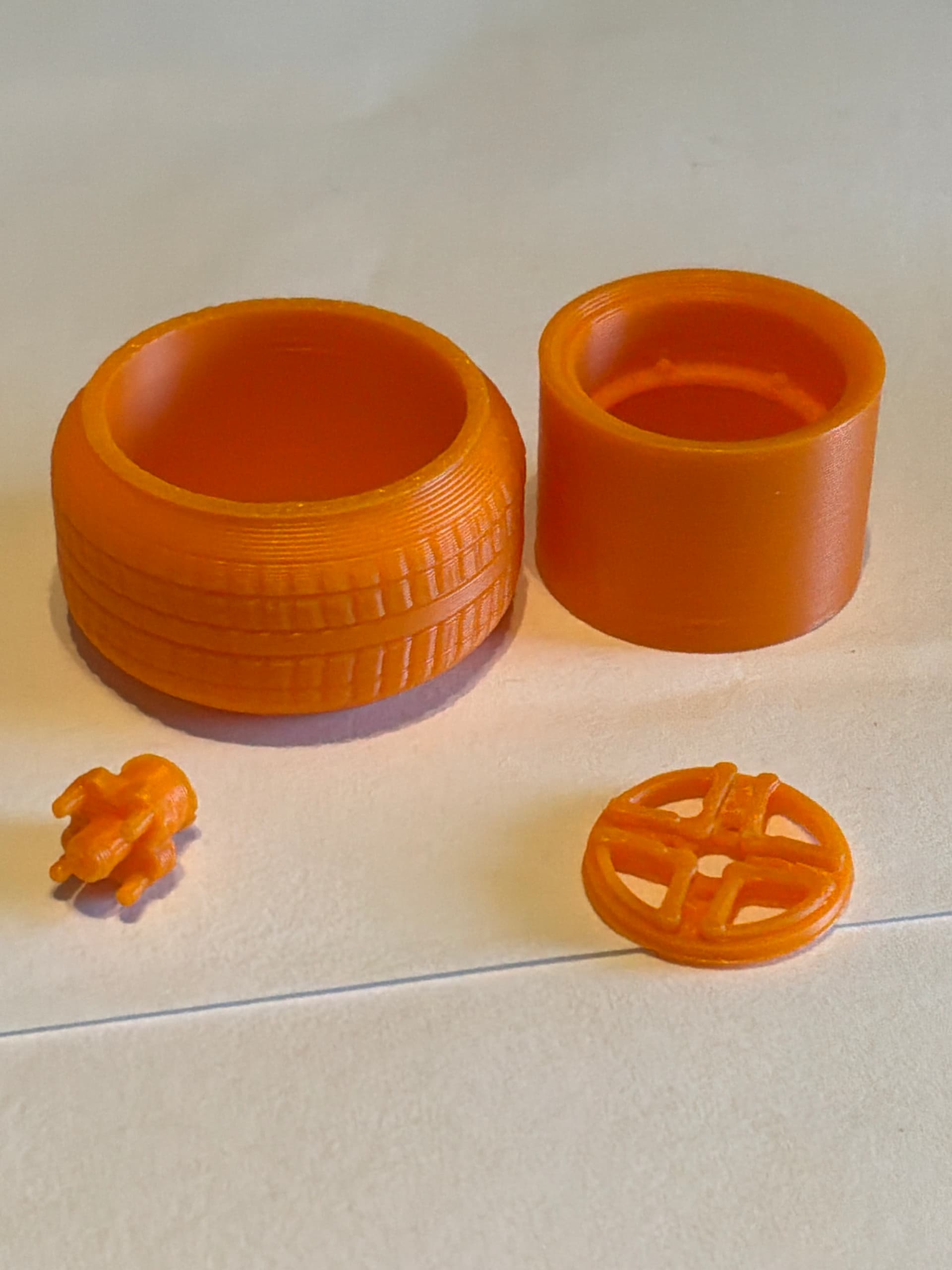
The first model related item I tried was a 1/24 scale tire and wheel. I figured I’d get a good idea about layer lines, details, etc.
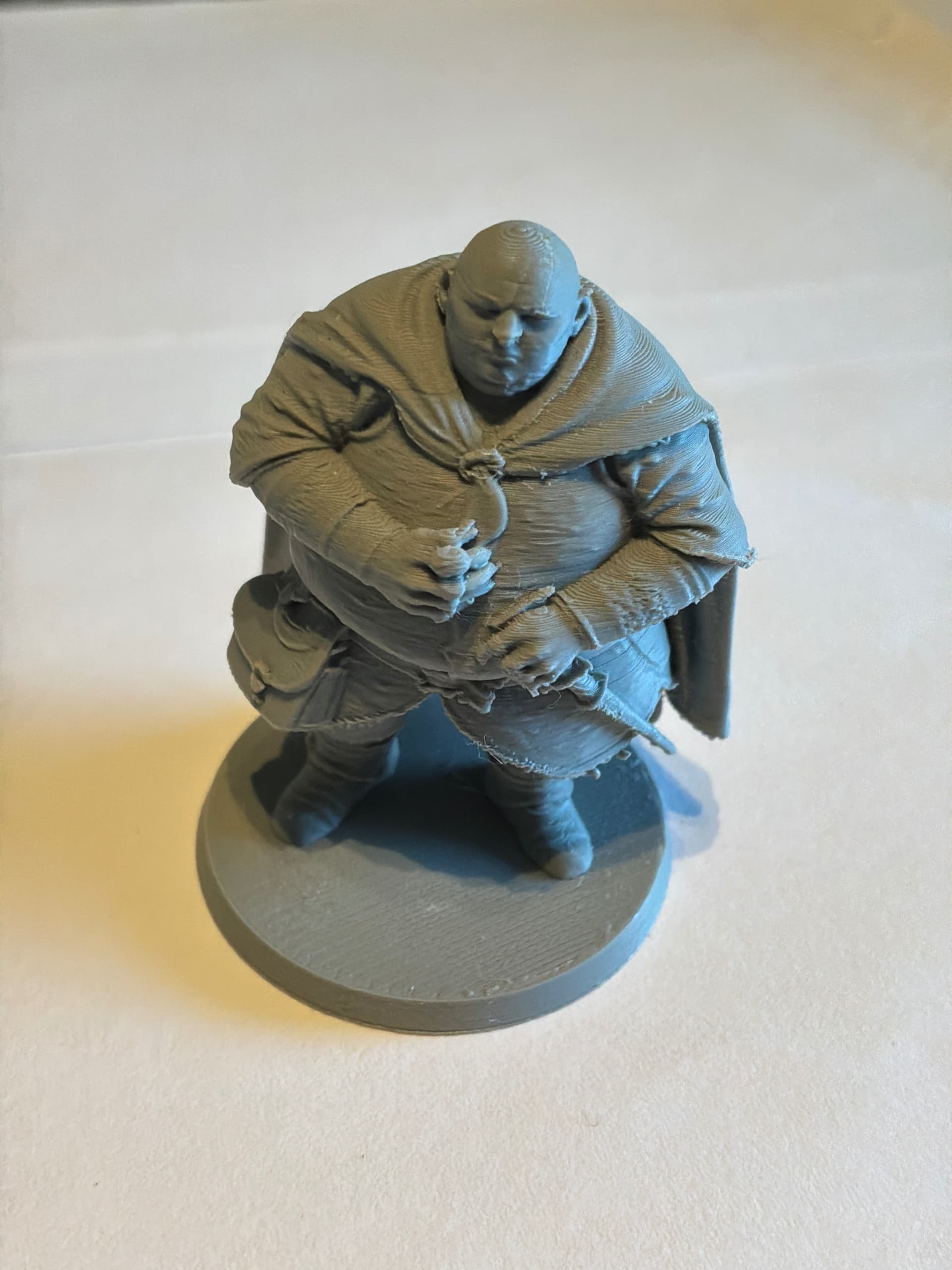
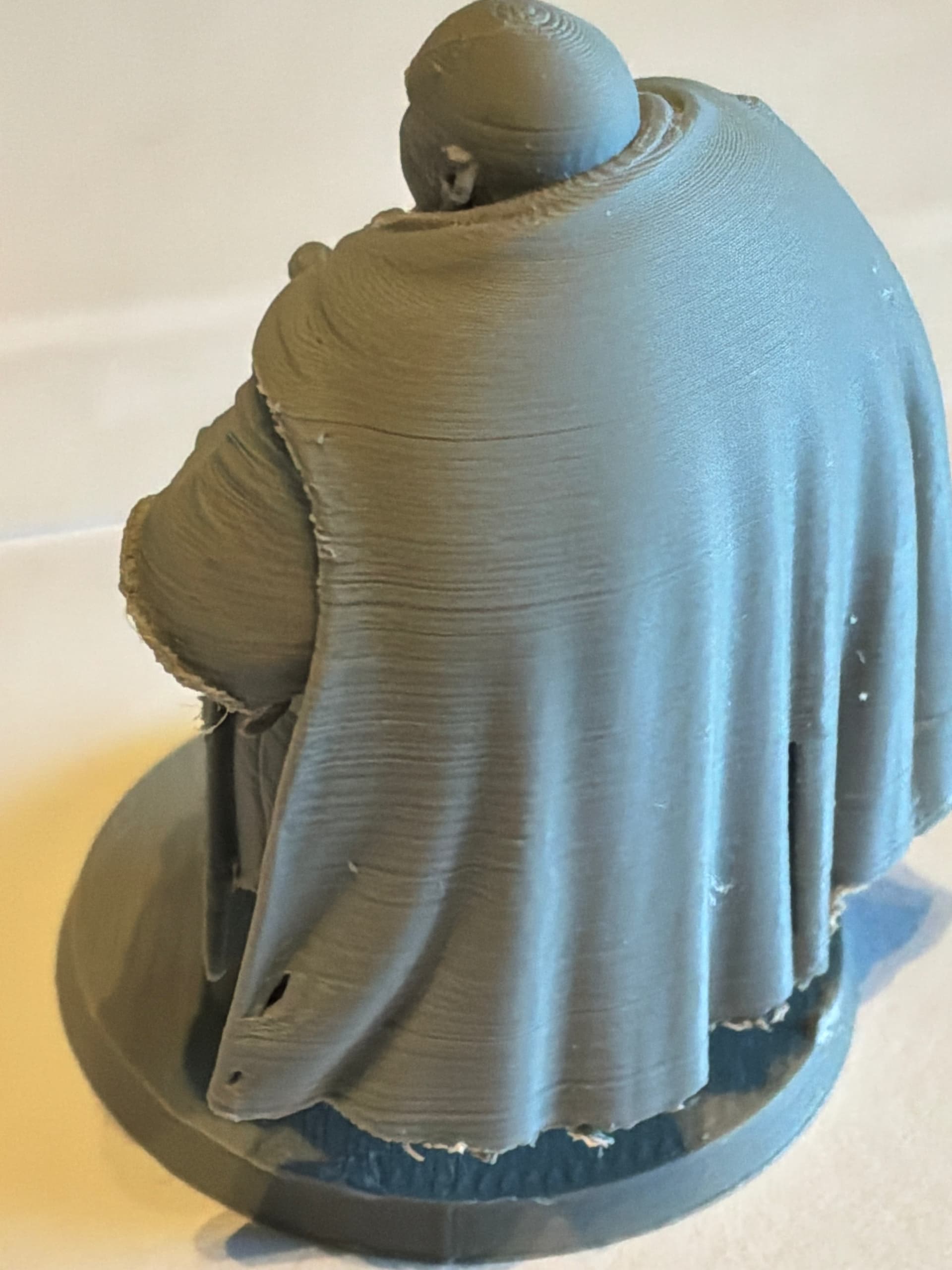
This figure is about 1.5” tall. Again you can see some of the layer lines, though they are more visible in pictures than on the figure.
Both of these are unprimed and used a medium nozzle and layer height. I didn’t try any smoothing or change of orientation to minimize layer lines.
I have a smaller nozzle, about half the size. I’m going to reprint each item using that to see how it changes.
I’ve yet to figure out how to modify files that I’ve already got, it might be the software doesn’t allow it or I’m just not figuring it out (I’m no tech genius, but managed to set the clocks on VCRs back in the day) .



 .